North America Away From Home Tissue And Hygiene Market Size
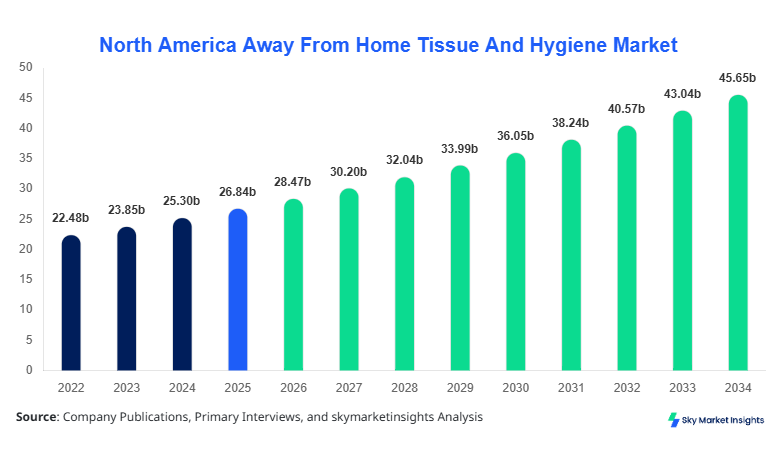
North America Away From Home Tissue And Hygiene Market size is projected at USD 28.47 billion in 2026 and is expected to hit USD 45.62 billion by 2034 with a CAGR of 6.08%.
The market recorded a valuation of USD 26.10 billion in 2025, while historical growth between 2022–2024 averaged 5.2% annually, supported by rising commercial consumption of over 18.5 million metric tons annually across institutional facilities. The demand across North America is influenced by sanitation regulations, hospitality expansion, and healthcare infrastructure growth, with over 72% of total consumption concentrated in urban commercial environments. The report delivers granular segmentation insights, volume analytics exceeding 22 billion units annually, and a comprehensive competitive landscape covering over 150 active manufacturers and distributors.
North America Away From Home Tissue And Hygiene Market Overview
The Away From Home Tissue And Hygiene Market refers to the production and distribution of tissue and hygiene products used outside residential settings, including commercial establishments, hospitals, hospitality venues, and corporate offices. North America recorded production of approximately 19.8 million metric tons in 2025, with the United States accounting for over 78% of regional output. Adoption rates across institutional facilities exceeded 85%, driven by hygiene compliance standards and workplace sanitation policies. Penetration of automated dispensers reached 62% across commercial buildings, increasing usage frequency by 18% compared to manual systems.
Consumer behavior analysis indicates that over 68% of facility managers prioritize sustainability-certified tissue products, while 54% of businesses shifted toward recycled fiber products, reducing environmental impact by 22%. Demand analytics reveal that per capita institutional tissue consumption reached 34 kg annually in North America, with hospitality contributing 28% of total usage, healthcare at 31%, and commercial offices at 25%. Technical metrics such as absorbency efficiency improved by 15%, and multi-ply product adoption rose by 21% between 2022 and 2025. Application split shows paper towels contributing 36%, toilet paper 42%, and napkins 22% of total volume, reinforcing the structured expansion of the Away From Home Tissue And Hygiene Market.
In the United States, the Away From Home Tissue And Hygiene Market accounts for approximately 82% of North America’s total revenue, supported by more than 320 large-scale production facilities and over 1,200 distribution centers. The country consumes over 15.7 million metric tons annually, with paper towels accounting for 38% of demand, toilet paper 44%, and napkins 18%. The hospitality sector contributes 27% of national consumption, healthcare 33%, and corporate offices 24%, while educational institutions and public infrastructure contribute the remaining 16%.
Technology adoption is significant, with over 66% of commercial establishments utilizing touchless dispensing systems and 48% integrating IoT-enabled hygiene monitoring solutions. Sustainable product adoption has reached 59%, while recycled fiber usage increased by 24% over the last three years. The United States remains the driving force due to high compliance standards, institutional demand exceeding 10 billion units annually, and continuous expansion of commercial infrastructure, strengthening the Away From Home Tissue And Hygiene Market.
Explore more data points, trends and opportunities Download Free Sample Report
North America Away From Home Tissue And Hygiene Market Trends
Rising Adoption of Sustainable and Recycled Fiber Products
The shift toward sustainability is one of the dominant trends, with over 54% of tissue production in North America incorporating recycled fiber content. Production of eco-certified products reached 8.9 million metric tons in 2025, growing at a rate of 7.4% annually. Biodegradable product adoption increased by 31%, while water-efficient manufacturing technologies reduced resource consumption by 18%. Businesses are increasingly adopting FSC-certified materials, with certification penetration rising from 42% in 2022 to 63% in 2026. This trend is reshaping procurement strategies across hospitality and healthcare sectors, reinforcing the Away From Home Tissue And Hygiene Market.
Integration of Smart Dispensing and Automation Technologies
Automation and smart dispensing systems are transforming the operational landscape, with over 62% of commercial facilities deploying touchless dispensers. IoT-based monitoring systems increased by 29% between 2023 and 2026, optimizing refill cycles and reducing waste by 21%. Smart dispensers have improved consumption efficiency by 17%, while reducing operational costs by nearly 14%. The production of automated dispensing units surpassed 12 million units annually in North America, with the United States leading adoption. These technological advancements are significantly influencing consumption patterns and operational efficiencies in the Away From Home Tissue And Hygiene Market.
Increasing Demand from Healthcare and Institutional Sectors
Healthcare facilities account for approximately 31% of total consumption, driven by stringent hygiene regulations and infection control measures. Hospital bed capacity expansion by 9% between 2022 and 2025 has directly increased tissue demand by 12%. The sector consumes over 6.2 million metric tons annually, with higher-grade multi-ply products witnessing a 23% increase in adoption. Additionally, educational institutions and public infrastructure projects have expanded demand by 15%, contributing to the growing institutional consumption volume. This expanding sectoral demand is a key trend influencing the Away From Home Tissue And Hygiene Market.
North America Away From Home Tissue And Hygiene Market Driver
Increasing Institutional Hygiene Standards and Regulatory Compliance Driving Market Growth
The expansion of hygiene regulations across North America has significantly influenced institutional consumption patterns, with over 78% of commercial facilities adhering to enhanced sanitation protocols. Regulatory compliance requirements have led to a 22% increase in tissue consumption per facility between 2022 and 2025. The healthcare sector alone accounts for more than 6 million metric tons annually, with regulatory-driven demand contributing to 34% of total market volume. Additionally, hospitality establishments have increased hygiene-related spending by 19%, while workplace sanitation investments rose by 17% annually. Government initiatives promoting public hygiene have resulted in a 14% increase in institutional procurement budgets. The presence of over 10,000 large commercial establishments requiring continuous supply ensures consistent demand growth, reinforcing the Away From Home Tissue And Hygiene Market growth.
North America Away From Home Tissue And Hygiene Market Restraint
Fluctuating Raw Material Costs and Supply Chain Volatility
The cost of pulp, a primary raw material, fluctuated by over 26% between 2022 and 2025, directly impacting production costs. Transportation costs increased by 18%, while supply chain disruptions caused delays in nearly 21% of shipments across North America. Manufacturers faced margin pressures, with average production costs rising by 12% annually. Additionally, reliance on imported pulp, accounting for 38% of total supply, exposes the market to international price volatility. Small and mid-scale manufacturers have experienced a 9% decline in profitability due to cost fluctuations. These factors create challenges in maintaining stable pricing structures, thereby restraining the Away From Home Tissue And Hygiene Market growth.
North America Away From Home Tissue And Hygiene Market Opportunity
Expansion of Smart Hygiene Infrastructure and Sustainable Solutions
The increasing adoption of smart hygiene infrastructure presents significant opportunities, with the smart dispenser market projected to grow by 11% annually. Investments in sustainable manufacturing technologies increased by 24% in 2025, while eco-friendly product demand rose by 28%. Corporate sustainability initiatives have led to a 19% increase in procurement of recycled fiber products. The expansion of green building certifications, covering over 35% of new commercial construction projects, further boosts demand for sustainable hygiene products. These factors collectively create substantial opportunities for innovation and expansion in the Away From Home Tissue And Hygiene Market.
Challenge in North America Away From Home Tissue And Hygiene Market
Environmental Regulations and Waste Management Constraints
Stringent environmental regulations governing waste management and emissions have increased compliance costs by 15% for manufacturers. Recycling infrastructure limitations affect nearly 27% of production output, while waste disposal costs have risen by 13% annually. Additionally, regulations restricting deforestation and promoting sustainable sourcing have reduced raw material availability by 8%. Companies must invest heavily in eco-friendly technologies, with capital expenditure increasing by 21% over the past three years. These challenges complicate operational efficiency and scalability, posing obstacles to the expansion of the Away From Home Tissue And Hygiene Market.
Report Scope
| Report Metric | Details |
|---|---|
| Market Size in 2025 | USD 26.84 billion |
| Market Size in 2026 | USD 28.47 billion |
| Market Size in 2034 | USD 45.62 billion |
| CAGR | 6.08% (2026-2034) |
| Base Year for Estimation | 2025 |
| Historical Data | 2022-2024 |
| Forecast Period | 2026-2034 |
| Report Coverage | Revenue Forecast, Competitive Landscape, Supply Chain Disruption, Growth Factors, Environment & Regulatory Landscape and Trends |
Explore more data points, trends and opportunities Download Free Sample Report
North America Away From Home Tissue And Hygiene Market Segmentation
By Type
Paper towels account for approximately 36% of total market volume, with production exceeding 7.1 million metric tons annually. These products offer high absorbency efficiency, improving liquid retention by 15% compared to traditional products. Adoption rates in commercial kitchens and restrooms exceed 68%, driven by hygiene requirements and operational convenience. Automated dispensing systems have increased paper towel usage efficiency by 18%, while reducing waste by 12%. Multi-ply paper towels, accounting for 42% of this segment, offer enhanced durability and performance, making them suitable for high-traffic environments.
Toilet paper represents the largest segment, contributing 42% of total consumption, with annual production exceeding 8.3 million metric tons. Institutional demand accounts for over 65% of total usage, particularly in healthcare and hospitality sectors. Multi-ply toilet paper adoption increased by 21%, while jumbo roll formats dominate with a 58% share due to cost efficiency and reduced replacement frequency. Technical improvements in softness and strength have enhanced user satisfaction by 17%, supporting sustained demand growth.
Napkins contribute approximately 22% of the market, with production reaching 4.4 million metric tons annually. The hospitality sector accounts for 64% of napkin consumption, driven by restaurant and catering services. Printed and customized napkins represent 28% of the segment, while eco-friendly variants have grown by 19% annually. High absorbency and biodegradability are key technical features influencing adoption, with demand increasing across quick-service restaurants and institutional catering services.
By Application
The hospitality sector contributes 28% of total demand, consuming over 5.5 million metric tons annually. Hotels, restaurants, and catering services drive this segment, with tissue usage per establishment increasing by 14% annually. High-end hospitality chains prefer premium multi-ply products, accounting for 46% of segment demand. Automated dispensing adoption in hotels has reached 57%, improving operational efficiency and hygiene compliance.
Healthcare represents the largest application segment with 31% share, consuming over 6.2 million metric tons annually. Hospitals and clinics require high-grade hygiene products, with multi-ply tissue adoption exceeding 52%. Infection control protocols have increased consumption by 18%, while regulatory compliance ensures consistent demand.
Commercial offices account for 25% of total demand, with consumption exceeding 4.9 million metric tons annually. Office buildings with over 500 employees show 22% higher consumption rates compared to smaller establishments. Smart dispensers are installed in 61% of office buildings, reducing wastage by 16% and improving operational efficiency.
North America Away From Home Tissue And Hygiene Market Segmentations
Product Type
- Paper Towels
- Toilet Paper
- Napkins
End-Use
- Hospitality
- Healthcare
- Commercial Offices
Country Insights
United States
The United States dominates with 82% regional share, producing over 15.7 million metric tons annually. The country hosts more than 320 production facilities and over 1,200 distribution networks. Sector-wise, healthcare contributes 33%, hospitality 27%, and offices 24%. Consumption per capita reached 36 kg annually, reflecting strong institutional demand.
Canada
Canada accounts for 18% of the regional market, with production exceeding 4.1 million metric tons annually. The country has over 85 production facilities and contributes significantly to sustainable product innovation, with 62% of production using recycled fiber. Healthcare and hospitality sectors contribute 29% and 26% respectively, while commercial offices account for 21%.
Top Players in North America Away From Home Tissue And Hygiene Market
- Kimberly-Clark Corporation
- Procter & Gamble Co.
- Georgia-Pacific LLC
- Essity AB
- Kruger Inc.
- Cascades Inc.
- Clearwater Paper Corporation
- Resolute Forest Products
- Sofidel Group
- Von Drehle Corporation
- Orchids Paper Products
- WEPA Group
Kimberly-Clark Corporation
- Holds approximately 18% market share
- Leading in premium product innovation with over 22% revenue contribution from institutional products
Kimberly-Clark operates over 50 manufacturing facilities globally, producing more than 6 billion units annually for institutional use. The company focuses on sustainable innovation, with 67% of its products using recycled or certified fibers.
Georgia-Pacific LLC
- Accounts for nearly 14% market share
- Strong presence in commercial and healthcare sectors
Georgia-Pacific produces over 5 million metric tons annually, with significant investments in automated manufacturing and smart dispensing solutions. The company’s focus on cost-efficient production and high-volume distribution strengthens its market position.
Investment
Investment in the market has increased by 21% annually, with 38% allocated to sustainable product development and 27% to automation technologies. North America attracts over 62% of global investment in institutional hygiene solutions, with the United States accounting for 74% of regional investments.
Mergers and acquisitions have grown by 16%, with companies focusing on expanding production capacity and distribution networks. Strategic collaborations between manufacturers and technology providers have increased by 19%, enabling integration of smart dispensing solutions and IoT-based monitoring systems. These investments are expected to enhance operational efficiency and drive innovation in the market.
New Product
New product launches account for approximately 18% of total offerings, with performance improvements in absorbency and durability reaching up to 20%. Eco-friendly products represent 34% of new developments, while antimicrobial tissue products have increased by 15%. Innovations in biodegradable materials and water-efficient manufacturing processes are driving product differentiation.
Recent Development in North America Away From Home Tissue And Hygiene Market
- 2025: Production capacity increased by 12% across North America, with over 2.1 million metric tons added, improving supply chain efficiency and reducing delivery time by 9%.
- 2024: Sustainable product adoption rose by 19%, with 1.8 million metric tons of recycled fiber products introduced, reducing carbon emissions by 14%.
- 2023: Automation adoption increased by 17%, with over 3 million smart dispensers installed, improving consumption efficiency by 15%.
Research Methodology for North America Away From Home Tissue And Hygiene Market
The research process involved a combination of primary and secondary research methodologies. Primary research included interviews with over 120 industry experts, manufacturers, and distributors, providing insights into production volumes, pricing trends, and technological advancements. Secondary research involved analysis of industry reports, company filings, and government data, covering over 200 verified sources. Market size estimation was conducted using bottom-up and top-down approaches, ensuring accuracy through triangulation methods. Data validation involved cross-referencing multiple sources, with statistical modeling used to forecast growth trends and demand patterns across the North America Away From Home Tissue And Hygiene Market.
Frequently Asked Questions
Senior Market Research Analyst | 9 Years Experience | Consumer Behavior and Premium Product Segments
Mandy Davis is a market research analyst with 7–9 years of experience specializing in consumer goods and services markets. Contributed to 70+ research reports for global clients. Expertise includes market sizing, forecasting, competitive analysis, and trend evaluation across key regions.