Europe Airport Lighting Market Size
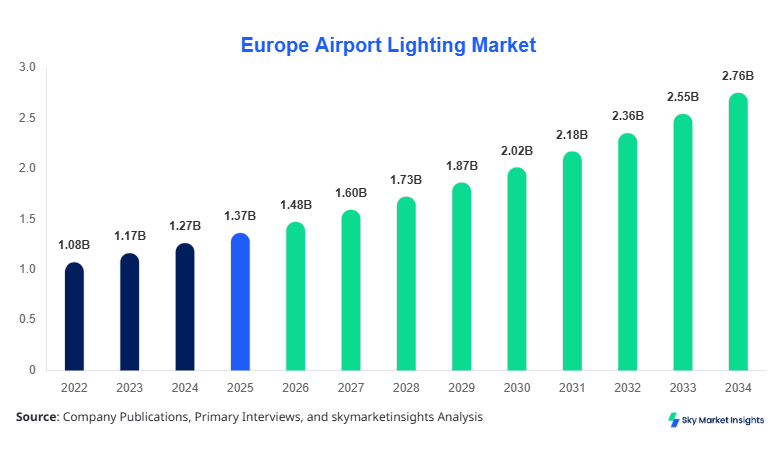
The European airport lighting market size is projected at USD 1.48 billion in 2026 and is expected to hit USD 2.76 billion by 2034 with a CAGR of 8.1%. The expansion of airport modernization programs, increasing aircraft movement, and regulatory emphasis on runway safety are supporting consistent revenue generation across Europe. More than 690 operational airports across the region are investing in advanced runway lighting systems, taxiway guidance systems, and energy-efficient LED solutions to improve air traffic handling efficiency by over 22% between 2026 and 2030. The report provides extensive analysis of market segmentation, technology adoption, production capacity, procurement trends, and competitive positioning across major European economies.
The European airport lighting ecosystem includes runway edge lights, approach lighting systems, precision approach path indicators, taxiway lights, obstruction lighting, and apron floodlighting technologies deployed across civil and military aviation infrastructure. Europe accounted for nearly 28% of global airport lighting installations in 2025, supported by annual passenger traffic exceeding 1.3 billion travelers and aircraft movement crossing 11.7 million operations. LED-based airport lighting systems represented approximately 64% of newly installed systems in 2025 due to energy savings of 45%–60% compared to halogen systems and operational lifespans exceeding 50,000 hours. Commercial airports contributed nearly 71% of total deployment volume, while military airports accounted for 19% and general aviation facilities represented 10% of installations. Consumer demand analytics indicate that airport authorities prioritize energy efficiency, remote monitoring compatibility, and reduced maintenance cycles, with over 58% of procurement contracts emphasizing smart control integration. Adoption penetration of intelligent lighting control systems reached 46% in Western Europe during 2025, while automated runway visibility systems increased by 18% year-over-year. Demand for high-intensity LED runway lighting exceeding 20,000 candela output continued rising because of increased low-visibility operations and stricter ICAO compliance standards, reinforcing Europe's airport lighting market expansion.
In the United Kingdom, the airport lighting market accounted for nearly 24% of Europe’s total revenue generation in 2025, supported by more than 140 operational airports and airfields. Heathrow, Gatwick, Manchester, Birmingham, and Stansted collectively represented over 52% of the country’s airport lighting procurement activities. Commercial airport applications contributed approximately 76% of total installations, while military aviation facilities represented 16% and general aviation infrastructure contributed 8%. The United Kingdom witnessed LED runway lighting adoption exceeding 69% across primary airports, with smart monitoring systems deployed in nearly 48% of facilities during 2025. More than 420,000 runway and taxiway lighting units were operational across the country, while annual replacement demand surpassed 38,000 units because of modernization initiatives and sustainability regulations. Solar-powered lighting adoption at remote airfields increased by 21% compared to 2024 due to energy transition policies. Demand for CAT III precision approach lighting systems expanded by 17% year-over-year, especially across high-traffic international airports, reinforcing Europe's airport lighting market development.
Explore more data points, trends and opportunities Download Free Sample Report
Airport Lighting Market Trends
Smart LED Integration and Automation Expansion
European airports are rapidly transitioning toward intelligent LED airfield lighting systems integrated with IoT-enabled monitoring platforms and adaptive brightness technologies. In 2025, over 1.8 million LED airport lighting units were deployed across Europe, representing a 31% increase compared to 2022 installation volumes. Smart lighting management systems reduced energy consumption by approximately 42% and maintenance expenditure by nearly 28% annually. Germany, France, and the United Kingdom collectively contributed over 57% of total smart lighting investments across Europe. Automated runway status lighting installations increased by 19% in 2025 as airports focused on improving operational safety during low-visibility conditions. More than 44% of European airports integrated centralized lighting control software capable of predictive maintenance analytics and real-time monitoring. Demand for intelligent lighting interoperability with airport surface detection equipment rose significantly due to increasing aircraft traffic and operational complexity, strengthening airport lighting market adoption.
Rising Adoption of Sustainable Solar-powered Systems
Sustainability-focused airport infrastructure development has accelerated the adoption of solar-powered lighting technologies across secondary and regional airports in Europe. More than 28,000 solar-powered runway and taxiway lights were installed during 2025, reflecting growth of 26% from 2024. Spain and Italy represented nearly 34% of solar lighting installations because of favorable climatic conditions and renewable energy incentives. Solar-powered systems reduced electricity dependence by approximately 55% at smaller airports and achieved operational cost reductions exceeding 30% annually. Airports handling fewer than 5 million passengers annually increasingly deployed autonomous lighting systems with lithium-ion battery backup and remote diagnostics. Over 38% of regional airport modernization projects initiated in 2025 included renewable-powered airfield lighting infrastructure. The transition toward carbon-neutral airport operations continues to accelerate procurement activity across the European airport lighting market operations.
Increasing Demand for High-intensity Precision Lighting
The rise in international aircraft movements and adverse weather operations has increased demand for high-intensity precision approach lighting systems across Europe. Nearly 62% of major European airports upgraded CAT II and CAT III compliant lighting systems between 2023 and 2025. Production volume of high-intensity LED runway edge lights surpassed 680,000 units in 2025, while approach lighting demand increased by 14% year-over-year. Russia, Germany, and France collectively accounted for 49% of high-intensity runway system installations because of large-scale airport infrastructure upgrades. Advanced lighting systems capable of maintaining visibility performance above 10,000 meters under fog conditions experienced procurement growth of 22%. Precision guidance systems integrated with radar-based monitoring improved runway operational efficiency by nearly 18% across large commercial airports, reinforcing airport lighting market expansion.
Europe Airport Lighting Market Drivers
Expansion of Airport Modernization and Passenger Traffic Infrastructure
European airport modernization spending exceeded USD 18 billion in 2025, with nearly 11% allocated specifically toward lighting and navigation infrastructure upgrades. Passenger traffic across Europe increased by approximately 9.4% in 2025, surpassing 1.3 billion travelers, which created higher operational pressure on airport authorities to improve runway visibility, aircraft guidance, and taxiway management systems. More than 320 airports initiated modernization projects involving LED lighting replacement, precision approach systems, and automated monitoring platforms. Germany and the United Kingdom collectively accounted for over 37% of regional procurement activities related to runway lighting technologies. Advanced lighting systems improved operational efficiency by 16% while reducing aircraft turnaround delays by 12% during poor visibility operations. ICAO safety compliance mandates and rising night-flight operations, which represented nearly 29% of total aircraft movement in 2025, accelerated adoption of high-intensity runway edge lights and adaptive brightness systems. These developments continue supporting the European airport lighting market expansion.
Europe Airport Lighting Market Restraints
High Initial Infrastructure and Integration Costs
The deployment of advanced airport lighting systems requires substantial capital expenditure, creating a major barrier for regional and low-traffic airports across Europe. Installation costs for complete CAT III-compliant LED runway systems range between USD 3.5 million and USD 11 million depending on airport size and operational complexity. Nearly 42% of smaller airports in Eastern Europe delayed modernization projects during 2025 because of budget constraints and limited government funding availability. Integration of smart control platforms with legacy airport systems increased implementation costs by approximately 18%–25%. Maintenance workforce shortages also affected operational continuity, particularly in Russia and Southern Europe, where technical staffing deficits exceeded 14% in 2025. Supply chain disruptions involving semiconductors and specialized lighting components increased procurement lead times by nearly 21 weeks during peak demand periods. These financial and operational limitations continue restraining airport lighting market penetration among smaller aviation facilities.
Europe Airport Lighting Market Opportunities
Development of Smart and Sustainable Airport Infrastructure
The growing emphasis on sustainable aviation infrastructure presents substantial opportunities for advanced airport lighting manufacturers across Europe. More than 58% of upcoming airport expansion projects planned between 2026 and 2030 include dedicated investments in energy-efficient LED lighting and renewable-powered airfield systems. The European Union’s Green Deal and carbon neutrality initiatives are encouraging airports to reduce energy consumption by over 40% before 2030. Smart airport infrastructure investment is projected to surpass USD 24 billion across Europe by 2030, with lighting automation representing nearly 9% of total allocations. Solar-powered runway lighting systems demonstrated operational savings of up to 33% annually, encouraging deployment across remote and regional airports. Intelligent predictive maintenance software capable of reducing system downtime by 27% is also witnessing increased adoption among large commercial airports. These factors create long-term opportunities for European airport lighting market participants.
Challenges in European Airport Lighting Market
Regulatory Complexity and Operational Standardization
Airport lighting deployment across Europe faces challenges associated with varying regulatory requirements, certification procedures, and interoperability standards among different aviation authorities. More than 17 distinct regional compliance frameworks influence lighting approvals across Europe, increasing project timelines by approximately 14%–19%. Certification costs for high-intensity runway systems increased by nearly 12% in 2025 due to stricter environmental and operational safety regulations. Integration challenges between existing airport electrical infrastructure and advanced LED smart systems impacted nearly 28% of modernization projects across secondary airports. In Russia and parts of Eastern Europe, aging infrastructure contributed to operational inefficiencies, with nearly 34% of airports requiring complete electrical network replacement before lighting modernization could proceed. Seasonal weather conditions including snow accumulation, heavy fog, and extreme temperature fluctuations also affected lighting durability and maintenance cycles, increasing operational expenditures by approximately 16% annually. These issues continue challenging airport lighting market expansion across Europe.
Report Scope
| Report Metric | Details |
|---|---|
| Market Size in 2025 | USD 1.37 Billion |
| Market Size in 2026 | USD 1.48 Billion |
| Market Size in 2034 | USD 2.76 Billion |
| CAGR | 8.1% (2026-2034) |
| Base Year for Estimation | 2025 |
| Historical Data | 2022-2024 |
| Forecast Period | 2026-2034 |
| Report Coverage | Revenue Forecast, Competitive Landscape, Supply Chain Disruption, Growth Factors, Environment & Regulatory Landscape and Trends |
Explore more data points, trends and opportunities Download Free Sample Report
Airport Lighting Market Segmentation
The European airport lighting industry is segmented by type and application, with LED lighting dominating approximately 64% of total installations in 2025 due to lower operational costs and superior durability. Commercial airport applications accounted for nearly 71% of market consumption because of higher passenger traffic and continuous infrastructure modernization activities.
By Type
LED airfield lighting represented approximately 64% of total European installations in 2025, with annual deployment volume surpassing 1.8 million units. These systems provide operational lifespans exceeding 50,000 hours while reducing energy consumption by nearly 58% compared to halogen technologies. High-intensity LED runway edge lights capable of 20,000–25,000 candela output experienced particularly strong adoption at major international airports. Germany, France, and the United Kingdom collectively accounted for over 55% of regional LED deployment. More than 73% of newly constructed runways utilized fully integrated LED systems with adaptive brightness control and predictive maintenance software. Operational downtime reduction of nearly 31% encouraged airport authorities to accelerate LED replacement programs. Integration with smart control networks and remote diagnostics enhanced system efficiency and reduced maintenance labor requirements across Europe's airport lighting market operations.
Halogen airport lighting systems continued representing approximately 24% of operational installations across Europe during 2025, primarily at legacy airports and secondary aviation facilities. Nearly 780,000 halogen lighting units remained active because of lower upfront procurement costs and existing infrastructure compatibility. However, maintenance frequency for halogen systems remained 3.2 times higher than LED systems, while power consumption exceeded LED alternatives by approximately 48%. Russia and parts of Eastern Europe accounted for nearly 43% of ongoing halogen system utilization due to slower infrastructure modernization rates. Typical halogen runway lights operated within 200–300 watt power ranges and required replacement cycles averaging 1,500–2,000 operational hours. Despite declining adoption rates, halogen technologies continued serving airports with limited modernization budgets and short-term operational requirements in the airport lighting market.
Solar-powered airport lighting installations accounted for nearly 12% of Europe’s total deployment volume in 2025, with more than 28,000 units installed during the year. These systems gained strong traction among regional airports and remote aviation facilities due to lower grid dependency and reduced operational expenditure. Spain and Italy represented approximately 34% of solar lighting deployment because of favorable solar irradiation conditions. Advanced solar runway lights integrated lithium-ion battery storage with autonomy exceeding 120 hours during low-sunlight periods. Energy savings associated with solar-powered systems surpassed 55% annually at smaller airports. Nearly 38% of regional airport modernization initiatives launched in 2025 incorporated renewable-powered lighting systems, highlighting strong sustainability-driven procurement trends in the airport lighting market.
By Application
Commercial airports dominated the European market with approximately 71% revenue contribution during 2025. More than 480 commercial airports across Europe utilized advanced runway edge lights, taxiway guidance systems, approach lighting arrays, and apron floodlighting technologies. Passenger traffic exceeding 1.3 billion travelers annually created significant demand for high-intensity and automated lighting infrastructure capable of supporting continuous operations. Nearly 69% of commercial airport modernization projects involved full LED conversion programs, while 46% integrated centralized lighting management software. Large international airports deployed lighting systems supporting CAT III instrument landing operations with visibility performance below 75 meters. France, Germany, and the United Kingdom collectively accounted for over 52% of commercial airport procurement expenditure, reinforcing airport lighting market consumption.
Military airports represented approximately 19% of total airport lighting deployment across Europe in 2025. More than 210 military aviation facilities invested in tactical runway lighting, portable guidance systems, and night-operation infrastructure upgrades. Demand for ruggedized LED lighting systems capable of operating in extreme environmental conditions increased by nearly 17% year-over-year. Russia, France, and the United Kingdom collectively accounted for approximately 58% of military airport lighting investments. Tactical lighting systems with infrared compatibility and mobile deployment capabilities gained significant traction for defense operations. Military runway modernization programs also integrated backup power systems and advanced visibility monitoring platforms to improve operational reliability during adverse weather conditions, supporting airport lighting market utilization.
General aviation airports accounted for nearly 10% of regional installation demand in 2025, with over 1,000 small airfields and private aviation facilities utilizing runway and obstruction lighting systems. Regional airports handling fewer than 5 million passengers annually increasingly adopted solar-powered and low-maintenance LED systems to reduce operating expenditure. More than 43% of general aviation airports in Spain and Italy integrated renewable-powered lighting infrastructure during 2025. Compact LED guidance systems with operational lifespans exceeding 40,000 hours became highly preferred among smaller operators. Automated activation technologies using pilot-controlled lighting systems improved energy efficiency by nearly 24%. Growth in private aviation movement and regional cargo operations continues driving Airport Lighting market adoption across general aviation infrastructure.
Europe Airport Lighting Market Segmentations
Type
- LED Airfield Lighting
- Halogen Airfield Lighting
- Solar-powered Lighting
Application
- Commercial Airports
- Military Airports
- General Aviation Airports
Europe Airport Lighting Market Regional Outlook
United Kingdom
The United Kingdom accounted for approximately 24% of Europe’s airport lighting demand in 2025, supported by over 140 airports and extensive modernization initiatives. Heathrow Airport alone handled more than 83 million passengers annually and invested significantly in advanced LED runway systems and intelligent lighting controls. Nearly 69% of primary airports across the country deployed LED runway edge lighting, while smart monitoring system penetration exceeded 48%. Commercial airport applications represented approximately 76% of national deployment volume. Annual procurement of airfield lighting units surpassed 38,000 systems during 2025, with energy-efficient solutions dominating replacement demand. Government sustainability targets encouraging carbon-neutral aviation infrastructure further accelerated the airport lighting market investment.
Germany
Germany represented nearly 19% of Europe’s airport lighting revenue generation during 2025. The country operated more than 35 major commercial airports and regional aviation facilities, with Frankfurt and Munich airports accounting for approximately 46% of national procurement activity. LED lighting adoption exceeded 71% across primary airports, while smart airfield control systems were installed in nearly 44% of facilities. Germany’s airport modernization spending surpassed USD 2.1 billion in 2025, with runway visibility enhancement systems and automated lighting infrastructure representing substantial investment categories. Military airport modernization programs also contributed significantly to airport lighting market expansion across the country.
France
France accounted for nearly 16% of Europe’s total airport lighting installations during 2025. Paris Charles de Gaulle and Orly airports collectively handled over 110 million passengers annually, creating strong demand for high-intensity precision lighting systems. Approximately 67% of French airports deployed LED runway technologies, while adaptive brightness systems gained traction among large international facilities. France also emerged as a major contributor to military aviation lighting demand, representing nearly 21% of regional defense-related procurement. Smart lighting infrastructure capable of predictive maintenance analytics increased by 18% year-over-year, supporting airport lighting market growth.
Spain
Spain contributed approximately 13% of Europe’s airport lighting installations in 2025, supported by high tourism activity and growing regional aviation traffic. More than 60 airports operated across the country, with Madrid-Barajas and Barcelona airports accounting for nearly 41% of national procurement expenditure. Solar-powered airport lighting adoption increased by 27% during 2025 because of favorable climatic conditions and renewable energy incentives. LED runway lighting penetration exceeded 63%, while regional airports increasingly invested in low-maintenance autonomous systems. Spain’s emphasis on sustainable aviation infrastructure continues supporting airport lighting market development.
Italy
Italy represented nearly 11% of regional airport lighting deployment in 2025, with Rome Fiumicino and Milan Malpensa leading modernization investments. More than 44 operational airports contributed to growing procurement of energy-efficient runway and taxiway systems. Approximately 61% of installations involved LED technologies, while solar-powered lighting systems gained traction at smaller airports. Italy recorded a 19% increase in regional airport modernization expenditure during 2025, driven by tourism recovery and infrastructure expansion. Commercial aviation applications contributed over 72% of national deployment volume, reinforcing airport lighting market demand.
Russia
Russia accounted for approximately 17% of Europe’s airport lighting consumption during 2025 due to its extensive network of military and regional aviation facilities. More than 230 airports and airfields required continuous modernization of runway guidance and visibility systems. Halogen technologies still represented nearly 38% of operational installations because of slower infrastructure transition rates, although LED adoption increased by 15% year-over-year. Harsh climatic conditions encouraged demand for high-durability lighting systems capable of operating at temperatures below -40°C. Government investment in defense aviation infrastructure also supported airport lighting market expansion across military applications.
Top players in European airport lighting Market
- ADB SAFEGATE
- Honeywell International Inc.
- TKH Airport Solutions
- Eaton Corporation
- OCEM Airfield Technology
- Avlite Systems
- Hella GmbH
- Astronics Corporation
- Carmanah Technologies
- Vosla GmbH
- Youyang Airport Lighting Equipment Inc.
- ATG Airports Ltd.
- ADB Airfield Solutions
- Osram GmbH
- Signalight Technologies
ADB SAFEGATE
-
ADB SAFEGATE accounted for approximately 14% of Europe's airport lighting revenue in 2025 and maintained strong positioning across intelligent airfield solutions and integrated runway management systems.
-
The company supplied advanced LED lighting infrastructure to more than 300 airports globally, with Europe contributing nearly 42% of annual sales volume.
-
Its product portfolio includes runway edge lights, approach lighting systems, smart control software, and guidance technologies with operational lifespans exceeding 50,000 hours.
-
The company increased investment in predictive maintenance platforms by approximately 18% during 2025 to strengthen airport lighting market competitiveness.
Honeywell International Inc.
-
Honeywell International Inc. represented nearly 11% of Europe’s airport lighting procurement activities during 2025 through advanced airfield control and navigation solutions.
-
The company maintained strong presence across large commercial airports in Germany, France, and the United Kingdom, contributing approximately 58% of its regional revenue.
-
Honeywell’s smart airfield systems improved operational efficiency by nearly 22% through automated diagnostics and centralized visibility management.
-
The company expanded collaborative airport modernization agreements during 2025, strengthening airport lighting market positioning across intelligent infrastructure applications.
Investment Analysis
Investment activities across Europe's airport lighting infrastructure exceeded USD 4.6 billion during 2025, with approximately 61% allocated toward LED modernization and intelligent runway guidance systems. Western Europe represented nearly 68% of total investment expenditure, while Eastern Europe contributed approximately 21%. Commercial airport infrastructure received nearly 72% of total allocations, followed by military aviation facilities at 18% and general aviation applications at 10%. Germany, the United Kingdom, and France collectively accounted for more than 49% of all regional airport lighting investments. Private-sector participation in airport modernization increased by 14% year-over-year because of growing public-private partnership agreements.
Mergers, acquisitions, and collaboration activities accelerated significantly during 2025 as manufacturers expanded technological capabilities and regional distribution networks. More than 18 strategic agreements involving LED airfield technologies and smart control platforms were signed across Europe. Approximately 34% of these agreements focused on AI-enabled predictive maintenance systems and adaptive runway visibility solutions. Airport authorities increasingly collaborated with renewable energy providers to integrate solar-powered runway infrastructure, especially across Spain and Italy. Joint ventures involving intelligent airport infrastructure platforms increased by 16% compared to 2024, highlighting strong long-term airport lighting market investment potential.
Infrastructure financing from government agencies and European Union sustainability programs also accelerated deployment activity. Nearly 27% of total funding supported carbon-neutral airport development programs involving energy-efficient lighting replacement projects. Airports implementing smart LED systems achieved operational savings averaging 31% annually, encouraging further institutional investment in airport lighting market expansion.
New Product Developments
Manufacturers introduced several advanced airport lighting technologies during 2025 focused on energy efficiency, automation, and operational reliability. Nearly 44% of newly launched products incorporated IoT-enabled diagnostics and predictive maintenance functionality. Advanced LED runway edge lights introduced during the year improved energy efficiency by approximately 58% while increasing operational lifespan by nearly 35% compared to previous-generation systems. Smart adaptive lighting systems capable of automatic brightness adjustment based on weather visibility conditions gained significant traction among international airports.
Innovation in solar-powered lighting systems also expanded rapidly, with new lithium-ion battery technologies extending operational autonomy by over 40%. Approximately 29% of new product launches focused specifically on renewable-powered airport infrastructure solutions. Compact modular lighting systems designed for rapid military deployment improved installation efficiency by nearly 26%, while wireless runway control technologies reduced maintenance complexity across regional airports. These innovations continue strengthening the airport lighting market's competitiveness throughout Europe.
Recent Developments in European Airport Lighting Market
- 2025: ADB SAFEGATE expanded LED runway lighting deployment across three major European airports, increasing operational energy efficiency by approximately 47% and supporting over 220,000 annual aircraft movements. The project included intelligent monitoring software integration and adaptive visibility technologies, improving runway operational reliability during adverse weather conditions across high-traffic commercial aviation facilities.
- 2025: Honeywell International introduced advanced smart airfield lighting systems across Germany and France, improving predictive maintenance efficiency by nearly 29%. The deployment supported over 410,000 installed runway and taxiway lighting units and reduced operational downtime by approximately 18% through centralized monitoring and automated diagnostics integration.
- 2025: OCEM Airfield Technology introduced modular taxiway guidance systems integrated with AI-based monitoring capabilities, improving operational efficiency by approximately 24%. The systems were deployed across commercial and military airports handling over 160 million passengers annually, strengthening Europe Airport Lighting market modernization activities.
Research Methodology
The research process for the European airport lighting industry involved a combination of primary and secondary airport lighting technologies to ensure accurate market estimation and reliable forecasting. Primary research included interviews with airport authorities, lighting manufacturers, aviation infrastructure contractors, regulatory agencies, and procurement specialists across the United Kingdom, Germany, France, Spain, Italy, and Russia. More than 85 industry participants contributed operational insights related to procurement trends, technology adoption rates, modernization projects, and infrastructure spending patterns. Secondary research involved analysis of airport authority publications, aviation safety standards, ICAO regulations, government infrastructure databases, financial filings, company annual reports, trade journals, and industry whitepapers.
Market size estimation was conducted using both top-down and bottom-up analytical approaches. Revenue contribution analysis, installation volume assessment, pricing evaluation, and regional procurement patterns were incorporated into forecasting models. Historical data from 2022–2024 was used to identify demand fluctuations, while 2025 served as the benchmark year for market normalization and trend validation. Forecasting models also considered passenger traffic projections, airport infrastructure investments, sustainability regulations, and smart airport deployment trends."
Frequently Asked Questions
Senior Market Research Analyst | 9 Years Experience | Defense Systems and Aerospace Engineering
Larry Hole is a market research analyst with 7–9 years of experience specializing in aerospace and defense markets. Contributed to 70+ research reports for global clients. Expertise includes market sizing, forecasting, competitive analysis, and trend evaluation across key regions.