Europe Agriculture ERP Market Size
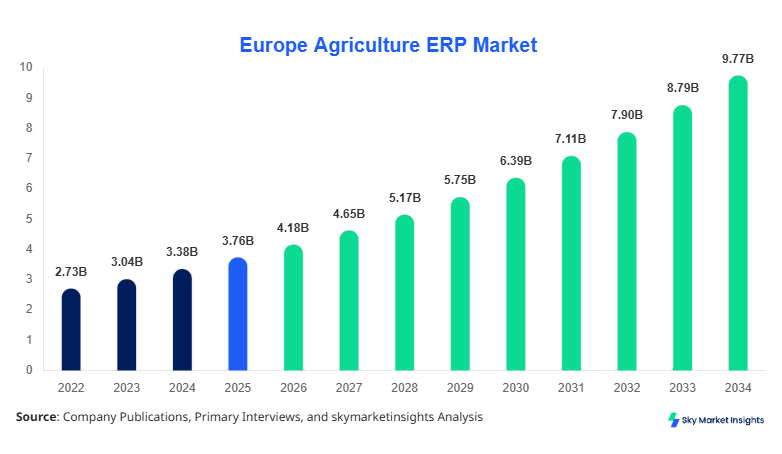
Europe's agriculture ERP market size is projected at USD 4.18 billion in 2026 and is expected to hit USD 9.74 billion by 2034 with a CAGR of 11.2%.
The increasing deployment of digital farm management systems, precision agriculture platforms, and integrated enterprise planning solutions across Europe is driving substantial expansion in the market. More than 61% of medium-to-large agricultural enterprises in Europe are expected to integrate ERP-enabled farm analytics by the end of 2026, compared with 44% in 2023. The market is witnessing higher investments in cloud infrastructure, IoT-enabled agriculture management, livestock monitoring, crop planning software, and automated procurement systems. Competitive intensity is increasing among software vendors due to the rapid adoption of AI-based farm productivity optimization and rising demand for data-driven agricultural operations across Germany, France, Italy, and the United Kingdom.
The Agriculture ERP ecosystem includes enterprise resource planning software designed specifically for farming operations, livestock management, crop analytics, warehouse coordination, procurement planning, distribution management, compliance tracking, and financial integration within agricultural enterprises. Europe recorded agricultural production exceeding 295 million metric tons in 2025, with Germany, France, and Spain accounting for nearly 48% of regional production output. Digital transformation spending in European agriculture surpassed USD 11.6 billion in 2025, while ERP-linked software implementation accounted for approximately 21% of overall agritech expenditure.
Adoption and penetration of agriculture ERP platforms are increasing rapidly due to government-backed smart farming initiatives and precision agriculture mandates. More than 72,000 commercial farms in Europe adopted integrated ERP systems in 2025, compared with 51,000 installations in 2022. Cloud-based deployment represented nearly 58% of total implementations due to lower infrastructure costs and improved accessibility across remote farming locations. Approximately 63% of agricultural cooperatives in Europe integrated ERP-supported inventory and logistics systems to improve supply visibility and reduce operational waste by 18%–24%.
Consumer behavior and demand analytics indicate that agricultural producers increasingly prioritize traceability, sustainability compliance, and predictive analytics. Around 67% of agribusiness firms in Europe reported growing demand for automated crop scheduling, livestock health tracking, and climate-based forecasting tools. Demand for ERP-integrated supply chain visibility platforms increased by 29% in 2025 due to rising export regulations and sustainability reporting requirements. Farm management applications accounted for 46% of total software deployment, while supply chain management contributed 31%, and financial management applications represented nearly 23% of the implementation base. The increasing focus on productivity optimization, automated decision-making, and operational efficiency continues to strengthen the agriculture ERP market.
In Germany, the agriculture ERP market is witnessing accelerated deployment due to strong agricultural digitization policies and increasing investments in smart farming infrastructure. Germany accounted for approximately 26% of the European agriculture ERP industry revenue in 2025, supported by over 14,500 commercial agricultural enterprises using integrated ERP platforms. More than 3,200 software-enabled farming cooperatives and agribusiness processing units adopted ERP-linked operational management systems during 2024–2025. Germany also recorded over 19 million hectares of managed agricultural land integrated with digital monitoring technologies.
Farm management applications represented nearly 43% of agriculture ERP implementation in Germany, while supply chain management accounted for 34%, and financial management contributed around 23%. Cloud deployment penetration exceeded 61% among medium-sized agricultural businesses due to lower maintenance costs and improved scalability. IoT-enabled farm monitoring adoption surpassed 49% among large-scale grain and livestock producers. Germany also reported approximately 18% improvement in operational planning efficiency and 22% reduction in procurement delays through ERP-integrated farm management systems. The expansion of AI-enabled predictive farming tools and precision resource allocation platforms continues to reinforce the agriculture ERP market.
Explore more data points, trends and opportunities Download Free Sample Report
Agriculture ERP Market Trends
Rising Adoption of AI-Driven Precision Agriculture Platforms
The integration of artificial intelligence, machine learning, and predictive analytics within agricultural ERP systems is emerging as a major transformation trend across Europe. In 2025, over 38% of newly implemented ERP platforms incorporated AI-based crop yield forecasting and automated irrigation optimization tools. Precision agriculture software deployments increased by 31% between 2023 and 2025, while ERP-linked satellite monitoring solutions covered more than 42 million hectares of agricultural land across Europe. Germany, France, and the United Kingdom collectively represented nearly 57% of AI-enabled ERP deployments in the region.
Agricultural enterprises are increasingly integrating real-time weather monitoring, nutrient management systems, and livestock analytics into centralized ERP environments to improve operational efficiency. More than 64% of large agribusinesses in Europe implemented sensor-connected farm monitoring systems in 2025, compared with 39% in 2022. Data processing capabilities improved significantly, with modern ERP platforms capable of handling more than 12 terabytes of operational farm data annually for large-scale enterprises. The increasing deployment of automation-enabled agricultural software continues to accelerate the agriculture ERP market.
Expansion of Cloud-based ERP Infrastructure Across Agricultural Enterprises
Cloud-based ERP infrastructure is rapidly replacing legacy on-premise agricultural management systems due to scalability advantages and lower operational costs. Cloud deployment accounted for nearly 58% of total agriculture ERP implementations in Europe during 2025 and is expected to exceed 71% by 2030. More than 49,000 agricultural businesses transitioned from manual management systems to cloud-integrated ERP environments between 2023 and 2025. Subscription-based software pricing reduced infrastructure costs by approximately 26% for medium-scale farming enterprises.
The growing demand for remote monitoring, mobile accessibility, and multi-location farm management is further increasing cloud ERP adoption. Approximately 68% of agricultural cooperatives in Spain and Italy deployed cloud-enabled supply chain coordination systems in 2025. Cloud-integrated ERP platforms also improved operational reporting speed by nearly 37% and reduced inventory management inefficiencies by 19%. Enhanced cybersecurity integration and real-time data synchronization capabilities are strengthening enterprise confidence in cloud infrastructure, thereby supporting long-term agriculture ERP market expansion.
Europe Agriculture ERP Market Drivers
Increasing Adoption of Precision Agriculture and Smart Farming Technologies
The rapid implementation of precision agriculture technologies and data-driven farming practices is a primary growth driver for the European agriculture ERP sector. More than 74% of large agricultural enterprises in Europe adopted at least one digital farming technology during 2025, while nearly 41% integrated complete ERP-based operational ecosystems. Agricultural automation investments surpassed USD 15.4 billion across Europe in 2025, with approximately 28% directed toward ERP-enabled farm management solutions. Smart irrigation deployment increased by 24%, GPS-enabled machinery utilization rose by 31%, and IoT-connected livestock monitoring systems expanded by 27% during the same year.
Government-backed sustainability initiatives and agricultural productivity optimization programs are encouraging ERP integration across small and medium-sized farms. Germany, France, and the United Kingdom collectively allocated more than USD 3.2 billion toward smart agriculture modernization projects in 2025. ERP systems are increasingly used to manage fertilizer consumption, pesticide application, crop rotation planning, and inventory tracking, resulting in operational efficiency improvements ranging between 18% and 29%. Real-time analytics integration also reduced manual reporting workloads by nearly 34% for agricultural enterprises. Increasing emphasis on productivity enhancement, resource optimization, and digital farm coordination continues to support agriculture ERP market expansion.
Europe Agriculture ERP Market Restraints
High Initial Implementation Costs and Limited Technical Expertise
Despite strong growth prospects, high implementation expenses and limited technical expertise among smaller agricultural enterprises remain significant barriers to market adoption. Average deployment costs for fully integrated agriculture ERP platforms ranged between USD 38,000 and USD 420,000 in 2025 depending on enterprise scale, customization requirements, and infrastructure complexity. Nearly 46% of small-scale farming enterprises in Europe cited high upfront software and training expenses as a major adoption challenge.
Rural connectivity limitations and lack of skilled personnel further restrict ERP implementation across underdeveloped agricultural regions. Approximately 37% of agricultural cooperatives in Eastern Europe reported operational disruptions during initial ERP integration phases due to inadequate IT infrastructure. Employee training requirements increased deployment timelines by 18%–22% across medium-scale agribusinesses. In addition, concerns regarding cybersecurity vulnerabilities and data ownership continue to affect adoption confidence, particularly among family-owned agricultural businesses. Integration complexity with legacy farm equipment and disconnected operational systems also limits implementation efficiency. These operational and financial challenges continue to restrain agriculture ERP market expansion in certain regions.
Europe Agriculture ERP Market Opportunities
Expansion of Sustainable Agriculture and Carbon Tracking Solutions
The increasing focus on sustainability monitoring and carbon emission management is creating substantial opportunities for agriculture ERP providers across Europe. More than 62% of agricultural enterprises in Europe are expected to implement sustainability reporting software by 2030, compared with 29% in 2025. Demand for ERP-integrated carbon footprint analytics increased by approximately 34% during 2024–2025 due to stricter environmental regulations and climate reporting requirements.
Agricultural producers are increasingly deploying ERP solutions to monitor water usage, fertilizer efficiency, greenhouse gas emissions, and soil health performance. Europe recorded over 21 million hectares of farmland participating in sustainability certification programs during 2025. ERP platforms capable of integrating environmental compliance reporting and predictive climate analytics are experiencing higher enterprise adoption rates. Investments in regenerative agriculture technologies exceeded USD 2.4 billion in 2025, with approximately 19% allocated toward software infrastructure and ERP-enabled sustainability tracking tools. Vendors offering AI-based environmental performance optimization and automated compliance reporting systems are expected to benefit significantly from evolving agricultural regulations. These emerging sustainability-focused deployments are creating strong long-term opportunities for the agriculture ERP market.
Challenges in European Agriculture ERP Market
Data Integration Complexity and Fragmented Agricultural Operations
One of the major challenges affecting agriculture ERP deployment across Europe is the fragmented nature of agricultural operations and difficulties associated with integrating multiple data sources into centralized systems. More than 52% of medium-sized agricultural enterprises operate across multiple disconnected software platforms, creating interoperability limitations during ERP deployment. Agricultural data generated from sensors, drones, satellite systems, irrigation equipment, and financial systems exceeded 7.8 petabytes across Europe in 2025, increasing integration complexity for ERP vendors.
Legacy farm machinery and outdated operational systems often lack compatibility with modern cloud-based ERP platforms, resulting in additional integration expenses of nearly 14%–19% during deployment phases. Approximately 33% of agricultural businesses reported data synchronization challenges between field monitoring systems and ERP dashboards. Cross-border regulatory differences among European countries also create operational difficulties for multinational agricultural enterprises. In addition, inconsistent internet connectivity across rural farming regions affects real-time analytics performance and cloud accessibility. The need for customized integrations and industry-specific workflow management continues to increase deployment timelines and operational complexity, posing persistent challenges for the Agriculture ERP market.
Report Scope
| Report Metric | Details |
|---|---|
| Market Size in 2025 | USD 3.76 Billion |
| Market Size in 2026 | USD 4.18 Billion |
| Market Size in 2034 | USD 9.74 Billion |
| CAGR | 11.2% (2026-2034) |
| Base Year for Estimation | 2025 |
| Historical Data | 2022-2024 |
| Forecast Period | 2026-2034 |
| Report Coverage | Revenue Forecast, Competitive Landscape, Supply Chain Disruption, Growth Factors, Environment & Regulatory Landscape and Trends |
Explore more data points, trends and opportunities Download Free Sample Report
Agriculture ERP Market Segmentation
The Agriculture ERP market is segmented based on deployment and application, with cloud-based deployment dominating approximately 58% of total implementations due to scalability advantages and lower maintenance costs. Farm management applications accounted for nearly 46% of market adoption because of rising demand for crop analytics, livestock monitoring, and operational optimization across European agricultural enterprises.
By Type
Cloud-based agriculture ERP platforms represented approximately 58% of the total market revenue in 2025. More than 49,000 agricultural enterprises across Europe implemented cloud-hosted ERP solutions due to reduced infrastructure expenditure and faster deployment cycles. Cloud-based systems improved remote accessibility for over 68% of multi-location farming businesses. Average data processing speeds increased by nearly 29% compared with legacy infrastructure. Subscription-based deployment models reduced software ownership costs by approximately 24% for medium-sized agricultural enterprises. Integration with IoT-enabled monitoring systems, AI analytics, and mobile farm management applications continues to strengthen adoption across Germany, France, and the United Kingdom.
On-premise ERP deployment accounted for nearly 27% of the European market in 2025. Large-scale agricultural enterprises handling sensitive operational data continue to prefer on-premise infrastructure due to higher customization flexibility and internal security control. More than 11,000 agricultural facilities operated dedicated on-premise ERP systems during 2025. Average server processing capabilities exceeded 240 GB per operational cycle in high-volume farming enterprises. On-premise systems are commonly deployed among grain storage facilities, livestock processing units, and agricultural cooperatives managing extensive internal databases. However, maintenance costs remained approximately 18% higher compared with cloud-based infrastructure.
Hybrid ERP deployment represented approximately 15% of the agriculture ERP market in Europe. Hybrid architecture combines cloud scalability with localized data storage, enabling agricultural enterprises to manage sensitive operational data while maintaining remote accessibility. Approximately 6,800 agribusiness facilities implemented hybrid ERP systems during 2025. Hybrid deployment improved operational flexibility by nearly 21% for multinational agricultural enterprises operating across multiple countries. The integration of localized analytics with centralized cloud dashboards has increased adoption among supply chain-intensive agricultural organizations.
By Application
Farm management applications dominated the market with nearly 46% share in 2025. More than 72,000 farms across Europe implemented ERP-enabled crop planning, irrigation management, livestock monitoring, and yield forecasting systems. Automated farm management reduced operational inefficiencies by approximately 23% and improved resource allocation accuracy by 28%. IoT-enabled field monitoring covered more than 42 million hectares of agricultural land in Europe during 2025. ERP-integrated nutrient optimization systems also reduced fertilizer wastage by approximately 16%–22%. The increasing focus on precision agriculture and predictive farming analytics continues to accelerate deployment across commercial farming enterprises.
Supply chain management applications accounted for approximately 31% of the agriculture ERP market. More than 38,000 agricultural distributors and processing facilities implemented ERP-linked logistics coordination systems in 2025. Real-time inventory monitoring improved warehouse efficiency by nearly 26%, while transportation optimization reduced supply chain delays by 18%. ERP-supported traceability systems tracked over 195 million metric tons of agricultural products across Europe during 2025. Demand for compliance reporting and export documentation automation is increasing significantly among multinational agricultural exporters.
Financial management applications represented nearly 23% of total ERP implementation across Europe. Agricultural enterprises increasingly deploy ERP-enabled accounting, payroll, budgeting, and tax management systems to streamline financial operations. More than 27,000 agricultural businesses adopted integrated financial management software during 2025. Automated reporting tools reduced financial reconciliation time by approximately 31% and improved compliance accuracy by 19%. Integration with procurement planning and subsidy management systems is further supporting adoption among medium-sized agricultural enterprises.
Europe Agriculture ERP Market Segmentations
Deployment
- Cloud-based
- On-premise
- Hybrid
Application
- Farm Management
- Supply Chain Management
- Financial Management
Europe Agriculture ERP Market: Regional Outlook
United Kingdom
The United Kingdom accounted for approximately 17% of the European agriculture ERP market in 2025. More than 9,800 agricultural enterprises in the country implemented ERP-enabled operational management systems, with cloud deployment representing nearly 63% of total installations. Farm management applications contributed approximately 44% of ERP utilization, while supply chain management represented 33%. The UK agricultural sector produced more than 70 million metric tons of agricultural output in 2025, creating significant demand for predictive analytics and automated logistics management.
Digital farming initiatives supported by government-backed sustainability programs are increasing ERP adoption across livestock and grain farming operations. Approximately 51% of large-scale agricultural producers implemented IoT-linked monitoring platforms integrated with ERP dashboards. Financial management applications also expanded due to increasing agricultural subsidy tracking requirements. Rising demand for traceability and compliance reporting continues to strengthen ERP deployment throughout the United Kingdom.
Germany
Germany represented approximately 26% of the European agriculture ERP market revenue during 2025, making it the largest regional contributor. The country recorded more than 14,500 ERP-enabled agricultural enterprises and over 19 million hectares of digitally monitored farmland. Cloud-based deployment exceeded 61%, while AI-integrated farm analytics adoption reached approximately 49% among large agricultural businesses.
Germany’s agricultural production surpassed 95 million metric tons in 2025, driving substantial investments in supply chain automation and predictive farm management systems. More than 3,200 agricultural cooperatives deployed integrated ERP-linked inventory and logistics platforms. Government-supported smart farming initiatives increased digital infrastructure spending by nearly 21% during 2024–2025. The strong emphasis on sustainability reporting and precision agriculture continues to reinforce Germany’s leadership position in the Agriculture ERP market.
France
France accounted for nearly 19% of the regional market in 2025 due to its large agricultural production base and strong adoption of farm automation technologies. More than 11,200 agricultural enterprises implemented ERP platforms, while cloud-based solutions represented approximately 55% of total deployments. France produced over 82 million metric tons of agricultural commodities in 2025, supporting demand for advanced supply chain coordination and operational planning systems.
Farm management applications contributed approximately 48% of ERP deployment in France, particularly among grain and dairy farming enterprises. Sustainability monitoring and carbon tracking software adoption increased by nearly 27% during 2025. Agricultural cooperatives also increased investments in logistics optimization and predictive maintenance systems. The integration of climate analytics and resource optimization platforms continues to support agriculture ERP adoption across France.
Spain
Spain represented approximately 12% of the European agriculture ERP market in 2025. The country witnessed rapid deployment of irrigation management and crop analytics systems due to increasing water optimization requirements. More than 6,700 agricultural enterprises implemented ERP-integrated monitoring platforms during 2025. Cloud deployment accounted for approximately 59% of total installations.
Agricultural production in Spain exceeded 58 million metric tons in 2025, with horticulture and fruit farming representing significant ERP adoption sectors. IoT-enabled irrigation systems integrated with ERP dashboards improved water utilization efficiency by approximately 24%. Supply chain management applications accounted for nearly 35% of ERP usage due to rising agricultural export activity. Increasing adoption of AI-enabled climate forecasting systems is expected to strengthen long-term agriculture ERP deployment in Spain.
Italy
Italy accounted for approximately 11% of the regional agriculture ERP market in 2025. More than 6,100 agricultural enterprises adopted integrated ERP systems, with strong implementation across wine production, dairy farming, and horticulture sectors. Cloud-based deployment represented approximately 57% of the market due to increasing remote operational management requirements.
Agricultural production in Italy exceeded 54 million metric tons during 2025. ERP-linked supply chain systems improved inventory visibility by nearly 22% and reduced procurement delays by approximately 17%. Financial management applications also experienced strong growth due to increasing tax compliance and subsidy reporting requirements. Government-supported agricultural modernization programs continue to accelerate digital farming infrastructure investments across Italy.
Russia
Russia represented approximately 9% of the European agriculture ERP market in 2025. More than 5,400 agricultural enterprises implemented ERP-enabled farm management and logistics coordination systems during the year. Agricultural production exceeded 110 million metric tons, driven primarily by grain and livestock sectors.
On-premise ERP deployment remained relatively strong in Russia, accounting for nearly 39% of implementations due to data security considerations. Farm management applications contributed approximately 45% of ERP adoption, while supply chain coordination represented 32%. Investments in precision agriculture and automated monitoring technologies increased by approximately 18% during 2025. Rising demand for productivity optimization and export coordination is expected to support future agriculture ERP market expansion across Russia.
Top players in European agriculture ERP Market
- SAP SE
- Oracle Corporation
- Microsoft Corporation
- Infor Inc.
- Trimble Inc.
- Ag Leader Technology
- Deere & Company
- Epicor Software Corporation
- Sage Group plc
- Aptean Inc.
- Agrivi Ltd.
- FarmERP
- NetSuite Inc.
- Syngenta Digital Agriculture
- Proagrica
SAP SE
-
SAP SE accounted for approximately 18% of the European agriculture ERP market revenue in 2025.
-
The company maintains strong positioning across Germany, France, and the United Kingdom due to its integrated cloud infrastructure and advanced analytics capabilities.
-
SAP’s agriculture-focused ERP systems support more than 9,000 agribusiness enterprises across Europe.
-
The company expanded AI-driven predictive analytics deployment by approximately 27% during 2024–2025.
-
SAP continues to strengthen market positioning through sustainability reporting integration, carbon tracking solutions, and supply chain optimization capabilities for agricultural enterprises.
Oracle Corporation
-
Oracle Corporation represented approximately 13% of the regional agriculture ERP industry in 2025.
-
The company expanded cloud-enabled agricultural management deployments by nearly 24% during the year.
-
Oracle’s ERP systems are widely implemented among multinational agricultural exporters and processing enterprises.
-
More than 5,800 agricultural facilities across Europe integrated Oracle-based financial management and supply chain optimization solutions.
-
The company’s increasing investments in AI-enabled forecasting, real-time inventory analytics, and automated compliance reporting continue to enhance its competitive positioning in the Agriculture ERP market.
Investment Analysis
Investment activity in the Europe The agriculture ERP sector increased significantly during 2024–2026 due to rising demand for smart farming infrastructure and digital agricultural management platforms. Total investments in agriculture-focused enterprise software exceeded USD 4.6 billion during 2025, with approximately 41% allocated toward cloud infrastructure deployment and 28% directed toward AI-based analytics integration. Germany accounted for nearly 31% of regional ERP investment activity, followed by France at 19% and the United Kingdom at 17%.
Private equity firms and agritech investors are increasingly focusing on predictive analytics platforms, automated supply chain systems, and sustainability management software. Approximately 36% of ERP-related investments targeted farm management applications, while supply chain management accounted for 33%, and financial management represented 21%. Strategic partnerships between software vendors and agricultural equipment manufacturers increased by approximately 22% during 2025 to improve interoperability and data integration capabilities.
Mergers, acquisitions, and collaborative agreements are becoming increasingly common within the Agriculture ERP ecosystem. More than 48 strategic collaborations were recorded across Europe during 2024–2025 involving cloud infrastructure providers, agritech firms, and AI analytics developers. ERP vendors are investing heavily in environmental compliance reporting, carbon tracking, and predictive climate analytics to align with evolving sustainability regulations. These investment activities continue to strengthen technological innovation and long-term market competitiveness.
New Product Developments
Agriculture ERP vendors are increasingly launching AI-enabled farm management platforms and cloud-integrated operational analytics systems to improve agricultural productivity. More than 34% of newly introduced ERP products in 2025 included predictive crop analytics, IoT-enabled equipment monitoring, and automated resource allocation features. Performance optimization improvements ranged between 18% and 29% across newly launched software solutions.
Several companies introduced sustainability-focused ERP modules capable of monitoring carbon emissions, fertilizer efficiency, and water utilization. Approximately 26% of new product launches during 2025 incorporated advanced climate forecasting and satellite-based field analytics. Mobile-accessible ERP dashboards and multilingual compliance reporting tools are also gaining significant adoption across multinational agricultural enterprises.
Recent Developments in European Agriculture ERP Market
- 2025: SAP SE expanded its AI-enabled agricultural ERP analytics platform across Germany and France, increasing operational data processing capacity by approximately 32%. The deployment improved predictive crop planning accuracy by nearly 21% and enhanced supply chain traceability for more than 4,500 agricultural enterprises.
- 2025: Oracle Corporation launched a cloud-integrated agricultural logistics management platform supporting over 12 million metric tons of agricultural product tracking annually. The solution reduced transportation coordination delays by approximately 18% and improved inventory visibility by nearly 24%.
- 2025: Trimble Inc. partnered with multiple agricultural cooperatives in Spain and Italy to deploy precision agriculture analytics integrated with ERP dashboards. The collaboration increased real-time equipment monitoring efficiency by approximately 26% and reduced fertilizer wastage by nearly 17%.
Research Methodology
The research process for the European agriculture ERP market involved a combination of primary research, secondary research, market validation, and quantitative modeling techniques to ensure accurate industry assessment. The study evaluated historical performance from 2022 to 2024, while 2025 was considered the base year for market estimation and forecasting through 2034. Primary research included interviews with agricultural software providers, agribusiness executives, farm management specialists, logistics coordinators, and technology consultants operating across Germany, France, the United Kingdom, Spain, Italy, and Russia.
Secondary research involved analysis of agricultural production databases, trade statistics, enterprise software deployment records, financial reports, industry publications, government agricultural modernization programs, and sustainability compliance frameworks. More than 120 verified data sources were analyzed to estimate deployment rates, adoption penetration, operational efficiency metrics, and regional implementation trends. Market size estimation incorporated revenue benchmarking, software deployment analysis, enterprise spending evaluation, and demand-side assessment across multiple agricultural applications. Forecast modeling also considered cloud adoption.
Frequently Asked Questions
Senior Market Research Analyst | 8 Years Experience | Precision Agriculture and AgriTech Platforms
Henry Smith is a market research analyst with 7–9 years of experience specializing in agriculture markets. Contributed to 70+ research reports for global clients. Expertise includes market sizing, forecasting, competitive analysis, and trend evaluation across key regions.