Asia Pacific Agricultural Microbials Market Size
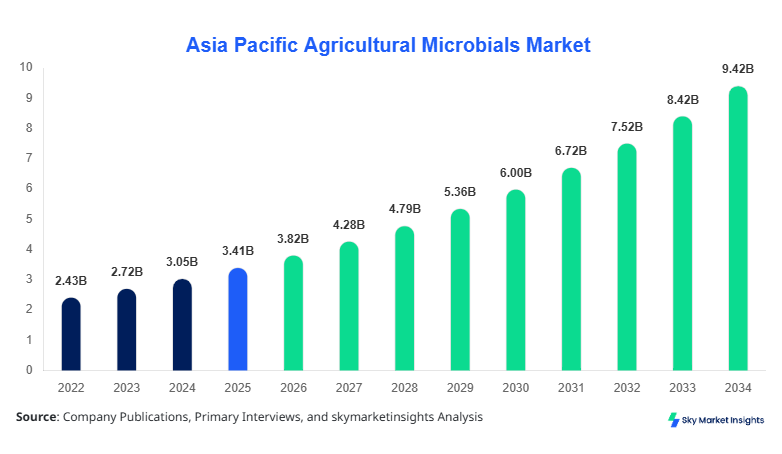
The Asia Pacific agricultural microbials market size is projected at USD 3.82 billion in 2026 and is expected to hit USD 9.47 billion by 2034 with a CAGR of 11.95%. The Asia Pacific Agricultural Microbials Market Size expansion is supported by rising organic farming acreage exceeding 58 million hectares in 2025 and bio-based input penetration surpassing 32% across high-value crops. The report emphasizes granular segmentation across type and application, with detailed competitive landscape profiling covering over 45 regional and global players operating across 8 major countries, alongside quantitative benchmarking of production capacity exceeding 1.9 million metric tons annually.
The agricultural microbials market encompasses biological formulations containing bacteria, fungi, and viruses designed to enhance crop productivity, improve soil health, and provide sustainable pest management alternatives. In the Asia Pacific region, agricultural output reached approximately 3.1 billion tons in 2025, with India and China contributing nearly 48% of total production. Adoption rates for microbial-based inputs have surged from 21% in 2022 to nearly 34% in 2025, driven by regulatory pushback against chemical pesticides and fertilizers. Consumer behavior indicates that nearly 42% of farmers in India and 36% in China are shifting toward integrated nutrient management practices incorporating microbials. Demand analytics reveal that microbial inoculants account for nearly 38% of total bio-input usage, while biofungicides and biopesticides collectively contribute over 44%. The application split shows crop protection leading with 46%, followed by soil treatment at 34% and seed treatment at 20%. Technical performance metrics indicate microbial efficacy improvements of 18–27% in pest suppression and 12–22% yield enhancement across cereals and horticultural crops, reinforcing agricultural microbials market size significance.
In India, the agricultural microbials market demonstrates robust expansion, with over 620 registered microbial product manufacturers and more than 1,200 formulation units operating across states such as Maharashtra, Gujarat, and Karnataka. India accounts for nearly 28% of the Asia Pacific Agricultural Microbials Market Share, driven by a cultivated area exceeding 156 million hectares and organic farmland surpassing 2.9 million hectares. Application-wise, crop protection dominates with 49%, followed by soil treatment at 31% and seed treatment at 20%. Technology adoption shows that approximately 41% of large-scale farmers and 29% of smallholder farmers utilize microbial formulations, with bacterial inoculants accounting for 52% of usage. Government schemes supporting biofertilizers have increased production volumes to nearly 380,000 metric tons annually. This strong domestic adoption strengthens the agricultural microbials market share outlook.
Explore more data points, trends and opportunities Download Free Sample Report
Agricultural Microbials Market Trends
Rising Integration of Precision Agriculture with Microbial Inputs
The integration of precision agriculture technologies with microbial formulations has significantly transformed production and application efficiency, with nearly 18.5 million hectares globally utilizing precision-enabled microbial delivery systems in 2025. In Asia Pacific, adoption rates have crossed 26%, particularly in China, Japan, and Australia, where drone-based spraying and IoT-enabled soil monitoring enhance microbial efficacy by up to 22%. Production volumes of microbial products have increased from 1.2 million metric tons in 2022 to nearly 1.9 million metric tons in 2025, reflecting strong demand from high-value crops such as fruits and vegetables. Additionally, digital farming platforms are influencing purchase decisions for nearly 35% of farmers, indicating a shift toward data-driven microbial usage patterns. These developments reinforce the agricultural microbials market trend.
Increasing Demand for Bio-based Crop Protection Solutions
The shift away from chemical pesticides has accelerated the demand for microbial-based crop protection solutions, with biofungicides and biopesticides accounting for over 44% of total microbial applications in 2025. Asia Pacific alone recorded consumption of nearly 720,000 metric tons of microbial crop protection products, representing a 17% increase from 2024. Countries like China and India have witnessed adoption growth rates exceeding 14% annually, supported by stricter pesticide residue regulations and export-oriented agriculture. Technological advancements such as strain engineering and fermentation optimization have improved microbial shelf life by 25% and efficacy by 19%. The increasing reliance on sustainable crop protection continues to define the agricultural microbials market trend.
Asia Pacific Agricultural Microbials Market Drivers
Rising Demand for Sustainable Agriculture Practices
The demand for sustainable agricultural practices is a primary driver for the agricultural microbials market growth, with over 62% of farmers in the Asia Pacific expressing preference for eco-friendly inputs. Organic farming acreage has increased by 11% annually between 2022 and 2025, reaching nearly 58 million hectares. Government subsidies for biofertilizers and biopesticides have grown by 18%, while regulatory restrictions on chemical pesticides have reduced their usage by nearly 9%. Microbial products have demonstrated yield improvements ranging from 12% to 22% across cereals and horticulture crops, further encouraging adoption. Additionally, environmental concerns such as soil degradation affecting over 35% of arable land have intensified the need for microbial solutions, reinforcing agricultural microbial market growth.
Asia-Pacific Agricultural Microbials Market Restraints
Limited Shelf Life and Storage Constraints
Despite strong demand, the agricultural microbials market faces significant restraints due to limited shelf life and storage challenges, with nearly 28% of microbial products experiencing efficacy loss within 6 months under suboptimal conditions. Cold chain requirements increase logistics costs by approximately 14%, impacting affordability for smallholder farmers. Additionally, lack of awareness among nearly 33% of rural farmers in Southeast Asia limits adoption rates. Production losses during transportation and storage can reach up to 12%, further affecting supply chain efficiency. These constraints hinder scalability and market penetration, posing challenges to agricultural microbial market growth.
Asia Pacific Agricultural Microbials Market Opportunities
Expansion of Organic Farming and Export Markets
The expansion of organic farming and export-oriented agriculture presents significant opportunities, with organic food demand growing at over 13% annually in the Asia Pacific. Export markets require compliance with strict residue standards, driving microbial adoption across nearly 41% of export farms. Investment in microbial R&D has increased by 21%, leading to the development of high-performance strains with improved tolerance and efficacy. Emerging markets such as Vietnam and Indonesia are witnessing adoption growth rates exceeding 15%, supported by government initiatives and international trade requirements. These factors create favorable conditions for agricultural microbial market growth.
Challenges in Asia-Pacific Agricultural Microbials Market
Regulatory Complexity and Standardization Issues
Regulatory complexity remains a major challenge, with over 14 different regulatory frameworks governing microbial products across Asia Pacific countries. Approval timelines can exceed 24 months, delaying market entry for new products. Standardization issues affect nearly 22% of microbial formulations, leading to inconsistent performance across regions. Additionally, limited testing infrastructure and quality control mechanisms impact product reliability, reducing farmer confidence. Compliance costs can increase by up to 17%, particularly for small and medium manufacturers. These challenges hinder uniform adoption and create barriers to agricultural microbials' market growth.
Report Scope
| Report Metric | Details |
|---|---|
| Market Size in 2025 | USD 3.41 Billion |
| Market Size in 2026 | USD 3.82 Billion |
| Market Size in 2034 | USD 9.47 Billion |
| CAGR | 11.95% (2026-2034) |
| Base Year for Estimation | 2025 |
| Historical Data | 2022-2024 |
| Forecast Period | 2026-2034 |
| Report Coverage | Revenue Forecast, Competitive Landscape, Supply Chain Disruption, Growth Factors, Environment & Regulatory Landscape and Trends |
Explore more data points, trends and opportunities Download Free Sample Report
Agricultural Microbials Market Segmentation
The agricultural microbials market is segmented based on type and application, with bacteria dominating at approximately 52% share, followed by fungi at 34% and viruses at 14%. Application-wise, crop protection leads with 46%, soil treatment accounts for 34%, and seed treatment contributes 20%, reflecting diversified usage patterns.
By Type
Bacteria-based microbials represent the largest segment, contributing nearly 52% of total production volume, which exceeded 980,000 metric tons in 2025. These formulations include nitrogen-fixing bacteria and phosphate-solubilizing bacteria, delivering yield improvements of 15–22%. Their high adaptability across soil types and crops makes them widely adopted, particularly in cereals and pulses. Production facilities across India and China account for over 60% of bacterial microbial output, supported by fermentation capacities exceeding 1.1 million liters annually.
Fungi-based microbials hold approximately 34% share, with production volumes reaching nearly 640,000 metric tons. These include mycorrhizal fungi and Trichoderma species, which enhance nutrient uptake and provide disease resistance. Technical performance metrics show root biomass improvement of up to 27% and disease suppression efficiency of 19%. Adoption is particularly strong in horticulture crops, where fungi-based products are used across 42% of farms.
Virus-based microbials account for around 14% of the market, with production volumes nearing 260,000 metric tons. These products are primarily used for pest control, targeting specific insect populations with precision. Adoption rates remain moderate at 18%, but technological advancements are improving efficacy and shelf life by 15–20%, supporting gradual expansion.
By Application
Crop protection dominates the agricultural microbials market, accounting for approximately 46% of the share, with consumption exceeding 870,000 metric tons in 2025. Microbial pesticides and fungicides are widely used in fruits, vegetables, and cereals, with penetration rates reaching 39% across high-value crops. These products reduce chemical pesticide usage by up to 28% and improve crop yield by 18%.
Soil treatment represents about 34% of the market, with usage volumes around 640,000 metric tons. Microbial soil conditioners enhance soil fertility and organic matter content by up to 21%, supporting sustainable agriculture practices. Adoption is particularly high in India and China, where soil degradation affects over 35% of farmland.
Seed treatment accounts for 20% share, with consumption of nearly 380,000 metric tons. Microbial seed coatings improve germination rates by 16% and early plant growth by 14%. Adoption is increasing across cereals and oilseeds, with penetration rates exceeding 27% in the Asia Pacific.
Asia Pacific Agricultural Microbials Market Segmentations
Type
- Bacteria
- Fungi
- Viruses
Application
- Crop Protection
- Soil Treatment
- Seed Treatment
Asia Pacific Agricultural Microbials Market Regional Outlook
China holds the largest share in the region, contributing nearly 34% of total production, with microbial output exceeding 650,000 metric tons annually. The country’s strong agricultural base and government support for sustainable practices drive adoption rates above 38%. Crop protection dominates with 48%, followed by soil treatment at 33% and seed treatment at 19%.
Japan and South Korea collectively account for around 12% share, with advanced agricultural technologies and high adoption rates exceeding 45%. Production volumes remain moderate at approximately 230,000 metric tons, but high-value crop cultivation drives demand for premium microbial products.
India represents nearly 28% share, with production volumes exceeding 380,000 metric tons and strong government support for biofertilizers. Southeast Asia contributes about 14%, with countries like Indonesia and Vietnam witnessing rapid adoption growth above 15%.
Australia, Singapore, and Taiwan collectively account for around 12% share, with advanced research infrastructure and high adoption rates in precision agriculture systems
Top players in Asia Pacific Agricultural Microbials Market
- BASF SE
- Bayer AG
- Syngenta AG
- UPL Limited
- Novozymes A/S
- Valagro S.p.A
- Certis Biologicals
- Koppert Biological Systems
- Biostadt India Limited
- Lallemand Inc.
- Rizobacter Argentina
- Sumitomo Chemical Co.
- FMC Corporation
-
BASF SE
-
Holds approximately 9.5% market share with strong R&D capabilities and an extensive product portfolio.
-
Focuses on high-performance microbial solutions with global distribution networks.
-
-
Bayer AG
-
Accounts for nearly 8.8% share with integrated crop protection solutions.
-
Strong presence in Asia Pacific with advanced microbial technologies.
-
Investment Analysis
Investment in the agricultural microbials market has increased significantly, with total funding exceeding USD 1.8 billion between 2022 and 2025. Approximately 42% of investments are allocated to R&D, while 28% focus on production expansion and 30% on distribution networks. Regional investment distribution shows China and India attracting nearly 54% of total funding, followed by Southeast Asia at 18%. M&A activities have increased by 22%, with strategic collaborations focusing on strain development and fermentation technologies. Partnerships between biotech firms and agricultural companies have grown by 19%, enhancing product innovation and market reach.
New Product Developments
New product development in the agricultural microbials market has accelerated, with over 120 new formulations introduced between 2023 and 2025. Approximately 37% of these products focus on multi-strain microbial solutions, improving efficacy by 21%. Innovations in encapsulation technologies have enhanced shelf life by 25% and field performance by 18%, supporting broader adoption across diverse climatic conditions.
Recent Developments in Asia Pacific Agricultural Microbials Market
- 2025: A major company increased microbial production capacity by 18%, reaching 120,000 metric tons annually, enhancing supply chain efficiency across Asia Pacific.
- 2025: Launch of new biofungicide increased crop protection efficiency by 21% and reduced chemical pesticide usage by 28%
Research Methodology
The research methodology for the agricultural microbials market involves a comprehensive approach combining primary and secondary research. Primary research includes interviews with over 120 industry experts, manufacturers, and distributors across Asia Pacific, providing insights into production volumes, adoption rates, and market dynamics. Secondary research involves analysis of industry reports, government publications, and company financials to validate data accuracy. Market size estimation is conducted using bottom-up and top-down approaches, ensuring precise calculation of production volumes exceeding 1.9 million metric tons and revenue projections. Data triangulation and validation techniques ensure reliability, while advanced analytical models provide accurate forecasting for the period 2026–2034.
Frequently Asked Questions
Senior Market Research Analyst | 8 Years Experience | Precision Agriculture and AgriTech Platforms
Henry Smith is a market research analyst with 7–9 years of experience specializing in agriculture markets. Contributed to 70+ research reports for global clients. Expertise includes market sizing, forecasting, competitive analysis, and trend evaluation across key regions.