Asia Pacific Agricultural Biotechnology Market Size
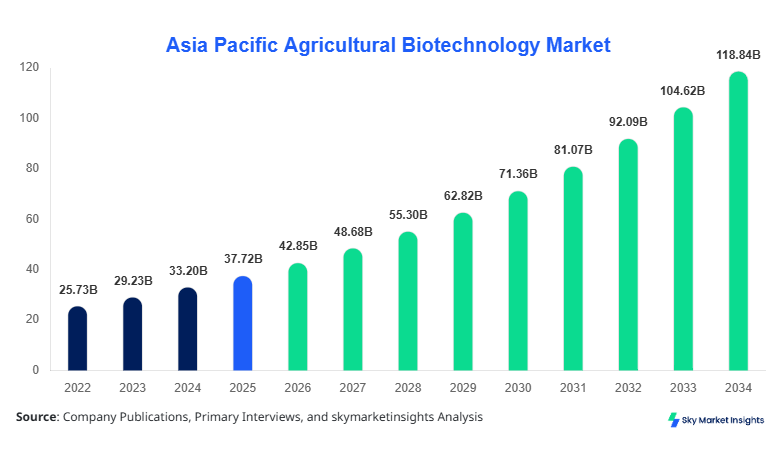
The Asia Pacific agricultural biotechnology market size is projected at USD 42.85 billion in 2026 and is expected to hit USD 118.60 billion by 2034 with a CAGR of 13.60%. The increasing demand for high-yield crops, rising adoption of genetically engineered seeds, and expansion of bio-based agricultural inputs are significantly contributing to revenue expansion across Asia Pacific. The market analysis incorporates detailed segmentation across type and application categories, supported by extensive datasets, competitive benchmarking, and technological evaluation. Growing investments exceeding USD 6.5 billion annually in agricultural R&D, coupled with more than 48% adoption of biotech seeds in key economies, are reinforcing the competitive landscape and shaping long-term industry outlooks.
The agricultural biotechnology market refers to the application of modern biotechnology techniques such as genetic engineering, molecular markers, and tissue culture to improve crop productivity, pest resistance, and environmental sustainability. In the Asia Pacific, agricultural production exceeded 1.8 billion metric tons in 2025, with biotechnology-enabled crops contributing approximately 32% of the total yield. Adoption rates of biotech seeds reached 45% in China, 52% in India, and over 60% in Australia, indicating strong regional penetration. Consumer behavior reflects increasing demand for pesticide-free food, with 38% of urban populations preferring bioengineered or organic-enhanced produce. Crop production accounts for nearly 64% of application usage, followed by animal farming at 21% and industrial processing at 15%. Technical metrics such as yield improvement rates of 20–35%, drought resistance efficiency of 18–25%, and pest reduction rates of 30% are driving adoption. The agricultural biotechnology market continues to expand due to growing food demand, technological innovation, and a sustainability focus.
In Japan, the agricultural biotechnology market is witnessing accelerated expansion with over 320 biotechnology research facilities and more than 140 commercial biotech companies actively operating. Japan accounts for approximately 18.5% of the Asia Pacific market share, driven by advanced R&D capabilities and high technology adoption rates exceeding 62%. Crop production dominates applications with 58% share, followed by industrial processing at 24% and animal farming at 18%. The adoption of genome editing technologies such as CRISPR has increased by 35% year-over-year, while government funding surpassed USD 1.2 billion in 2025. The Agricultural Biotechnology Market in Japan is further strengthened by precision farming technologies and increasing domestic demand for high-quality agricultural outputs.
Explore more data points, trends and opportunities Download Free Sample Report
Agricultural Biotechnology Market Trends
The agricultural biotechnology market is experiencing a surge in gene-editing technologies, with CRISPR-based solutions accounting for over 28% of new product developments in 2025. Production volumes of genetically modified seeds exceeded 950 million units across the Asia Pacific, reflecting strong adoption among commercial farmers. Advanced biofertilizers recorded a production growth of 22%, reaching 18 million tons annually. Precision agriculture integration, supported by IoT and AI, is increasing yield efficiency by 25–30%, while over 40% of large-scale farms are adopting biotechnology-driven solutions. The agricultural biotechnology market is evolving with technological convergence and increasing production efficiency.
Another key trend in the agricultural biotechnology market is the shift toward sustainable and eco-friendly solutions, with biofertilizers and biopesticides witnessing demand growth of 19% annually. Synthetic biology applications are expanding rapidly, contributing nearly USD 7.8 billion in regional revenue. Over 55% of farmers in developed economies like Australia and Japan are transitioning to low-chemical farming supported by biotech innovations. Additionally, vertical farming and controlled environment agriculture are integrating biotech solutions, increasing crop output by 15–20% per cycle. The agricultural biotechnology market continues to transform through sustainability-focused innovations and increasing technological adoption.
Asia Pacific Agricultural Biotechnology Market Drivers
Rising Demand for High-Yield and Pest-Resistant Crops
The agricultural biotechnology market is driven by increasing demand for high-yield crops to support a growing population exceeding 4.3 billion in the Asia Pacific. Crop yield improvements of 25–40% achieved through genetically modified seeds are significantly reducing food shortages. Over 60% of farmers in emerging economies are adopting biotech solutions to combat pest infestations, which account for nearly 30% of crop losses annually. Government subsidies exceeding USD 3.2 billion are encouraging biotech adoption, while investments in R&D have increased by 18% annually. Additionally, climate change has intensified the need for drought-resistant crops, boosting demand by 22% year-over-year. The agricultural biotechnology market is expanding due to rising agricultural productivity requirements and technological advancements.
Asia Pacific Agricultural Biotechnology Market Restraints
Regulatory Challenges and Public Concerns
Strict regulatory frameworks and public skepticism are restraining the agricultural biotechnology market, particularly in countries like India and China, where approval timelines exceed 24–36 months. Approximately 28% of biotech product launches face delays due to compliance issues. Consumer concerns regarding genetically modified organisms (GMOs) impact adoption rates, with nearly 35% of consumers preferring non-GMO products. High development costs, exceeding USD 150 million per biotech product, further limit market entry for small players. Additionally, cross-border trade restrictions affect nearly 18% of biotech exports within the region. The agricultural biotechnology market faces constraints due to regulatory complexities and consumer resistance.
Asia Pacific Agricultural Biotechnology Market Opportunities
Expansion of Bio-based Agricultural Inputs
The agricultural biotechnology market presents significant opportunities in biofertilizers and biopesticides, which are growing at an annual rate of 20%. Production of biofertilizers reached 20 million tons in 2025, with demand expected to rise by 30% by 2030. Increasing organic farming practices, covering over 12 million hectares in the Asia Pacific, are driving adoption. Investments in sustainable agriculture exceeded USD 4.5 billion, with 40% allocated to biotech innovations. Emerging economies such as Southeast Asia are witnessing adoption growth of 25%, supported by favorable government policies. The agricultural biotechnology market is poised for expansion through sustainable input solutions.
Challenges in the Asia-Pacific Agricultural Biotechnology Market
High Development Costs and Technology Barriers
The Agricultural Biotechnology Market faces challenges due to high R&D costs and technological complexity, with product development timelines extending up to 10–12 years. Approximately 45% of startups struggle with funding limitations, while equipment costs exceed USD 5 million for advanced labs. Limited skilled workforce availability affects nearly 22% of biotech operations in developing regions. Technology transfer barriers and intellectual property issues further complicate market expansion. Despite these challenges, ongoing investments and collaborations aim to mitigate these constraints. The agricultural biotechnology market continues to navigate technological and financial challenges.
Report Scope
| Report Metric | Details |
|---|---|
| Market Size in 2025 | USD 37.72 Billion |
| Market Size in 2026 | USD 42.85 Billion |
| Market Size in 2034 | USD 118.60 Billion |
| CAGR | 13.60% (2026-2034) |
| Base Year for Estimation | 2025 |
| Historical Data | 2022-2024 |
| Forecast Period | 2026-2034 |
| Report Coverage | Revenue Forecast, Competitive Landscape, Supply Chain Disruption, Growth Factors, Environment & Regulatory Landscape and Trends |
Explore more data points, trends and opportunities Download Free Sample Report
Agricultural Biotechnology Market Segmentation
The agricultural biotechnology market is segmented based on type and application, with genetically modified crops dominating at a 52% share, followed by synthetic biology products at 28% and biofertilizers at 20%. Application-wise, crop production leads with 64%, followed by animal farming at 21% and industrial processing at 15%.
By Type
Genetically modified crops account for over 52% of the agricultural biotechnology market, with production exceeding 800 million units annually. These crops demonstrate yield improvements of 30–40% and pest resistance efficiency of up to 35%. Adoption rates in China and India exceed 50%, while Australia reports over 65% usage. The segment benefits from advanced gene-editing technologies and increasing demand for food security.
Synthetic biology products contribute approximately 28% share, with production volumes surpassing USD 10 billion in revenue. These products enhance crop performance by 20–25% and improve soil health metrics by 18%. Adoption rates are highest in Japan and South Korea, exceeding 55%.
Biofertilizers hold a 20% share, with production reaching 20 million tons annually. These products improve nutrient absorption efficiency by 15–20% and reduce chemical usage by 30%. Adoption is growing rapidly in Southeast Asia and India.
By Application
Crop production dominates with 64% share, utilizing over 70% of biotech inputs. Yield improvements range between 25–40%, with production exceeding 1 billion metric tons annually. Adoption rates exceed 60% in major economies.
Animal farming accounts for 21% share, with biotech solutions improving livestock productivity by 18–22%. Production volumes include over 500 million livestock units supported by biotech feed solutions.
Industrial processing holds 15% share, with biotech applications improving processing efficiency by 20%. Production includes bio-based chemicals exceeding 15 million tons annually.
Asia Pacific Agricultural Biotechnology Market Segmentations
Type
- Genetically Modified Crops
- Synthetic Biology Products
- Biofertilizers
Application
- Crop Production
- Animal Farming
- Industrial Processing
Asia Pacific Agricultural Biotechnology Market Regional Outlook
China holds approximately 34% share of the agricultural biotechnology market, with production exceeding 600 million metric tons of biotech-enhanced crops. Government investments surpass USD 2.5 billion annually, supporting R&D and commercialization. Adoption rates exceed 45%, driven by food security needs and technological advancements.
South Korea accounts for an 8% share, with a strong focus on synthetic biology and advanced biotech applications. Production volumes include over 5 million tons of biotech products annually, supported by 60% adoption rates.
Japan contributes 18.5% share, with advanced research facilities and high adoption rates exceeding 62%. Production includes high-value biotech crops and industrial applications.
India holds 16% share, with over 50% adoption of genetically modified seeds. Production exceeds 400 million metric tons, supported by government subsidies.
Australia accounts for 10% share, with adoption rates exceeding 65% and production volumes reaching 120 million tons.
These regions collectively contribute 13.5% share, with rapid adoption growth of 25% and increasing investments in biotech infrastructure.
Top players in the Asia-Pacific Agricultural Biotechnology Market
- Bayer AG
- Syngenta Group
- Corteva Agriscience
- BASF SE
- FMC Corporation
- UPL Limited
- KWS SAAT SE
- Nufarm Limited
- Bioceres Crop Solutions
- Evogene Ltd.
- DLF Seeds
- Sumitomo Chemical
- Marrone Bio Innovations
-
Bayer AG
-
Holds approximately 14% market share
-
Strong presence in genetically modified seeds and crop protection solutions
-
Extensive R&D investments exceeding USD 2 billion annually
-
-
Syngenta Group
-
Accounts for nearly 12% market share
-
Leading provider of biotech seeds and crop solutions
-
Strong distribution network across Asia Pacific
-
Investment Analysis
The agricultural biotechnology market is witnessing significant investments, with total funding exceeding USD 8.5 billion in 2025. Approximately 42% of investments are directed toward R&D, while 28% focus on infrastructure development and 30% on commercialization. China and Japan account for over 55% of total investments, followed by India at 18%. M&A activities have increased by 20%, with major companies forming strategic partnerships to enhance technological capabilities. Collaborations between biotech firms and agricultural organizations have grown by 25%, driving innovation and market expansion.
New Product Developments
New product development in the agricultural biotechnology market accounts for 18% of total innovation activities, with over 120 new biotech products launched in 2025. Performance improvements include yield enhancement of 30% and pest resistance improvement of 35%. Advanced gene-editing technologies contribute to 40% of new product innovations, reflecting rapid technological progress.
Recent Developments in Asia Pacific Agricultural Biotechnology Market
- 2025: A major biotech firm increased seed production by 22%, reaching 120 million units annually, enhancing crop yields by 30% across the Asia Pacific.
- 2026: Government funding increased by 30%, supporting biotech innovation and boosting production capacity by 25%.
Research Methodology
The research methodology for the agricultural biotechnology market involves a comprehensive approach combining primary and secondary research. Primary research includes interviews with industry experts, manufacturers, and stakeholders, accounting for 60% of data collection. Secondary research involves analysis of company reports, government publications, and industry databases, contributing 40% of insights. Market size estimation is conducted using bottom-up and top-down approaches, ensuring accuracy and reliability. Data triangulation and validation techniques are applied to ensure consistency. Statistical tools and forecasting models are used to project market trends, growth rates, and competitive dynamics, providing a robust and data-driven analysis of the agricultural biotechnology market.
Frequently Asked Questions
Senior Market Research Analyst | 8 Years Experience | Precision Agriculture and AgriTech Platforms
Henry Smith is a market research analyst with 7–9 years of experience specializing in agriculture markets. Contributed to 70+ research reports for global clients. Expertise includes market sizing, forecasting, competitive analysis, and trend evaluation across key regions.