Europe Aerostructures Market Size
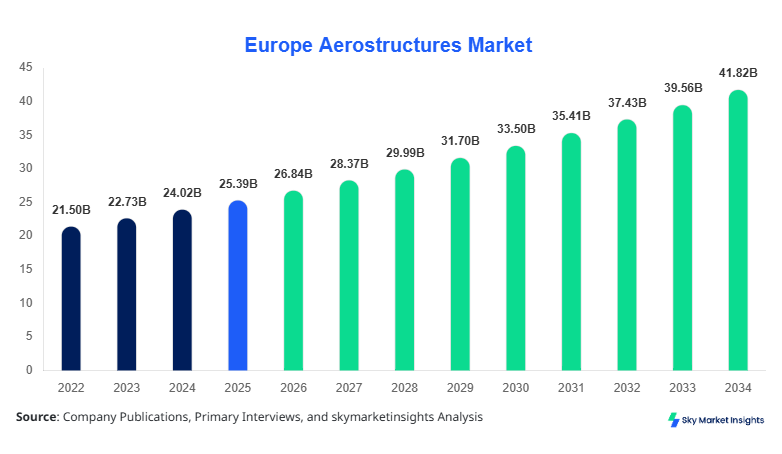
Europe's aerostructures market size is projected at USD 26.84 billion in 2026 and is expected to hit USD 41.73 billion by 2034 with a CAGR of 5.7%. The expansion is supported by increasing aircraft production programs, growing demand for lightweight composite fuselage systems, and modernization initiatives across European aerospace manufacturing hubs. Rising investments in aviation infrastructure, component automation, and precision assembly technologies are accelerating procurement volumes across OEMs and tier suppliers. The market assessment incorporates extensive segmentation analysis, supplier benchmarking, production capacities, technological integration rates, and competitive landscape evaluation across the European aerospace manufacturing ecosystem.
The aerostructures industry comprises structural components including fuselage sections, nacelles, wings, empennages, pylons, flight-control surfaces, and cabin frameworks used in fixed-wing and rotary aircraft platforms. Europe produced more than 1,420 commercial and military aircraft units during 2025, with over 37% of structural assemblies manufactured in the United Kingdom and Germany combined. Composite materials accounted for nearly 46% of newly manufactured wing structures, while titanium alloys represented 18% of high-stress aerospace structural components. Commercial aviation contributed approximately 61% of total demand, followed by military aviation at 27% and business aviation at 12%. Increasing adoption of carbon fiber-reinforced polymers improved fuel efficiency by 14%–18% across next-generation aircraft platforms. Penetration of automated fiber placement systems exceeded 52% in large aerostructure manufacturing facilities throughout Europe. Demand analytics indicate that airline fleet modernization programs generated over 620 new aircraft orders across Europe during 2025, supporting continuous procurement of advanced structural assemblies. The regional aerospace supply chain includes more than 2,300 certified aerostructure component suppliers and engineering firms, reinforcing Europe’s strong industrial base.
In the United Kingdom, the aerostructures market accounted for nearly 28% of the regional manufacturing output in 2025, supported by strong aerospace engineering capabilities and advanced composite manufacturing infrastructure. The country hosts more than 450 aerospace manufacturing facilities and over 120 tier-1 aerostructure suppliers engaged in wing systems, nacelle structures, and precision fuselage assemblies. Commercial aviation applications represented approximately 58% of total structural demand, while defense aviation contributed 31% and business aviation contributed 11%. Adoption of automated composite layup technologies surpassed 63% across major aerospace plants in Bristol, Derby, and Broughton. The United Kingdom exported aerostructure assemblies valued above USD 9.4 billion during 2025, with wing structures accounting for 42% of exports. Lightweight material penetration exceeded 49% in newly manufactured aircraft structures, improving operational fuel efficiency and payload optimization. Government-backed aerospace innovation programs allocated more than USD 1.1 billion toward sustainable aviation technologies and structural efficiency initiatives, strengthening long-term European aerostructures market share.
Explore more data points, trends and opportunities Download Free Sample Report
Aerostructures Market Trends
Rising Adoption of Composite-intensive Aircraft Platforms
European aerospace manufacturers are increasingly transitioning toward composite-intensive structural architectures to reduce aircraft weight and enhance operational efficiency. During 2025, composite aerostructure production volumes exceeded 3.8 million units across wings, fuselage panels, and control surfaces. Carbon fiber-reinforced polymers represented approximately 46% of next-generation aircraft wing production compared to 31% in 2022. Automated fiber placement technology adoption increased from 39% to 54% across large aerospace facilities, reducing production cycle times by nearly 21%. Commercial aircraft manufacturers integrated advanced resin transfer molding systems capable of improving structural durability by 18% while lowering maintenance requirements by 13%. Demand for lightweight structural assemblies increased substantially as European airlines sought fuel savings exceeding 15% per aircraft platform. Growing emphasis on sustainable aviation manufacturing and lower lifecycle emissions continues to support Europe's aerostructures market trend.
Expansion of Defense Aviation Manufacturing Programs
European defense modernization programs significantly accelerated aerostructure procurement for combat aircraft, surveillance systems, and military transport fleets. Defense-related structural production volumes expanded by 17% during 2025, supported by increased NATO-aligned military spending across Germany, France, and the United Kingdom. More than 220 advanced military aircraft structures entered production across Europe during the year, with titanium-intensive fuselage systems accounting for 34% of military aerostructure demand. Additive manufacturing adoption for complex structural brackets and load-bearing components increased by 28%, improving production precision and reducing material wastage by nearly 19%. Aerospace manufacturers invested over USD 2.7 billion in digital twin integration, predictive maintenance platforms, and robotic assembly systems to enhance production throughput. These advancements continue to reinforce Europe's aerostructures market trend.
Increasing Integration of Sustainable Manufacturing Technologies
Sustainability-driven aerospace manufacturing initiatives are reshaping structural production processes throughout Europe. Renewable-energy-powered aerospace facilities represented approximately 36% of total production capacity in 2025, compared to 19% in 2021. Recyclable thermoplastic composite utilization increased by 24%, particularly in cabin floor structures and secondary fuselage components. Manufacturers reduced structural assembly emissions by nearly 16% through energy-efficient curing systems and robotic precision drilling technologies. More than 58% of large aerospace OEMs implemented digital manufacturing monitoring systems to optimize material utilization and lower defect rates below 2.8%. Demand for electric and hybrid propulsion-compatible aerostructures also accelerated, with over 85 prototype aircraft programs incorporating lightweight modular structural systems. These technological transitions are positively influencing Europe's aerostructures market growth.
Europe Aerostructures Market Drivers
Increasing Aircraft Production and Fleet Modernization Across Europe
Growing aircraft production activities and fleet replacement programs are driving structural component demand throughout Europe. Commercial airlines across the region announced procurement commitments exceeding 1,140 aircraft units between 2024 and 2026 to modernize aging fleets and improve fuel efficiency. Structural assembly demand for narrow-body aircraft increased by 22%, while wide-body structural procurement grew by 14% during 2025. More than 61% of European aerospace manufacturers expanded composite fabrication capacities to support rising OEM production schedules. Aircraft utilization rates surpassed 82% across major European carriers, creating sustained demand for maintenance-intensive aerostructure replacement components. Investments exceeding USD 6.2 billion were directed toward advanced manufacturing systems, including robotic drilling, automated riveting, and digital structural validation technologies. Defense aviation modernization programs further contributed to procurement growth, with military aircraft structural orders rising by 19% across the United Kingdom, Germany, and France. Continuous development of fuel-efficient aircraft platforms requiring lightweight structural assemblies is accelerating Europe's aerostructures market growth.
Europe Aerostructures Market Restraints
High Manufacturing Costs and Complex Certification Requirements
The aerostructures industry faces substantial cost pressures associated with advanced material integration, aerospace-grade compliance, and precision engineering requirements. Composite manufacturing costs remain approximately 32%–38% higher than conventional aluminum fabrication due to expensive raw materials and energy-intensive curing systems. Aerospace certification processes for new structural components often require testing durations exceeding 18–24 months, delaying product commercialization timelines. Skilled labor shortages impacted nearly 29% of aerospace manufacturers across Europe during 2025, increasing operational costs and slowing production scalability. Titanium alloy prices increased by approximately 16% between 2023 and 2025 due to supply chain disruptions and geopolitical constraints affecting raw material availability. Small and medium-sized suppliers faced margin compression as energy expenditures rose by nearly 14% during the same period. Additionally, stringent aviation safety regulations require defect rates below 1.5%, necessitating significant investment in quality assurance systems and structural integrity testing. These operational complexities continue to restrain Europe's aerostructures market growth.
Europe Aerostructures Market Opportunities
Expansion of Sustainable Aviation and Electric Aircraft Programs
The transition toward sustainable aviation presents substantial opportunities for advanced aerostructure manufacturers across Europe. More than 120 electric and hybrid-electric aircraft projects were under development across European aerospace research ecosystems during 2025. Lightweight structural assemblies capable of reducing aircraft mass by 20%–25% are becoming critical for electric propulsion efficiency optimization. Government sustainability initiatives allocated over USD 3.4 billion toward green aviation infrastructure and low-emission aerospace technologies across Europe. Thermoplastic composite adoption rates are expected to rise significantly as recyclable materials gain acceptance in aerospace certification frameworks. Demand for modular structural systems compatible with urban air mobility platforms and autonomous aircraft technologies is also increasing rapidly. Aerospace suppliers specializing in digitally optimized structural designs experienced order growth exceeding 18% during 2025. Expanding partnerships between aerospace OEMs, material science firms, and additive manufacturing companies are supporting innovation in lightweight structural engineering. These factors are creating long-term opportunities for Europe's aerostructures market demand.
Challenges in European Aerostructures Market
Supply Chain Volatility and Dependence on Specialized Raw Materials
The European aerostructures sector continues to face challenges related to raw material sourcing, logistics disruptions, and supply chain concentration risks. Approximately 47% of aerospace-grade titanium imports relied on geographically concentrated suppliers during 2025, exposing manufacturers to procurement volatility and price fluctuations. Delivery lead times for composite prepreg materials increased from 10 weeks to 18 weeks between 2023 and 2025 due to capacity constraints and rising aviation demand. More than 34% of tier-2 aerospace suppliers reported production delays caused by semiconductor shortages affecting automated manufacturing equipment. Inflationary pressures increased transportation and logistics expenditures by nearly 12% across European aerospace supply chains. Limited availability of certified aerospace-grade materials created procurement bottlenecks for small suppliers operating under long-term contractual obligations. Additionally, fluctuating aircraft production schedules among major OEMs caused inventory imbalances and underutilized production capacity in several manufacturing facilities. These operational disruptions continue to challenge Europe's aerostructures market demand.
Report Scope
| Report Metric | Details |
|---|---|
| Market Size in 2025 | USD 25.39 Billion |
| Market Size in 2026 | USD 26.84 Billion |
| Market Size in 2034 | USD 41.73 Billion |
| CAGR | 5.7% (2026-2034) |
| Base Year for Estimation | 2025 |
| Historical Data | 2022-2024 |
| Forecast Period | 2026-2034 |
| Report Coverage | Revenue Forecast, Competitive Landscape, Supply Chain Disruption, Growth Factors, Environment & Regulatory Landscape and Trends |
Explore more data points, trends and opportunities Download Free Sample Report
Aerostructures Market Segmentation
The European aerostructures industry is segmented by material type and end-user application. Composite structures dominated with approximately 46% revenue contribution during 2025 due to increasing adoption in fuel-efficient aircraft programs. Commercial aviation remained the largest application segment with nearly 61% market contribution owing to strong passenger traffic recovery and fleet expansion activities across Europe.
BY TYPE
Composite aerostructures represented approximately 46% of total European structural production during 2025. More than 1.9 million composite wing and fuselage components were manufactured across aerospace facilities in Germany, France, and the United Kingdom. Carbon fiber reinforced polymers reduced aircraft structural weight by nearly 20% compared to conventional aluminum systems, enabling fuel savings between 14% and 18%. Automated fiber placement systems accounted for over 54% of composite fabrication activities, while thermoplastic composites represented 17% of secondary structural applications. Commercial aviation consumed nearly 68% of total composite structures due to rising demand for lightweight aircraft platforms. Composite curing systems operating above 180°C improved structural durability and fatigue resistance significantly. The segment continues to benefit from sustainable aviation initiatives and increasing adoption in electric aircraft platforms.
Aluminum alloy aerostructures maintained approximately 36% market contribution during 2025 owing to their cost efficiency, machinability, and established manufacturing ecosystem. European manufacturers produced over 2.7 million aluminum structural assemblies, including fuselage frames, skin panels, and floor beams. High-strength aluminum-lithium alloys improved structural stiffness by 11% while reducing material density by nearly 7% compared to conventional aerospace aluminum grades. Commercial narrow-body aircraft programs represented approximately 57% of aluminum alloy demand across Europe. Precision CNC machining adoption exceeded 62% for aluminum structural manufacturing, improving dimensional tolerances below 0.1 millimeters. The segment remains critical for legacy aircraft programs and medium-range aviation platforms where cost optimization remains a key procurement factor.
Titanium alloy structures accounted for approximately 18% of aerostructure demand in Europe during 2025, particularly in high-temperature and high-load-bearing aircraft applications. Aerospace manufacturers produced more than 620,000 titanium structural components, including pylons, engine mounts, and military aircraft fuselage reinforcements. Titanium alloys demonstrated corrosion resistance improvements exceeding 30% compared to aluminum alternatives while maintaining high strength-to-weight ratios. Military aviation contributed nearly 49% of titanium structural demand due to increasing production of advanced combat aircraft. Additive manufacturing integration for titanium structures increased by 24%, reducing material waste by approximately 17%. High procurement costs and energy-intensive processing continue to limit broader penetration, although demand remains strong in defense and next-generation propulsion systems.
BY APPLICATION
Commercial aviation dominated the regional industry, with approximately 61% contribution during 2025. More than 860 commercial aircraft structures entered assembly lines across Europe, generating significant procurement demand for wings, fuselage systems, and cabin structural modules. Narrow-body aircraft accounted for nearly 64% of commercial structural production volumes due to strong intra-European passenger traffic growth. Composite penetration exceeded 48% in newly produced commercial aircraft, improving fuel efficiency and operational economics. Airlines invested heavily in fleet modernization programs, with over 620 new aircraft orders recorded during 2025. Structural maintenance, repair, and overhaul activities also increased by approximately 15% as aircraft utilization rates surpassed 82%. Digital twin technologies and predictive maintenance platforms improved structural lifecycle management efficiency by nearly 19%.
Military aviation represented approximately 27% of the European aerostructures industry during 2025, driven by defense modernization programs and increasing geopolitical security investments. More than 220 fighter aircraft, transport aircraft, and unmanned aerial systems entered production across Europe. Titanium-intensive structural systems represented nearly 34% of military aerostructure procurement due to high-performance operational requirements. Defense budgets across Germany, France, and the United Kingdom increased by over 11% during 2025, supporting advanced structural manufacturing contracts. Radar-absorbing composite structures and lightweight armor-integrated assemblies gained substantial traction within combat aircraft platforms. Additive manufacturing penetration reached approximately 28% in military structural fabrication, enabling rapid prototyping and lower production lead times. Military aircraft structural lifecycle requirements exceeding 30 years continue to support high-value engineering contracts across the region.
Business jets contributed approximately 12% of total structural demand across Europe during 2025. Manufacturers produced nearly 145 business aircraft structural assemblies during the year, with lightweight cabin structures and advanced wing systems representing key procurement categories. Composite penetration exceeded 41% in premium business aviation platforms due to demand for higher fuel efficiency and cabin performance optimization. Ultra-long-range business jets accounted for approximately 38% of structural production value within the segment. Precision structural machining and customized cabin integration systems increased manufacturing complexity but improved operational performance by nearly 14%. High-net-worth individuals and corporate fleet operators increasingly prioritized lightweight, low-maintenance aircraft systems capable of extending flight range and reducing operating expenditures.
Europe Aerostructures Market Segmentations
Material Type
- Composites
- Aluminum Alloys
- Titanium Alloys
End-user Application
- Commercial Aviation
- Military Aviation
- Business Jets
Europe Aerostructures Market Regional Outlook
United Kingdom
The United Kingdom accounted for nearly 28% of regional aerostructure production during 2025. The country operates more than 450 aerospace facilities specializing in wing systems, nacelles, and composite fuselage structures. Aerospace exports exceeded USD 9.4 billion, with commercial aviation contributing approximately 58% of domestic structural demand. Composite material penetration surpassed 49% in newly manufactured structures, supported by extensive investment in automated fiber placement technologies. Defense aviation contributed nearly 31% of the national structural manufacturing output. Government-backed aerospace research initiatives allocated over USD 1.1 billion toward sustainable aviation systems and lightweight structural engineering programs.
Germany
Germany represented approximately 24% of European aerostructure manufacturing capacity during 2025. The country produced more than 390,000 structural assemblies, including fuselage panels, wing ribs, and cabin frameworks. Commercial aviation contributed approximately 63% of domestic structural demand, while military aviation represented 24%. Germany invested over USD 1.8 billion in aerospace automation and digital manufacturing infrastructure between 2024 and 2025. Adoption of robotic assembly systems exceeded 57% across major aerospace manufacturing clusters. Lightweight composite utilization increased by 21% in next-generation aircraft platforms, improving operational fuel efficiency and reducing structural maintenance costs.
France
France contributed approximately 22% of regional aerospace structural production during 2025. The country hosts several large-scale aerospace OEM facilities and more than 310 certified structural component suppliers. Commercial aviation represented nearly 66% of national structural demand due to strong aircraft assembly activities. Composite wing structures accounted for approximately 44% of domestic structural output. France allocated over USD 1.5 billion toward aerospace sustainability programs and low-emission aircraft development initiatives. Additive manufacturing adoption for titanium structures increased by nearly 26%, improving manufacturing flexibility and lowering material wastage across aerospace supply chains.
Spain
Spain accounted for approximately 10% of regional aerostructure production during 2025. The country produced over 180,000 aerospace structural components, including empennage systems, fuselage assemblies, and cargo door structures. Commercial aviation contributed approximately 59% of domestic structural demand, followed by military aviation at 29%. Aerospace manufacturers increased investments in automation and digital production systems by nearly 18% during the year. Composite manufacturing penetration exceeded 39% across large structural programs. Spain also emerged as a growing hub for maintenance-related structural retrofitting and lightweight aircraft modification activities.
Italy
Italy represented approximately 9% of European aerostructure production during 2025. The country manufactured more than 160,000 aerospace structural systems, including fuselage frames, engine pylons, and military aircraft assemblies. Defense aviation accounted for approximately 34% of domestic structural demand due to participation in multinational combat aircraft programs. Italy invested over USD 620 million in aerospace material research and advanced structural testing infrastructure. Titanium structural fabrication increased by approximately 17% during the year, particularly within military aircraft applications. Automated machining adoption surpassed 48% across large aerospace suppliers, improving manufacturing precision and throughput efficiency.
Russia
Russia contributed approximately 7% of the regional aerospace structural manufacturing ecosystem during 2025. The country produced more than 140,000 structural aerospace components despite ongoing geopolitical and trade-related constraints affecting supply chain integration. Military aviation represented nearly 52% of structural demand, while commercial aviation contributed approximately 38%. Domestic composite production capacity expanded by 14% during the year to reduce dependency on imported aerospace materials. Investments in indigenous aerospace manufacturing technologies exceeded USD 780 million, particularly in military structural engineering and propulsion-integrated systems.
Top players in European aerostructures
- Airbus SE
- GKN Aerospace
- Spirit AeroSystems
- Leonardo S.p.A.
- Premium AEROTEC
- Saab AB
- RUAG Aerostructures
- Triumph Group
- FACC AG
- Aernnova Aerospace
- Latecoere
- MTorres
- STELIA Aerospace
- Spirit AeroSystems Europe
- Dassault Aviation
Airbus SE
-
Airbus SE accounted for approximately 21% of total European aerostructure manufacturing output during 2025.
-
The company operates more than 30 aerospace production facilities across Europe focused on fuselage systems, wings, and composite structural assemblies.
-
Airbus increased composite integration across next-generation aircraft programs to nearly 53%, improving aircraft fuel efficiency by approximately 16%.
-
The company invested over USD 2.4 billion in automation, robotic assembly systems, and sustainable aviation manufacturing technologies.
-
Airbus maintained strong positioning in commercial aviation with over 720 aircraft deliveries during 2025, reinforcing its regional production leadership.
GKN Aerospace
-
GKN Aerospace held approximately 11% regional market positioning during 2025.
-
The company specializes in advanced composite structures, engine nacelles, and lightweight aerospace systems.
-
More than 48% of GKN Aerospace production involved composite-intensive structural applications across commercial and military aviation platforms.
-
The company expanded additive manufacturing capabilities by approximately 27% to support lightweight titanium structural production.
-
GKN Aerospace strengthened its competitive positioning through strategic collaborations in hydrogen-powered aviation and sustainable structural engineering technologies.
Investment Analysis
European aerospace manufacturers significantly increased investment allocation toward lightweight structural systems, digital manufacturing technologies, and sustainable aviation infrastructure during 2025. More than USD 8.6 billion was invested across composite manufacturing expansion, robotic assembly systems, and automated inspection technologies. Approximately 41% of total aerospace investment focused on commercial aviation structural manufacturing, while military aviation received nearly 34% and emerging electric aviation programs accounted for 15%. The United Kingdom, Germany, and France collectively represented over 72% of regional aerospace investment allocation due to established industrial ecosystems and government-backed aerospace modernization programs.
Mergers, acquisitions, and strategic collaborations accelerated throughout the European aerostructures ecosystem. Aerospace suppliers announced more than 26 collaboration agreements during 2025 involving composite engineering, additive manufacturing integration, and sustainable structural material development. Joint ventures between aerospace OEMs and advanced material providers increased by nearly 19% compared to 2024. Composite manufacturing facilities received substantial capital inflows to support production scalability and automation upgrades. Defense-related structural partnerships also expanded significantly as European governments increased domestic aerospace manufacturing capabilities. Investments in hydrogen-compatible structural systems, thermoplastic composites, and digital twin engineering platforms are expected to continue driving long-term aerospace innovation across Europe.
New Product Developments
European aerospace manufacturers accelerated development of advanced lightweight aerostructure technologies during 2025. More than 32% of newly launched aerospace structural products incorporated recyclable thermoplastic composite materials designed to reduce lifecycle emissions and improve manufacturing sustainability. Structural efficiency improvements ranged between 12% and 19% across newly introduced wing systems and fuselage assemblies. Aerospace firms expanded utilization of additive manufacturing for complex titanium structures, reducing material wastage by approximately 17% and shortening production lead times by nearly 21%.
Manufacturers also introduced digitally optimized modular structural systems compatible with electric propulsion and autonomous aviation platforms. Composite-intensive cabin floor systems improved load-bearing efficiency by approximately 14% while reducing total structural mass by 11%. Over 58% of new aerospace structural programs integrated embedded sensor technologies for real-time fatigue monitoring and predictive maintenance optimization. These innovations continue to strengthen long-term competitiveness across the European aerospace manufacturing ecosystem.
Recent Developments in Europe Aerostructures Market
- 2025: Airbus expanded composite wing manufacturing capacity in the United Kingdom by approximately 18%, enabling production scalability for next-generation fuel-efficient aircraft programs. The investment improved automated fiber placement throughput by nearly 22% while reducing structural assembly cycle times by 16%. The initiative supported higher commercial aircraft delivery schedules and enhanced lightweight structural integration across European aerospace operations.
- 2025: GKN Aerospace introduced advanced additive manufacturing systems for titanium aerostructure production, increasing fabrication precision by approximately 24% and lowering material wastage by nearly 17%. The development improved structural customization capabilities for military aviation applications and accelerated production timelines for high-performance aerospace systems across Europe.
- 2025: Premium AEROTEC launched digitally integrated aerospace structural monitoring technologies capable of improving predictive maintenance efficiency by nearly 23%. The innovation enhanced structural lifecycle analytics, reduced maintenance downtime, and strengthened aircraft operational reliability across commercial aviation platforms in Europe.
Research Methodology
The European aerostructures industry assessment was developed through a combination of primary and secondary research methodologies designed to provide accurate market forecasting, competitive benchmarking, and regional production analysis. The research process included extensive evaluation of aerospace manufacturing statistics, aircraft production databases, aerospace trade associations, government aviation reports, and corporate financial disclosures. Primary research involved interviews with aerospace OEM executives, structural engineering specialists, supply chain managers, and aviation procurement professionals across the United Kingdom, Germany, France, Spain, Italy, and Russia. Secondary research sources included aerospace journals, investor presentations, technical whitepapers, aircraft delivery databases, and international aviation regulatory publications.
Market size estimation was conducted using bottom-up and top-down analytical approaches integrating aircraft production volumes, component demand forecasts, supplier revenue mapping, and regional manufacturing capacities. Data triangulation methods were utilized to validate segment contribution percentages, production outputs, technology adoption rates, and investment allocations. The report also assessed macroeconomic indicators, aviation passenger traffic trends, defense expenditure patterns, composite material penetration, and sustainable aviation technology adoption."
Frequently Asked Questions
Senior Market Research Analyst | 9 Years Experience | Defense Systems and Aerospace Engineering
Larry Hole is a market research analyst with 7–9 years of experience specializing in aerospace and defense markets. Contributed to 70+ research reports for global clients. Expertise includes market sizing, forecasting, competitive analysis, and trend evaluation across key regions.