Europe Aerospace Wire Harness Market Size
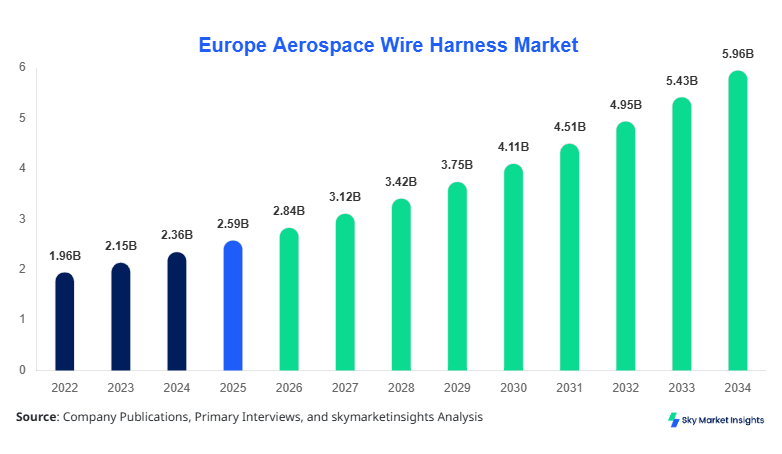
The European aerospace wire harness market size is projected at USD 2.84 billion in 2026 and is expected to hit USD 5.97 billion by 2034 with a CAGR of 9.7%.
The increasing electrification of aircraft systems, rising aircraft deliveries, and modernization of avionics platforms are accelerating the expansion of the European aerospace wire harness industry across commercial aviation, military aviation, and spacecraft manufacturing. The market evaluation includes detailed analysis of product categories, application adoption, production capacity, technology penetration, supply chain mapping, and competitive benchmarking across leading aerospace manufacturing economies. More than 68% of the regional demand originates from commercial aircraft integration programs, while defense aviation contributes nearly 24% of overall consumption volume in 2026.
The European Aerospace Wire Harness industry represents a critical component segment within aircraft electrical architecture systems. Aerospace wire harnesses are integrated bundles of electrical cables, fiber optics, signal connectors, and shielding materials used to transmit power, signals, and communication data throughout aircraft systems. In Europe, more than 4.2 million wire harness assemblies were manufactured during 2025 for aerospace applications, with Germany, France, and the United Kingdom accounting for over 71% of regional production output. Adoption of lightweight aluminum conductors and high-temperature fluoropolymer insulation has increased by 37% since 2022 owing to fuel efficiency targets and thermal resistance requirements above 200°C in advanced propulsion systems.
Commercial aviation applications contributed approximately 58% of overall installation demand in 2025, while military aircraft applications represented 27%, and spacecraft integration accounted for nearly 15%. More than 62% of next-generation aircraft programs across Europe are utilizing modular wire harness systems integrated with high-speed Ethernet connectivity exceeding 10 Gbps transmission rates. Passenger aircraft electrification has increased average harness length per aircraft from 120 km to nearly 180 km in wide-body configurations. Aerospace OEMs are also witnessing a 31% increase in demand for EMI-shielded cable assemblies for autonomous avionics systems and advanced radar platforms. Rising maintenance, repair, and retrofit cycles across aging aircraft fleets are further strengthening aerospace wire harness market demand across Europe.
Explore more data points, trends and opportunities Download Free Sample Report
Aerospace Wire Harness Market Trends
Rising Electrification and Lightweight Integration
The rapid electrification of aircraft systems is becoming one of the strongest trends influencing aerospace wire harness manufacturing across Europe. More than 48% of newly designed aircraft platforms in 2025 incorporated advanced electrical architectures replacing hydraulic and pneumatic systems. Aircraft manufacturers are increasingly integrating lightweight aluminum and composite conductor technologies, reducing total harness weight by nearly 18% per aircraft. Production of lightweight aerospace harness systems exceeded 1.9 million units across Europe in 2025, compared to 1.2 million units in 2022. Demand for high-voltage harness systems supporting electric propulsion platforms has also increased by 36% year-over-year. Aerospace OEMs are now utilizing high-temperature insulation materials capable of operating beyond 250°C for engine proximity applications and high-altitude systems. The integration of fiber-optic data harnesses supporting low-latency communications in advanced cockpit systems is also expanding rapidly across military and commercial aviation programs, reinforcing the aerospace wire harness market trend.
Increasing Demand for High-Speed Data Connectivity
The adoption of advanced avionics and digital aircraft management systems has significantly increased demand for high-speed aerospace wire harness solutions across Europe. More than 71% of next-generation aircraft deliveries scheduled between 2026 and 2030 are expected to integrate Ethernet-based data harnesses capable of transmission rates above 10–40 Gbps. European aerospace manufacturers produced nearly 620,000 advanced data harness assemblies in 2025, representing an increase of 33% compared to 2023. Shielded RF harness installations for radar systems and satellite communication platforms increased by 28% during the same period. Defense aviation programs across France, Germany, and the United Kingdom are accelerating deployment of autonomous surveillance systems and electronic warfare platforms requiring high-density connectivity solutions. Additionally, predictive maintenance integration using smart sensor networks has increased wire harness complexity by nearly 22% per aircraft platform. These developments continue strengthening the aerospace wire harness market trend across Europe.
Expansion of Spacecraft and Satellite Programs
Europe’s expanding satellite manufacturing ecosystem is creating substantial opportunities for aerospace harness suppliers. More than 1,450 satellite subsystems were manufactured in Europe during 2025, generating demand for radiation-resistant harness assemblies and low-weight signal distribution systems. Spacecraft applications accounted for nearly 15% of regional aerospace harness demand in 2025 and are projected to expand steadily due to rising investments in Earth observation, communication satellites, and deep-space exploration missions. Fiber-optic harness adoption in spacecraft systems increased by 44% between 2022 and 2025 due to lower electromagnetic interference and enhanced signal reliability. Companies are also introducing miniaturized connector systems, reducing assembly space requirements by nearly 21%. The increasing launch frequency of low-earth-orbit satellites and reusable launch systems continues to accelerate aerospace wire harness market demand across European aerospace supply chains.
Europe Aerospace Wire Harness Drivers
“Increasing Aircraft Production and Fleet Modernization Programs”
Europe’s aircraft production ecosystem is witnessing substantial expansion due to rising passenger traffic, fleet modernization initiatives, and defense procurement activities. Airbus delivered more than 760 commercial aircraft units during 2025, while regional military aviation programs commissioned over 180 advanced fighter and transport aircraft. Every commercial narrow-body aircraft contains approximately 110–140 km of wiring systems, while wide-body aircraft may exceed 220 km of harness integration. The transition toward connected aircraft systems and fly-by-wire technologies has increased aerospace harness complexity by nearly 26% since 2022. More than 59% of European airlines initiated retrofit projects involving advanced cabin connectivity, inflight entertainment systems, and predictive maintenance infrastructure during 2025. Defense modernization initiatives across Germany, France, and Italy allocated nearly USD 4.1 billion toward avionics and electrical subsystem upgrades. Rising investments in electric aircraft platforms and hybrid propulsion technologies are further increasing demand for high-voltage aerospace harness solutions operating beyond 800V systems. These factors collectively continue driving aerospace wire harness market growth across Europe.
Europe Aerospace Wire Harness Restraints
“High Raw Material Costs and Complex Certification Requirements”
The aerospace wire harness industry faces considerable operational constraints associated with fluctuating raw material prices, lengthy certification cycles, and stringent aerospace safety standards. Copper prices increased by approximately 17% during 2025, while aerospace-grade fluoropolymer insulation material costs rose by 13%. Nearly 42% of manufacturers reported margin pressure due to elevated procurement expenses and logistics disruptions across European aerospace supply chains. Aerospace harness certification processes may require testing periods extending beyond 12–18 months, particularly for high-voltage and space-grade applications. Compliance with AS9100, EN9100, and MIL-SPEC standards adds substantial manufacturing complexity and increases operational costs by nearly 21%. Additionally, labor shortages within precision aerospace assembly operations impacted nearly 31% of suppliers during 2025. Small and medium-sized component manufacturers also face challenges in scaling automation due to high capital expenditure requirements exceeding USD 20 million for advanced robotic harness assembly lines. These limitations continue restraining aerospace wire harness market growth.
Europe Aerospace Wire Harness Opportunities
“Expansion of Electric Aviation and Autonomous Aircraft Systems”
The emergence of electric aviation, autonomous aerial platforms, and advanced air mobility systems is creating substantial opportunities across Europe’s aerospace wire harness ecosystem. More than 140 electric aircraft prototypes were under development across Europe during 2025, with over 38% integrating high-voltage electrical architectures exceeding 600V. Urban air mobility systems require nearly 22% more electrical connectivity components compared to conventional rotorcraft due to distributed propulsion systems and autonomous navigation modules. Investments in hydrogen-powered aircraft programs surpassed USD 2.3 billion across Europe between 2023 and 2025, generating additional demand for thermal-resistant harness technologies and intelligent power distribution systems. Autonomous drone production for defense and logistics applications increased by 34% year-over-year, while smart avionics integration expanded by 29%. Suppliers are increasingly developing AI-enabled harness diagnostic systems capable of reducing maintenance downtime by nearly 18%. The growing transition toward connected, electrified, and autonomous aviation platforms presents major aerospace wire harness market opportunities.
Challenges in the European Aerospace Wire Harness Market
“Supply Chain Disruptions and Manufacturing Complexity”
Manufacturing aerospace wire Harness involves highly specialized processes requiring precision assembly, advanced shielding integration, and rigorous testing procedures. More than 63% of aerospace harness manufacturers across Europe reported supply chain disruptions affecting connector availability, specialty insulation materials, and semiconductor-linked avionics interfaces during 2025. Production lead times increased from 14 weeks in 2022 to nearly 22 weeks in 2025 for complex military-grade harness systems. The average aircraft wire harness contains over 25,000 individual connection points, significantly increasing assembly complexity and quality assurance requirements. Additionally, defect tolerance levels below 0.001% are mandated for mission-critical aerospace systems, increasing inspection costs by nearly 19%. Labor-intensive manual assembly processes continue to dominate approximately 54% of production operations despite automation advancements. Furthermore, cybersecurity requirements associated with connected aircraft systems are adding new compliance burdens for manufacturers integrating digital diagnostics and smart connectivity modules. These operational challenges continue impacting aerospace wire harness market performance across Europe.
Report Scope
| Report Metric | Details |
|---|---|
| Market Size in 2025 | USD 2.59 Billion |
| Market Size in 2026 | USD 2.84 Billion |
| Market Size in 2034 | USD 5.97 Billion |
| CAGR | 9.7% (2026-2034) |
| Base Year for Estimation | 2025 |
| Historical Data | 2022-2024 |
| Forecast Period | 2026-2034 |
| Report Coverage | Revenue Forecast, Competitive Landscape, Supply Chain Disruption, Growth Factors, Environment & Regulatory Landscape and Trends |
Explore more data points, trends and opportunities Download Free Sample Report
Aerospace Wire Harness Market Segmentation
The European aerospace wire harness ecosystem is segmented by type and application, with power harness systems accounting for approximately 43% of total market demand in 2025 due to rising electrification initiatives across aviation platforms. Commercial aircraft applications dominate nearly 58% of overall consumption, followed by military aviation and spacecraft systems. Increasing adoption of lightweight conductors, high-speed data transmission systems, and EMI-shielded architectures continues influencing segment expansion across the regional aerospace manufacturing landscape.
BY TYPE
Power harness systems represented nearly 43% of Europe’s aerospace harness installations during 2025, driven by increasing electrification of aircraft propulsion, cabin systems, and avionics infrastructure. More than 1.8 million power harness units were manufactured across Europe during the year, supporting voltage capacities ranging between 28V and 800V for commercial and defense applications. Modern wide-body aircraft now require over 90 km of dedicated power wiring systems, integrating thermal-resistant insulation materials capable of operating beyond 250°C. Demand for lightweight aluminum conductor systems increased by approximately 39% between 2022 and 2025 due to fuel efficiency objectives. Hybrid-electric aircraft prototypes across Germany and France are further accelerating high-voltage harness adoption. These systems also integrate advanced shielding mechanisms, reducing electromagnetic interference by nearly 27%, ensuring compatibility with next-generation avionics systems.
Data harness systems accounted for approximately 34% of overall installations in 2025 due to rapid growth in digital cockpit technologies and aircraft connectivity infrastructure. Europe produced nearly 620,000 high-speed aerospace data harness assemblies during the year, supporting Ethernet transmission rates above 40 Gbps in advanced aviation platforms. Fiber-optic harness integration increased by 44% since 2022 owing to reduced signal loss and lower electromagnetic interference. Commercial aircraft applications contributed over 61% of data harness demand, while military surveillance systems accounted for 24%. These harnesses support predictive maintenance, inflight entertainment, navigation control, and autonomous flight systems. Increasing implementation of AI-enabled avionics and connected aircraft architectures continues accelerating production of advanced aerospace data harness systems across Europe.
RF harness systems represented nearly 23% of total market installations in 2025, primarily driven by military radar, satellite communication, and electronic warfare applications. More than 410,000 RF harness assemblies were manufactured across Europe during the year, supporting frequencies exceeding 18 GHz for advanced aerospace communication platforms. Defense aviation applications contributed approximately 56% of RF harness demand, while spacecraft integration accounted for nearly 28%. Advanced shielding materials capable of reducing signal attenuation by 31% are increasingly being integrated into high-performance RF assemblies. The growth of unmanned aerial systems and secure military communication networks is also increasing demand for compact, lightweight RF harness solutions with enhanced vibration resistance and thermal stability.
BY APPLICATION
Commercial aircraft applications dominated approximately 58% of Europe’s aerospace harness demand in 2025 due to rising aircraft deliveries and retrofit modernization activities. More than 2.4 million aerospace harness assemblies were integrated into narrow-body, wide-body, and regional aircraft platforms during the year. A modern narrow-body aircraft contains nearly 120 km of wiring systems, while next-generation wide-body aircraft may exceed 220 km of integrated harness infrastructure. Passenger connectivity systems, inflight entertainment platforms, and fly-by-wire avionics significantly increased data harness demand across commercial aviation. Approximately 68% of newly delivered aircraft across Europe incorporated lightweight electrical distribution systems, reducing overall aircraft weight by nearly 15%. Increasing airline investments in predictive maintenance and digital cabin systems continue strengthening aerospace harness consumption across commercial aviation.
Military aircraft applications represented approximately 27% of total market demand in 2025 due to defense modernization programs across Germany, France, Italy, and the United Kingdom. More than 760,000 aerospace harness systems were deployed across fighter aircraft, transport platforms, helicopters, and unmanned aerial systems during the year. Advanced military aircraft require extensive RF and data harness integration supporting radar systems, electronic warfare modules, autonomous navigation systems, and secure communication platforms. High-temperature and vibration-resistant harness technologies are increasingly being utilized in combat aviation applications. Nearly 49% of military harness demand originated from next-generation fighter modernization initiatives, while unmanned systems contributed approximately 21%. Europe’s increasing defense budgets and NATO modernization requirements continue driving aerospace harness deployment across military aviation platforms.
Spacecraft applications accounted for nearly 15% of Europe’s aerospace harness installations in 2025, supported by expanding satellite launches and space exploration initiatives. More than 390,000 specialized aerospace harness assemblies were manufactured for satellites, launch systems, and deep-space exploration vehicles during the year. Space-grade harnesses require radiation-resistant insulation materials capable of operating under extreme thermal fluctuations ranging from -150°C to over 200°C. Fiber-optic communication Harness represented approximately 38% of spacecraft harness demand due to enhanced signal reliability and reduced electromagnetic interference. Europe’s low-earth-orbit satellite deployment programs increased spacecraft harness demand by nearly 33% between 2022 and 2025. Growing investments in reusable launch systems, Earth observation satellites, and space communication infrastructure continue supporting long-term aerospace harness expansion.
Europe Aerospace Wire Harness Market Segmentations
Type
- Power Harness
- Data Harness
- RF Harness
Application
- Commercial Aircraft
- Military Aircraft
- Spacecraft
Europe Aerospace Wire Harness: Regional Outlook
United Kingdom
The United Kingdom accounted for approximately 18% of Europe’s aerospace harness production in 2025, supported by strong defense aviation and aerospace engineering capabilities. More than 740,000 aerospace harness units were manufactured across the country during the year. Military aviation contributed nearly 42% of UK demand, while commercial aircraft applications represented approximately 46%. Advanced radar integration and electronic warfare modernization programs increased RF harness demand by 31% since 2023. The country also witnessed substantial investments in autonomous drone systems and space technologies, driving production of lightweight fiber-optic harness assemblies.
Germany
Germany remained the dominant regional contributor with nearly 29% market participation during 2025. The country manufactured over 1.3 million aerospace harness systems supported by Airbus supply chain operations and advanced defense aviation manufacturing. Commercial aircraft applications represented 52% of Germany’s harness installations, while military aviation contributed 33%. More than 64% of newly integrated aerospace systems adopted high-speed data harness technologies exceeding 40 Gbps communication speeds. Investments in electric aircraft and hydrogen aviation platforms further accelerated adoption of high-voltage aerospace wiring architectures.
France
France represented approximately 21% of Europe’s aerospace harness demand in 2025 owing to strong aerospace OEM activity and spacecraft manufacturing operations. The country produced nearly 940,000 aerospace harness assemblies during the year. Commercial aviation applications contributed over 57% of domestic demand, while spacecraft integration represented nearly 19%. France also experienced a 36% increase in fiber-optic aerospace harness production due to expanding satellite manufacturing programs. Investments in next-generation avionics systems and digital aircraft platforms continue strengthening regional aerospace component manufacturing.
Spain
Spain accounted for approximately 11% of Europe’s aerospace harness manufacturing capacity during 2025. More than 470,000 aerospace harness systems were produced across the country, primarily supporting commercial aircraft assembly programs and defense helicopter modernization projects. Commercial aviation represented approximately 61% of national harness consumption. Lightweight composite conductor adoption increased by nearly 28% between 2022 and 2025. The country also witnessed rising investments in unmanned aerial vehicle manufacturing and avionics testing infrastructure.
Italy
Italy contributed nearly 12% of Europe’s aerospace harness demand in 2025, supported by military aircraft manufacturing and aerospace electronics integration programs. More than 520,000 aerospace harness units were manufactured during the year. Defense aviation accounted for approximately 39% of Italy’s demand, while spacecraft applications represented nearly 16%. Investments in satellite communication systems and advanced military radar integration significantly increased RF harness adoption across the country. Italy also expanded aerospace research collaborations focused on lightweight electrical distribution systems.
Russia
Russia represented approximately 9% of Europe’s aerospace harness production in 2025 despite geopolitical and supply chain challenges. The country manufactured over 410,000 aerospace harness assemblies during the year, largely supporting military aircraft and spacecraft programs. Defense aviation contributed approximately 58% of overall harness demand. High-temperature insulation technologies and secure communication harness systems witnessed increased deployment across advanced military aviation projects. Space exploration activities and launch vehicle modernization programs also supported demand for specialized aerospace harness solutions.
Top players in European aerospace wire harness
- Safran S.A.
- Amphenol Corporation
- TE Connectivity
- Collins Aerospace
- Nexans S.A.
- Leoni AG
- GKN Aerospace
- Latecoere Group
- Motherson Group
- Aptiv PLC
- Radiall S.A.
- Carlisle Interconnect Technologies
- Rosenberger Group
- Draka Aerospace
- Axon Cable
Safran S.A.
-
Safran S.A. accounted for approximately 14% of Europe’s aerospace harness industry revenue during 2025.
-
The company operates more than 40 aerospace electrical system facilities globally and supplies harness assemblies for commercial aircraft, defense platforms, and spacecraft systems.
-
Safran expanded production capacity by nearly 18% between 2023 and 2025 through investments in lightweight electrical architectures and high-voltage aviation systems.
-
The company strengthened its market positioning through long-term agreements with Airbus and European defense manufacturers focused on connected aircraft technologies and electric propulsion integration.
TE Connectivity
-
TE Connectivity represented nearly 11% of regional aerospace harness demand during 2025.
-
The company specializes in high-performance connectors, RF systems, and data harness solutions supporting transmission speeds above 40 Gbps.
-
TE Connectivity increased aerospace R&D spending by approximately 16% during 2025 to develop compact lightweight harness systems for urban air mobility and autonomous aircraft platforms.
-
Its strong presence across military aviation and spacecraft communication systems continues strengthening competitive positioning across the European aerospace supply chain.
Investment Analysis
Europe witnessed substantial investment inflows into aerospace electrical systems and aircraft electrification infrastructure during 2025. More than USD 6.8 billion was allocated toward aerospace subsystem modernization programs across Germany, France, and the United Kingdom. Approximately 41% of investments targeted commercial aviation electrification initiatives, while defense aviation accounted for nearly 37%, and spacecraft technologies represented 22%. Germany alone contributed over USD 2.1 billion toward aircraft electrical architecture modernization and autonomous aviation systems. Increasing demand for lightweight conductors, fiber-optic harnesses, and AI-enabled diagnostics continues attracting investments from aerospace OEMs and Tier-1 suppliers.
Mergers, acquisitions, and strategic collaborations also intensified across Europe’s aerospace harness ecosystem during 2024–2025. More than 18 strategic partnerships involving avionics suppliers, connector manufacturers, and aerospace OEMs were announced during the period. Safran and multiple European defense contractors expanded collaboration agreements focused on electric propulsion integration and next-generation military communication systems. Investment allocation toward automated harness manufacturing increased by approximately 29% during 2025 as companies adopted robotic assembly systems to reduce production lead times. Spacecraft harness manufacturers also secured funding exceeding USD 850 million for satellite communication infrastructure and reusable launch system development projects.
Private equity participation within aerospace component manufacturing increased substantially, with approximately 24% of regional investments directed toward advanced electrical subsystem startups. The United Kingdom and France experienced strong venture capital activity focused on autonomous aircraft systems and smart connectivity platforms. Aerospace OEMs are also allocating nearly 13% of annual R&D budgets toward lightweight electrical systems and predictive maintenance technologies. Cross-border technology collaborations involving Germany, Italy, and Spain are strengthening regional manufacturing resilience and supporting long-term aerospace innovation.
New Product Developments
European aerospace manufacturers are increasingly introducing advanced lightweight harness systems designed for next-generation aviation platforms. More than 32% of newly launched aerospace harness products during 2025 incorporated composite shielding materials, reducing electromagnetic interference by nearly 30%. High-voltage aerospace harnesses supporting electric propulsion systems achieved thermal performance improvements exceeding 24% compared to previous-generation products. Companies are also introducing modular connector architectures, reducing assembly complexity by approximately 19%.
Fiber-optic aerospace harness innovations increased by nearly 38% between 2023 and 2025 due to rising demand for high-speed avionics communication systems. Advanced RF harness systems supporting frequencies above 18 GHz are now being deployed across military surveillance and spacecraft communication applications. Additionally, manufacturers introduced AI-enabled diagnostic harness platforms capable of reducing aircraft maintenance downtime by approximately 17%. Increasing emphasis on miniaturization, lightweight integration, and enhanced thermal stability continues accelerating aerospace product innovation across Europe.
Recent Developments in European Aerospace Wire Harnesses
- 2025: Safran expanded aerospace electrical system production capacity in Germany by approximately 16%, increasing annual harness output beyond 280,000 units. The expansion focused on lightweight electrical systems for electric aircraft platforms and advanced military avionics integration. The company also introduced automated assembly technologies, reducing manufacturing cycle times by nearly 21%.
- 2025: TE Connectivity launched next-generation aerospace data harness systems supporting communication speeds exceeding 40 Gbps for connected aircraft platforms. Production output increased by approximately 19% across European facilities. The new product range improved signal reliability by nearly 27% and reduced harness weight by 14%.
Research Methodology
The research process for the European aerospace wire harness industry involved extensive primary and secondary research methodologies focused on aerospace OEMs, component suppliers, defense contractors, regulatory databases, and aircraft manufacturing statistics. Primary research included interviews with aerospace system integrators, avionics engineers, procurement managers, and wire harness manufacturers across Germany, France, the United Kingdom, Italy, and Spain. More than 85 industry participants contributed quantitative and qualitative insights regarding production volumes, technology adoption rates, pricing structures, and future aviation electrification trends.
Secondary research involved analysis of aerospace trade databases, company annual reports, aircraft delivery statistics, defense procurement records, and European aviation authority publications. Market size estimation utilized bottom-up and top-down analytical approaches incorporating aircraft production rates, average harness integration volumes, retrofit demand, and regional aerospace investments
Frequently Asked Questions
Senior Market Research Analyst | 9 Years Experience | Defense Systems and Aerospace Engineering
Larry Hole is a market research analyst with 7–9 years of experience specializing in aerospace and defense markets. Contributed to 70+ research reports for global clients. Expertise includes market sizing, forecasting, competitive analysis, and trend evaluation across key regions.