Europe Aerospace Testing Market Size
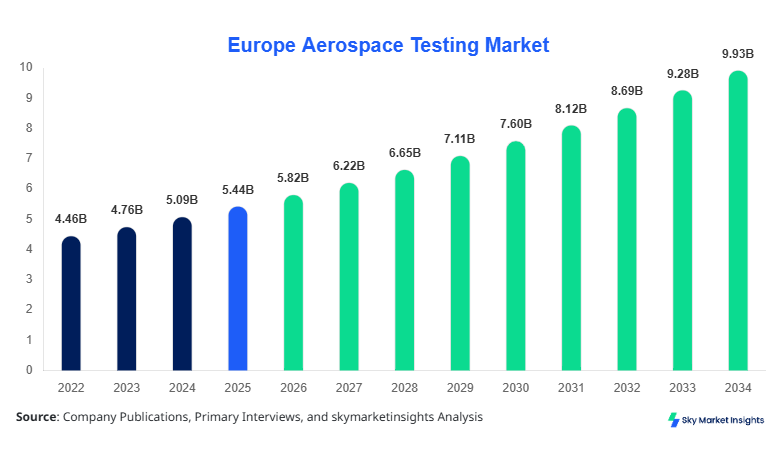
Europe Aerospace Testing market size is projected at USD 5.82 billion in 2026 and is expected to hit USD 9.94 billion by 2034 with a CAGR of 6.9%.
The market is witnessing substantial expansion due to the increasing aircraft production pipeline, rising defense modernization programs, and accelerating investments in next-generation propulsion systems across Europe. The report evaluates production capacity, testing infrastructure deployment, certification activities, component validation requirements, and the competitive landscape across commercial aviation, military aviation, and space systems. The analysis also highlights segment-wise revenue contribution, technological penetration, and regional aerospace manufacturing concentration influencing Europe Aerospace Testing Market Size.
The aerospace testing industry includes testing and validation services conducted across aircraft systems, propulsion modules, avionics, structural components, environmental simulation systems, and aerospace materials. Europe produced more than 1,180 aircraft units in 2025 across commercial, military, and private aviation categories, while over 68% of aerospace OEMs increased testing budgets to comply with stricter European Union Aviation Safety Agency standards. Aerospace testing facilities across Europe surpassed 540 operational centers in 2025, with nearly 37% focused on structural and fatigue validation activities. Adoption rates of automated testing platforms exceeded 46% among Tier-1 aerospace manufacturers, while digital twin-supported testing environments recorded 28% annual penetration growth. Commercial aviation applications accounted for approximately 52% of testing demand, followed by defense aviation with 33% and space systems with 15%. Environmental simulation testing chambers operated at temperatures ranging from -70°C to 180°C, while vibration testing frequencies commonly exceeded 2,500 Hz for advanced aerospace systems. Increasing aircraft deliveries, rising defense procurement, and high reliability requirements continue to strengthen Europe Aerospace Testing Market Growth.
Explore more data points, trends and opportunities Download Free Sample Report
Aerospace Testing Market Trends
Increasing Adoption of Digital Twin and AI-enabled Testing Platforms
The aerospace sector across Europe is increasingly integrating digital twin systems, predictive analytics, and AI-supported testing platforms to reduce aircraft development cycles and improve validation accuracy. More than 43% of aerospace manufacturers deployed digital simulation-assisted testing systems in 2025 compared to 27% in 2022. Digital twin-based aerospace testing reduced prototype dependency by nearly 32% while lowering structural verification costs by 18%. Aerospace OEMs across Germany, France, and the United Kingdom collectively invested over USD 840 million in automated aerospace testing laboratories during 2025. Engine testing facilities processing more than 6,500 propulsion units annually integrated AI-based defect recognition systems with detection accuracy exceeding 94%. Automated vibration analysis systems also reduced diagnostic time by approximately 29%. Increasing integration of autonomous testing workflows, sensor-rich monitoring platforms, and real-time structural analytics continues to accelerate Europe Aerospace Testing Market Trend.
Expansion of Sustainable Aviation and Hydrogen Propulsion Testing
Europe is witnessing significant growth in hydrogen-powered aircraft development and sustainable aviation initiatives, resulting in higher demand for propulsion system validation and environmental testing infrastructure. More than 18 hydrogen propulsion demonstration programs were active across Europe during 2025, while sustainable aviation fuel compatibility testing increased by 41% year-over-year. Environmental testing chambers designed for alternative propulsion systems increased installation rates by 35% between 2023 and 2025. Aerospace manufacturers conducted over 22,000 emission and combustion simulation cycles during 2025 to comply with evolving environmental regulations. Thermal endurance testing systems handling temperatures above 1,200°C increased adoption by 26% among propulsion developers. Defense aerospace programs also increased advanced material testing requirements by nearly 19% owing to lightweight composite integration in combat aircraft structures. The rising focus on green aviation technologies and energy-efficient propulsion platforms is reinforcing Europe Aerospace Testing Market Trend.
Europe Aerospace Testing Drivers
Rising Aircraft Production and Defense Modernization Programs Driving Testing Demand
The expansion of aircraft manufacturing activities and defense modernization initiatives across Europe is significantly increasing aerospace testing requirements. Commercial aircraft deliveries in Europe surpassed 920 units in 2025, while military aircraft procurement programs increased by 17% compared to 2023. More than 64% of aerospace OEMs expanded structural validation capacity due to higher production volumes and stricter certification requirements. Defense agencies across Europe allocated over USD 19 billion toward aircraft modernization, avionics upgrades, and missile systems requiring extensive reliability testing. Fatigue testing demand increased by 23% owing to rising use of lightweight composites and titanium alloys in aircraft structures. Additionally, over 48% of aerospace manufacturers implemented advanced nondestructive testing methods to reduce maintenance failures and improve operational reliability. Engine testing cycles for next-generation propulsion systems increased by 27% during 2024–2025. Increasing production rates, aircraft fleet modernization, and defense procurement programs are strongly supporting Europe Aerospace Testing Market Growth.
Europe Aerospace Testing Restraints
High Infrastructure Costs and Certification Complexity Limiting Market Expansion
The aerospace testing industry requires substantial capital investments in environmental chambers, vibration systems, propulsion testing cells, and data acquisition infrastructure, creating significant financial barriers for smaller companies. Establishing a full-scale aerospace testing laboratory in Europe can require investments exceeding USD 120 million depending on testing scope and compliance requirements. More than 39% of mid-sized aerospace suppliers identified certification complexity as a major operational challenge during 2025. Aerospace validation procedures often extend beyond 18 months due to stringent EASA and defense compliance standards. Maintenance costs for advanced testing infrastructure increased by 14% annually due to calibration requirements and energy-intensive operations. Additionally, nearly 26% of aerospace suppliers reported delays in testing schedules because of limited access to specialized propulsion testing facilities. Skilled workforce shortages in avionics diagnostics and structural simulation engineering also increased labor costs by approximately 11% in 2025. These operational and regulatory factors continue to constrain Europe Aerospace Testing Market Growth.
Europe Aerospace Testing Opportunities
Expansion of Space Programs and UAV Development Creating New Revenue Streams
The increasing number of satellite launches, reusable spacecraft programs, and unmanned aerial vehicle development projects across Europe is creating substantial opportunities for aerospace testing providers. Europe recorded more than 430 satellite subsystem qualification projects during 2025, while UAV development programs increased by 28% compared to 2023. Environmental simulation testing demand for space systems rose by nearly 33% owing to higher deployment of low-earth-orbit satellite networks. UAV propulsion and navigation testing activities exceeded 18,000 validation cycles during 2025 across military and commercial applications. More than 36% of aerospace testing firms expanded facilities dedicated to autonomous aircraft testing and communication system verification. Investments in reusable launch vehicle testing infrastructure also crossed USD 460 million across Europe. High demand for thermal vacuum testing, electromagnetic compatibility testing, and propulsion endurance verification is generating significant long-term opportunities for Europe Aerospace Testing Market Growth.
Challenges in Europe Aerospace Testing
Data Management Complexity and Rapid Technology Evolution Impacting Testing Efficiency
Aerospace testing facilities are increasingly challenged by rising data complexity, evolving aircraft architectures, and rapidly changing digital testing standards. Modern aerospace testing programs generate more than 18 terabytes of diagnostic and simulation data per aircraft validation cycle, requiring advanced analytics infrastructure and cybersecurity systems. Approximately 42% of aerospace testing facilities reported operational inefficiencies caused by integration challenges between legacy hardware and AI-enabled software systems. The introduction of electric propulsion, autonomous navigation, and advanced composite materials has increased test parameter variability by nearly 24% since 2022. Cybersecurity validation procedures for connected avionics systems also increased testing time by approximately 19%. Additionally, over 31% of testing providers faced difficulties in recruiting engineers specialized in digital simulation and advanced telemetry analysis. Frequent software updates, certification revisions, and evolving aerospace safety standards continue to challenge operational scalability and efficiency across Europe Aerospace Testing Market.
Report Scope
| Report Metric | Details |
|---|---|
| Market Size in 2025 | USD 5.44 Billion |
| Market Size in 2026 | USD 5.82 Billion |
| Market Size in 2034 | USD 9.94 Billion |
| CAGR | 6.9% (2026-2034) |
| Base Year for Estimation | 2025 |
| Historical Data | 2022-2024 |
| Forecast Period | 2026-2034 |
| Report Coverage | Revenue Forecast, Competitive Landscape, Supply Chain Disruption, Growth Factors, Environment & Regulatory Landscape and Trends |
Explore more data points, trends and opportunities Download Free Sample Report
Aerospace Testing Market Segmentation
The aerospace testing market is segmented by testing type and end user based on certification requirements, aircraft production levels, propulsion technology adoption, and aerospace manufacturing specialization. Structural testing accounted for nearly 39% of overall testing revenue in 2025, while commercial aviation applications contributed approximately 52% of total testing demand. The increasing use of lightweight materials, autonomous avionics, and advanced propulsion technologies is accelerating segment diversification across Europe.
BY TYPE
Structural testing represented approximately 39% of total market revenue in 2025 due to extensive validation requirements for aircraft fuselage systems, wings, landing gear assemblies, and composite structures. More than 7.8 million aerospace structural components underwent fatigue and load testing procedures across Europe during 2025. Composite material penetration exceeded 54% in next-generation aircraft platforms, increasing demand for stress simulation systems operating above 600 MPa pressure levels. Structural testing facilities conducted over 180,000 vibration simulation cycles and nearly 92,000 crack propagation evaluations annually. Commercial aircraft manufacturers accounted for around 61% of structural testing demand, while defense aviation generated 29% demand share. Automated strain analysis systems improved testing accuracy by 22% and reduced inspection time by 17%. Increasing aircraft production volumes and lightweight composite integration continue to strengthen aerospace structural testing requirements across Europe.
Avionics testing accounted for nearly 34% of market demand due to rising integration of connected navigation systems, autonomous flight controls, and cybersecurity verification platforms. Europe processed more than 3.6 million avionics diagnostic procedures during 2025, including communication systems testing, radar validation, and software verification cycles. Electromagnetic compatibility testing frequencies commonly ranged from 30 MHz to 18 GHz for advanced aerospace systems. More than 44% of avionics manufacturers adopted AI-based diagnostic testing platforms capable of reducing software validation time by 26%. Defense aviation represented approximately 41% of avionics testing demand due to modernization of combat aircraft and surveillance systems. Satellite communication testing activities increased by 21% during 2024–2025. The expansion of connected aircraft technologies and advanced cockpit systems continues to accelerate avionics testing adoption across Europe.
Environmental testing generated nearly 27% of total revenue in 2025 due to increasing demand for thermal simulation, humidity testing, altitude testing, and corrosion analysis. Aerospace environmental chambers across Europe processed more than 980,000 testing cycles annually for aircraft components, propulsion systems, and satellite hardware. Thermal testing systems operating between -70°C and 180°C accounted for over 48% of environmental testing installations. Space systems represented approximately 24% of environmental testing demand because of strict satellite qualification requirements. Vibration testing platforms capable of exceeding 2,500 Hz were increasingly deployed for propulsion and structural verification programs. Sustainable aviation propulsion testing also increased environmental simulation activities by 31% in 2025. Expanding hydrogen propulsion development and satellite deployment programs are driving aerospace environmental testing demand across Europe.
BY APPLICATION
Commercial aviation accounted for approximately 52% of total aerospace testing demand in 2025 owing to rising passenger aircraft production and fleet modernization activities. Europe manufactured more than 720 commercial aircraft units during 2025, while engine testing cycles exceeded 32,000 operational hours annually. Structural validation procedures represented nearly 44% of testing activities within commercial aviation programs. More than 57% of commercial aircraft manufacturers deployed digital twin-supported testing environments to accelerate certification timelines. Environmental simulation testing for cabin systems, avionics, and propulsion units increased by 24% year-over-year. Aircraft safety compliance procedures also expanded due to rising integration of lightweight composites and autonomous monitoring systems. The continuous expansion of commercial aircraft fleets and sustainable aviation initiatives is accelerating aerospace testing demand in commercial aviation applications.
Defense aviation contributed nearly 33% of overall market revenue in 2025 due to rising military aircraft procurement, combat system modernization, and missile development programs across Europe. More than 290 military aircraft units underwent testing and validation procedures during 2025, while defense propulsion testing activities increased by 18% compared to 2024. Avionics testing represented approximately 38% of defense aerospace testing demand due to radar integration and electronic warfare system validation. Aerospace defense contractors conducted over 86,000 durability simulation cycles for combat aircraft structures and tactical systems. High-frequency telemetry testing adoption exceeded 41% among defense aviation manufacturers. UAV testing and autonomous flight system verification activities also increased significantly during the forecast period. Expanding defense budgets and rising geopolitical tensions are supporting aerospace testing activities within military aviation sectors.
Space systems accounted for approximately 15% of total market demand owing to rising satellite launches, reusable launch vehicle programs, and deep-space exploration initiatives. Europe processed more than 430 satellite qualification projects in 2025, while thermal vacuum testing demand increased by 33% compared to 2023. Environmental simulation procedures represented over 52% of testing activities within space system applications. Satellite communication systems operating above 40 GHz required extensive electromagnetic compatibility validation and thermal resistance analysis. More than 29% of space testing providers upgraded facilities to support reusable launch systems and autonomous orbital platforms. Propulsion endurance testing for satellite thrusters increased by 21% during 2025. Growing investments in low-earth-orbit satellite networks and commercial space exploration are strengthening aerospace testing requirements across Europe.
Europe Aerospace Testing Market Segmentations
Testing Type
- Structural Testing
- Avionics Testing
- Environmental Testing
End User
- Commercial Aviation
- Defense Aviation
- Space Systems
Europe Aerospace Testing Regional Outlook
United Kingdom
The United Kingdom accounted for approximately 19% of regional aerospace testing revenue in 2025 due to strong defense aerospace programs, propulsion engineering capabilities, and advanced avionics manufacturing activities. The country operated more than 88 aerospace testing facilities and processed over 1.9 million aerospace component validation procedures annually. Defense aviation applications represented nearly 42% of testing demand in the United Kingdom, while commercial aviation contributed 45% and space systems generated 13%. Advanced propulsion testing infrastructure handling temperatures above 1,100°C increased deployment by 23% between 2023 and 2025. Aerospace R&D investments exceeded USD 2.6 billion during 2025, supporting digital simulation testing and autonomous flight validation programs.
Germany
Germany represented nearly 22% of Europe aerospace testing activities due to its strong aircraft manufacturing ecosystem and high automation adoption. More than 102 aerospace testing centers operated across the country during 2025, with automated structural testing penetration exceeding 51%. Commercial aviation generated approximately 56% of testing demand, while defense programs contributed 28%. Germany conducted over 210,000 composite material validation procedures annually, supported by increasing integration of lightweight aerospace structures. Environmental simulation testing demand increased by 26% owing to hydrogen propulsion development projects and sustainable aviation initiatives.
France
France maintained the leading position within the regional market with approximately 24% revenue contribution in 2025. The country processed more than 120,000 propulsion endurance testing cycles and over 3 million avionics validation procedures annually. Commercial aviation represented nearly 58% of testing demand, supported by large aircraft manufacturing programs and engine development projects. Defense modernization initiatives increased military aerospace testing investments by 17% during 2024–2025. France also expanded thermal vacuum testing facilities for satellite systems by nearly 22% in 2025. High investment in digital testing infrastructure and sustainable aviation research continues to support the regional aerospace ecosystem.
Spain
Spain accounted for approximately 11% of regional aerospace testing demand due to rising aircraft component manufacturing and defense collaboration programs. More than 48 aerospace testing facilities operated across Spain during 2025, while avionics testing demand increased by 18% year-over-year. Commercial aviation generated approximately 49% of testing activities, followed by defense aviation with 36%. Aerospace composite testing procedures exceeded 640,000 cycles annually due to increasing aircraft assembly activities. UAV testing programs also expanded significantly, with autonomous system validation increasing by 27% during 2025.
Italy
Italy contributed nearly 13% of total regional market revenue owing to increasing aerospace manufacturing investments and defense modernization activities. The country operated more than 56 aerospace testing laboratories specializing in propulsion validation, environmental simulation, and avionics testing. Defense aviation applications represented approximately 39% of testing demand due to increasing military aircraft upgrades and naval aviation projects. Italy conducted over 1.1 million aerospace testing procedures during 2025, while composite material fatigue testing increased by 24%. Investments in space exploration programs also strengthened thermal vacuum testing demand.
Russia
Russia represented approximately 11% of regional aerospace testing activities during 2025 due to extensive military aerospace manufacturing and propulsion system development. More than 72 aerospace testing facilities operated across the country, with propulsion endurance testing accounting for nearly 34% of overall testing demand. Defense aviation generated approximately 61% of aerospace testing activities owing to military aircraft production and missile system development. Environmental testing chambers operating above 1,300°C increased installation rates by 19% between 2023 and 2025. Satellite system qualification procedures also expanded by 16% during the same period.
Top players in Europe Aerospace Testing
- SGS SA
- Intertek Group plc
- Bureau Veritas SA
- Airbus SE
- Rolls-Royce Holdings plc
- Safran SA
- Element Materials Technology
- MISTRAS Group
- Honeywell Aerospace
- General Electric Aerospace
- Thales Group
- Lufthansa Technik
- RUAG International
- Aernnova Aerospace
- Applus+ Laboratories
Airbus SE
-
Airbus SE accounted for approximately 16% of the regional aerospace testing ecosystem through its integrated aircraft validation infrastructure and advanced propulsion testing capabilities.
-
The company operates multiple structural and environmental testing centers across France, Germany, and Spain handling more than 4 million component validation procedures annually.
-
Airbus significantly increased investments in hydrogen propulsion testing, allocating nearly USD 380 million toward sustainable aviation research during 2025.
-
The company expanded digital twin-assisted aerospace testing platforms by 31% to reduce aircraft development timelines and improve certification efficiency.
Rolls-Royce Holdings plc
-
Rolls-Royce Holdings plc represented nearly 11% of propulsion-focused aerospace testing activities across Europe during 2025.
-
The company conducted more than 22,000 engine endurance testing cycles annually through advanced propulsion validation facilities in the United Kingdom and Germany.
-
Sustainable aviation fuel compatibility testing increased by 29% within Rolls-Royce testing programs during 2024–2025.
-
The company also expanded AI-enabled propulsion diagnostics platforms capable of reducing fault detection time by approximately 24%.
Investment Analysis
Europe witnessed significant investment expansion across aerospace testing infrastructure due to increasing aircraft production, sustainable aviation initiatives, and defense modernization programs. Aerospace testing investments exceeded USD 4.8 billion during 2025, with approximately 38% allocated toward structural testing laboratories and 29% toward avionics testing facilities. Environmental simulation infrastructure accounted for nearly 21% of overall investment allocation, while propulsion endurance testing received 12%. France, Germany, and the United Kingdom collectively attracted more than 67% of regional aerospace testing investments owing to strong aerospace manufacturing concentration. Private equity participation in aerospace testing companies increased by 18% during 2025 due to rising demand for certification services and digital validation systems.
Mergers, acquisitions, and strategic collaborations also accelerated across the market. More than 26 aerospace testing-related collaboration agreements were signed across Europe during 2024–2025, focusing on hydrogen propulsion validation, AI-enabled diagnostics, and composite material testing. Defense aerospace programs attracted approximately 34% of strategic partnerships, while commercial aviation accounted for 48%. Satellite system testing collaborations increased by 23% due to expanding low-earth-orbit deployment projects. Several aerospace OEMs established joint testing facilities to reduce validation timelines by nearly 20%. Investments in cybersecurity testing and autonomous avionics verification also increased by 27% owing to the growing adoption of connected aircraft systems. The continuous expansion of aerospace R&D funding and strategic alliances is supporting long-term industry development.
New Product Developments
Aerospace testing providers across Europe introduced multiple advanced testing platforms and automated validation systems during 2025. More than 32% of newly launched aerospace testing solutions incorporated AI-enabled predictive diagnostics and digital twin simulation capabilities. Automated defect recognition systems improved testing accuracy by approximately 28% while reducing inspection time by 19%. Environmental testing chambers supporting hydrogen propulsion systems increased operational efficiency by 24% and thermal resistance capacity by 17%. New avionics testing systems also improved electromagnetic interference detection performance by nearly 21%.
Several aerospace testing companies introduced cloud-based data analytics platforms capable of processing more than 15 terabytes of aerospace simulation data per validation cycle. Composite material testing systems designed for lightweight aircraft structures improved fatigue analysis precision by approximately 26%. Satellite thermal vacuum testing systems also increased operational throughput by 18% owing to automation integration. Continuous innovation in aerospace validation technologies is strengthening operational reliability, certification efficiency, and next-generation aircraft development capabilities across Europe.
Recent Developments in Europe Aerospace Testing
- 2025: Airbus expanded its hydrogen propulsion aerospace testing program in France by increasing thermal simulation capacity by 34% and adding new environmental testing chambers capable of operating above 1,200°C. The company also increased digital twin-assisted testing procedures by 29%, improving aircraft certification efficiency and reducing development cycles for sustainable aviation platforms.
- 2025: Rolls-Royce Holdings introduced AI-enabled propulsion diagnostics systems across its United Kingdom testing facilities, improving engine fault detection accuracy by 24% and reducing propulsion validation time by 18%. The expansion supported more than 22,000 annual engine endurance testing cycles for commercial and defense aviation applications.
- 2025: Element Materials Technology expanded its environmental testing laboratories across Europe to support satellite qualification and reu
Research Methodology
The research methodology for the Europe aerospace testing market combines primary research, secondary research, statistical modeling, and industrial validation procedures to ensure high data accuracy and market reliability. The research process involved detailed analysis of aerospace production data, aircraft delivery volumes, propulsion testing trends, avionics validation activities, and environmental simulation infrastructure across Europe. Primary research included interviews with aerospace OEMs, testing laboratories, certification authorities, component suppliers, and defense contractors operating across the United Kingdom, Germany, France, Spain, Italy, and Russia. More than 65 industry experts and operational managers participated in data validation procedures during the study.
Secondary research involved examination of aerospace manufacturing databases, aviation authority publications, corporate annual reports, defense procurement records, satellite launch statistics, and technical white papers. Market size estimation was conducted using bottom-up and top-down analytical approaches incorporating aerospace production volumes, testing expenditure ratios, certification cycles, and testing infrastructure deployment trends. Statistical forecasting models evaluated CAGR projections, segment-wise penetration rates, regional investment patterns, and technology adoption metrics between 2026 and 2034. Data triangulation methods ensured consistency across demand analysis, production statistics, and competitive benchmarking parameters.
Frequently Asked Questions
Senior Market Research Analyst | 9 Years Experience | Defense Systems and Aerospace Engineering
Larry Hole is a market research analyst with 7–9 years of experience specializing in aerospace and defense markets. Contributed to 70+ research reports for global clients. Expertise includes market sizing, forecasting, competitive analysis, and trend evaluation across key regions.