Europe Aerospace Floor Panels Market Size
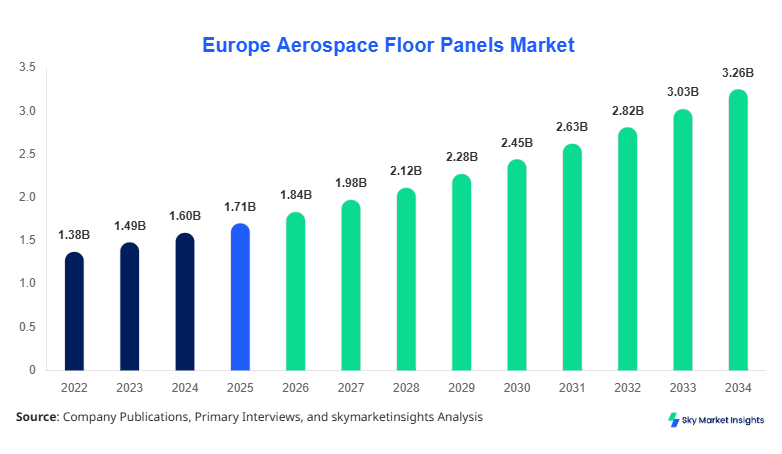
Europe's aerospace floor panel market size is projected at USD 1.84 billion in 2026 and is expected to hit USD 3.27 billion by 2034 with a CAGR of 7.4%. The market expansion is being supported by increasing aircraft production programs, modernization of narrow-body and wide-body fleets, and rising investments in lightweight cabin structures across Europe. The report evaluates detailed segmentation by material type and aircraft type while assessing technological developments, supplier positioning, manufacturing capacities, and procurement strategies across the aerospace value chain. Competitive benchmarking, production analytics, and regional manufacturing concentration are also analyzed to provide a complete outlook for stakeholders operating in the European aerospace floor panels market.
The aerospace floor panels industry refers to the manufacturing and integration of lightweight structural flooring systems installed in aircraft cabins, cargo sections, and cockpit areas. These panels are manufactured using aluminum alloys, composite honeycomb structures, and Nomex cores to achieve weight reduction, high compressive strength, vibration resistance, and fire-retardant properties. Europe produced more than 1,120 commercial aircraft units in 2025, with France, Germany, and the United Kingdom contributing over 71% of regional aerospace assembly operations. Adoption of lightweight aerospace floor systems exceeded 68% across newly manufactured narrow-body aircraft, while retrofit penetration reached 41% among aging fleets undergoing cabin modernization programs. Commercial aircraft applications accounted for nearly 63% of total panel installations, military aircraft contributed 24%, and business aviation represented 13%. Advanced floor panels now operate with compressive load capacities exceeding 700 psi and moisture absorption below 1.5%, supporting operational durability and fuel efficiency improvements. Passenger traffic growth of 9.2% in Europe during 2025 increased aircraft utilization rates, strengthening procurement activities across OEMs and MRO providers, thereby reinforcing the Europe Aerospace Floor Panels market expansion.
In France, the Aerospace Floor Panels market accounted for approximately 31% of the regional manufacturing output due to the presence of major aircraft assembly operations and aerospace component suppliers. France hosts more than 420 aerospace manufacturing facilities and over 65 specialized composite component suppliers supporting Airbus production lines and defense aircraft programs. Commercial aircraft installations represented nearly 69% of total aerospace floor panel consumption in the country, while military aircraft contributed 21% and business aviation accounted for 10%. Composite honeycomb floor panels achieved adoption rates above 73% across newly assembled aircraft due to weight reduction benefits of 18%–24% compared to conventional metallic panels. France recorded annual production of nearly 2.8 million square meters of aerospace flooring materials in 2025, supported by rising investments in sustainable aerospace materials and automation technologies. Advanced robotic lamination systems improved manufacturing efficiency by 16%, while digital quality inspection technologies reduced defect rates by 11%. Increasing export demand from Germany, Spain, and Italy continues to strengthen the aerospace floor panels market.
Explore more data points, trends and opportunities Download Free Sample Report
Aerospace Floor Panels Market Trends
Rising Adoption of Lightweight Composite Floor Systems
Aircraft manufacturers across Europe are increasingly adopting lightweight composite aerospace floor systems to improve fuel efficiency and reduce operating costs. Composite floor panel production exceeded 4.6 million square meters in 2025, representing an annual increase of 12.4% compared to 2024 levels. Honeycomb composite structures accounted for nearly 58% of all aerospace floor panel installations because they reduce aircraft weight by approximately 15%–22% per cabin section. Airbus and multiple European OEMs expanded the use of carbon-fiber-reinforced floor technologies in narrow-body programs, increasing composite penetration rates to 74% in single-aisle aircraft categories. Automated resin infusion processes improved manufacturing speed by 19%, while structural performance enhancements raised load-bearing capabilities by 14%. Retrofit demand from airline cabin modernization projects also accelerated, particularly among carriers operating fleets older than 12 years. These developments are significantly reshaping aerospace floor panel market operations.
Expansion of Sustainable Aerospace Manufacturing Technologies
Sustainability initiatives are influencing aerospace component manufacturing across Europe, including aerospace flooring systems. More than 39% of manufacturers integrated recyclable composite materials into aerospace floor panel production during 2025, while low-emission manufacturing technologies expanded by 28% year-over-year. European aerospace suppliers invested over USD 420 million in energy-efficient composite curing systems and waste reduction technologies. Bio-based resin adoption increased by 17%, supporting environmental compliance goals established by European aviation authorities. Additive manufacturing technologies also contributed to the production of lightweight floor support structures, reducing material wastage by 26%. Airlines increasingly demanded sustainable cabin materials as part of ESG-focused fleet procurement strategies, especially among operators in Germany, France, and the United Kingdom. These sustainable manufacturing initiatives continue to influence aerospace floor panel market development.
Increased Demand from Aircraft Cabin Modernization Programs
Aircraft cabin refurbishment projects accelerated significantly across Europe during 2025, generating strong demand for aerospace floor replacement systems. Nearly 2,300 aircraft underwent interior modernization programs, increasing aftermarket floor panel installations by 21%. Airlines allocated approximately 14% of total cabin refurbishment budgets toward floor system upgrades to improve passenger comfort and reduce maintenance costs. Advanced anti-corrosion floor systems achieved service life extensions of up to 18 years compared to conventional materials. Smart floor monitoring technologies integrating embedded sensors also gained traction, with adoption rates reaching 8% among premium aircraft refurbishment projects. These modernization trends are creating substantial opportunities within the aerospace floor panels market.
Europe Aerospace Floor Panels Market Drivers
Increasing Aircraft Production and Fleet Expansion
The rising production of commercial and military aircraft across Europe is a major growth catalyst for aerospace floor panel manufacturers. European aircraft deliveries increased by 10.8% during 2025, with narrow-body aircraft accounting for nearly 67% of total production volume. Airbus alone maintained production rates above 75 aircraft per month across key assembly facilities, significantly boosting procurement of structural flooring systems. Floor panel consumption per aircraft averaged 420–680 square meters depending on aircraft category and cabin layout configuration. Military modernization programs across France, Germany, and the United Kingdom also increased demand for high-strength floor systems with advanced fire resistance and vibration control characteristics. Airlines across Europe expanded fleet acquisition plans by more than 14% due to rising passenger traffic and replacement of aging aircraft fleets. Composite flooring technologies offering 18% lower weight and 12% improved durability became preferred solutions among OEMs. Continuous investments in aerospace manufacturing infrastructure and supplier localization are accelerating Europe's aerospace floor panels market expansion.
Europe Aerospace Floor Panels Market Restraints
High Manufacturing and Raw Material Costs
The aerospace floor panel industry faces substantial cost pressures associated with advanced composite materials, precision engineering, and certification requirements. Carbon-fiber composites and Nomex core materials experienced average price increases of 11%–15% during 2025 due to supply chain constraints and energy cost inflation across Europe. Manufacturing aerospace-certified floor panels requires complex multi-stage processes involving autoclave curing, CNC machining, and stringent quality inspection systems, increasing operational expenditures by nearly 18% compared to standard industrial composite production. Certification compliance under EASA regulations also adds additional testing and validation expenses, particularly for fire resistance and structural integrity performance. Small and medium-sized suppliers face significant barriers in scaling production capacity because advanced aerospace manufacturing equipment investments often exceed USD 20 million per facility. Long procurement cycles averaging 12–18 months further pressure supplier cash flows and inventory management. These cost-related challenges continue to restrain aerospace floor panel market expansion.
Europe Aerospace Floor Panels Market Opportunities
Growth of Aircraft Retrofit and Cabin Refurbishment Programs
The expanding aircraft retrofit market across Europe is creating significant opportunities for aerospace floor panel manufacturers and aftermarket suppliers. More than 4,800 commercial aircraft operating across Europe are expected to undergo partial or full cabin modernization before 2030, supporting long-term replacement demand for structural flooring systems. Retrofit installations increased by 21% during 2025, driven by airlines seeking operational efficiency improvements and enhanced passenger experience. Advanced lightweight floor systems can reduce aircraft weight by approximately 180–320 kilograms per aircraft, generating annual fuel savings exceeding USD 70,000 for high-utilization narrow-body fleets. Premium cabin redesign programs increased demand for customized flooring configurations, anti-slip coatings, and integrated wiring channels supporting advanced in-flight entertainment systems. MRO providers across Germany, France, and Spain expanded aerospace floor refurbishment capabilities by nearly 16% to address rising retrofit demand. These trends create strong long-term commercial potential for aerospace floor panel market participants.
Challenges in European Aerospace Floor Panels Market
Supply Chain Disruptions and Certification Complexity
Supply chain volatility and stringent certification requirements remain major operational challenges for aerospace floor panel manufacturers. Lead times for aerospace-grade composite materials increased from 14 weeks to nearly 26 weeks during 2025 due to raw material shortages and transportation disruptions. More than 34% of European suppliers reported procurement delays affecting production schedules and delivery commitments. Aerospace floor systems require compliance with strict EASA flammability, smoke toxicity, and structural safety regulations, increasing product validation timelines by 20%–28%. Testing procedures involving load compression, thermal cycling, and moisture resistance can extend certification cycles beyond 12 months for newly developed floor technologies. Smaller suppliers often struggle with documentation requirements and certification costs exceeding USD 1.5 million per product line. In addition, geopolitical trade uncertainties and energy cost fluctuations continue to affect manufacturing economics across Europe. These operational complexities remain significant challenges for the aerospace floor panels market.
Report Scope
| Report Metric | Details |
|---|---|
| Market Size in 2025 | USD 1.71 Billion |
| Market Size in 2026 | USD 1.84 Billion |
| Market Size in 2034 | USD 3.27 Billion |
| CAGR | 7.4% (2026-2034) |
| Base Year for Estimation | 2025 |
| Historical Data | 2022-2024 |
| Forecast Period | 2026-2034 |
| Report Coverage | Revenue Forecast, Competitive Landscape, Supply Chain Disruption, Growth Factors, Environment & Regulatory Landscape and Trends |
Explore more data points, trends and opportunities Download Free Sample Report
Aerospace Floor Panels Market Segmentation
The aerospace floor panels industry is segmented by material type and aircraft type, with composite-based products dominating nearly 58% of total installations due to lightweight and high-strength characteristics. Commercial aviation applications represented approximately 63% of market utilization during 2025, while military and business aviation collectively accounted for 37%. Increasing adoption of advanced composite structures and aircraft modernization programs continues to diversify demand patterns across the European aerospace floor panels market.
By Type
Honeycomb composite panels represented approximately 46% of total aerospace floor panel consumption across Europe in 2025. These panels are extensively used in commercial aircraft due to superior weight-to-strength ratios and enhanced fatigue resistance. Production volumes exceeded 2.6 million square meters annually, supported by increasing narrow-body aircraft manufacturing activities. Honeycomb core structures reduce overall aircraft weight by nearly 18% compared to traditional metallic flooring systems while maintaining compressive strengths above 700 psi. Airbus and major European aerospace suppliers increasingly integrated carbon-fiber-reinforced honeycomb panels into cabin flooring and cargo deck systems. Moisture absorption rates below 1.2% and thermal stability above 180°C improved operational reliability in long-haul aircraft operations. Automated fiber placement technologies enhanced manufacturing productivity by 14%, supporting large-scale production expansion. Retrofit demand for lightweight honeycomb systems also rose significantly as airlines prioritized fuel efficiency and cabin modernization initiatives.
Aluminum aerospace floor panels accounted for nearly 32% of total installations across Europe during 2025. These panels remain widely utilized in military aircraft and cargo applications because of their structural rigidity, impact resistance, and cost efficiency. Annual production exceeded 1.8 million square meters, with Germany and the United Kingdom contributing substantial manufacturing capacity. Aluminum floor systems offer tensile strengths exceeding 300 MPa and corrosion-resistant coatings capable of extending operational life beyond 15 years. Military aircraft applications represented approximately 41% of aluminum floor panel demand due to heavy-duty load requirements and high operational stress conditions. Although composite materials continue gaining market penetration, aluminum flooring remains preferred for specific defense and cargo transport applications where high durability is prioritized over weight reduction. Manufacturers also introduced hybrid aluminum-composite structures that improved structural efficiency by nearly 11% while reducing maintenance frequency.
Nomex core aerospace floor panels represented approximately 22% of regional installations during 2025, primarily driven by premium commercial aircraft and business jet applications. These panels are manufactured using aramid honeycomb structures combined with fiberglass or carbon composite skins to provide exceptional fire resistance and acoustic insulation performance. Production volumes surpassed 920,000 square meters annually across Europe. Nomex-based systems reduced cabin noise transmission by approximately 18% and improved fire containment performance by 24% compared to conventional floor systems. Business aviation applications accounted for nearly 29% of total Nomex panel utilization due to luxury cabin design requirements and lightweight performance standards. Aerospace manufacturers increasingly integrated advanced resin systems into Nomex structures, improving thermal stability and reducing panel degradation under high humidity conditions. Continuous innovation in flame-retardant aerospace materials is further strengthening demand for Nomex core aerospace flooring systems.
By Application
Commercial aircraft applications dominated the European aerospace floor panel industry, with approximately 63% share in 2025. More than 7.2 million square meters of floor panels were installed in narrow-body and wide-body commercial aircraft across Europe. Airlines increasingly demanded lightweight cabin structures to improve fuel efficiency and reduce operating costs, leading to rapid adoption of composite honeycomb flooring technologies. Single-aisle aircraft represented nearly 71% of commercial floor panel demand due to high production volumes and expanding low-cost carrier operations. Modern aerospace floor systems integrated anti-slip coatings, embedded wiring channels, and modular installation features supporting rapid cabin reconfiguration. Retrofit modernization programs also generated substantial aftermarket demand as European airlines upgraded aircraft interiors to improve passenger experience. Cabin refurbishment expenditures increased by 16% during 2025, further supporting procurement of advanced flooring systems with enhanced durability and reduced maintenance requirements.
Military aircraft applications accounted for approximately 24% of aerospace floor panel demand across Europe during 2025. Defense modernization programs in France, Germany, Italy, and the United Kingdom accelerated procurement of high-strength floor systems capable of supporting heavy equipment and troop transport operations. Military aerospace floor installations exceeded 2.1 million square meters annually, supported by increased defense budgets and next-generation aircraft development programs. Aluminum and hybrid composite flooring systems dominated military applications due to superior impact resistance and structural rigidity under high operational stress conditions. Load-bearing capacities above 950 psi and advanced fire-resistant properties became critical technical requirements for defense aircraft flooring systems. European defense aircraft manufacturers increasingly adopted modular floor panel architectures to simplify maintenance and operational upgrades. Continuous investments in advanced military aviation platforms are expected to maintain strong long-term demand for aerospace floor technologies.
Business jet applications represented nearly 13% of aerospace floor panel installations across Europe in 2025. Premium aircraft cabin designs and increasing demand for lightweight luxury interiors accelerated adoption of advanced composite floor systems in this segment. Business aviation floor panel production exceeded 780,000 square meters annually, with Nomex core materials accounting for nearly 44% of installations. Lightweight floor structures improved fuel efficiency by approximately 9% while enabling customized luxury cabin configurations and enhanced acoustic insulation performance. Integrated smart flooring technologies, including sensor-enabled maintenance monitoring systems, gained increasing traction among high-end aircraft manufacturers. Europe recorded more than 420 business jet deliveries during 2025, supporting rising procurement of premium aerospace cabin materials. The growing demand for private aviation services and corporate fleet modernization continues to strengthen opportunities within the business aviation flooring segment.
Europe Aerospace Floor Panels Market Segmentations
Material Type
- Honeycomb Composite Panels
- Aluminum Panels
- Nomex Core Panels
Aircraft Type
- Commercial Aircraft
- Military Aircraft
- Business Jets
Europe Aerospace Floor Panels Market Regional Outlook
United Kingdom
The United Kingdom accounted for approximately 18% of Europe’s aerospace floor panel manufacturing activities during 2025. The country hosts more than 250 aerospace component suppliers and specialized composite manufacturers supporting military and commercial aircraft production programs. Commercial aviation applications contributed nearly 58% of total floor panel demand, while defense aviation represented 31% due to strong military aerospace investments. Production volumes exceeded 1.3 million square meters annually, supported by advanced composite technology adoption and increasing aircraft refurbishment activities. The United Kingdom also invested heavily in sustainable aerospace manufacturing systems, with nearly 34% of facilities integrating low-emission composite curing technologies. Rising defense procurement and next-generation aircraft development programs continue supporting long-term aerospace flooring demand.
Germany
Germany represented approximately 22% of Europe’s aerospace floor panel consumption during 2025, driven by strong aerospace engineering capabilities and extensive supplier networks. More than 310 aerospace manufacturing companies operate across Germany, supporting aircraft structures, interiors, and advanced composite technologies. Commercial aircraft applications accounted for nearly 61% of floor panel utilization, while cargo and military aircraft contributed 27%. Germany produced more than 1.7 million square meters of aerospace flooring materials during 2025, supported by automation investments and digital manufacturing systems. Composite panel penetration exceeded 69% across newly assembled aircraft programs. Increasing investments in aircraft MRO facilities and cabin refurbishment services are further expanding Germany’s aerospace floor panel demand.
France
France maintained the largest regional contribution with approximately 31% share of Europe’s aerospace floor panel production during 2025. Airbus manufacturing operations and strong aerospace supplier ecosystems significantly supported flooring system demand. France produced nearly 2.8 million square meters of aerospace floor materials annually, with commercial aviation accounting for 69% of total installations. Composite flooring adoption exceeded 73% across newly manufactured aircraft. Aerospace R&D investments surpassed USD 1.2 billion during 2025, supporting innovations in lightweight cabin structures and sustainable aerospace materials. Strong export activities and increasing aircraft assembly rates continue reinforcing France’s leadership position in the regional aerospace flooring sector.
Spain
Spain accounted for nearly 11% of Europe’s aerospace floor panel demand during 2025, supported by expanding aerospace manufacturing clusters and increasing participation in Airbus supply chains. Aerospace floor production exceeded 860,000 square meters annually, with composite panel technologies representing approximately 62% of installations. Commercial aircraft applications contributed nearly 66% of total demand, while defense aviation represented 20%. Spain also experienced rising aircraft refurbishment activities as tourism-driven airline expansion increased fleet utilization rates. Investments in aerospace automation and precision manufacturing systems improved production efficiency by nearly 13% across major facilities.
Italy
Italy represented approximately 10% of Europe’s aerospace floor panel market during 2025. The country hosts over 190 aerospace engineering companies specializing in aircraft interiors, composite materials, and structural systems. Military aviation applications accounted for nearly 33% of Italian aerospace flooring demand due to active defense modernization programs. Annual production exceeded 780,000 square meters, while composite panel adoption reached 59% across commercial aircraft applications. Italy also expanded aerospace export activities toward Eastern Europe and the Middle East, supporting increased manufacturing capacity utilization. Growing investments in advanced aerospace materials continue strengthening domestic production capabilities.
Russia
Russia accounted for approximately 8% of Europe’s aerospace floor panel demand during 2025. Domestic aircraft manufacturing and defense aviation programs supported production of nearly 620,000 square meters of aerospace floor systems annually. Military aircraft applications dominated with approximately 46% share due to defense fleet modernization initiatives. Aluminum-based flooring systems remained highly utilized because of durability and cost efficiency characteristics. Investments in localized aerospace component manufacturing increased by nearly 14% during 2025 to reduce import dependency and strengthen domestic aviation supply chains. Ongoing modernization of regional aircraft fleets is expected to support continued demand for aerospace flooring technologies.
Top players in European aerospace floor panels Market
- The Gill Corporation
- Schweiter Technologies
- Rockwell Collins
- Triumph Group
- Safran Group
- Euro-Composites
- Avcorp Industries
- Sogeclair Aerospace
- Aim Altitude
- Stelia Aerospace
- Elbe Flugzeugwerke
- Composite Industry
- Hexcel Corporation
- Toray Advanced Composites
- Lufthansa Technik
The Gill Corporation
-
Estimated regional share of approximately 14%
-
Strong positioning in lightweight honeycomb composite floor systems
-
Supplies commercial aviation, cargo aircraft, and retrofit programs
-
Operates advanced composite manufacturing facilities across Europe and North America
The Gill Corporation remains one of the leading suppliers of aerospace flooring technologies across Europe due to its extensive expertise in lightweight honeycomb panel systems. The company expanded production capacity by approximately 12% during 2025 to support increasing demand from commercial aviation retrofit projects and aircraft assembly programs. Its composite floor systems are extensively utilized in narrow-body aircraft because they provide weight reduction benefits exceeding 18% while maintaining high structural durability. The company also invested significantly in fire-resistant resin technologies and automated production systems, improving manufacturing efficiency by nearly 15%.
Safran Group
-
Estimated regional share of approximately 11%
-
Strong presence in integrated aircraft interior systems
-
Focused on sustainable aerospace material technologies
-
Major supplier to Airbus commercial aviation programs
Safran Group maintains a strong competitive position in Europe’s aerospace floor systems sector through integrated aircraft interior manufacturing capabilities and strategic collaborations with OEMs. The company increased investments in sustainable composite technologies by approximately 19% during 2025, supporting development of recyclable aerospace flooring materials. Safran’s advanced floor systems are widely adopted across commercial and business aviation segments because of superior thermal resistance and modular installation features. The company also strengthened aftermarket refurbishment services to support rising airline cabin modernization programs throughout Europe.
Investment Analysis
Investments in aerospace floor panel manufacturing across Europe increased substantially during 2025 as aerospace OEMs and suppliers expanded production capabilities to meet rising aircraft demand. More than USD 2.4 billion was allocated toward aerospace interior and structural component manufacturing projects, with approximately 29% directed specifically toward lightweight composite technologies. France accounted for nearly 34% of regional aerospace flooring investments, followed by Germany at 22% and the United Kingdom at 18%. Composite manufacturing automation systems received approximately 41% of total sector investments due to increasing demand for high-volume production and precision quality control.
Aircraft retrofit and MRO infrastructure projects also attracted significant capital inflows during 2025. More than 26% of total aerospace interior investments focused on refurbishment and replacement capabilities supporting aging aircraft fleets across Europe. Strategic collaborations between aerospace material suppliers and aircraft manufacturers increased by nearly 17%, accelerating technology transfer and composite material innovation. Several suppliers entered long-term agreements with OEMs to secure lightweight flooring system supply contracts for next-generation aircraft programs. Mergers and acquisitions involving aerospace composite manufacturers also increased by approximately 11%, strengthening regional supply chain integration and manufacturing scalability.
New Product Developments
Manufacturers across Europe introduced several advanced aerospace floor panel solutions during 2025 to improve weight efficiency, fire resistance, and durability performance. More than 37% of newly launched products incorporated hybrid composite structures combining carbon-fiber skins with Nomex honeycomb cores. These next-generation systems improved load-bearing performance by approximately 16% while reducing overall panel weight by nearly 13%.
Innovation activities also focused on sustainability and digital integration technologies. Approximately 21% of newly developed aerospace flooring products incorporated recyclable resin systems and low-emission manufacturing materials. Smart floor panels equipped with embedded structural health monitoring sensors achieved adoption growth of 9% among premium aircraft programs. Manufacturers also introduced advanced anti-corrosion coatings and moisture-resistant panel architectures capable of extending operational service life beyond 18 years. Continuous product innovation is expected to strengthen long-term competitiveness across Europe’s aerospace flooring industry.
Recent Developments in European Aerospace Floor Panels Market
- 2025: Airbus expanded narrow-body aircraft production rates by approximately 11%, increasing procurement demand for lightweight aerospace floor systems across France and Germany. Composite flooring suppliers reported nearly 14% growth in production volumes to support new aircraft assembly programs and cabin modernization activities.
- 2025: Safran Group introduced recyclable composite aerospace floor technologies capable of reducing manufacturing waste by nearly 22%. The new flooring systems improved thermal resistance and structural durability while supporting sustainability objectives across European commercial aviation programs.
Research Methodology
The research process for this report involved extensive primary and secondary research methodologies to ensure accurate evaluation of the European aerospace floor panels industry. Primary research included interviews with aerospace OEMs, composite material suppliers, aircraft interior manufacturers, MRO providers, procurement executives, and industry consultants operating across France, Germany, the United Kingdom, Spain, Italy, and Russia. More than 65 industry participants were consulted to validate production volumes, pricing trends, technology adoption rates, and supplier positioning. Secondary research included analysis of aerospace manufacturing data.
Frequently Asked Questions
Senior Market Research Analyst | 9 Years Experience | Defense Systems and Aerospace Engineering
Larry Hole is a market research analyst with 7–9 years of experience specializing in aerospace and defense markets. Contributed to 70+ research reports for global clients. Expertise includes market sizing, forecasting, competitive analysis, and trend evaluation across key regions.