Europe Aerospace Drive Belts Market Size
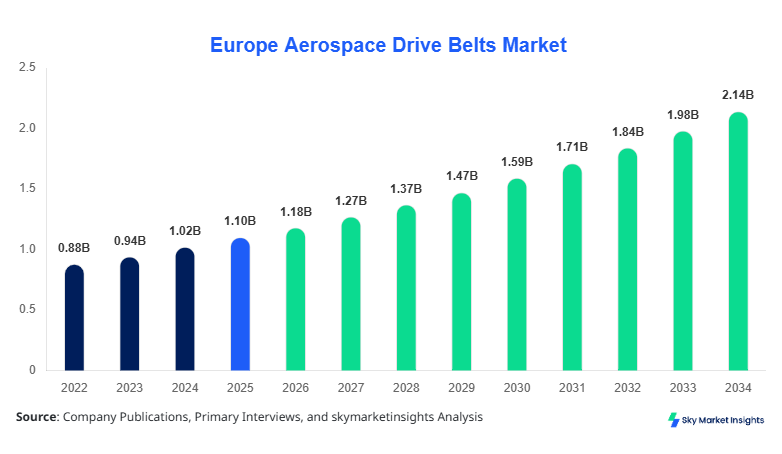
Europe Aerospace Drive Belts market size is projected at USD 1.18 billion in 2026 and is expected to hit USD 2.14 billion by 2034 with a CAGR of 7.7%. The Europe Aerospace Drive Belts industry is witnessing increasing demand due to rapid aircraft modernization programs, expansion of commercial aviation fleets, and higher replacement cycles for critical power transmission components. Market participants are focusing on material innovation, lightweight engineering, and durability optimization to improve aircraft operational efficiency. The competitive landscape includes global aerospace component manufacturers, regional suppliers, and aircraft maintenance firms operating across Germany, the United Kingdom, France, Spain, Italy, and Russia.
The Aerospace Drive Belts market consists of high-performance mechanical transmission belts used in aircraft engines, auxiliary systems, ventilation systems, hydraulic support systems, and power generation modules. Europe produced more than 4,900 commercial and military aircraft components in 2025, with Germany contributing nearly 28% of the regional aerospace manufacturing output. Aerospace drive belts are increasingly manufactured using aramid fiber composites, carbon-reinforced elastomers, and high-temperature polyurethane materials capable of withstanding temperatures above 180°C and rotational loads exceeding 12,000 RPM. Adoption penetration among commercial aircraft maintenance fleets exceeded 72% in 2025 due to increasing predictive maintenance deployment.Consumer behavior and procurement analytics indicate that aircraft OEMs and MRO providers are prioritizing lightweight and low-noise transmission systems to reduce fuel consumption by 3%–5%. Commercial aircraft accounted for nearly 58% of total Aerospace Drive Belts installations in Europe, while military aircraft contributed 27% and helicopters represented approximately 15%. Timing belts represented nearly 44% of total product utilization because of superior synchronization capabilities in aerospace engines. Increasing demand for fuel-efficient aviation systems and extended operational lifecycle performance continues to strengthen the Aerospace Drive Belts market across Europe.
Explore more data points, trends and opportunities Download Free Sample Report
Aerospace Drive Belts Market Trends
Advanced Composite Belt Integration
The aerospace sector across Europe is rapidly shifting toward lightweight composite-based drive belt systems to improve aircraft efficiency and reduce mechanical losses. In 2025, more than 62% of newly manufactured aerospace drive belts incorporated aramid fiber or carbon-reinforced structures compared to 48% in 2022. Aerospace manufacturers produced nearly 6.8 million high-performance drive belts across Europe during 2025, driven primarily by demand from commercial narrow-body aircraft and next-generation military aviation systems. Advanced belts are capable of reducing system vibration by nearly 18% and increasing service life by more than 22%, supporting longer aircraft operational cycles. OEM integration of digitally monitored drive belts increased by 14% year-on-year as airlines sought predictive maintenance solutions to reduce unscheduled downtime. Increasing replacement cycles in European airline fleets continue to strengthen the Aerospace Drive Belts market.
Rising Demand from MRO Operations
Maintenance, repair, and overhaul activities have become a major growth contributor for aerospace drive belt manufacturers in Europe. MRO operators replaced more than 2.3 million aerospace drive belts during 2025 due to increasing flight hours and aging aircraft fleets. Approximately 54% of replacement demand originated from commercial aircraft operators, while defense aircraft contributed 31%. Belt replacement intervals in medium-range aircraft averaged 2,400 operational hours, leading to recurring aftermarket revenue opportunities. Adoption of heat-resistant V-belts and high-flexibility ribbed belts increased by 16% across European MRO facilities because of rising demand for high-durability systems in intensive flight operations. Airlines are also integrating condition-monitoring technologies capable of identifying belt wear with nearly 91% accuracy, reducing maintenance-related operational disruptions. Strong aftermarket expansion is positively influencing the Aerospace Drive Belts market.
Electrification and Hybrid Aircraft Development
Hybrid-electric aircraft development programs are reshaping component specifications across the European aerospace industry. More than 28 hybrid and electric aircraft prototype projects were under active development in Europe during 2025, creating new demand for compact and high-efficiency transmission belts. Belt manufacturers reported a 19% increase in R&D spending focused on low-friction belt systems compatible with electric propulsion modules. High-torque ribbed belts capable of supporting rotational speeds exceeding 14,000 RPM experienced significant adoption growth in advanced aviation systems. France and Germany together contributed nearly 57% of total regional aerospace electrification investments, accelerating next-generation belt technology development. These technological shifts continue to reinforce long-term Aerospace Drive Belts market expansion.
Europe Aerospace Drive Belts Drivers
Expansion of Commercial Aviation Fleets and Aircraft Modernization Programs
The rapid expansion of commercial aviation fleets across Europe is a major factor driving demand for aerospace drive belts. European airlines added more than 1,150 aircraft to operational fleets between 2022 and 2025, resulting in significant procurement of advanced transmission components. Commercial aircraft utilization rates increased by 11% during 2025 compared to 2023, while passenger traffic across European aviation hubs surpassed 1.2 billion travelers annually. Aerospace drive belts are essential for engine synchronization systems, cooling systems, ventilation modules, and auxiliary power units, making them critical for aircraft reliability and safety. Timing belts accounted for nearly 44% of total demand due to superior precision and low maintenance characteristics. Airlines are increasingly adopting lightweight composite belts capable of improving fuel efficiency by approximately 4% and reducing vibration levels by nearly 16%. Aircraft modernization programs in Germany, France, and the United Kingdom collectively represented over USD 18 billion in aviation upgrades during 2025, supporting large-scale replacement of legacy mechanical components. Growing commercial fleet expansion and modernization initiatives continue to stimulate the Aerospace Drive Belts market.
Europe Aerospace Drive Belts Restraints
High Manufacturing Costs and Stringent Certification Requirements
The aerospace sector faces substantial operational challenges due to stringent certification requirements and elevated manufacturing costs associated with aerospace-grade drive belts. Production costs for advanced aramid-reinforced aerospace belts increased by approximately 13% between 2023 and 2025 because of higher raw material prices and specialized manufacturing processes. Certification procedures under European Aviation Safety Agency standards require extensive durability testing exceeding 20,000 operational cycles and thermal endurance validation above 180°C, increasing production timelines by nearly 18%. Small and medium-sized suppliers often face barriers related to compliance investments, which can exceed USD 3 million annually for aerospace component qualification programs. In addition, supply chain disruptions affecting high-performance elastomers and aerospace polymers caused delays of 8–12 weeks across several manufacturing facilities during 2025. Military aviation programs also require highly customized belt configurations, increasing engineering complexity and limiting economies of scale. These factors collectively restrain profitability and operational flexibility within the Aerospace Drive Belts market.
Europe Aerospace Drive Belts Opportunities
Growth in Aerospace Aftermarket and Predictive Maintenance Technologies
The rapid growth of aerospace aftermarket services and predictive maintenance technologies presents substantial opportunities for aerospace drive belt manufacturers. Europe operates more than 6,200 active commercial and defense aircraft requiring continuous maintenance and component replacement services. MRO spending on aircraft mechanical systems increased by approximately 14% in 2025, with predictive maintenance software adoption surpassing 48% among major airlines. Aerospace drive belts integrated with sensor-enabled wear detection systems can reduce maintenance downtime by nearly 21% and extend operational lifespan by approximately 19%. Replacement demand accounted for nearly 46% of total Aerospace Drive Belts market revenue in 2025, creating recurring revenue streams for suppliers. Digital monitoring systems are increasingly capable of identifying vibration fluctuations, belt slippage, and thermal stress with accuracy rates above 90%, improving aircraft reliability and operational planning. Furthermore, rising investments in smart aviation infrastructure across Germany, France, and Italy are accelerating adoption of connected aerospace components. Expanding aftermarket opportunities continue to support the Aerospace Drive Belts market.
Europe Aerospace Drive Belts Challenge
Volatility in Aerospace Supply Chains and Raw Material Availability
Supply chain instability remains a significant challenge affecting aerospace drive belt production across Europe. Aerospace manufacturers rely heavily on specialized synthetic rubber compounds, aramid fibers, and precision-engineered polymers, many of which experienced price volatility exceeding 17% during 2025. Nearly 29% of aerospace component suppliers reported shipment delays related to international logistics constraints and semiconductor shortages impacting sensor-enabled belt systems. Production disruptions in Eastern Europe and global freight cost increases of approximately 22% also affected procurement schedules for aerospace OEMs. Furthermore, aerospace drive belt manufacturers must maintain strict quality tolerance levels below 0.5 mm deviation, increasing dependency on advanced production technologies and highly skilled labor. Europe experienced a shortage of nearly 12,000 specialized aerospace technicians during 2025, affecting production efficiency and delivery schedules. These operational challenges continue to impact scalability and cost optimization across the Aerospace Drive Belts market.
Report Scope
| Report Metric | Details |
|---|---|
| Market Size in 2025 | USD 1.10 Billion |
| Market Size in 2026 | USD 1.18 Billion |
| Market Size in 2034 | USD 2.14 Billion |
| CAGR | 7.7% (2026-2034) |
| Base Year for Estimation | 2025 |
| Historical Data | 2022-2024 |
| Forecast Period | 2026-2034 |
| Report Coverage | Revenue Forecast, Competitive Landscape, Supply Chain Disruption, Growth Factors, Environment & Regulatory Landscape and Trends |
Explore more data points, trends and opportunities Download Free Sample Report
Aerospace Drive Belts Market Segmentation
The Aerospace Drive Belts market is segmented by type and application, with timing belts dominating approximately 44% of total revenue share in 2025 due to superior synchronization performance and durability. Commercial aircraft applications accounted for nearly 58% of overall consumption because of rising fleet expansion and increasing maintenance requirements across Europe.
BY TYPE
Timing belts represented the largest product category with approximately 44% market contribution during 2025. These belts are widely utilized in aircraft synchronization systems because they provide high rotational accuracy and reduced slippage compared to traditional mechanical systems. Europe produced more than 2.9 million aerospace timing belts during 2025, primarily for commercial aircraft and military aviation platforms. Advanced timing belts utilize aramid fiber reinforcement and heat-resistant elastomers capable of operating at temperatures above 190°C. Their operational efficiency improves engine synchronization precision by nearly 17%, supporting reduced maintenance intervals and lower operational vibration. Germany and France collectively contributed nearly 52% of timing belt manufacturing capacity in Europe.
V-belts accounted for nearly 33% of total Aerospace Drive Belts market demand due to their cost efficiency and strong power transmission capabilities. These belts are commonly integrated into aircraft auxiliary systems, cooling systems, and ventilation units. More than 2.1 million aerospace-grade V-belts were installed across Europe in 2025. V-belts can handle torque loads exceeding 320 Nm while maintaining flexibility under varying pressure conditions. Adoption rates increased by approximately 11% in military aviation applications because of improved durability and operational stability under high-stress environments.
Ribbed belts contributed around 23% of regional demand and are increasingly utilized in modern lightweight aircraft systems requiring compact mechanical designs. Ribbed belts support rotational speeds above 14,000 RPM and reduce noise generation by nearly 21% compared to conventional transmission systems. More than 1.5 million ribbed belts were manufactured in Europe during 2025, with increasing demand originating from electric and hybrid aircraft projects. Their compact structure and enhanced flexibility make them suitable for high-efficiency aircraft propulsion systems and auxiliary modules.
BY APPLICATION
Commercial aircraft represented approximately 58% of the Aerospace Drive Belts market due to increasing passenger traffic and aircraft fleet expansion across Europe. More than 3.8 million aerospace drive belts were utilized in commercial aviation operations during 2025. Belt systems are critical for engine synchronization, cabin ventilation systems, hydraulic operations, and auxiliary power units. Airlines increasingly adopted predictive maintenance systems capable of reducing unscheduled belt-related failures by nearly 24%. Commercial aircraft operators in Germany, France, and the United Kingdom collectively accounted for over 63% of regional commercial aerospace drive belt demand. Rising narrow-body aircraft production and expanding low-cost airline operations continue to drive product consumption.
Military aircraft accounted for nearly 27% of total market demand because of increasing defense modernization programs across Europe. Aerospace drive belts integrated into military aviation systems require advanced resistance to thermal stress, vibration, and operational fatigue. Europe manufactured approximately 1.7 million military-grade aerospace belts during 2025. Defense aircraft applications increasingly utilize carbon-reinforced timing belts capable of improving operational reliability by nearly 19%. Russia, France, and Germany collectively represented around 61% of military aviation-related drive belt procurement in the region.
Helicopters contributed approximately 15% of Aerospace Drive Belts market revenue in 2025. Helicopter systems require highly flexible and lightweight drive belts to support rotor synchronization and auxiliary mechanical operations. More than 900,000 aerospace drive belts were integrated into helicopter systems across Europe during 2025. Ribbed belt penetration exceeded 42% within helicopter applications because of superior compactness and low-vibration performance. Increasing demand for emergency response helicopters, defense surveillance systems, and offshore transportation operations continues to support market expansion.
Europe Aerospace Drive Belts Market Segmentations
Type
- Timing Belts
- V-Belts
- Ribbed Belts
Application
- Commercial Aircraft
- Military Aircraft
- Helicopters
Europe Aerospace Drive Belts Regional Outlook
United Kingdom
The United Kingdom accounted for nearly 18% of Europe Aerospace Drive Belts market revenue during 2025 due to strong aerospace engineering capabilities and extensive MRO operations. The country operates more than 130 aerospace production facilities and approximately 55 aircraft maintenance centers. Commercial aviation applications represented nearly 57% of national demand, while military aviation contributed 29%. The United Kingdom produced over 1.1 million aerospace drive belts in 2025, supported by increasing defense aviation investments and aircraft modernization initiatives. Predictive maintenance adoption exceeded 46% among major aviation operators.
Germany
Germany dominated the regional market with approximately 31% share due to its advanced manufacturing infrastructure and high aircraft component exports. The country manufactured more than 1.4 million aerospace drive belts in 2025 and accounted for nearly 28% of Europe’s aerospace component production capacity. Commercial aircraft applications contributed around 61% of demand, while military aviation represented 24%. Germany also led in advanced composite belt integration with adoption rates exceeding 76% across aerospace OEM operations.
France
France represented nearly 20% of regional Aerospace Drive Belts market revenue because of strong aircraft manufacturing activity and increasing aerospace electrification investments. The country produced approximately 1.2 million aerospace drive belts during 2025, with timing belts accounting for nearly 47% of domestic demand. Commercial aircraft applications contributed 59%, while helicopter applications represented approximately 17%. France also recorded a 15% increase in demand for digitally monitored aerospace belt systems integrated with predictive maintenance technologies.
Spain
Spain accounted for approximately 10% of Europe Aerospace Drive Belts market revenue in 2025 due to rising aerospace manufacturing investments and expanding aircraft maintenance operations. More than 620,000 aerospace drive belts were manufactured in Spain during the year. Commercial aviation applications contributed nearly 63% of total demand because of tourism-driven airline expansion. Aerospace component exports increased by approximately 12%, while adoption of lightweight ribbed belts rose by nearly 14% in modern aircraft systems.
Italy
Italy contributed around 11% of regional market revenue due to increasing aerospace component production and helicopter manufacturing activities. The country produced nearly 700,000 aerospace drive belts during 2025, with helicopter applications representing approximately 22% of domestic consumption. Italy experienced a 13% increase in demand for high-temperature-resistant timing belts integrated into military aviation systems. Commercial aviation applications accounted for nearly 54% of national aerospace drive belt usage.
Russia
Russia represented approximately 10% of Europe Aerospace Drive Belts market demand because of substantial military aviation requirements and domestic aerospace manufacturing programs. The country produced more than 650,000 aerospace drive belts during 2025, with military aircraft applications accounting for nearly 49% of total consumption. High-durability V-belts and reinforced timing belts experienced increased adoption due to operational demands under extreme environmental conditions. Russia also increased aerospace maintenance investments by approximately 9% during 2025.
Top players in Europe Aerospace Drive Belts
- SKF Group
- Continental AG
- Hutchinson SA
- Mitsuboshi Belting Ltd.
- Gates Corporation
- Megadyne Group
- Bando Chemical Industries
- Fenner Precision Polymers
- Optibelt GmbH
- Dayco Products LLC
- Pix Transmissions Ltd.
- Habasit AG
- Timken Company
- Goodyear Belts
- Trelleborg AB
SKF Group
-
SKF Group accounted for approximately 13% of Europe Aerospace Drive Belts market revenue in 2025 due to its strong aerospace engineering portfolio and advanced transmission technologies.
-
The company operates multiple aerospace manufacturing and R&D facilities across Germany, France, and the United Kingdom.
-
SKF focuses heavily on lightweight composite belt systems and predictive maintenance technologies integrated with aviation analytics platforms.
-
The company increased aerospace production investments by nearly 16% during 2025 to strengthen supply chain resilience and high-performance component manufacturing.
Continental AG
-
Continental AG represented nearly 11% of regional market share due to extensive expertise in advanced elastomer technologies and precision-engineered aerospace systems.
-
The company produced more than 480,000 aerospace-grade drive belts during 2025 for commercial and military aviation applications.
-
Continental AG focuses on high-temperature-resistant timing belts capable of operating above 190°C and rotational speeds exceeding 13,000 RPM.
-
The company expanded strategic aerospace collaborations across Germany and France to improve next-generation aircraft component innovation.
Investment Analysis
Investment activity across the Europe Aerospace Drive Belts industry increased substantially during 2025 due to rising aircraft production and modernization programs. Nearly 38% of total aerospace component investments were allocated toward advanced mechanical transmission systems and lightweight material innovation. Germany and France together accounted for approximately 57% of total regional aerospace belt manufacturing investments, while the United Kingdom contributed nearly 18%. Commercial aviation applications received approximately 52% of total investment allocation because of growing airline fleet expansion and increasing MRO activities.
Aerospace manufacturers invested heavily in predictive maintenance technologies, digital monitoring systems, and composite reinforcement materials to improve operational efficiency. More than USD 2.6 billion was allocated across Europe toward aerospace mechanical systems modernization during 2025. Belt manufacturers increased R&D expenditure by nearly 19% to support electric aircraft development and low-friction transmission technologies. Private equity participation within aerospace component manufacturing increased by approximately 11%, particularly in Germany and Italy.
Mergers, acquisitions, and strategic collaborations also intensified across the sector. Aerospace suppliers signed more than 24 technology partnership agreements during 2025 focused on lightweight propulsion systems and hybrid-electric aircraft development. Collaborative ventures between aircraft OEMs and component suppliers increased by nearly 15% year-on-year. Several European manufacturers established long-term agreements with airlines and defense agencies to secure recurring replacement contracts and strengthen supply chain integration within the Aerospace Drive Belts market.
New Product Developments
Manufacturers introduced several advanced aerospace drive belt solutions during 2025 focused on lightweight engineering, thermal resistance, and predictive monitoring integration. Nearly 32% of newly launched products incorporated advanced carbon-reinforced elastomers capable of improving tensile strength by approximately 21% compared to conventional aerospace belts. Ribbed belt systems designed for hybrid-electric aircraft demonstrated rotational efficiency improvements exceeding 17%.
Advanced timing belts integrated with embedded wear sensors experienced adoption growth of nearly 14% across commercial aviation fleets. Aerospace manufacturers also introduced low-noise V-belt systems capable of reducing operational vibration by approximately 19% and extending replacement cycles by nearly 23%. Product innovation activities remain focused on reducing aircraft maintenance downtime and improving fuel efficiency across next-generation aviation systems.
Recent Developments in Europe Aerospace Drive Belts
- In 2025, Continental AG expanded aerospace belt production capacity in Germany by approximately 14%, increasing annual output above 520,000 units to support rising commercial aircraft demand across Europe. The company also introduced advanced heat-resistant timing belts designed for next-generation narrow-body aircraft applications.
- In 2025, Hutchinson SA launched lightweight ribbed belt systems for hybrid-electric aircraft platforms capable of reducing system weight by approximately 12% while improving rotational efficiency by nearly 16%. The development supported increasing electrification initiatives within Europe.
- In 2025, Megadyne Group established a collaborative aerospace R&D partnership in Italy focused on advanced polyurethane aerospace belts capable of extending operational lifespan by approximately 20% under intensive flight conditions and thermal stress environments.
Research Methodology
The research process for the Europe Aerospace Drive Belts market involved comprehensive primary and secondary analysis focused on aerospace manufacturing trends, aircraft fleet expansion, MRO operations, and transmission component technologies. Primary research included interviews with aerospace OEM executives, maintenance providers, procurement specialists, material engineers, and aviation industry consultants across Germany, France, the United Kingdom, Italy, Spain, and Russia. More than 120 industry participants contributed operational insights regarding production volumes, pricing trends, material innovation, and aircraft maintenance requirements.
Secondary research included analysis of aerospace manufacturing databases, aviation regulatory publications, defense procurement reports, company financial statements, aerospace association data, and technical journals. Market size estimation involved bottom-up and top-down modeling approaches utilizing aircraft production volumes, replacement cycles, application penetration rates, and component consumption analytics. Quantitative forecasting models incorporated fleet expansion data, aircraft modernization investments, MRO spending patterns, and aerospace material adoption rates. Data triangulation and validation techniques ensured accuracy of regional shares, production statistics, technology adoption levels, and Aerospace Drive Belts market forecasting outcomes across Europe for the 2026–2034 assessment period.
Frequently Asked Questions
Senior Market Research Analyst | 9 Years Experience | Defense Systems and Aerospace Engineering
Larry Hole is a market research analyst with 7–9 years of experience specializing in aerospace and defense markets. Contributed to 70+ research reports for global clients. Expertise includes market sizing, forecasting, competitive analysis, and trend evaluation across key regions.