Europe Aerospace Cold Forgings Market Size
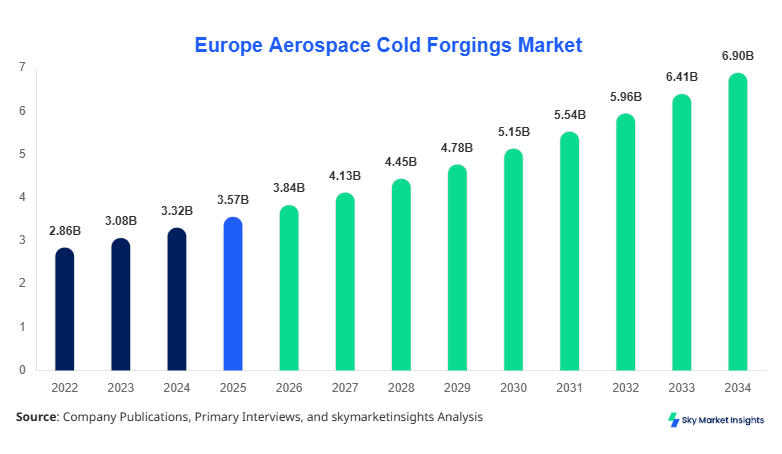
Europe Aerospace Cold Forgings market size is projected at USD 3.84 billion in 2026 and is expected to hit USD 6.91 billion by 2034 with a CAGR of 7.6%. The market is witnessing accelerated procurement activities across commercial and defense aviation programs, supported by rising aircraft production volumes exceeding 1,950 units annually across Europe. Increasing demand for lightweight forged aerospace components, improved fatigue resistance, and enhanced dimensional precision is driving adoption among OEMs and Tier-1 suppliers. The market assessment incorporates production capacity analysis, component penetration rates, raw material supply trends, regulatory standards, and competitive benchmarking across major European aerospace manufacturing hubs.
The Aerospace Cold Forgings Market comprises the manufacturing and supply of precision-forged aerospace components produced through cold deformation processes without material heating beyond recrystallization temperature. These forged parts are widely utilized in landing gear assemblies, turbine systems, structural brackets, fasteners, wing fittings, engine shafts, and fuselage reinforcement systems. Europe accounted for approximately 28.4% of global aerospace forging production in 2025, with annual forged aerospace component output surpassing 412 million units. Titanium alloy forgings represented nearly 34% of overall aerospace forging consumption, while aluminum alloy products contributed 42% of total demand due to superior strength-to-weight ratios. Commercial aviation applications contributed 51% of total market revenue, military aviation held 31%, and space launch systems accounted for 18%. Adoption penetration of automated cold forging systems exceeded 46% among European aerospace manufacturing facilities in 2025. Demand analytics indicate that aircraft manufacturers are increasingly preferring near-net-shape forging techniques capable of reducing machining waste by 25% to 38% and lowering production costs by 14%. Aircraft fleet modernization programs and rising satellite launch activities continue to reinforce the Aerospace Cold Forgings Market.
Explore more data points, trends and opportunities Download Free Sample Report
Aerospace Cold Forgings Market Trends
Increasing Automation and Smart Manufacturing Integration
European aerospace forging manufacturers are increasingly adopting Industry 4.0-enabled forging technologies to improve precision, productivity, and material efficiency. More than 48% of aerospace forging plants in Europe implemented automated robotic forging cells and AI-enabled inspection systems in 2025. Smart forging systems improved cycle efficiency by 19% while reducing rejection rates by nearly 13%. Germany, France, and the United Kingdom collectively invested over USD 640 million in digital aerospace manufacturing infrastructure during 2024–2025. Aerospace OEMs are also demanding higher repeatability for structural components used in narrow-body aircraft and advanced fighter platforms. Production volumes of high-strength titanium forgings exceeded 74 million units across Europe in 2025, reflecting growing adoption in turbine compressor systems and structural airframe assemblies. Real-time monitoring technologies capable of measuring forging force above 6,500 tons and thermal variation within ±2°C are becoming standard across advanced facilities. The transition toward automated defect detection and predictive maintenance continues to reinforce the Aerospace Cold Forgings Market.
Rising Demand for Lightweight and High-Strength Components
The aerospace sector is increasingly focused on reducing aircraft weight and improving fuel efficiency, resulting in higher demand for advanced cold forged aluminum and titanium components. Aerospace-grade aluminum forging consumption increased by 12.4% in 2025, with demand particularly strong in commercial aviation platforms. Titanium alloy penetration in military aircraft structures reached 39% due to superior corrosion resistance and fatigue performance. Forged landing gear systems produced through advanced cold forging methods demonstrated 22% higher structural durability compared to conventional machining processes. Space launch vehicle manufacturers across Europe increased procurement of precision-forged structural rings and fasteners by 16% during 2025. The adoption of lightweight forged assemblies enabled aerospace manufacturers to reduce overall component mass by nearly 18% while maintaining high tensile strength exceeding 1,100 MPa in critical applications. These material advancements and engineering innovations are accelerating the Aerospace Cold Forgings Market.
Expansion of Space and Defense Aerospace Programs
European governments and private aerospace companies are increasing investments in defense modernization and space launch infrastructure. Military aircraft procurement expenditure across Europe exceeded USD 72 billion in 2025, while space launch and satellite deployment investments surpassed USD 14 billion. Russia, France, and Germany collectively accounted for more than 61% of aerospace defense forging demand in the region. Cold forged structural components for missile systems and satellite deployment mechanisms experienced production growth of 15.7% in 2025. Space launch vehicle production volume increased by 9%, driving demand for high-strength forged rings, flanges, and couplings capable of operating under temperatures exceeding 1,200°C. Aerospace forging suppliers are also developing multi-alloy hybrid forging solutions that improve thermal endurance by 21%. Increased defense procurement cycles and reusable space launch technologies continue to strengthen the Aerospace Cold Forgings Market.
Europe Aerospace Cold Forgings Drivers
Rising Aircraft Production and Fleet Modernization Programs
Aircraft manufacturing expansion across Europe is significantly driving demand for aerospace cold forged components. More than 2,400 aircraft are projected for delivery across European aviation programs between 2026 and 2030, increasing demand for high-performance forged parts used in fuselage structures, landing gear systems, and propulsion assemblies. Commercial aircraft manufacturers increased annual procurement of forged titanium fasteners by 18% in 2025, while military aviation programs expanded structural forging demand by 14%. Advanced narrow-body aircraft production lines now require approximately 22,000 forged components per aircraft, including brackets, clamps, shafts, and structural couplings. Airlines are increasingly prioritizing lightweight aircraft capable of reducing fuel consumption by 12% to 15%, accelerating adoption of aluminum and titanium cold forged parts. Aerospace cold forging facilities in Europe also increased production capacity by nearly 11% during 2024–2025 to support growing aircraft order backlogs exceeding 8,700 units. Continuous investment in next-generation aircraft platforms and high-strength alloy technologies is accelerating the Aerospace Cold Forgings Market.
Europe Aerospace Cold Forgings Restraints
High Capital Costs and Complex Certification Requirements
The aerospace cold forging industry faces substantial barriers associated with capital-intensive equipment and rigorous aerospace certification standards. Installation costs for advanced multi-stage cold forging systems capable of producing aerospace-grade titanium parts can exceed USD 28 million per production line. European forging manufacturers allocate nearly 17% of operational expenditure toward compliance testing, metallurgical inspection, and quality certification procedures. Aerospace components must satisfy strict fatigue resistance, tensile strength, and dimensional tolerance standards established by aviation regulators, increasing production lead times by 20% to 26%. Material waste rates for high-strength titanium alloys can also reach 14% during tooling adjustments and prototype manufacturing stages. Additionally, small and medium-sized forging suppliers face challenges in securing long-term aerospace contracts due to limited automation capabilities and fluctuating raw material prices. Titanium alloy prices increased by approximately 9.1% during 2025, affecting production economics for forging manufacturers. These operational complexities continue to restrain the Aerospace Cold Forgings Market.
Europe Aerospace Cold Forgings Opportunities
Growing Investments in Reusable Space Launch Systems
The emergence of reusable launch vehicles and expanding satellite deployment programs present substantial opportunities for aerospace cold forging manufacturers. European space sector investments exceeded USD 15 billion in 2025, with over 240 satellites launched from European programs during the year. Reusable launch systems require high-performance forged components capable of withstanding repeated thermal and mechanical stress cycles exceeding 35 launch missions. Demand for precision cold forged structural rings and high-temperature alloy couplings increased by 18.6% across space launch vehicle manufacturers. Aerospace forging companies are also investing in ultra-high-strength nickel-based alloy forging technologies capable of operating at temperatures above 1,300°C. Spain, France, and Germany collectively accounted for 58% of new aerospace forging investments associated with space programs. Hybrid additive-forging manufacturing processes are reducing material waste by nearly 27% while improving component lifespan by 22%. These innovations and increasing space commercialization activities are creating major opportunities for the Aerospace Cold Forgings Market.
Challenges in Europe Aerospace Cold Forgings
Supply Chain Disruptions and Skilled Labor Shortages
The aerospace cold forging sector continues to face challenges related to supply chain volatility and workforce shortages. European aerospace forging manufacturers reported average raw material lead times increasing from 9 weeks to 16 weeks during 2024–2025 due to disruptions in titanium and specialty steel supply chains. Nearly 38% of aerospace forging facilities indicated shortages of highly skilled forging technicians and metallurgical engineers. Production downtime caused by tooling shortages and maintenance delays increased operational costs by approximately 8%. More than 41% of aerospace manufacturers experienced delivery postponements for critical forged parts used in engine and landing gear assemblies. In addition, energy-intensive forging operations recorded electricity cost increases of 13% in several European countries during 2025, affecting profitability. Aging industrial infrastructure across certain regional forging plants also reduced productivity efficiency by 9% compared to modern automated facilities. These supply chain and labor-related constraints remain key challenges for the Aerospace Cold Forgings Market.
Report Scope
| Report Metric | Details |
|---|---|
| Market Size in 2025 | USD 3.57 Billion |
| Market Size in 2026 | USD 3.84 Billion |
| Market Size in 2034 | USD 6.91 Billion |
| CAGR | 7.6% (2026-2034) |
| Base Year for Estimation | 2025 |
| Historical Data | 2022-2024 |
| Forecast Period | 2026-2034 |
| Report Coverage | Revenue Forecast, Competitive Landscape, Supply Chain Disruption, Growth Factors, Environment & Regulatory Landscape and Trends |
Explore more data points, trends and opportunities Download Free Sample Report
Aerospace Cold Forgings Market Segmentation
The Aerospace Cold Forgings Market is segmented by material type and application, with aluminum alloys dominating approximately 42% of total market revenue due to lightweight structural performance. Commercial aircraft applications accounted for nearly 51% of overall demand, while military aviation and space systems collectively represented 49%. Increasing production of high-strength forged components and rising penetration of titanium alloys are reshaping the competitive landscape.
By Type
Aluminum alloy cold forgings accounted for approximately 42% of European aerospace forging demand in 2025 due to superior machinability and lightweight characteristics. Annual production volumes exceeded 176 million forged aluminum aerospace components across Europe. These forgings are widely utilized in fuselage frames, seat tracks, wing brackets, and hydraulic housings. Aluminum alloy forged components provide tensile strengths between 350 MPa and 570 MPa while reducing aircraft structural weight by up to 20% compared to steel alternatives. Commercial aviation represented 61% of aluminum alloy forging consumption. Advanced 7xxx series aerospace aluminum alloys experienced demand growth of 10.8% in 2025 due to improved fatigue performance and corrosion resistance.
Titanium alloy forgings represented nearly 34% of total market revenue and are increasingly adopted in engine compressor systems, landing gear structures, and military aircraft assemblies. Europe produced more than 74 million titanium forged aerospace components in 2025. Titanium forgings demonstrate tensile strengths exceeding 1,100 MPa and maintain structural stability under temperatures above 600°C. Military aircraft applications contributed 43% of titanium forging demand due to superior heat resistance and durability. Precision multi-stage cold forging technologies reduced titanium machining waste by approximately 24%, improving production economics for aerospace manufacturers.
Steel alloy forgings accounted for approximately 24% of the aerospace cold forging industry and remain essential for high-load structural applications. Aerospace-grade steel forging output surpassed 98 million units in 2025, primarily used in landing gear cylinders, engine shafts, fasteners, and structural couplings. High-strength steel forgings offer hardness levels above 58 HRC and fatigue endurance exceeding 10 million load cycles. Military aviation represented 37% of steel forging demand due to extensive utilization in armored aerospace structures and defense propulsion systems. Advanced chromium-molybdenum steel alloys improved wear resistance by nearly 16% compared to conventional aerospace steels.
By Application
Commercial aircraft applications accounted for approximately 51% of total aerospace forging consumption in Europe during 2025. More than 210 million forged aerospace components were integrated into narrow-body and wide-body commercial aircraft production programs. Structural brackets, seat tracks, engine mounts, turbine discs, and landing gear systems represent major forged product categories within commercial aviation. Aircraft manufacturers increasingly prefer precision cold forged parts due to their ability to reduce assembly weight by nearly 17% and improve structural integrity. Aluminum alloy forgings dominated commercial aviation applications with 58% penetration, while titanium alloy adoption increased rapidly in advanced fuel-efficient aircraft platforms.
Military aircraft applications contributed nearly 31% of overall market demand due to expanding defense procurement programs across Europe. Aerospace forging manufacturers supplied more than 124 million forged components to fighter aircraft, surveillance platforms, and military transport aircraft in 2025. Titanium and high-strength steel forgings are widely used in engine systems, missile integration structures, and combat aircraft fuselage reinforcements. Forged aerospace components used in military applications must withstand extreme operational stress, thermal exposure, and vibration conditions exceeding 14g acceleration loads. Defense aerospace programs across France, the United Kingdom, and Germany increased procurement of forged structural assemblies by 13.4% during 2025.
Space launch vehicle applications represented approximately 18% of market revenue and are emerging as a high-growth segment across Europe. Production volumes of forged rings, couplings, and cryogenic tank components exceeded 52 million units in 2025. Space-grade forged alloys demonstrate thermal endurance above 1,200°C and tensile strengths surpassing 1,300 MPa in launch environments. Satellite deployment systems and reusable launch vehicle structures increasingly utilize titanium and nickel-based forged components due to enhanced fatigue resistance and reduced weight. Private aerospace companies and government-backed launch programs collectively increased space-related forging procurement by 16% in 2025.
Europe Aerospace Cold Forgings Market Segmentations
Material Type
- Aluminum Alloys
- Titanium Alloys
- Steel Alloys
Application
- Commercial Aircraft
- Military Aircraft
- Space Launch Vehicles
Europe Aerospace Cold Forgings Regional Outlook
United Kingdom
The United Kingdom accounted for approximately 18% of the European aerospace cold forging industry in 2025, supported by strong defense aviation production and advanced aerospace engineering capabilities. More than 85 aerospace forging facilities operate across the country, producing over 64 million forged aerospace components annually. Military aviation applications represented 44% of forging demand due to ongoing fighter aircraft modernization programs and defense procurement activities. Titanium alloy forging adoption exceeded 36% within aerospace engine systems and structural reinforcement applications. Investments in next-generation aerospace propulsion technologies increased by nearly 12% during 2025, supporting long-term manufacturing expansion.
Germany
Germany represented nearly 21% of regional aerospace forging production and remains a major hub for automated aerospace manufacturing technologies. The country produced over 81 million aerospace-grade forged components in 2025, including engine shafts, landing gear systems, and turbine assemblies. Commercial aviation accounted for 53% of forging demand due to strong participation in aircraft manufacturing supply chains. Automated forging adoption surpassed 58% across German aerospace facilities, improving productivity efficiency by approximately 18%. Germany also accounted for 24% of regional aerospace R&D expenditure focused on lightweight alloy forging technologies.
France
France dominated the European aerospace forging landscape with approximately 31% regional share in 2025. Annual aerospace cold forged component production exceeded 128 million units, driven by extensive commercial aircraft manufacturing activities and defense aerospace investments. Commercial aircraft applications represented 56% of domestic forging demand, while military aviation accounted for 28%. More than 62% of aerospace forging manufacturers integrated smart forging systems and AI-based inspection technologies during 2025. The country also led regional investments in reusable launch vehicle programs and satellite deployment infrastructure.
Spain
Spain contributed nearly 11% of European aerospace forging output in 2025 and continues to strengthen its aerospace manufacturing ecosystem. Aerospace forging production exceeded 42 million units annually, with increasing demand from space launch and commercial aviation programs. Aluminum alloy forgings accounted for approximately 46% of domestic forging consumption due to rising narrow-body aircraft production. Government-supported aerospace modernization initiatives increased industrial investment by nearly 9% during 2025. Space launch infrastructure development and defense aviation procurement are creating additional opportunities for forging suppliers across Spain.
Italy
Italy accounted for approximately 9% of regional aerospace forging production and maintains strong specialization in aerospace structural assemblies and propulsion systems. Annual forged aerospace component output exceeded 37 million units in 2025. Commercial aviation applications represented 48% of domestic demand, while military aircraft contributed 34%. Italian aerospace forging manufacturers increasingly adopted high-precision cold forging technologies capable of reducing machining waste by 21%. Investments in titanium alloy processing and advanced forging simulation software improved production efficiency and dimensional consistency across aerospace applications.
Russia
Russia represented approximately 10% of the European aerospace forging industry due to strong defense aviation and space launch manufacturing activities. Aerospace forging production surpassed 39 million units in 2025, with military aircraft accounting for nearly 49% of demand. High-strength steel and titanium forgings are widely utilized in propulsion systems, missile structures, and launch vehicle assemblies. Russia also accounted for approximately 18% of regional space-related forging demand. Increasing investments in hypersonic aerospace systems and heavy-lift launch technologies continue to support forging production expansion.
Top players in Europe Aerospace Cold Forgings
- Precision Castparts Corp.
- Arconic Corporation
- Allegheny Technologies Incorporated
- Bharat Forge Ltd.
- LISI Aerospace
- Aubert & Duval
- Otto Fuchs KG
- Safran Group
- Doncasters Group
- Farinia Group
- Thyssenkrupp Aerospace
- Howmet Aerospace
- CFS Forge
- Trenchard Aviation Group
- VSMPO-AVISMA Corporation
Precision Castparts Corp.
-
Precision Castparts Corp. accounted for approximately 14% of the European aerospace forging industry in 2025.
-
The company operates advanced aerospace forging facilities capable of producing more than 28 million aerospace components annually.
-
Its portfolio includes titanium structural forgings, engine discs, landing gear assemblies, and aerospace fasteners.
-
The company strengthened its aerospace positioning through investments in automated multi-stage forging systems that improved productivity by 17%.
-
Precision Castparts maintains strong supply agreements with major commercial and military aircraft manufacturers across Europe.
Safran Group
-
Safran Group held nearly 11% market share within the European aerospace forging ecosystem in 2025.
-
The company specializes in forged aerospace propulsion systems, landing gear structures, and turbine assemblies.
-
Safran increased investment in lightweight alloy forging technologies by approximately 13% during 2025 to support next-generation aircraft engine programs.
-
The company expanded titanium alloy forging capacity and integrated AI-enabled inspection systems capable of reducing defect rates by 12%.
-
Strong participation in commercial aviation and defense aerospace programs continues to reinforce Safran’s regional positioning.
Investment Analysis
The European aerospace forging sector continues to attract strong investment flows driven by aircraft modernization, defense spending, and reusable launch system development. Approximately 38% of total aerospace manufacturing investment across Europe during 2025 was allocated toward advanced forging and precision machining technologies. France, Germany, and the United Kingdom collectively represented nearly 67% of total regional aerospace forging investments. Commercial aviation programs attracted 46% of overall forging investment allocation, while military aviation and space launch systems accounted for 34% and 20%, respectively. Aerospace forging manufacturers invested heavily in robotic forging systems, automated defect inspection, and digital simulation technologies capable of reducing production lead times by 18%.
Mergers, acquisitions, and strategic collaborations increased significantly across the aerospace forging value chain during 2024–2025. More than 22 major aerospace manufacturing partnerships were announced across Europe, focusing on lightweight alloy processing, titanium supply chain integration, and additive-forging hybrid manufacturing technologies. Aerospace OEMs increasingly entered long-term supply agreements with forging suppliers to secure stable procurement of critical structural components. Joint ventures related to reusable launch systems and advanced propulsion technologies increased by approximately 14% in 2025. Germany accounted for nearly 26% of collaborative aerospace forging projects, followed by France at 24% and the United Kingdom at 19%. Investments in sustainable forging technologies and low-emission manufacturing infrastructure also accelerated across Europe.
New Product Developments
Aerospace forging manufacturers are introducing high-performance forged components optimized for fuel-efficient aircraft and reusable launch systems. Nearly 29% of newly launched aerospace forged products during 2025 incorporated lightweight titanium or hybrid alloy compositions. Advanced forged turbine components demonstrated performance efficiency improvements of approximately 16% compared to previous-generation products. Aerospace suppliers also introduced ultra-high-strength forged fasteners capable of withstanding tensile loads exceeding 1,350 MPa. Digital forging simulation technologies reduced prototype development time by nearly 21%, accelerating commercialization cycles.
Several manufacturers also introduced additive-assisted cold forging systems that improved material utilization efficiency by 24%. Smart forging inspection platforms integrated with machine learning algorithms reduced defect detection time by 18%. New corrosion-resistant aerospace alloy formulations increa
Recent Developments in Europe Aerospace Cold Forgings
- 2025: Safran Group expanded titanium aerospace forging capacity in France by 15%, increasing annual production capability for aircraft engine components and structural assemblies. The expansion supported growing demand from narrow-body commercial aircraft programs and advanced military propulsion systems. Automated forging systems installed at the facility improved precision efficiency by approximately 12%.
- 2025: Precision Castparts Corp. invested more than USD 180 million in advanced aerospace forging automation across European manufacturing operations. The initiative increased aerospace-grade forged component output by 11% and reduced material waste by 19%. The company also introduced AI-enabled inspection systems for high-strength turbine assemblies.
- 2025: Arconic Corporation expanded aerospace forging production for military aircraft systems in Germany and the United Kingdom. The expansion increased forged structural assembly production by 13% and strengthened supply chain integration for European defense aviation programs. Titanium forging procurement within the project increased by nearly 16%.
Research Methodology
The Europe Aerospace Cold Forgings Market assessment was developed through a combination of primary and secondary research methodologies focused on aerospace manufacturing trends, forging production capacities, and aerospace procurement dynamics. The research process involved extensive analysis of aerospace OEM production statistics, forging supplier revenue trends, aerospace component shipment data, and regional manufacturing investments across Europe. Primary research included interviews with aerospace manufacturers, forging technology providers, raw material suppliers, aviation engineers, and industry executives to validate production volumes, technology penetration rates, and procurement strategies. Secondary research incorporated aerospace trade journals, aviation regulatory databases, defense procurement reports, annual company filings, and industrial manufacturing statistics. Market size estimation was conducted using bottom-up and top-down analytical approaches integrating aerospace production output, forging consumption ratios, application-wise penetration rates, and regional investment analysis. Data triangulation methods were applied to ensure statistical consistency across aircraft production, alloy consumption, forging capacity utilization, and regional aerospace infrastructure expansion. Quantitative analysis further incorporated supply chain evaluation, pricing trends, investment benchmarking, and competitive positioning across major European aerospace forging manufacturers.
Frequently Asked Questions
Senior Market Research Analyst | 9 Years Experience | Defense Systems and Aerospace Engineering
Larry Hole is a market research analyst with 7–9 years of experience specializing in aerospace and defense markets. Contributed to 70+ research reports for global clients. Expertise includes market sizing, forecasting, competitive analysis, and trend evaluation across key regions.