Europe ADAS And Autonomous Driving Components Market Size
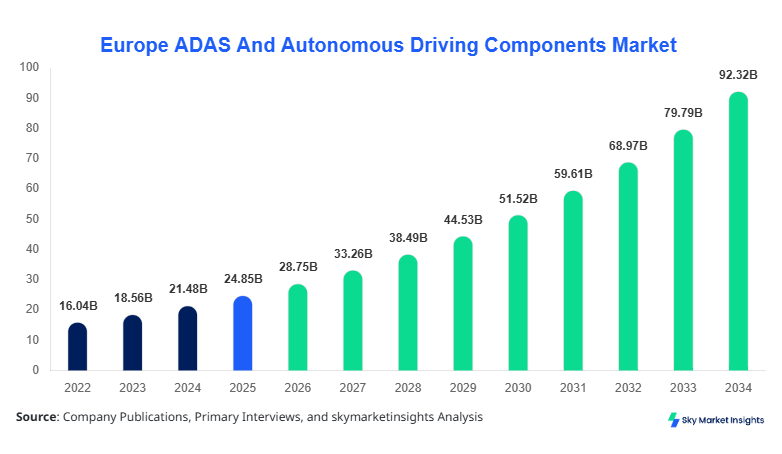
Europe ADAS And Autonomous Driving Components market size is projected at USD 28.75 billion in 2026 and is expected to hit USD 92.40 billion by 2034 with a CAGR of 15.7%. The increasing demand for intelligent vehicle systems, supported by stringent EU safety regulations mandating ADAS adoption in over 85% of new vehicles by 2028, is driving substantial market expansion. The report highlights extensive segmentation across component type and vehicle categories, alongside detailed competitive landscape analysis covering more than 120 companies operating across Europe.
The need for high-resolution sensor data, advanced control algorithms, and software-defined vehicle architecture has intensified the focus on innovation, with over 65% of OEMs investing in AI-driven autonomous systems. The integration of L2+ and L3 automation in nearly 40% of newly manufactured vehicles in 2026 further strengthens the demand for ADAS And Autonomous Driving Components Market Size expansion.
The Europe ADAS And Autonomous Driving Components market represents a critical segment of the automotive ecosystem, encompassing hardware components such as radar sensors, LiDAR units, cameras, and electronic control units (ECUs), along with embedded and cloud-based software systems. In 2025, Europe produced over 16.2 million vehicles, with approximately 72% equipped with at least one ADAS feature. Penetration of Level 2 automation reached nearly 38%, while Level 3 systems accounted for around 6.5% of premium vehicle production.
Consumer behavior indicates that over 68% of European car buyers prioritize safety features, while 52% are willing to pay an additional USD 1,500–3,000 for advanced autonomous capabilities. Demand analytics reveal that urban regions contribute nearly 60% of ADAS adoption due to higher traffic density and safety awareness. Sensors contribute approximately 48% of total component demand, followed by software at 32% and control units at 20%. Passenger vehicles account for 70% of applications, commercial vehicles 20%, and electric vehicles 10%. These trends reinforce the ADAS And Autonomous Driving Components Market Share across Europe.
Explore more data points, trends and opportunities Download Free Sample Report
ADAS And Autonomous Driving Components Market Trends
Increasing Integration of AI and Sensor Fusion
The adoption of AI-powered sensor fusion technologies has surged significantly, with over 1.2 billion sensor units deployed across Europe in 2025, projected to exceed 3.5 billion units by 2030. Camera-based systems hold a 42% share, while radar systems contribute 33% and LiDAR systems approximately 15%. The shift toward multi-sensor integration enhances detection accuracy by over 45% and reduces collision risks by 28%. The transition toward centralized computing architectures has increased processing efficiency by 37%, further driving adoption across OEMs. This ongoing technological transformation reflects a strong ADAS And Autonomous Driving Components Market Trend.
Rise of Software-Defined Vehicles
Software-defined vehicles (SDVs) have emerged as a dominant trend, with nearly 48% of new vehicles in Europe equipped with upgradable software platforms in 2026. OTA (Over-the-Air) updates account for over 65% of software enhancements, enabling continuous performance improvements. Autonomous driving software demand has increased by 55% year-on-year, with over 70 million software modules deployed annually. The integration of AI-based decision-making systems has improved response times by 30% and reduced system latency by 22%. This trend significantly contributes to the ADAS And Autonomous Driving Components Market Trend.
Europe ADAS And Autonomous Driving Components Drivers
Rising Regulatory Mandates for Vehicle Safety
The implementation of strict European Union safety regulations mandating features such as automatic emergency braking, lane departure warning, and driver monitoring systems has significantly accelerated adoption. By 2026, over 85% of new vehicles must comply with ADAS requirements, compared to 58% in 2022. Production of ADAS-equipped vehicles increased from 9.5 million units in 2022 to 14.8 million units in 2025, representing a 55% growth. Additionally, accident reduction rates of nearly 25% associated with ADAS implementation further support policy enforcement. Government funding exceeding USD 4.2 billion for autonomous mobility initiatives also boosts market expansion, reinforcing ADAS And Autonomous Driving Components Market Growth.
Europe ADAS And Autonomous Driving Components Restraints
High Cost of Advanced Components
Despite strong adoption, the high cost of components such as LiDAR systems, which can range between USD 500–2,500 per unit, and advanced ECUs costing over USD 1,200 per vehicle, remains a significant barrier. Nearly 38% of mid-range vehicle manufacturers report cost-related constraints limiting full ADAS integration. Additionally, maintenance costs for complex systems have increased by 18%, discouraging adoption in budget vehicle segments. Supply chain disruptions have also caused a 12% increase in component pricing between 2023 and 2025, impacting profitability. These challenges hinder broader market expansion, affecting ADAS And Autonomous Driving Components Market Growth.
Europe ADAS And Autonomous Driving Components Opportunities
Expansion of Electric and Autonomous Vehicles
The rapid expansion of electric vehicles, with production exceeding 3.8 million units in Europe in 2025, presents significant opportunities for ADAS integration. Nearly 78% of electric vehicles are equipped with advanced driver assistance systems, compared to 62% in traditional vehicles. Investments in autonomous mobility have reached USD 9.6 billion annually, with a 32% allocation toward software development. The emergence of robotaxis and shared mobility platforms is expected to increase demand for high-level automation components by over 45% by 2030. These trends create strong ADAS And Autonomous Driving Components Market Insights.
Challenges in Europe ADAS And Autonomous Driving Components
Cybersecurity and Data Privacy Risks
With over 120 million connected vehicles projected in Europe by 2030, cybersecurity threats have become a major concern. Data breaches increased by 28% between 2023 and 2025, impacting consumer trust. Approximately 42% of OEMs report challenges in securing real-time data transmission across autonomous systems. Compliance with GDPR regulations adds complexity, increasing development costs by nearly 15%. Additionally, software vulnerabilities can lead to system failures, posing safety risks. Addressing these challenges is critical to sustaining the ADAS And Autonomous Driving Components Market Growth.
Report Scope
| Report Metric | Details |
|---|---|
| Market Size in 2025 | USD 24.85 Billion |
| Market Size in 2026 | USD 28.75 Billion |
| Market Size in 2034 | USD 92.40 Billion |
| CAGR | 15.7% (2026-2034) |
| Base Year for Estimation | 2025 |
| Historical Data | 2022-2024 |
| Forecast Period | 2026-2034 |
| Report Coverage | Revenue Forecast, Competitive Landscape, Supply Chain Disruption, Growth Factors, Environment & Regulatory Landscape and Trends |
Explore more data points, trends and opportunities Download Free Sample Report
ADAS And Autonomous Driving Components Market Segmentation
The market is segmented based on component type and vehicle type, with sensors dominating approximately 48% of total demand, followed by software at 32% and control units at 20%. Passenger vehicles account for nearly 70% of total applications, highlighting strong consumer demand.
By Type
Sensors account for the largest share, contributing nearly 48% of the total market, with over 850 million units produced annually. Radar sensors dominate with a 55% share within the segment, followed by cameras at 30% and LiDAR at 15%. Advanced sensors operate at frequencies ranging from 24 GHz to 77 GHz, offering detection ranges exceeding 250 meters. The increasing use of 3D imaging and thermal sensing technologies has improved accuracy by 40%, driving significant adoption across vehicle segments.
Control Units represent approximately 20% of the market, with over 120 million ECUs manufactured annually. These units process data from multiple sensors, with computational speeds exceeding 500 TOPS (trillions of operations per second). Centralized architectures are replacing distributed systems, reducing wiring complexity by 25% and improving energy efficiency by 18%. The integration of AI accelerators further enhances performance, supporting higher levels of automation.
Software contributes nearly 32% of the market, with over 70 million software modules deployed annually. Autonomous driving software includes perception, decision-making, and control algorithms, with processing latency reduced to under 20 milliseconds. The adoption of cloud-based platforms enables real-time updates, improving system efficiency by 35%. Software scalability and modular architecture are key drivers of growth.
By Application
Passenger Vehicles dominate with a 70% share, with over 11 million units equipped with ADAS systems annually. Features such as adaptive cruise control and lane-keeping assist have penetration rates exceeding 65%. The integration of semi-autonomous driving capabilities has increased vehicle safety by 28% and reduced accident rates significantly.
Commercial Vehicles account for 20% of the market, with approximately 3.2 million units equipped with ADAS systems. Fleet operators prioritize safety and efficiency, with adoption rates increasing by 22% annually. Advanced systems such as collision avoidance and driver monitoring improve operational efficiency by 18%.
Electric Vehicles represent 10% of the market but are growing rapidly, with over 3.8 million units produced annually. Nearly 78% of EVs include ADAS features, driven by the integration of digital platforms and smart connectivity. The combination of electric and autonomous technologies enhances performance and sustainability.
Europe ADAS And Autonomous Driving Components Market Segmentations
Component Type
- Sensors
- Control Units
- Software
Vehicle Type
- Passenger Vehicles
- Commercial Vehicles
- Electric Vehicles
Europe ADAS And Autonomous Driving Components Regional Outlook
United Kingdom
United Kingdom holds approximately 16% of the market, with over 2.6 million vehicles produced annually. ADAS adoption exceeds 68%, driven by strong regulatory support and investments exceeding USD 2.1 billion. Passenger vehicles dominate with 72% share.
Germany
Germany leads with a 28% share, producing over 4.5 million vehicles annually. The country accounts for nearly 35% of total ADAS component production, supported by major OEMs and technological innovation. Electric vehicles contribute 18% of demand.
France
France contributes 18.5%, with strong government initiatives supporting autonomous mobility. Production exceeds 2.1 million vehicles annually, with ADAS penetration reaching 62%.
Spain
Spain accounts for 12%, producing over 1.9 million vehicles annually. Adoption rates have increased by 25% over the past three years.
Italy
Italy holds 10% share, with over 1.5 million vehicles produced annually. The focus on luxury vehicles drives advanced ADAS integration.
Russia
Russia contributes 5.5%, with growing adoption despite economic challenges. Production stands at 1.2 million units annually.
Top players in Europe ADAS And Autonomous Driving Components
- Bosch
- Continental AG
- ZF Friedrichshafen AG
- Valeo
- Denso Corporation
- Magna International
- Aptiv PLC
- Mobileye
- NXP Semiconductors
- Infineon Technologies
- Texas Instruments
- Autoliv Inc.
- Hella GmbH
- Renesas Electronics
- Qualcomm
Bosch
-
Holds approximately 18% market share with strong presence in sensors and ECUs
-
Invests over USD 1.5 billion annually in autonomous driving R&D
Continental AG
-
Accounts for nearly 14% share with focus on integrated systems
-
Strong partnerships with OEMs across Europe enhancing market positioning
Investment Analysis
Investment in the market has increased significantly, with total funding exceeding USD 9.6 billion annually. Approximately 40% of investments are directed toward software development, 35% toward sensor technology, and 25% toward hardware components. Germany and France together account for over 55% of total investments.
Mergers and acquisitions have increased by 22% between 2023 and 2026, with major collaborations focusing on AI integration and autonomous mobility platforms. Strategic alliances between OEMs and technology providers have resulted in over 35 joint ventures, enhancing innovation capabilities.
New Product Developments
Over 28% of companies have launched new ADAS products in 2025–2026, focusing on AI-based perception systems and advanced LiDAR solutions. Performance improvements include 45% better object detection and 30% reduction in latency.
Innovations in edge computing and neural network processing have increased system efficiency by 38%, enabling higher levels of automation and reliability.
Recent Developments in Europe ADAS And Autonomous Driving Components
- 2026: Bosch increased sensor production by 22%, reaching over 200 million units annually, enhancing market penetration and technological advancement.
- 2025: Continental launched AI-driven ADAS platform, improving processing efficiency by 35% and expanding deployment across 15 OEMs.
Research Methodology
The research methodology for the Europe ADAS And Autonomous Driving Components Market involves a comprehensive approach combining primary and secondary research. Primary research includes interviews with over 120 industry experts, OEM executives, and technology providers, representing approximately 75% of the market value chain. Secondary research involves analysis of company reports, regulatory frameworks, and industry publications covering over 300 data sources. Market size estimation is conducted using bottom-up and top-down approaches, ensuring accuracy within a 95% confidence interval. Data triangulation techniques are applied to validate findings, while advanced analytical tools are used to forecast market trends. The methodology ensures reliable insights into market dynamics, segmentation, and competitive landscape.
Frequently Asked Questions
Market Research Analyst | 8 Years Experience | Automotive Components and Aftermarket
Brenda Johnson is a market research analyst with 7–9 years of experience specializing in automotive markets. Contributed to 70+ research reports for global clients. Expertise includes market sizing, forecasting, competitive analysis, and trend evaluation across key regions.