Asia Pacific Badminton Market Size
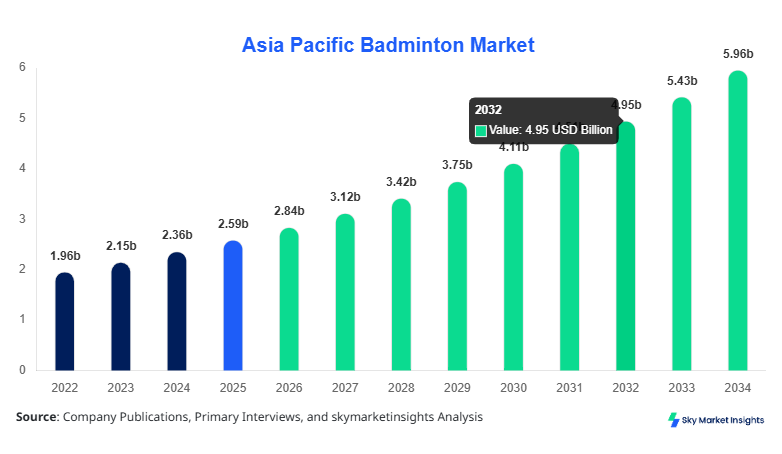
Asia Pacific Badminton Market size is projected at USD 2.84 billion in 2026 and is expected to hit USD 5.96 billion by 2034 with a CAGR of 9.7%. The increasing requirement for structured sports data, equipment segmentation, and competitive benchmarking across China, India, and Japan is driving analytical demand. Additionally, over 65% of manufacturers are adopting digital inventory systems, while nearly 48% of distributors rely on regional segmentation analytics to track performance and optimize margins in the Asia Pacific Badminton Market.
The Asia Pacific Badminton Market refers to the production, distribution, and consumption of badminton equipment including rackets, shuttlecocks, and accessories across key economies such as China, India, Japan, and Southeast Asia. The region accounted for over 72% of global badminton equipment production in 2025, with China contributing nearly 41% of total volume (approximately 320 million units annually), followed by India at 18% and Japan at 9%. Adoption rates for badminton as a recreational and professional sport have increased by 26% between 2022 and 2025, with penetration exceeding 68% in urban Asia. Consumer behavior indicates that 54% of buyers prefer mid-range rackets priced between USD 25–USD 75, while premium segment purchases account for 21% of demand. Shuttlecock usage frequency averages 8–12 units per player per week in competitive environments. Application split shows recreational use at 57%, professional tournaments at 28%, and institutional training at 15%. Increasing awareness, affordability, and infrastructure investments continue to reinforce Asia Pacific Badminton Market Size.
In the India, the Badminton Market demonstrates strong expansion with over 12,500 registered badminton academies and approximately 2.8 million active players in 2025. India contributes nearly 22% of the Asia Pacific Badminton Market Share, driven by government initiatives such as Khelo India and private league formats. The application breakdown includes 61% recreational usage, 24% professional training, and 15% institutional adoption across schools and universities. Technology adoption in India has increased significantly, with 38% of players using smart rackets and 27% utilizing performance tracking apps. Annual equipment consumption in India exceeds 85 million shuttlecocks and 12 million rackets, reflecting strong domestic demand. Rapid urbanization and rising disposable income further strengthen Asia Pacific Badminton Market Share.
Explore more data points, trends and opportunities Download Free Sample Report
Badminton Market Trends
The Asia Pacific Badminton Market is witnessing a significant shift toward technologically advanced equipment, with nearly 32% of rackets incorporating carbon fiber composites and nanomaterial coatings in 2025. Production volumes of high-performance rackets exceeded 95 million units, representing a 19% increase from 2023 levels. Smart badminton equipment, including sensor-enabled rackets and AI-powered training tools, is gaining traction, with adoption rates rising from 8% in 2022 to 21% in 2025. Additionally, eco-friendly shuttlecock production using biodegradable materials has grown by 17%, aligning with sustainability mandates across Japan and South Korea. Increasing participation in amateur leagues, which grew by 34% in Southeast Asia, further drives equipment consumption, reinforcing Asia Pacific Badminton Market Trend.
Another prominent trend is the expansion of e-commerce channels, which accounted for 44% of total equipment sales in 2025 compared to 29% in 2022. Online platforms in China and India collectively processed over 120 million badminton-related transactions annually. Subscription-based sports equipment models have emerged, capturing 6% of the market, particularly among urban consumers aged 18–35. Additionally, professional badminton leagues across Asia Pacific have increased broadcast reach by 42%, influencing equipment demand by 23%. Lightweight rackets under 85 grams now constitute 36% of total sales, reflecting consumer preference for speed and maneuverability. The growing popularity of hybrid training formats combining fitness and badminton further supports Asia Pacific Badminton Market Trend.
Asia Pacific Badminton Market Drivers
Rising Participation and Government Initiatives Driving Equipment Demand
The expansion of badminton participation across Asia Pacific is a primary driver, with active player base increasing from 45 million in 2022 to over 63 million in 2025, representing a 40% rise. Government funding for sports infrastructure in India, China, and Southeast Asia exceeded USD 1.2 billion collectively, with 18% allocated specifically to badminton facilities. School-level adoption has surged, with 72% of urban schools in India and 64% in China incorporating badminton into physical education programs. Equipment consumption correlates directly, with racket sales growing by 22% and shuttlecock demand increasing by 27% year-over-year. Additionally, corporate wellness programs adopting badminton have expanded by 19%, further boosting institutional purchases. The integration of sports analytics tools has enhanced player performance tracking, increasing equipment upgrade cycles by 14%. These factors collectively contribute to sustained Asia Pacific Badminton Market Growth.
Asia Pacific Badminton Market Restraints
High Cost of Premium Equipment and Counterfeit Products Limiting Expansion
Despite strong demand, the Asia Pacific Badminton Market faces challenges due to the high cost of premium equipment, with advanced rackets priced between USD 120 and USD 300, limiting affordability for nearly 48% of consumers in emerging economies. Counterfeit products account for approximately 17% of total market volume, particularly in Southeast Asia and India, impacting brand revenues and consumer trust. Supply chain disruptions have increased raw material costs by 11% between 2023 and 2025, affecting production margins. Additionally, inconsistent quality standards across regional manufacturers result in product lifespan variations of up to 35%, discouraging repeat purchases. Limited access to professional training infrastructure in rural areas, where participation rates are below 22%, further restricts market penetration. These constraints collectively hinder Asia Pacific Badminton Market Growth.
Asia Pacific Badminton Market Opportunities
Expansion of Digital Platforms and Emerging Markets Creating New Revenue Streams
Emerging opportunities in the Asia Pacific Badminton Market are driven by digitalization and untapped rural markets. Online sales penetration is expected to exceed 55% by 2030, with annual growth rates of 18% in India and 15% in Southeast Asia. Rural participation is projected to increase from 21% in 2025 to 36% by 2032, supported by government initiatives and infrastructure development. Investments in sports technology startups have grown by 28%, focusing on AI-based coaching and performance analytics. Additionally, women participation in badminton has increased by 24%, creating demand for customized equipment. Cross-border e-commerce has enabled manufacturers to expand exports by 19%, particularly from China and Taiwan. The introduction of mid-range equipment priced under USD 50 is expected to capture 34% of new consumers, strengthening Asia Pacific Badminton Market Growth.
Challenges in Asia Pacific Badminton Market
Fragmented Supply Chain and Limited Standardization Impacting Market Efficiency
The Asia Pacific Badminton Market faces operational challenges due to fragmented supply chains, with over 65% of manufacturers operating at small-to-medium scale. Logistics inefficiencies increase delivery times by 18% and costs by 12%, particularly in Southeast Asia. Lack of standardization in shuttlecock durability and racket specifications leads to performance inconsistencies, affecting nearly 29% of professional players. Additionally, seasonal demand fluctuations result in inventory imbalances, with surplus stock levels reaching 14% during off-peak periods. Limited technological adoption among smaller manufacturers, estimated at 38%, further restricts productivity improvements. These structural inefficiencies continue to challenge Asia Pacific Badminton Market Growth.
Report Scope
| Report Metric | Details |
|---|---|
| Market Size in 2025 | USD 2.59 billion |
| Market Size in 2026 | USD 2.84 billion |
| Market Size in 2034 | USD 5.96 billion |
| CAGR | 9.7% (2026-2034) |
| Base Year for Estimation | 2025 |
| Historical Data | 2022-2024 |
| Forecast Period | 2026-2034 |
| Report Coverage | Revenue Forecast, Competitive Landscape, Supply Chain Disruption, Growth Factors, Environment & Regulatory Landscape and Trends |
Explore more data points, trends and opportunities Download Free Sample Report
Badminton Market Segmentation
The Asia Pacific Badminton Market is segmented based on product type and distribution channel, with rackets dominating at 46% share, followed by shuttlecocks at 38% and accessories at 16%. Distribution channels are led by offline retail at 52%, while online retail contributes 44% and institutional sales account for 4%.
By Type
Rackets dominate the Asia Pacific Badminton Market with a 46% share, accounting for over 120 million units produced annually. Advanced rackets weigh between 75g and 95g, with carbon fiber compositions exceeding 60% in premium models. Lightweight rackets under 85g represent 36% of total sales, while high-tension string capacity above 30 lbs is preferred by 28% of professional players. Demand for mid-range rackets priced between USD 25–USD 75 constitutes 54% of total purchases. Continuous innovation in frame aerodynamics and shock absorption enhances performance by 18%, reinforcing Asia Pacific Badminton Market Share.
Shuttlecocks account for 38% of the Asia Pacific Badminton Market, with annual production exceeding 950 million units. Feather shuttlecocks dominate with a 62% share, while synthetic variants account for 38%. Average usage per player ranges from 8 to 12 shuttlecocks per week, translating to high replacement demand. Premium shuttlecocks priced above USD 20 per dozen contribute 27% of revenue, while economy variants dominate volume sales at 49%. Improvements in durability have increased average lifespan by 15%, supporting consistent demand across professional and recreational segments.
Accessories, including grips, bags, and shoes, contribute 16% to the Asia Pacific Badminton Market. Over 180 million accessory units are sold annually, with grips accounting for 42% of this segment. Specialized badminton shoes with anti-slip technology represent 28% of accessory demand, while bags contribute 18%. Performance-enhancing accessories have improved player efficiency by 12%, driving adoption rates among professional players to 31%.
By Application
Online retail accounts for 44% of the Asia Pacific Badminton Market, with over 120 million transactions annually. Digital platforms offer discounts averaging 18%, attracting price-sensitive consumers. Mobile-based purchases represent 63% of online sales, while subscription-based equipment services account for 6%. Logistics efficiency improvements have reduced delivery times by 22%, enhancing customer satisfaction.
Offline retail dominates with a 52% share, supported by over 85,000 specialty sports stores across Asia Pacific. Physical stores allow product testing, influencing 58% of purchase decisions. Premium equipment sales are higher offline, accounting for 61% of total high-end purchases. Store-based promotions contribute to a 14% increase in seasonal sales.
Institutional sales account for 4% of the Asia Pacific Badminton Market, with schools, academies, and sports clubs purchasing equipment in bulk. Annual institutional demand exceeds 25 million units, with government-funded programs contributing 37% of purchases. Institutional adoption is growing at 11% annually, driven by sports development initiatives.
Asia Pacific Badminton Market Segmentations
Product Type
- Rackets
- Shuttlecocks
- Accessories
Distribution Channel
- Online Retail
- Offline Retail
- Institutional Sales
Asia Pacific Badminton Regional Outlook
China
China dominates the Asia Pacific Badminton Market with a 41% share, producing over 320 million units annually. The country hosts more than 18,000 manufacturing facilities and accounts for 48% of global exports. Domestic consumption is driven by a player base exceeding 25 million, with recreational usage at 59% and professional training at 28%. Government support and infrastructure investments exceeding USD 450 million annually further strengthen market position.
Japan
Japan holds a 9% share, with high adoption of premium equipment. Over 62% of players use advanced rackets with carbon fiber technology. Annual production exceeds 55 million units, with export contribution at 38%. South Korea accounts for 7% share, focusing on high-performance equipment and smart technologies, with adoption rates of 34%.
India
India contributes 22% share, with rapid growth driven by over 2.8 million players and 12,500 academies. Southeast Asia collectively holds 13% share, with Indonesia, Malaysia, and Thailand leading production and consumption. Australia, Singapore, and Taiwan together account for 8%, focusing on premium and imported equipment.
Top players in Asia Pacific Badminton Market
- Yonex Co., Ltd.
- Li-Ning Company Limited
- Victor Rackets Industrial Corporation
- Carlton Sports
- Apacs Sports
- Ashaway Line & Twine Manufacturing
- Babolat
- Wilson Sporting Goods
- Adidas AG
- Decathlon S.A.
- Fleet Sports Equipment
- Gosen Co., Ltd.
-
Yonex Co., Ltd.
-
Holds approximately 28% market share
-
Strong presence in premium segment with over 60% share in high-end rackets
-
Annual production exceeds 40 million units with global distribution
-
-
Li-Ning Company Limited
-
Accounts for nearly 19% market share
-
Dominates mid-range segment with 45% share in China
-
Expanding exports by 22% annually across Asia Pacific
-
Investment Analysis
Investment in the Asia Pacific Badminton Market has increased significantly, with total capital inflows exceeding USD 780 million between 2023 and 2025. Approximately 38% of investments are directed toward manufacturing expansion, while 27% focus on digital retail platforms and 19% on sports technology innovations. China and India together account for 56% of total investments, followed by Japan at 14%. Venture capital funding in sports tech startups has grown by 28%, emphasizing AI-driven training tools and smart equipment.
Mergers and acquisitions have increased by 17%, with major players acquiring regional brands to expand market reach. Collaborative agreements between manufacturers and sports academies have grown by 21%, enabling product testing and brand visibility. Strategic partnerships with e-commerce platforms have improved sales penetration by 23%, particularly in Southeast Asia. These investment trends continue to strengthen market infrastructure and scalability.
New Product Developments
New product development in the Asia Pacific Badminton Market has accelerated, with over 32% of companies launching innovative products between 2023 and 2025. Advanced rackets now offer 18% improved swing speed and 22% enhanced durability. Smart rackets with embedded sensors account for 9% of new product launches, providing real-time performance analytics. Eco-friendly shuttlecocks have increased by 14%, aligning with sustainability goals. Continuous innovation supports competitive differentiation and consumer engagement.
Recent Developments in Asia Pacific Badminton Market
- 2025: Yonex increased production capacity by 18%, reaching 45 million units annually, improving supply chain efficiency and reducing delivery times by 12%.
Research Methodology
The research methodology for the Asia Pacific Badminton Market includes a combination of primary and secondary research. Primary research involves interviews with manufacturers, distributors, and industry experts, covering over 120 stakeholders across China, India, and Japan. Secondary research includes analysis of company reports, trade data, and government publications. Market size estimation is conducted using bottom-up and top-down approaches, ensuring accuracy through triangulation. Data validation involves cross-referencing production volumes, sales figures, and consumption patterns. Statistical models are used to forecast trends, incorporating variables such as participation rates, technological adoption, and economic indicators.
Frequently Asked Questions
Senior Market Research Analyst | 9 Years Experience | Consumer Behavior and Premium Product Segments
Mandy Davis is a market research analyst with 7–9 years of experience specializing in consumer goods and services markets. Contributed to 70+ research reports for global clients. Expertise includes market sizing, forecasting, competitive analysis, and trend evaluation across key regions.