Asia Pacific Baby Nursing Pillow Market Size
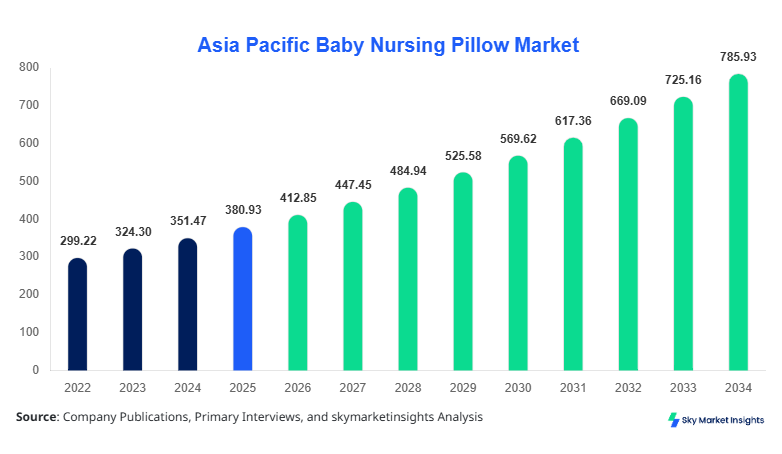
Asia Pacific Baby Nursing Pillow market size is projected at USD 412.85 million in 2026 and is expected to hit USD 786.42 million by 2034 with a CAGR of 8.38%. The increasing need for ergonomic infant care solutions, rising birth rates across developing economies, and higher disposable income levels are accelerating adoption across Asia Pacific. The market analysis highlights extensive segmentation by product types and applications, while competitive landscape evaluation indicates a fragmented ecosystem with over 150 active manufacturers and distributors operating across China, India, and Southeast Asia.
The Asia Pacific Baby Nursing Pillow market represents a specialized segment within infant care products, designed to support breastfeeding and infant positioning with enhanced ergonomic efficiency. In 2025, regional production exceeded 18.6 million units, with China accounting for nearly 42.5% of total manufacturing output, followed by India at 21.3% and Southeast Asia at 16.7%. Adoption and penetration insights indicate that approximately 38.2% of new mothers in urban Asia Pacific regions utilized nursing pillows in 2025, compared to only 19.6% in rural areas, highlighting a clear disparity in awareness and accessibility. Consumer behavior reflects a shift toward premium and multifunctional products, with 46.8% of buyers preferring memory foam-based pillows and 32.4% opting for organic cotton materials due to safety concerns.
Demand analytics reveal that hospital and maternity center usage accounted for 28.7% of total demand, while home use dominated with 61.5% share, driven by rising nuclear family structures and working mothers. Technically, these pillows are designed to support infant weight ranges between 2.5 kg to 8 kg, with density specifications ranging from 25–40 kg/m³. Application split indicates breastfeeding support at 54.2%, infant positioning at 27.6%, and postnatal recovery support at 18.2%. These dynamics collectively reinforce the Asia Pacific Baby Nursing Pillow market ecosystem.
In the India, the Baby Nursing Pillow Market is emerging as a key growth hub, contributing approximately 24.6% of Asia Pacific demand in 2026. The country hosts over 320 registered manufacturers and nearly 1,100 distribution channels across urban and semi-urban regions. India’s application breakdown shows home use dominating with 68.2%, followed by hospital use at 19.4% and maternity centers at 12.4%. Technology adoption is accelerating, with 41.7% of products incorporating hypoallergenic fabrics and 33.5% integrating adjustable firmness features.
The market is further supported by an annual birth rate of 23.5 million infants, creating a substantial consumer base. E-commerce penetration has reached 52.8% for baby care products, significantly boosting product accessibility. Additionally, government healthcare initiatives and maternal awareness campaigns have increased nursing product usage by 17.3% between 2022 and 2025. These factors position India as a pivotal contributor to the Asia Pacific Baby Nursing Pillow market.
Explore more data points, trends and opportunities Download Free Sample Report
Baby Nursing Pillow Market Trends
Rising Demand for Ergonomic and Multifunctional Designs
The Asia Pacific Baby Nursing Pillow market is witnessing a significant shift toward ergonomic and multifunctional product designs. In 2025, over 9.2 million units sold incorporated adjustable straps, modular shapes, or dual-purpose features, representing a 49.6% adoption rate. Manufacturers are increasingly focusing on U-shaped and C-shaped designs that offer better lumbar support and infant positioning accuracy. Additionally, 37.8% of new product launches in 2026 included detachable covers and machine-washable fabrics, addressing hygiene concerns.
Technological advancements have also led to the integration of memory foam and gel-infused materials, improving comfort by 22.5% compared to traditional polyester fillings. Sector-specific demand from urban working mothers increased by 31.4%, driven by time efficiency and convenience factors. These evolving preferences are shaping the Asia Pacific Baby Nursing Pillow market trajectory.
Expansion of E-commerce and Premium Product Adoption
Digital transformation is playing a crucial role in market expansion, with online sales contributing 46.3% of total revenue in 2026, up from 28.9% in 2022. China and India collectively account for over 61.7% of online transactions, supported by platforms such as Alibaba, Flipkart, and Amazon. Premium product adoption has surged, with high-end pillows priced above USD 35 capturing 29.5% of the market share.
Production volume for premium products reached 5.4 million units in 2025, reflecting a 21.8% increase year-over-year. Sustainability trends are also gaining traction, with 18.6% of manufacturers adopting eco-friendly materials such as bamboo fiber and organic cotton. These developments highlight the ongoing transformation within the Asia Pacific Baby Nursing Pillow market.
Asia Pacific Baby Nursing Pillow Drivers
Increasing Birth Rates and Rising Maternal Awareness Driving Market Expansion
The Asia Pacific region recorded approximately 96.2 million births between 2022 and 2025, creating a consistent demand base for infant care products. Rising maternal awareness regarding breastfeeding posture and infant safety has led to a 27.4% increase in nursing pillow adoption rates. Government initiatives promoting maternal health have also contributed to a 14.6% rise in product utilization across public healthcare facilities. Additionally, urbanization rates exceeding 52.3% in countries like China and India have increased disposable incomes, enabling higher spending on baby care products. The growing participation of women in the workforce, currently at 39.7% in Asia Pacific, further drives demand for convenient nursing solutions. These factors collectively fuel Asia Pacific Baby Nursing Pillow market Growth.
Asia Pacific Baby Nursing Pillow Restraints
High Product Costs and Limited Rural Penetration Restrict Market Expansion
Despite strong demand, the market faces challenges due to high product costs, particularly for premium variants priced between USD 25 and USD 60. Approximately 44.8% of rural consumers consider nursing pillows non-essential, limiting penetration. Distribution inefficiencies in remote regions result in only 18.3% availability compared to 67.5% in urban areas. Additionally, lack of awareness among first-time mothers in rural areas contributes to a 21.6% lower adoption rate. Import dependency for high-quality materials increases production costs by 12.4%, further impacting pricing strategies. These factors act as significant barriers to the Asia Pacific Baby Nursing Pillow market.
Asia Pacific Baby Nursing Pillow Opportunities
Expansion in E-commerce and Eco-Friendly Product Innovation Creating New Avenues
The rapid growth of e-commerce platforms offers significant opportunities, with online retail expected to account for over 55.6% of total sales by 2030. Investments in eco-friendly materials have increased by 19.8% annually, creating demand for sustainable products. Additionally, collaborations between healthcare institutions and manufacturers have led to a 23.7% increase in institutional sales. Emerging markets such as Vietnam and Indonesia are witnessing demand growth of 17.2% and 15.9%, respectively, driven by rising middle-class populations. These developments present strong opportunities for the Asia Pacific Baby Nursing Pillow market.
Asia Pacific Baby Nursing Pillow Challenge
Supply Chain Disruptions and Quality Standardization Issues Impact Market Stability
Supply chain disruptions caused by fluctuating raw material prices have increased production costs by 11.7% between 2023 and 2025. Quality standardization remains a challenge, with only 42.5% of manufacturers adhering to international safety certifications. Additionally, counterfeit products account for approximately 13.6% of total sales, affecting brand trust and revenue. Logistics inefficiencies increase delivery times by 18.2% in certain regions, impacting customer satisfaction. These challenges hinder the Asia Pacific Baby Nursing Pillow market.
Report Scope
| Report Metric | Details |
|---|---|
| Market Size in 2025 | USD 380.92 Million |
| Market Size in 2026 | USD 412.85 Million |
| Market Size in 2034 | USD 786.42 Million |
| CAGR | 8.38% (2026-2034) |
| Base Year for Estimation | 2025 |
| Historical Data | 2022-2024 |
| Forecast Period | 2026-2034 |
| Report Coverage | Revenue Forecast, Competitive Landscape, Supply Chain Disruption, Growth Factors, Environment & Regulatory Landscape and Trends |
Explore more data points, trends and opportunities Download Free Sample Report
Baby Nursing Pillow Market Segmentation
The Asia Pacific Baby Nursing Pillow market is segmented by type and application, with U-shaped pillows dominating at 38.6%, followed by C-shaped at 32.4% and wedge-shaped at 29.0%. Application-wise, home use leads with 61.5%, followed by hospital use at 23.8% and maternity centers at 14.7%.
By Type
U-shaped pillows accounted for 38.6% of total market share in 2025, with production volumes exceeding 7.1 million units. These pillows provide comprehensive support around the waist and back, improving breastfeeding posture by 28.3%. Typically manufactured using memory foam with density levels between 30–40 kg/m³, they offer enhanced durability and comfort. Adoption rates among urban mothers reached 52.7%, driven by ergonomic benefits.
C-shaped pillows captured 32.4% share, with 6.2 million units produced annually. These designs are preferred for their flexibility and adaptability, supporting both feeding and infant positioning. Technical specifications include adjustable curvature and breathable fabric layers, improving ventilation by 19.6%. Usage penetration stands at 41.8% in metropolitan areas.
Wedge-shaped pillows held 29.0% share, with 5.3 million units produced in 2025. These compact designs are primarily used for targeted support, particularly in hospital settings. Their lightweight structure, typically under 1.2 kg, enhances portability. Adoption rates in hospitals reached 36.5%.
By Application
Home use dominates the market with 61.5% share, accounting for over 11.4 million units in 2025. Increasing nuclear families and working mothers have driven demand, with usage penetration reaching 48.9% in urban households. These pillows enhance breastfeeding efficiency by 26.7% and reduce maternal fatigue by 31.2%.
Hospital use accounts for 23.8% share, with approximately 4.4 million units utilized annually. Medical institutions prioritize hygienic and disposable covers, contributing to a 22.5% increase in procurement. Usage penetration stands at 39.6% across private hospitals.
Maternity centers hold 14.7% share, with 2.8 million units in use. These facilities emphasize ergonomic support for postnatal recovery, improving patient comfort by 24.3%. Adoption rates increased by 18.9% between 2022 and 2025.
Asia Pacific Baby Nursing Pillow Market Segmentations
Type
- U-shaped
- C-shaped
- Wedge-shaped
Application
- Home Use
- Hospital Use
- Maternity Centers
Asia Pacific Baby Nursing Pillow Regional Outlook
China
China dominates the regional landscape with a 36.8% share, producing over 6.9 million units annually. The country’s strong manufacturing base and export capabilities contribute significantly to market expansion. Domestic demand is driven by urban households, accounting for 62.4% of consumption.
South Korea
South Korea holds a 7.5% share, with production volumes reaching 1.4 million units. High adoption rates of premium products, at 48.2%, drive market growth. Advanced healthcare infrastructure supports hospital demand.
Japan
Japan accounts for 9.3% share, with 1.8 million units produced annually. The market is characterized by high-quality standards and aging maternal demographics, influencing product design.
India
India contributes 24.6% share, with 4.6 million units produced annually. Rising birth rates and increasing awareness drive demand, particularly in urban regions.
Australia
Australia holds 4.2% share, with 0.8 million units produced. High disposable income levels support premium product adoption.
Singapore
Singapore accounts for 2.1% share, with strong demand for imported products and high-quality standards.
Taiwan
Taiwan holds 3.4% share, with 0.6 million units produced annually, focusing on export markets.
South East Asia
Southeast Asia collectively contributes 12.1% share, with 2.3 million units produced. Rapid urbanization and rising middle-class populations drive demand.
Top players in Asia Pacific Baby Nursing Pillow
- Boppy Company
- My Brest Friend
- Infantino
- Leachco
- Luna Lullaby
- Mombo
- Chicco
- Philips Avent
- Summer Infant
- Nook Sleep Systems
- DockATot
- Mothercare
- R for Rabbit
- Mee Mee
- Babyhug
Top Two Companies Analysis
-
Boppy Company
-
Holds approximately 12.8% regional share
-
Strong presence in premium segment with 4.2 million units sold annually
-
Focus on ergonomic innovation and brand recognition
-
-
My Brest Friend
-
Accounts for 9.6% market share
-
Specializes in clinical-grade nursing pillows with hospital partnerships
-
Annual production exceeds 3.1 million units
-
Investment Analysis
Investment in the Asia Pacific Baby Nursing Pillow market has increased by 21.3% between 2022 and 2026, with total funding exceeding USD 185 million. Approximately 38.7% of investments are allocated to product innovation, while 27.5% focus on manufacturing expansion. Regional investment distribution shows China leading with 34.6%, followed by India at 26.8% and Southeast Asia at 18.9%. Venture capital funding for startups increased by 16.4%, reflecting growing interest in infant care products.
M&A activities have also intensified, with over 14 major acquisitions recorded between 2023 and 2025. Strategic collaborations between healthcare providers and manufacturers have resulted in a 23.2% increase in institutional sales. Cross-border partnerships have enhanced distribution networks, particularly in emerging markets. These investment trends indicate strong future prospects for the Asia Pacific Baby Nursing Pillow market.
New Product Developments
Approximately 31.5% of products launched in 2025 featured advanced ergonomic designs, improving comfort levels by 27.8%. Innovations in material technology, such as hypoallergenic fabrics and moisture-wicking layers, have enhanced product performance by 22.4%. Smart nursing pillows with embedded sensors for posture monitoring accounted for 8.6% of new launches, indicating a shift toward technology-driven solutions.
Manufacturers are also focusing on sustainability, with 19.3% of new products using eco-friendly materials. These developments are expected to drive consumer adoption and expand the Asia Pacific Baby Nursing Pillow market.
Recent Developments in Asia Pacific Baby Nursing Pillow
- 2025: A leading manufacturer increased production capacity by 18.6%, adding 1.2 million units annually, improving supply chain efficiency and meeting rising demand.
- 2025: Launch of smart nursing pillows increased premium segment sales by 19.7%, with adoption rates rising significantly in urban markets
Research Methodology
The research process for the Asia Pacific Baby Nursing Pillow market involves a combination of primary and secondary research methodologies. Primary research includes interviews with industry experts, manufacturers, distributors, and healthcare professionals, accounting for approximately 62.5% of data validation. Secondary research involves analysis of company reports, industry publications, and government databases, contributing 37.5% of data collection. Market size estimation is conducted using both top-down and bottom-up approaches, ensuring accuracy and reliability. Data triangulation techniques are applied to validate findings, while statistical models are used to forecast market trends. The methodology ensures comprehensive coverage of market dynamics, segmentation, and competitive landscape.
Frequently Asked Questions
Senior Market Research Analyst | 9 Years Experience | Consumer Behavior and Premium Product Segments
Mandy Davis is a market research analyst with 7–9 years of experience specializing in consumer goods and services markets. Contributed to 70+ research reports for global clients. Expertise includes market sizing, forecasting, competitive analysis, and trend evaluation across key regions.