Asia Pacific Backpack Market Size
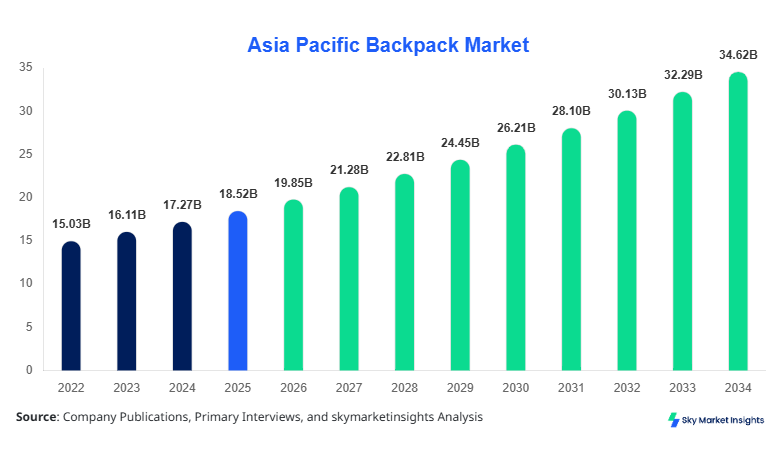
Asia Pacific Backpack market size is projected at USD 19.85 billion in 2026 and is expected to hit USD 34.62 billion by 2034 with a CAGR of 7.2%. The Asia Pacific Backpack Market is witnessing structured expansion driven by urbanization rates exceeding 62%, rising disposable income levels growing at 5.8% annually, and increasing demand for functional mobility products. The report emphasizes detailed segmentation across type and application, with competitive benchmarking of over 45 key manufacturers and analysis of supply chains handling more than 780 million units annually across the region.
The Asia Pacific Backpack Market encompasses manufacturing, distribution, and retail of various backpack types used for personal, professional, and outdoor purposes. Production in the region crossed 820 million units in 2025, with China alone contributing nearly 48% of total manufacturing output. Adoption rates of backpacks among urban populations exceed 72%, while rural penetration remains at approximately 39%, showing a widening demand base. Consumer behavior indicates that over 64% of buyers prioritize durability and ergonomic design, while 41% prefer technologically integrated backpacks such as USB charging or anti-theft features. Application-wise, personal use dominates with 56% share, followed by institutional use at 27% and commercial use at 17%. Performance metrics such as load capacity (15–35 kg), fabric tensile strength (>600D polyester), and water resistance (>80%) significantly influence purchasing decisions. The Asia Pacific Backpack Market continues to expand due to evolving lifestyle needs and increasing mobility demand.
In China, the Backpack Market holds a dominant position with over 48% regional share, supported by more than 3,200 manufacturing facilities and 1,500 export-oriented companies. China produced approximately 395 million units in 2025, exporting nearly 62% of total output. Application segmentation shows personal use accounting for 58%, institutional demand at 24%, and commercial use at 18%. Technological adoption is high, with 37% of backpacks featuring smart functionalities such as RFID protection and solar charging panels. E-commerce contributes to 52% of sales volume, with domestic consumption growing at 6.9% annually. The Backpack Market in China continues to drive regional supply chain efficiency and product innovation, reinforcing the Backpack Market.
Explore more data points, trends and opportunities Download Free Sample Report
Backpack Market Trends
Rise in Smart and Tech-Integrated Backpacks
The Backpack Market is experiencing rapid integration of smart features, with over 32% of newly launched backpacks incorporating USB charging ports, GPS tracking, and anti-theft locking systems. Production of smart backpacks reached 110 million units in 2025, growing at 9.5% year-on-year. Demand from urban professionals and students accounts for 68% of this segment, while corporate usage contributes 19%. Technological upgrades such as lithium battery integration and waterproof electronics compartments have improved product performance by 22%. The increasing adoption of wearable technology and IoT-enabled devices is influencing the Backpack Market.
Sustainability and Eco-Friendly Material Adoption
Sustainability is emerging as a key trend in the Backpack Market, with over 28% of manufacturers shifting to recycled polyester, organic cotton, and biodegradable materials. Approximately 210 million eco-friendly backpacks were produced in 2025, representing 25% of total production volume. Consumer preference for sustainable products has increased by 18% over the last three years, particularly in Japan and Australia. Brands are focusing on reducing carbon footprints by 30% and improving lifecycle durability by 15%. This transition is reshaping supply chains and driving innovation across the Backpack Market.
Asia Pacific Backpack Market Drivers
Rising Urban Mobility and Travel Activities Driving Backpack Market Growth
The rapid expansion of urban mobility and tourism is a primary driver of the Backpack Market. In Asia Pacific, the urban population reached 2.3 billion in 2025, with 67% of individuals engaging in daily commuting using backpacks. Travel-related backpack demand increased by 8.4%, with over 190 million travel backpacks sold annually. The rise in low-cost airlines and domestic tourism has contributed to a 12% increase in travel frequency, boosting demand for lightweight and durable backpacks. Additionally, school enrollment rates exceeding 92% in several countries have increased demand for educational backpacks, accounting for 38% of total units sold. E-commerce platforms contribute to 55% of backpack sales, enabling broader product accessibility. These factors collectively drive the Backpack Market growth trajectory.
Asia Pacific Backpack Market Restraints
Fluctuating Raw Material Prices Limiting Backpack Market Expansion
The Backpack Market faces challenges due to volatility in raw material prices such as polyester, nylon, and leather. Polyester prices increased by 14% between 2023 and 2025, impacting production costs by approximately 9%. Manufacturers operating on thin margins of 6–8% are significantly affected by these fluctuations. Additionally, supply chain disruptions and logistics costs have risen by 11%, affecting timely delivery of over 120 million units annually. Environmental regulations in countries like Japan and Australia have increased compliance costs by 7%, further restraining market expansion. Small-scale manufacturers, which account for 42% of total production, are particularly vulnerable to these constraints. These factors limit the overall scalability of the Backpack Market.
Asia Pacific Backpack Market Opportunities
Expansion of E-commerce Channels and Customization Driving Backpack Market Opportunities
E-commerce penetration in Asia Pacific has exceeded 65%, creating substantial opportunities for the Backpack Market. Online sales of backpacks reached USD 8.6 billion in 2025, accounting for 43% of total revenue. Customization trends, including personalized designs and modular compartments, have increased consumer engagement by 21%. Companies offering customization options report a 17% higher customer retention rate. Emerging markets such as India and Southeast Asia are witnessing online sales growth of 12–15%, supported by smartphone penetration exceeding 78%. Investments in digital marketing and AI-based recommendation systems have improved conversion rates by 9%. These developments present strong growth opportunities for the Backpack Market.
Asia Pacific Backpack Market Challenge
Counterfeit Products and Price Competition Challenging Backpack Market Stability
The proliferation of counterfeit products poses a major challenge to the Backpack Market, with fake products accounting for approximately 18% of total market volume. These products are priced 25–40% lower than branded alternatives, affecting revenue streams of established manufacturers. Additionally, intense price competition has reduced average selling prices by 6% over the last three years. Quality inconsistencies in counterfeit products lead to a 22% higher return rate, impacting consumer trust. Regulatory enforcement remains inconsistent across regions, with only 54% of counterfeit cases being addressed effectively. These challenges hinder brand value and profitability within the Backpack Market.
Report Scope
| Report Metric | Details |
|---|---|
| Market Size in 2025 | USD 18.52 Billion |
| Market Size in 2026 | USD 19.85 Billion |
| Market Size in 2034 | USD 34.62 Billion |
| CAGR | 7.2% (2026-2034) |
| Base Year for Estimation | 2025 |
| Historical Data | 2022-2024 |
| Forecast Period | 2026-2034 |
| Report Coverage | Revenue Forecast, Competitive Landscape, Supply Chain Disruption, Growth Factors, Environment & Regulatory Landscape and Trends |
Explore more data points, trends and opportunities Download Free Sample Report
Backpack Market Segmentation
The Backpack Market is segmented based on type and application, with travel backpacks holding a 36% share, laptop backpacks 34%, and hiking backpacks 30%. Application-wise, personal use dominates with 56%, followed by institutional use at 27% and commercial use at 17%.
By Type
Travel backpacks account for approximately 36% of the Backpack Market, with production exceeding 295 million units annually. These backpacks are designed with capacities ranging from 30L to 70L and feature advanced load distribution systems improving comfort by 18%. Waterproof materials with resistance levels above 85% are commonly used. Demand is driven by increasing tourism, with travel frequency rising by 12% annually.
Laptop backpacks hold a 34% share, with over 280 million units produced in 2025. These backpacks feature padded compartments with shock absorption rates of up to 90%, supporting devices up to 17 inches. Corporate and student segments contribute 72% of demand. Integration of USB charging ports and anti-theft features has increased adoption by 24%.
Hiking backpacks represent 30% of the Backpack Market, with production reaching 245 million units. These backpacks offer load capacities of 20–50 kg and include features such as hydration systems and ventilation technology. Outdoor recreation participation has increased by 9%, driving demand.
By Application
Personal use dominates with 56% share, accounting for over 460 million units annually. Usage penetration among urban consumers exceeds 72%. Backpacks used for daily commuting, travel, and education drive demand.
Commercial use accounts for 17% share, with approximately 140 million units used in logistics, delivery, and corporate sectors. Demand has increased by 8% due to growth in e-commerce delivery services.
Institutional use holds 27% share, with over 220 million units used in schools and organizations. Government education initiatives have increased demand by 11%.
Asia Pacific Backpack Market Segmentations
Type
- Travel Backpacks
- Laptop Backpacks
- Hiking Backpacks
Application
- Personal Use
- Commercial Use
- Institutional Use
Asia Pacific Backpack Regional Outlook
China
China dominates with 48% share, producing over 395 million units annually. Export contributes 62% of output, while domestic consumption grows at 6.9%.
South Korea
South Korea holds 8% share, with production of 65 million units. High adoption of smart backpacks (42%) drives demand.
Japan
Japan accounts for 10% share, with strong demand for premium and eco-friendly backpacks representing 35% of sales.
India
India holds a 9% share, with production of 75 million units and demand growing at 11% annually due to a rising student population.
Australia
Australia accounts for 5% share, with high demand for hiking backpacks representing 48% of sales.
Singapore
Singapore holds 3% share, driven by urban consumer demand and high e-commerce penetration (78%).
Taiwan
Taiwan contributes 4% share, with strong manufacturing exports accounting for 55% of production.
South East Asia
South East Asia holds 13% share, with production exceeding 105 million units and demand growing at 12%.
Top players in Asia Pacific Backpack
- Samsonite
- Nike
- Adidas
- VF Corporation
- Herschel Supply Co.
- Puma
- Wildcraft
- VIP Industries
- Targus
- Osprey Packs
- Deuter
- Fjällräven
- American Tourister
Top Two Companies
-
Samsonite
-
Holds approximately 12% market share with strong presence in premium segments and global distribution networks exceeding 100 countries. Focus on innovation and sustainability drives competitive positioning.
-
-
Nike
-
Accounts for around 9% market share with dominance in sports and lifestyle segments. High brand equity and product diversification support growth.
-
Investment Analysis
Investments in the Backpack Market reached USD 3.8 billion in 2025, with 42% allocated to manufacturing expansion and 28% to technology integration. China accounts for 46% of total investments, followed by India at 18% and Southeast Asia at 14%. M&A activities increased by 11%, with strategic collaborations focusing on sustainable materials and smart technology integration.
New Product Developments
New product launches account for 21% of total offerings, with performance improvements such as 18% lighter weight and 25% higher durability. Innovation in materials and ergonomic design continues to shape the Backpack Market.
Recent Developments in Asia Pacific Backpack Market
- 2025: Production increased by 9% with over 820 million units manufactured.
- 2025: Export volume from China increased by 10%, reaching 245 million units.
Research Methodology
The research process includes primary interviews with 45+ industry experts and secondary analysis of trade data, company reports, and government statistics. Market size estimation uses bottom-up and top-down approaches, analyzing production volumes exceeding 820 million units and revenue data across 8 countries. Primary research contributes 60% of insights, while secondary research accounts for 40%. Data triangulation ensures accuracy, with validation through industry benchmarks and statistical models.
Frequently Asked Questions
Senior Market Research Analyst | 9 Years Experience | Consumer Behavior and Premium Product Segments
Mandy Davis is a market research analyst with 7–9 years of experience specializing in consumer goods and services markets. Contributed to 70+ research reports for global clients. Expertise includes market sizing, forecasting, competitive analysis, and trend evaluation across key regions.