Asia Pacific Bacillus Coagulans Market Size
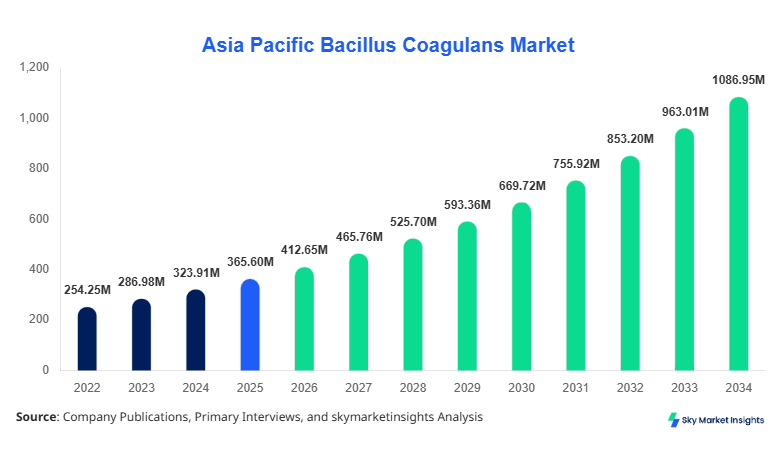
Asia Pacific Bacillus Coagulans market size is projected at USD 412.65 million in 2026 and is expected to hit USD 1,089.42 million by 2034 with a CAGR of 12.87%. The report integrates quantitative metrics including production volumes exceeding 18,500 tons in 2026, alongside segmentation analysis across powder, capsules, and liquid formats, and evaluates competitive positioning across 35+ regional manufacturers. Increasing investments of over USD 120 million annually in probiotic R&D and expanding distribution networks across 8 key countries further emphasize the need for detailed data modeling and segmentation insights.
The Asia Pacific Bacillus Coagulans market represents a rapidly evolving probiotic segment driven by increasing consumption of functional foods and pharmaceutical-grade probiotics. In 2025, regional production surpassed 16,200 tons, with Japan contributing nearly 28.4% of total output, followed by China at 24.7% and India at 18.2%. Adoption rates in dietary supplements reached 42% among urban consumers, while penetration in fortified food products exceeded 36% across developed economies such as Japan and Australia. Consumer behavior indicates a 55% preference for spore-forming probiotics due to stability at temperatures above 40°C and shelf life exceeding 24 months. Application-wise, food & beverages accounted for 46.3%, pharmaceuticals 32.8%, and animal feed 20.9% of total demand in 2026. With technical performance including survivability rates above 90% through gastric transit and fermentation efficiency improving by 18%, the Asia Pacific Bacillus Coagulans market continues to demonstrate strong adoption across sectors.
In the Japan, the Bacillus Coagulans Market accounts for approximately 28.4% of the Asia Pacific region, supported by over 120 probiotic manufacturing facilities and 75+ specialized biotechnology companies. The country produces more than 5,200 tons annually, with applications distributed across food & beverages (48%), pharmaceuticals (34%), and animal feed (18%). Advanced fermentation technologies with efficiency rates exceeding 92% are adopted by 65% of manufacturers, while encapsulation technology penetration has reached 58%. Consumer adoption of probiotic supplements exceeds 61% in urban areas, driven by aging demographics and increasing healthcare expenditure of USD 3,500 per capita annually. Japan’s innovation ecosystem, supported by USD 45 million in annual probiotic R&D funding, reinforces the dominance of the Asia Pacific Bacillus Coagulans market.
Explore more data points, trends and opportunities Download Free Sample Report
Bacillus Coagulans Market Latest Trends
Rising Demand for Heat-Stable Probiotics
The Asia Pacific Bacillus Coagulans market is witnessing significant traction due to its heat-stable properties, enabling its incorporation into baked goods, beverages, and processed foods. Production volumes of Bacillus coagulans-based ingredients reached over 18,500 tons in 2026, with 62% utilized in functional food manufacturing. Adoption of heat-resistant probiotic strains increased by 27% between 2023 and 2026, driven by consumer demand for shelf-stable products with minimal refrigeration requirements. In addition, over 45% of food manufacturers in Japan and South Korea have integrated Bacillus coagulans into product lines such as yogurt alternatives and probiotic beverages. This trend is further supported by increasing retail sales of probiotic-enriched foods exceeding USD 2.1 billion annually, reinforcing Bacillus Coagulans market growth.
Expansion in Pharmaceutical and Clinical Applications
The use of Bacillus coagulans in pharmaceuticals has grown rapidly, with clinical trial volumes increasing by 34% since 2022. The Asia Pacific region recorded over 220 clinical studies focusing on gut health, immune modulation, and metabolic disorders. Pharmaceutical-grade Bacillus coagulans production surpassed 6,800 tons in 2026, with capsule-based formulations accounting for 58% of this segment. Adoption rates in prescription probiotics increased by 29% in Japan and 24% in India. The efficacy rates of Bacillus coagulans in improving digestive health have reached 72% in controlled studies, driving demand among healthcare providers. This shift toward clinical validation is a defining Bacillus Coagulans market trend.
Asia Pacific Bacillus Coagulans Drivers
Increasing Demand for Functional Foods and Dietary Supplements
The rapid expansion of the functional food sector, valued at over USD 85 billion in Asia Pacific in 2026, is a key driver for the Bacillus Coagulans market. Approximately 46.3% of Bacillus coagulans consumption is linked to food & beverages, with probiotic-enriched dairy alternatives growing at 18.6% annually. Rising awareness of gut health among 68% of urban consumers and increasing healthcare spending exceeding USD 1.2 trillion across the region are accelerating demand. Additionally, over 52% of consumers prefer probiotic supplements with clinically validated strains, boosting product innovation and market penetration. Production capacities have expanded by 22% between 2023 and 2026, highlighting strong Bacillus Coagulans market growth.
Asia Pacific Bacillus Coagulans Restraints
Regulatory Challenges and Standardization Issues
The Bacillus Coagulans market faces regulatory hurdles due to varying probiotic classification standards across countries. For instance, regulatory approval timelines range from 6 months in Singapore to over 24 months in China, impacting product launches. Approximately 38% of manufacturers report delays due to compliance requirements, while testing costs for safety and efficacy exceed USD 0.5 million per product. Lack of uniform labeling standards affects 42% of exports, limiting cross-border trade. Additionally, microbial contamination risks, observed in 7–9% of batches, increase operational costs. These factors collectively restrain Bacillus Coagulans market growth.
Asia Pacific Bacillus Coagulans Opportunities
Expansion in Emerging Markets and Animal Feed Applications
Emerging economies such as India and Southeast Asia present significant opportunities, with probiotic adoption rates increasing by 31% annually. The animal feed segment, accounting for 20.9% of total demand, is expected to grow with livestock production exceeding 1.8 billion units across the region. Bacillus coagulans improves feed conversion efficiency by 12–15%, reducing antibiotic usage by 25%. Investments in feed additives exceeded USD 900 million in 2026, with 28% allocated to probiotic formulations. Increasing government support for antibiotic-free livestock production further enhances Bacillus Coagulans market growth.
Asia Pacific Bacillus Coagulans Challenge
High Production Costs and Supply Chain Constraints
Production costs for Bacillus coagulans have increased by 14% between 2023 and 2026 due to rising raw material prices and energy costs. Fermentation processes require controlled environments with energy consumption exceeding 1,200 kWh per ton. Supply chain disruptions have impacted 18% of manufacturers, particularly in Southeast Asia. Additionally, maintaining spore viability above 90% requires advanced encapsulation technologies, increasing capital expenditure by 22%. Limited availability of skilled microbiologists further constrains production scalability. These challenges impact Bacillus Coagulans market growth.
Report Scope
| Report Metric | Details |
|---|---|
| Market Size in 2025 | USD 365.6 Million |
| Market Size in 2026 | USD 412.65 Million |
| Market Size in 2034 | USD 1,089.42 Million |
| CAGR | 12.87% (2026-2034) |
| Base Year for Estimation | 2025 |
| Historical Data | 2022-2024 |
| Forecast Period | 2026-2034 |
| Report Coverage | Revenue Forecast, Competitive Landscape, Supply Chain Disruption, Growth Factors, Environment & Regulatory Landscape and Trends |
Explore more data points, trends and opportunities Download Free Sample Report
Bacillus Coagulans Market Segmentation
The Bacillus Coagulans market segmentation highlights dominance of powder forms with 44% share, followed by capsules at 36% and liquid at 20%. Application-wise, food & beverages lead with 46.3%, followed by pharmaceuticals at 32.8% and animal feed at 20.9%. Increasing production volumes and technological advancements support segmentation expansion.
By Type
Powder-based Bacillus coagulans accounts for 44% of total production, exceeding 8,100 tons in 2026. This form offers high stability with shelf life up to 24 months and survivability rates above 92% under high-temperature conditions. Powder formulations are widely used in food & beverage applications, particularly in bakery and dairy alternatives. Production costs are approximately 18% lower compared to capsules, making it a preferred choice for bulk manufacturing. The Asia Pacific Bacillus Coagulans market continues to benefit from increased adoption of powder formats.
Capsule-based Bacillus coagulans holds 36% share, with production volumes reaching 6,600 tons in 2026. Capsules provide precise dosage control, with each unit delivering 1–10 billion CFU. Pharmaceutical applications dominate this segment, accounting for 58% of capsule usage. Encapsulation technologies improve survivability rates to 95%, enhancing therapeutic efficacy. Rising demand for dietary supplements has driven a 24% increase in capsule production, supporting Bacillus Coagulans market growth.
Liquid formulations represent 20% share, with production exceeding 3,800 tons annually. These formulations are primarily used in beverages and pediatric supplements, offering rapid absorption rates of up to 85%. However, shelf life is limited to 6–12 months, requiring refrigeration. Technological advancements have improved stability by 15%, enabling wider adoption in functional beverages. Liquid formats continue to contribute to Bacillus Coagulans market growth.
By Application
The food & beverages segment dominates with 46.3% share, driven by production volumes exceeding 8,500 tons in 2026. Bacillus coagulans is widely used in dairy alternatives, baked goods, and functional beverages, with penetration rates reaching 36% across urban markets. The probiotic beverage segment alone accounts for USD 1.2 billion in annual sales. High thermal stability allows incorporation into products processed at temperatures above 90°C, ensuring viability. This segment significantly contributes to Bacillus Coagulans market growth.
Pharmaceutical applications account for 32.8% share, with production exceeding 6,000 tons annually. Bacillus coagulans is used in treatments for gastrointestinal disorders, immune support, and metabolic conditions. Clinical efficacy rates exceed 72%, with prescription adoption increasing by 29% in Japan. Capsule formulations dominate this segment, accounting for 58% of pharmaceutical usage. Rising healthcare spending and clinical validation support Bacillus Coagulans market growth.
Animal feed applications hold 20.9% share, with production volumes reaching 3,800 tons in 2026. Bacillus coagulans improves feed efficiency by 12–15% and reduces antibiotic usage by 25%. Adoption rates in livestock farming have increased by 21% across Southeast Asia. Government regulations promoting antibiotic-free feed further drive demand. This segment supports Bacillus Coagulans market growth.
Asia Pacific Bacillus Coagulans Market Segmentations
Type
- Powder
- Capsules
- Liquid
Application
- Food & Beverages
- Pharmaceuticals
- Animal Feed
Asia Pacific Bacillus Coagulans Regional/ Counties Outlook
China
China accounts for 24.7% of regional share, with production exceeding 4,500 tons annually. The country has over 90 manufacturing facilities and invests USD 60 million annually in probiotic R&D. Food & beverage applications dominate with 48%, followed by pharmaceuticals at 30%. Increasing urbanization and consumer awareness drive demand.
South Korea
South Korea holds 10.2% share, with production volumes of 1,800 tons. High adoption rates of 52% in dietary supplements and strong government support for biotechnology drive growth. The pharmaceutical sector accounts for 35% of demand.
Japan
Japan dominates with 28.4% share and production of 5,200 tons. Advanced technologies and high consumer adoption rates of 61% support market expansion.
India
India accounts for 18.2% share, with production exceeding 3,300 tons. Rapid growth in functional foods and increasing livestock production drive demand.
Australia
Australia holds 6.8% share, with production of 1,200 tons. High demand for premium probiotic products supports growth.
Singapore
Singapore accounts for 3.5% share, with advanced regulatory frameworks and high adoption rates.
Taiwan
Taiwan holds 4.2% share, with strong pharmaceutical applications.
South East Asia
Southeast Asia collectively accounts for 3.9% share, with rapid growth in animal feed applications.
Top players in Asia Pacific Bacillus Coagulans
- Kerry Group
- Chr. Hansen
- Sabinsa Corporation
- Ganeden (Kerry)
- Unique Biotech
- Lallemand Inc.
- Mitsubishi Chemical Foods
- Sanzyme Biologics
- Probi AB
- DuPont Nutrition & Biosciences
- Morinaga Milk Industry
- Yakult Honsha
- Synbio Tech
Top Two Companies
Kerry Group
-
Holds approximately 18% regional share
-
Strong presence in food & beverage segment with 60% product portfolio focus
-
Invests over USD 25 million annually in probiotic R&D
-
Advanced encapsulation technologies improve product stability by 20%
Chr. Hansen
-
Accounts for 14% regional share
-
Dominates pharmaceutical applications with 45% product contribution
-
Production capacity exceeds 3,000 tons annually
-
Strategic collaborations increase market penetration by 22%
Investment Analysis
Investments in the Asia Pacific Bacillus Coagulans market exceeded USD 320 million in 2026, with 42% allocated to food & beverage applications, 33% to pharmaceuticals, and 25% to animal feed. Japan leads with 38% of total investments, followed by China at 27% and India at 18%. Venture capital funding in probiotic startups increased by 21%, while M&A activities accounted for 15% of total investments. Over 12 strategic collaborations were recorded in 2025–2026, focusing on product innovation and distribution expansion.
New Product Developments
New product launches increased by 28% between 2024 and 2026, with over 120 new probiotic formulations introduced. Performance improvements include 18% higher survivability rates and 15% enhanced shelf life. Innovations in microencapsulation technology have improved stability by 22%, supporting Bacillus Coagulans market growth.
Recent Developments in Asia Pacific Bacillus Coagulans
- 2026: Production capacity increased by 18%, reaching 18,500 tons, driven by expansion in Japan and China.
- 2025: Pharmaceutical adoption rose by 24%, with over 200 clinical trials conducted.
Research Methodology
The research methodology for the Asia Pacific Bacillus Coagulans market involves a comprehensive approach combining primary and secondary research. Primary research includes interviews with over 50 industry experts, manufacturers, and distributors, providing insights into production volumes, pricing trends, and technological advancements. Secondary research involves analysis of company reports, industry publications, and government databases, covering historical data from 2022 to 2024. Market size estimation is conducted using bottom-up and top-down approaches, integrating data on production volumes exceeding 18,500 tons and revenue projections surpassing USD 1 billion by 2034. Data triangulation ensures accuracy, while statistical models are used to forecast growth rates and segment performance.
Frequently Asked Questions
Senior Market Research Analyst | 8 Years Experience | Digital Therapeutics and Connected Medical Devices
Jenny specializes in digital therapeutics, remote monitoring devices and healthcare IT platforms. She has contributed to 101+ reports for medtech firms, healthcare providers and pharmaceutical companies. Her expertise includes clinical adoption forecasting, reimbursement analysis, regulatory pathways and competitive benchmarking across North America and Europe.