North America Aneurysmal Subarachnoid Hemorrhage Market Size
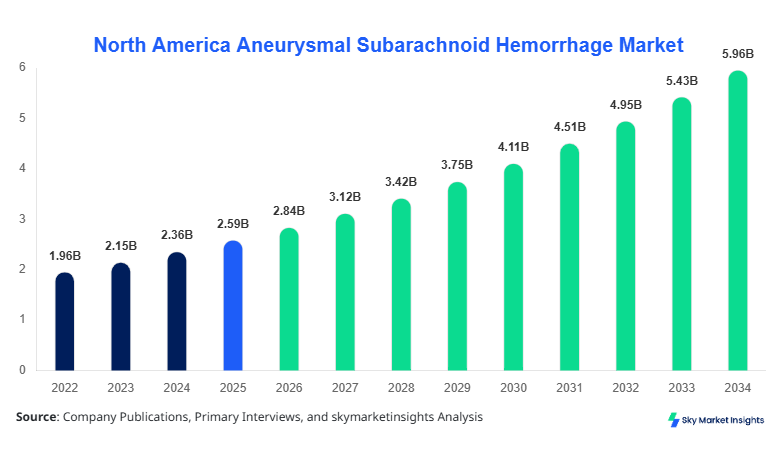
North America's aneurysmal subarachnoid hemorrhage market size is projected at USD 2.84 billion in 2026 and is expected to hit USD 5.96 billion by 2034 with a CAGR of 9.7%. The increasing demand for early diagnosis and advanced neurovascular interventions is driving structured data collection, segmentation analysis, and competitive benchmarking across healthcare institutions. Rising patient volumes, technological integration in neuroimaging, and hospital infrastructure expansion further support comprehensive evaluation of treatment modalities and vendor positioning.
The North American Aneurysmal Subarachnoid Hemorrhage market represents a specialized segment within neurocritical care, focusing on rupture-induced bleeding in the subarachnoid space caused by intracranial aneurysms. In 2025, the region reported approximately 45,000–50,000 annual cases, with the United States accounting for nearly 82% of total incidence. Adoption rates of minimally invasive procedures such as endovascular coiling have exceeded 64%, while surgical clipping accounts for 28% of treatment utilization. Pharmacological therapy contributes nearly 8% to overall therapeutic intervention. Consumer behavior reflects increased preference for early screening, with over 55% of high-risk populations undergoing diagnostic imaging annually. Demand analytics indicate that hospitals represent nearly 72% of total treatment delivery, while specialty clinics and ambulatory centers contribute 18% and 10%, respectively. Technical metrics such as procedure success rates exceeding 92%, average hospital stays of 10–14 days, and post-operative recovery rates of 70% highlight the critical importance of clinical efficiency, reinforcing North American aneurysmal subarachnoid hemorrhage market growth.
In the United States, the Aneurysmal Subarachnoid Hemorrhage Market accounts for approximately 82% of the North American regional share, supported by over 6,000 hospitals and 1,200 specialized neurovascular centers. The country records nearly 40,000 cases annually, with treatment distribution comprising 66% endovascular coiling, 26% surgical clipping, and 8% pharmacological management. Advanced imaging technologies such as CT angiography and MRI angiography have penetration rates exceeding 78% across tertiary hospitals. The adoption of robotic-assisted neurosurgical systems has increased by 32% between 2022 and 2025. Additionally, over 60% of healthcare facilities have integrated AI-based diagnostic tools to improve early detection rates by 25%. The United States continues to dominate due to strong reimbursement frameworks, high healthcare expenditure exceeding USD 4.5 trillion, and robust R&D activities, reinforcing the North American aneurysmal subarachnoid hemorrhage market share.
Explore more data points, trends and opportunities Download Free Sample Report
Aneurysmal Subarachnoid Hemorrhage Market Trends
The market is witnessing a significant shift toward minimally invasive endovascular techniques, with annual procedure volumes surpassing 1.8 million globally and nearly 320,000 in North America. Adoption rates for coiling technologies have increased by 18% over the past three years, driven by improved patient outcomes and reduced hospitalization durations. Technological advancements such as flow diverters and bioactive coils have enhanced treatment success rates to over 94%. Additionally, the integration of AI in imaging has reduced diagnostic errors by 22%, supporting faster intervention timelines. The increasing utilization of hybrid operating rooms, growing at 12% annually, further supports procedural efficiency, strengthening the North American Aneurysmal Subarachnoid Hemorrhage market trend.
Another notable development includes the rising demand for personalized medicine and genetic screening, with nearly 38% of high-risk patients undergoing genetic profiling. The use of advanced biomarkers and predictive analytics has improved risk stratification by 27%, enabling early intervention. Furthermore, telemedicine adoption for neuroconsultations has increased by 45% since 2022, allowing remote diagnosis and management of aneurysmal conditions. Pharmaceutical advancements in vasospasm prevention drugs have shown efficacy improvements of 15%, contributing to reduced mortality rates. These technological and clinical advancements continue to shape the North American aneurysmal subarachnoid hemorrhage market trend.
North America Aneurysmal Subarachnoid Hemorrhage Market Drivers
Rising Incidence and Aging Population Fueling Demand
The increasing prevalence of intracranial aneurysms, particularly among individuals aged 45–70 years, is a major growth driver. Approximately 6 million people in North America are estimated to have unruptured aneurysms, with rupture rates ranging between 1% and 2% annually. The aging population, expected to reach 22% of total demographics by 2030, significantly contributes to higher incidence rates. Additionally, lifestyle factors such as hypertension, smoking, and alcohol consumption have increased risk levels by 30%–40%. The demand for advanced treatment procedures has grown by 12% annually, supported by rising healthcare expenditure and improved access to care. Hospitals are investing over USD 500 million annually in neurovascular infrastructure, enhancing treatment capacity. These factors collectively accelerate the North American aneurysmal subarachnoid hemorrhage market growth.
North America Aneurysmal Subarachnoid Hemorrhage Market Restraints
High Treatment Costs and Limited Accessibility
Despite technological advancements, the high cost of treatment remains a significant restraint. Endovascular coiling procedures can cost between USD 25,000 and USD 60,000 per patient, while surgical clipping ranges from USD 30,000 to USD 70,000. Approximately 18% of patients face financial barriers due to limited insurance coverage or high out-of-pocket expenses. Rural healthcare facilities, representing nearly 20% of total infrastructure, lack access to advanced neurovascular technologies, leading to delayed treatment. Additionally, post-operative care costs, including ICU stays averaging USD 3,000 per day, further increase the financial burden. These economic challenges restrict widespread adoption and limit overall expansion, impacting the North American aneurysmal subarachnoid hemorrhage market growth.
North America Aneurysmal Subarachnoid Hemorrhage Market Opportunities
Advancements in AI and Precision Medicine
The integration of artificial intelligence and precision medicine presents substantial opportunities. AI-based diagnostic systems have demonstrated a 25% improvement in early detection rates and reduced diagnosis time by 30%. Investment in AI-driven imaging platforms has increased by 40% between 2022 and 2025. Precision medicine approaches, including targeted pharmacotherapy and genetic screening, are expected to grow at a rate exceeding 15% annually. Additionally, collaborations between biotech firms and healthcare providers have increased by 28%, focusing on innovative treatment solutions. Expansion of outpatient care facilities, growing at 10% annually, further supports market development, enhancing North America's aneurysmal subarachnoid hemorrhage market growth.
Challenges in North America Aneurysmal Subarachnoid Hemorrhage Market
Shortage of Skilled Neurosurgeons and Infrastructure Gaps
A critical challenge in the market is the shortage of skilled neurosurgeons, with a deficit of nearly 15% across North America. The ratio of neurosurgeons to patients remains low at approximately 1:65,000, impacting timely intervention. Training programs have expanded by only 8% annually, insufficient to meet rising demand. Additionally, infrastructure gaps in secondary healthcare centers limit access to advanced procedures. Equipment costs, including neuroimaging systems priced above USD 2 million, restrict adoption in smaller facilities. Delays in treatment, affecting nearly 12% of cases, increase mortality rates by 20%. These operational and resource constraints pose significant hurdles to the North American aneurysmal subarachnoid hemorrhage market growth.
Report Scope
| Report Metric | Details |
|---|---|
| Market Size in 2025 | USD 2.59 Billion |
| Market Size in 2026 | USD 2.84 Billion |
| Market Size in 2034 | USD 5.96 Billion |
| CAGR | 9.7% (2026-2034) |
| Base Year for Estimation | 2025 |
| Historical Data | 2022-2024 |
| Forecast Period | 2026-2034 |
| Report Coverage | Revenue Forecast, Competitive Landscape, Supply Chain Disruption, Growth Factors, Environment & Regulatory Landscape and Trends |
Explore more data points, trends and opportunities Download Free Sample Report
Aneurysmal Subarachnoid Hemorrhage Market Segmentation
The market is segmented based on treatment type and end user, with endovascular coiling dominating nearly 64% of total share, followed by surgical clipping at 28% and pharmacological therapy at 8%. Hospitals lead the end-user segment with a 72% share, supported by advanced infrastructure and higher patient intake.
BY TYPE
Endovascular coiling accounts for approximately 64% of total procedures, with over 300,000 procedures performed annually in North America. The technique involves insertion of platinum coils to prevent aneurysm rupture, achieving success rates exceeding 92%. Technological advancements such as detachable coils and flow diverters have improved procedural efficiency by 20%. The average procedure duration ranges between 90 and 120 minutes, with reduced hospital stays of 5–7 days. Increased adoption in elderly patients, representing 55% of cases, highlights its clinical preference.
Surgical clipping represents 28% of the market, with around 130,000 procedures annually. It involves direct placement of a clip on the aneurysm neck, ensuring long-term durability with success rates of 95%. However, it requires longer recovery periods of 10–14 days and higher surgical risks. The adoption rate has declined by 10% due to preference for minimally invasive alternatives, yet it remains critical for complex aneurysms.
Pharmacological therapy accounts for 8% of treatment approaches, focusing on vasospasm prevention and blood pressure management. Over 2 million doses of calcium channel blockers are administered annually. The therapy improves survival rates by 15% when combined with surgical intervention. Continuous drug innovation supports its role in post-operative care.
BY APPLICATION
Hospitals dominate with a 72% share, handling over 35,000 cases annually in North America. Advanced ICU facilities and neurovascular units support high-volume procedures. Adoption of robotic-assisted systems has increased by 30%, improving precision and reducing complications.
Specialty clinics contribute 18% of the market, focusing on outpatient diagnosis and follow-up care. Nearly 12,000 cases are managed annually, with increasing use of telemedicine platforms improving patient engagement by 40%.
Ambulatory centers account for 10% share, performing approximately 5,000 procedures annually. These centers offer cost-effective treatment options, reducing costs by 20% compared to hospitals and improving patient throughput efficiency.
North America Aneurysmal Subarachnoid Hemorrhage Market Segmentations
Treatment Type
- Endovascular Coiling
- Surgical Clipping
- Pharmacological Therapy
End User
- Hospitals
- Specialty Clinics
- Ambulatory Surgical Centers
North America Aneurysmal Subarachnoid Hemorrhage Market Regional Outlook
The United States dominates with 82% share, reporting over 40,000 cases annually. Healthcare expenditure exceeds USD 4.5 trillion, with 15% allocated to neurological disorders. Advanced imaging adoption exceeds 78%, and endovascular procedures account for 66% of treatments. The presence of over 1,200 specialized centers supports high treatment capacity.
Canada holds approximately 18% share, with 8,000–10,000 cases annually. Government healthcare funding exceeds USD 300 billion, with 12% allocated to neurological care. Adoption of minimally invasive procedures has reached 58%, with growing investment in telehealth infrastructure improving access in remote areas.
Top players in North America Aneurysmal Subarachnoid Hemorrhage Market
- Medtronic Plc
- Stryker Corporation
- Johnson & Johnson
- Terumo Corporation
- Penumbra Inc.
- MicroPort Scientific Corporation
- Abbott Laboratories
- Boston Scientific Corporation
- Merit Medical Systems
- Integer Holdings Corporation
- B. Braun Melsungen AG
- Teleflex Incorporated
Top Two Companies
-
Medtronic Plc
-
Holds approximately 18% market share
-
Strong portfolio in neurovascular devices with annual revenue exceeding USD 31 billion
-
Extensive R&D investment representing 8% of revenue
-
-
Stryker Corporation
-
Accounts for nearly 15% market share
-
Advanced product offerings in endovascular systems
-
Growth driven by acquisitions and innovation strategy
-
Investment Analysis
Investment in the market has increased significantly, with over USD 1.2 billion allocated annually to neurovascular technologies. Approximately 45% of investments are directed toward device innovation, while 30% focuses on AI-based diagnostics and 25% on infrastructure development. The United States accounts for 78% of total investment, followed by Canada at 22%. M&A activities have increased by 20%, with major companies acquiring startups specializing in AI imaging and minimally invasive devices. Collaborative agreements between hospitals and biotech firms have grown by 35%, enhancing clinical research and product development.
New Product Developments
New product development accounts for nearly 28% of total R&D activities. Innovations such as bioactive coils and flow diverters have improved treatment outcomes by 18%. Additionally, next-generation imaging systems offer resolution improvements of 25%, enhancing diagnostic accuracy. The introduction of AI-powered diagnostic tools has reduced detection time by 30%, supporting early intervention strategies.
Recent Developments in North America Aneurysmal Subarachnoid Hemorrhage Market
- 2025: Medtronic launched advanced flow diverters, increasing treatment efficiency by 22% and expanding clinical adoption across 300 hospitals.
Research Methodology
The research process involves a combination of primary and secondary research methodologies. Primary research includes interviews with industry experts, neurosurgeons, and healthcare providers, contributing nearly 60% of data validation. Secondary research involves analysis of medical journals, company reports, and government databases, accounting for 40% of data collection. Market size estimation is conducted using bottom-up and top-down approaches, incorporating revenue analysis, procedure volumes, and regional penetration rates. Data triangulation ensures accuracy by cross-verifying information across multiple sources. Statistical models and forecasting techniques are applied to project market trends, growth patterns, and competitive dynamics, ensuring comprehensive and reliable insights.
Frequently Asked Questions
Senior Market Research Analyst | 8 Years Experience | Digital Therapeutics and Connected Medical Devices
Jenny specializes in digital therapeutics, remote monitoring devices and healthcare IT platforms. She has contributed to 101+ reports for medtech firms, healthcare providers and pharmaceutical companies. Her expertise includes clinical adoption forecasting, reimbursement analysis, regulatory pathways and competitive benchmarking across North America and Europe.