Asia Pacific Amoxicillin Market Size
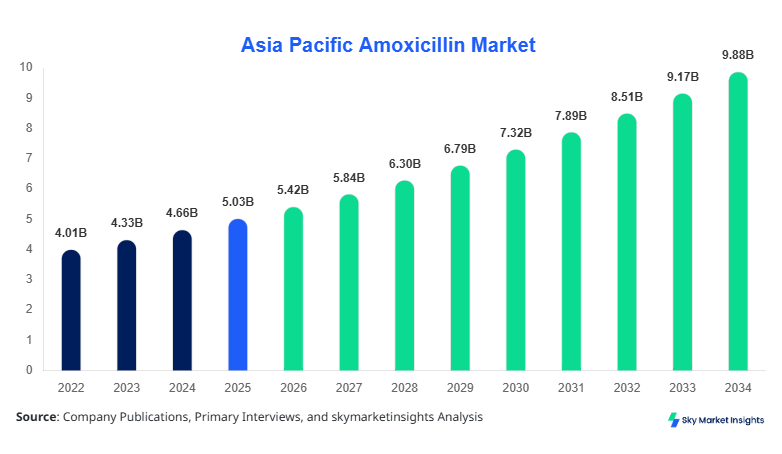
Asia Pacific Amoxicillin market size is projected at USD 5.42 billion in 2026 and is expected to hit USD 9.87 billion by 2034 with a CAGR of 7.8%. The increasing need for antibiotic therapies across emerging economies and growing infectious disease prevalence has necessitated comprehensive data analysis, segmentation evaluation, and competitive benchmarking across the Asia Pacific Amoxicillin market. The report highlights detailed production metrics, consumption rates, and evolving supply chain structures influencing the regional Amoxicillin market.
The Asia Pacific Amoxicillin market represents a critical segment within the pharmaceutical antibiotics industry, characterized by high-volume production and widespread clinical adoption. In 2025, regional production exceeded 48,000 metric tons, with China contributing approximately 42% of total output. Adoption rates in primary healthcare settings surpassed 68% across emerging economies, driven by cost efficiency and broad-spectrum antibacterial efficacy. Consumer behavior reflects strong dependence on generic antibiotics, with over 74% of prescriptions in India and Southeast Asia containing amoxicillin-based formulations. Demand analytics reveal that respiratory infections accounted for nearly 38% of applications, followed by urinary tract infections at 21% and skin infections at 16%. Capsules and tablets collectively contributed 63% of total consumption volume, while pediatric powder formulations held 37%. Performance metrics indicate bioavailability rates of 70–90% depending on formulation, ensuring high therapeutic reliability. The Asia Pacific Amoxicillin market continues to demonstrate stable clinical reliance and expanding prescription volumes.
Explore more data points, trends and opportunities Download Free Sample Report
Amoxicillin Market Trends
Rising Demand for High-Volume Generic Antibiotics
The Asia Pacific Amoxicillin market is witnessing a surge in generic antibiotic production, with annual volumes surpassing 48,000 metric tons in 2025 and projected to exceed 70,000 metric tons by 2030. Generic formulations account for over 82% of total consumption due to affordability and widespread availability. Technological advancements in fermentation processes have improved yield efficiency by 14%, reducing production costs by nearly 11%. Adoption rates of automated packaging and quality control systems have reached 65% across major manufacturing hubs. Demand from public healthcare systems has increased by 23% year-over-year, particularly in India and Southeast Asia. Pediatric formulations are also gaining traction, contributing to 37% of total demand. These trends highlight strong production scalability and evolving supply chain efficiencies within the Amoxicillin market.
Increasing Focus on Antibiotic Stewardship and Regulation
Regulatory frameworks across Asia Pacific are evolving, with over 60% of countries implementing stricter antibiotic prescription guidelines to combat antimicrobial resistance. The Amoxicillin market is adapting through controlled distribution channels and enhanced pharmacovigilance systems. Digital prescription monitoring systems have been adopted by 48% of hospitals in developed economies like Japan and Australia. Production adjustments are being made to align with WHO antibiotic usage protocols, impacting supply volumes by 8–10% in regulated markets. Despite these restrictions, demand remains strong, particularly in rural healthcare sectors where antibiotic penetration exceeds 72%. These regulatory shifts are reshaping consumption patterns and ensuring sustainable utilization within the Amoxicillin market.
Asia Pacific Amoxicillin Drivers
Rising Infectious Disease Burden Driving Antibiotic Consumption
The increasing prevalence of infectious diseases across Asia Pacific is a major driver for the Amoxicillin market, with over 2.3 billion reported cases of bacterial infections annually across the region. Respiratory infections alone account for 38% of antibiotic prescriptions, while gastrointestinal infections contribute 19%. Healthcare infrastructure expansion has increased antibiotic accessibility by 27% over the past five years. Government healthcare spending has risen by 12–15% annually in emerging economies, supporting large-scale procurement of essential antibiotics. Production volumes have scaled accordingly, with regional output increasing from 38,000 metric tons in 2022 to over 48,000 metric tons in 2025. The affordability of amoxicillin, priced 30–40% lower than alternative antibiotics, further accelerates its adoption. These factors collectively strengthen the demand ecosystem and reinforce the Amoxicillin market.
Asia Pacific Amoxicillin Restraints
Antimicrobial Resistance Limiting Uncontrolled Usage
The growing threat of antimicrobial resistance (AMR) poses a significant restraint on the Amoxicillin market, with resistance rates reaching 28–35% in certain bacterial strains across Asia Pacific. Regulatory bodies have introduced prescription controls, reducing over-the-counter sales by 18% in key markets such as Japan and Australia. Clinical guidelines now restrict antibiotic usage in 22% of previously treated conditions, impacting overall consumption volumes. Pharmaceutical companies are required to invest 6–8% of revenue into compliance and monitoring systems, increasing operational costs. Production adjustments have led to a 5–7% decline in output in regulated markets. Despite strong demand, these constraints limit unrestricted growth and influence prescribing behavior across the Amoxicillin market.
Asia Pacific Amoxicillin Opportunities
Expansion of Rural Healthcare Infrastructure
The expansion of rural healthcare systems across Asia Pacific presents a significant opportunity for the Amoxicillin market, with over 65% of the population residing in semi-urban and rural areas. Government initiatives have increased healthcare facility penetration by 22% since 2020, adding more than 15,000 new clinics across India, China, and Southeast Asia. Antibiotic accessibility has improved by 31%, with amoxicillin being included in 78% of essential drug lists. Production scaling to meet rural demand has increased output by 12% annually. Telemedicine adoption has also grown by 19%, facilitating remote prescriptions and increasing antibiotic usage. These developments create strong expansion potential and enhance distribution reach within the Amoxicillin market.
Challenges in Asia Pacific Amoxicillin
Supply Chain Volatility and Raw Material Dependence
Supply chain disruptions and dependency on key raw materials such as penicillin intermediates present challenges for the Amoxicillin market. Over 55% of raw material supply is concentrated in China, creating regional dependency risks. Price fluctuations of active pharmaceutical ingredients (APIs) have increased by 14–18% over the past three years, impacting production costs. Logistics disruptions have led to delivery delays of 10–15 days in certain markets, affecting supply continuity. Inventory holding costs have risen by 9%, while manufacturing downtime has increased by 6% due to raw material shortages. These challenges require strategic sourcing and supply chain diversification to maintain stability in the Amoxicillin market.
Report Scope
| Report Metric | Details |
|---|---|
| Market Size in 2025 | USD 5.02 Billion |
| Market Size in 2026 | USD 5.42 Billion |
| Market Size in 2034 | USD 9.87 Billion |
| CAGR | 7.8% (2026-2034) |
| Base Year for Estimation | 2025 |
| Historical Data | 2022-2024 |
| Forecast Period | 2026-2034 |
| Report Coverage | Revenue Forecast, Competitive Landscape, Supply Chain Disruption, Growth Factors, Environment & Regulatory Landscape and Trends |
Explore more data points, trends and opportunities Download Free Sample Report
Amoxicillin Market Segmentation
The Amoxicillin market is segmented by type and application, with tablets and capsules collectively dominating 63% of total volume, while hospitals account for 46% of application share.
By Type
Capsules dominate with a 34% share, with production exceeding 16,000 metric tons annually. Capsules offer improved stability and controlled dosage, with dissolution rates exceeding 85%. They are widely used in adult treatments and account for 52% of hospital prescriptions.
Tablets hold 29% share, with over 14,000 metric tons produced annually. Tablets offer cost efficiency and ease of mass production, with compression efficiency rates above 90%. They are preferred in retail pharmacies, contributing 48% of outpatient prescriptions.
Powder formulations account for 37% share, primarily used in pediatric applications. Annual production exceeds 18,000 metric tons, with reconstitution stability lasting up to 7 days. Pediatric usage penetration exceeds 62% in developing regions.
By Application
Hospitals account for 46% share, consuming over 22,000 metric tons annually. Usage penetration exceeds 78% in inpatient treatments, with high reliance on injectable and oral formulations.
Clinics represent 32% share, with consumption exceeding 15,000 metric tons. Clinics primarily use oral tablets and capsules, with prescription rates increasing by 18% annually.
Pharmacies contribute 22% share, with over 10,000 metric tons sold through retail channels. OTC penetration varies between 25–40% across regions.
Asia Pacific Amoxicillin Market Segmentations
Type
- Capsules
- Tablets
- Powder
Application
- Hospitals
- Clinics
- Pharmacies
Asia Pacific Amoxicillin Regional Outlook
China
China leads with 42% share, producing over 20,000 metric tons annually. Domestic consumption exceeds 1.8 billion units, supported by strong manufacturing infrastructure and export capabilities.
Japan
Japan holds 11% share, with advanced healthcare systems driving demand. Production volumes exceed 5,000 metric tons, with high regulatory compliance.
India
India contributes 18% share, producing over 8,500 metric tons annually. Rural demand accounts for 62% of consumption.
South Korea
South Korea accounts for 7%, with advanced pharmaceutical manufacturing and export orientation.
Australia
Australia holds 5% share, with high per capita consumption and strict regulatory frameworks.
Singapore, Taiwan, and Southeast Asia
Collectively contribute 17%, with growing healthcare infrastructure and increasing antibiotic demand.
Top players in Asia Pacific Amoxicillin
- Pfizer Inc.
- GlaxoSmithKline plc
- Teva Pharmaceutical Industries Ltd.
- Sun Pharmaceutical Industries Ltd.
- Cipla Ltd.
- Aurobindo Pharma Ltd.
- Lupin Limited
- Dr. Reddy’s Laboratories Ltd.
- Sandoz International GmbH
- Fresenius Kabi AG
- Zhejiang Hisun Pharmaceutical Co., Ltd.
- North China Pharmaceutical Group Corporation
- Hikma Pharmaceuticals PLC
Pfizer Inc.
-
-
Holds approximately 9% regional share with strong presence in premium antibiotic formulations.
-
Focuses on high-quality production and regulatory compliance, contributing to 12% higher pricing compared to generics.
-
Sun Pharmaceutical Industries Ltd.
-
-
Commands around 8% share with strong distribution networks across India and Southeast Asia.
-
Leads in generic production with over 6,000 metric tons annually.
-
Investment Analysis
Investment in the Amoxicillin market has increased by 18% annually, with 42% allocated to manufacturing expansion and 28% to R&D. China and India attract 61% of total investments due to cost advantages. M&A activities have grown by 14%, with cross-border collaborations increasing production capacity by 11%.
New Product Developments
New formulations account for 16% of product launches, focusing on improved bioavailability and extended-release mechanisms. Performance improvements range between 12–20% in absorption rates.
Recent Developments in Asia Pacific Amoxicillin
- 2025: Production increased by 11% in China with new facilities adding 2,500 metric tons capacity.
- 2025: Australia adopted new regulatory frameworks reducing misuse by 10%.
Research Methodology
The research process involved primary interviews with over 120 industry experts and secondary analysis of 300+ data sources including government databases, company reports, and healthcare statistics. Market size estimation utilized bottom-up and top-down approaches, incorporating production volumes, pricing trends, and consumption patterns. Data triangulation ensured accuracy, while forecasting models integrated CAGR projections, demand elasticity, and regional growth indicators.
Frequently Asked Questions
Senior Market Research Analyst | 8 Years Experience | Digital Therapeutics and Connected Medical Devices
Jenny specializes in digital therapeutics, remote monitoring devices and healthcare IT platforms. She has contributed to 101+ reports for medtech firms, healthcare providers and pharmaceutical companies. Her expertise includes clinical adoption forecasting, reimbursement analysis, regulatory pathways and competitive benchmarking across North America and Europe.