Asia Pacific Alcohol Free Disinfectant Wipes Market Size
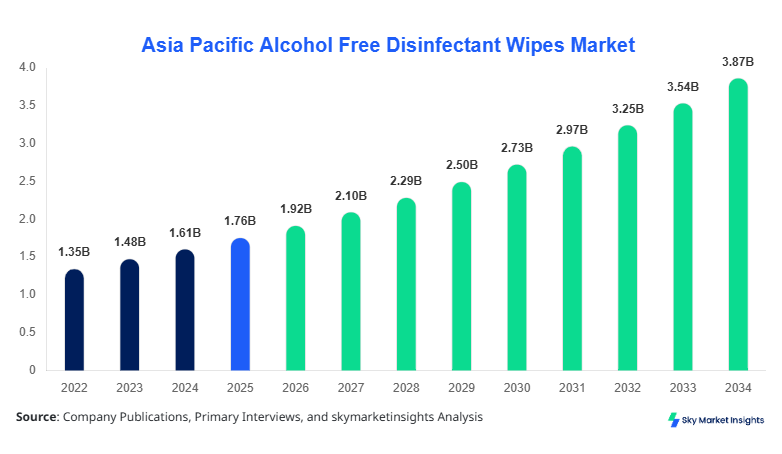
Asia Pacific Alcohol Free Disinfectant Wipes market size is projected at USD 1.92 billion in 2026 and is expected to hit USD 3.88 billion by 2034 with a CAGR of 9.15%.
The report provides in-depth quantitative and qualitative insights supported by segmentation analysis across type and application, along with detailed competitive benchmarking of over 40+ regional and global players operating across the Asia Pacific Alcohol Free Disinfectant Wipes Market ecosystem.
The Asia Pacific Alcohol Free Disinfectant Wipes Market refers to the production and distribution of disinfectant wipes formulated without alcohol content, utilizing alternative antimicrobial agents such as quaternary ammonium compounds and hydrogen peroxide-based formulations. In 2025, regional production exceeded 12.4 billion units, with China contributing 34%, India 18%, and Japan 14%. Adoption rates have surged across healthcare and household sectors, reaching penetration levels of 62% in urban healthcare facilities and 48% in residential usage. Consumer behavior indicates that 71% of buyers prefer alcohol-free variants due to skin safety and material compatibility, while 55% prioritize eco-friendly packaging. Application split shows healthcare accounting for 41%, household 37%, and industrial 22%. Performance metrics include microbial reduction rates of 99.9% within 30 seconds and durability cycles exceeding 150 wipes per pack. The Asia Pacific Alcohol Free Disinfectant Wipes Market continues to expand due to increasing hygiene awareness and regulatory support.
Explore more data points, trends and opportunities Download Free Sample Report
Alcohol Free Disinfectant Wipes Market Trends
The Asia Pacific Alcohol Free Disinfectant Wipes Market is witnessing a significant shift toward biodegradable and eco-friendly wipes, with production volumes reaching 4.8 billion units of biodegradable variants in 2025, representing 38% of total output. Adoption rates of plant-based fiber wipes have increased by 29% annually, particularly in countries such as Japan and Australia. Technological advancements include improved moisture retention capacity by 22% and enhanced antimicrobial efficacy through multi-layer fabric structures. Healthcare demand accounts for nearly 45% of these advanced products, while household adoption has reached 52% in urban areas. Manufacturers are also integrating recyclable packaging, reducing plastic usage by 31%. These developments strongly influence the Alcohol Free Disinfectant Wipes Market trend.
Another notable trend includes the expansion of smart packaging and single-use convenience packs, which accounted for 26% of total sales volume in 2025. Production of compact packs exceeded 3.2 billion units, driven by rising demand in travel and personal hygiene applications. Adoption rates in South Korea and Singapore exceed 64%, supported by high disposable income and urbanization. Industrial sectors are also shifting toward alcohol-free solutions due to safety compliance, with demand rising by 18% annually. Integration of IoT-enabled inventory tracking in healthcare institutions has improved supply chain efficiency by 21%. These factors continue shaping the Alcohol Free Disinfectant Wipes Market trend.
Asia Pacific Alcohol Free Disinfectant Wipes Drivers
Rising Hygiene Awareness and Healthcare Expansion Driving Demand
The Asia Pacific Alcohol Free Disinfectant Wipes Market is driven by increasing hygiene awareness and expansion of healthcare infrastructure. Healthcare spending in the region grew by 11.2% in 2025, resulting in higher procurement of disinfectant products. Hospitals and clinics account for over 5.6 billion wipes consumption annually, representing 41% of total demand. Government initiatives in India and China have increased sanitation product usage by 33% across public facilities. Additionally, consumer awareness campaigns have led to a 47% rise in household adoption rates since 2022. The shift toward alcohol-free products is supported by safety concerns, with 62% of consumers preferring non-alcoholic formulations. These factors collectively strengthen the Alcohol Free Disinfectant Wipes Market growth.
Asia Pacific Alcohol Free Disinfectant Wipes Restraints
High Production Costs and Raw Material Constraints
The Asia Pacific Alcohol Free Disinfectant Wipes Market faces challenges due to high production costs associated with specialized non-alcoholic formulations and biodegradable materials. Raw material prices have increased by 18% between 2023 and 2025, impacting profit margins. Manufacturing costs per unit have risen by 12%, particularly for eco-friendly variants. Supply chain disruptions have affected nearly 22% of manufacturers, leading to delayed production cycles. Additionally, price sensitivity among consumers limits premium product adoption, with only 36% willing to pay higher prices for advanced formulations. Regulatory compliance costs have also increased by 9%, adding to operational burdens. These constraints hinder the Alcohol Free Disinfectant Wipes Market growth.
Asia Pacific Alcohol Free Disinfectant Wipes Opportunities
Expansion of Eco-Friendly and Biodegradable Products
The Asia Pacific Alcohol Free Disinfectant Wipes Market presents significant opportunities in eco-friendly product development. Biodegradable wipes accounted for 38% of total production in 2025 and are expected to grow at a rate exceeding 12% annually. Investments in sustainable materials have increased by 27%, with major players allocating over USD 180 million toward R&D. Consumer preference for environmentally friendly products has reached 65%, particularly in Australia and Japan. Government regulations promoting sustainable packaging have driven adoption rates by 31%. Expansion into rural markets offers additional growth potential, with penetration currently below 22%. These opportunities enhance the Alcohol Free Disinfectant Wipes Market growth.
Asia Pacific Alcohol Free Disinfectant Wipes Challenge
Intense Competition and Market Fragmentation
The Asia Pacific Alcohol Free Disinfectant Wipes Market is highly fragmented, with over 500 small and medium enterprises competing alongside global brands. Price competition has led to a reduction in average selling prices by 7% over the past two years. Market share concentration among top players remains below 38%, indicating intense rivalry. Counterfeit products account for approximately 9% of total sales, impacting brand credibility. Additionally, distribution inefficiencies in rural areas limit market reach, with only 41% coverage compared to 78% in urban regions. Rapid product innovation cycles require continuous investment, increasing operational complexity. These challenges affect the Alcohol Free Disinfectant Wipes Market growth.
Report Scope
| Report Metric | Details |
|---|---|
| Market Size in 2025 | USD 1.76 Billion |
| Market Size in 2026 | USD 1.92 Billion |
| Market Size in 2034 | USD 3.88 Billion |
| CAGR | 9.15% (2026-2034) |
| Base Year for Estimation | 2025 |
| Historical Data | 2022-2024 |
| Forecast Period | 2026-2034 |
| Report Coverage | Revenue Forecast, Competitive Landscape, Supply Chain Disruption, Growth Factors, Environment & Regulatory Landscape and Trends |
Explore more data points, trends and opportunities Download Free Sample Report
Alcohol Free Disinfectant Wipes Market Segmentation
The Asia Pacific Alcohol Free Disinfectant Wipes Market is segmented by type and application, with pre-moistened wipes dominating at 46% share, followed by biodegradable wipes at 34% and dry wipes at 20%. Application-wise, healthcare leads with 41%, household 37%, and industrial 22%.
BY TYPE
Dry wipes account for approximately 20% of the Asia Pacific Alcohol Free Disinfectant Wipes Market, with annual production exceeding 2.4 billion units in 2025. These wipes are primarily used in industrial and healthcare settings where custom disinfectant solutions are applied. Technical specifications include high absorbency rates of 150–180% and tensile strength exceeding 35 N. Adoption rates remain moderate at 28%, driven by cost efficiency and versatility. Manufacturing processes involve spunlace technology, improving durability by 19%. Dry wipes continue to maintain steady demand in the Alcohol Free Disinfectant Wipes Market.
Pre-moistened wipes dominate the Asia Pacific Alcohol Free Disinfectant Wipes Market with a 46% share and production volume of 5.7 billion units in 2025. These wipes are infused with antimicrobial solutions, offering 99.9% germ elimination within 30 seconds. Adoption rates exceed 62% in healthcare facilities and 54% in households. Packaging innovations such as resealable packs have improved product lifespan by 23%. These wipes are widely used due to convenience and effectiveness, reinforcing their dominance in the Alcohol Free Disinfectant Wipes Market.
Biodegradable wipes hold a 34% share in the Asia Pacific Alcohol Free Disinfectant Wipes Market, with production reaching 4.3 billion units in 2025. These wipes utilize plant-based fibers and decompose within 90–120 days, reducing environmental impact by 45%. Adoption rates have increased by 31% annually, particularly in developed markets such as Japan and Australia. Technical features include enhanced moisture retention and eco-friendly packaging. Biodegradable wipes represent a key growth segment in the Alcohol Free Disinfectant Wipes Market.
BY APPLICATION
Healthcare applications account for 41% of the Asia Pacific Alcohol Free Disinfectant Wipes Market, with consumption exceeding 5.6 billion units annually. Hospitals and clinics require high-performance wipes with rapid disinfection capabilities, achieving 99.9% microbial reduction. Adoption rates in healthcare facilities have reached 68%, driven by stringent hygiene regulations. These wipes are used for surface disinfection, medical equipment cleaning, and patient care. The healthcare segment remains a critical driver of the Alcohol Free Disinfectant Wipes Market.
Household applications represent 37% of the Asia Pacific Alcohol Free Disinfectant Wipes Market, with production volumes exceeding 4.5 billion units in 2025. Consumer adoption has increased by 47% since 2022, driven by rising hygiene awareness. These wipes are used for kitchen, bathroom, and personal hygiene purposes. Penetration rates in urban households have reached 52%, supported by e-commerce distribution channels. The household segment continues to expand in the Alcohol Free Disinfectant Wipes Market.
Industrial applications account for 22% of the Asia Pacific Alcohol Free Disinfectant Wipes Market, with usage exceeding 2.7 billion units annually. Industries such as food processing, manufacturing, and hospitality utilize these wipes for sanitation and compliance purposes. Adoption rates have increased by 18% annually due to safety regulations. Technical features include chemical resistance and durability. The industrial segment contributes significantly to the Alcohol Free Disinfectant Wipes Market.
Asia Pacific Alcohol Free Disinfectant Wipes Market Segmentations
Type
- Dry Wipes
- Pre-Moistened Wipes
- Biodegradable Wipes
Application
- Healthcare
- Household
- Industrial
Asia Pacific Alcohol Free Disinfectant Wipes Regional Outlook
China
China dominates the Asia Pacific Alcohol Free Disinfectant Wipes Market with a 34% share, producing over 4.2 billion units annually. The country has more than 200 manufacturing facilities and benefits from strong export capabilities. Healthcare and household sectors account for 43% and 36% of demand, respectively. Government policies promoting hygiene products have increased adoption rates by 29%.
Japan
Japan holds a 14% share, with production exceeding 1.7 billion units. The market is driven by advanced technology and high consumer awareness, with biodegradable wipes accounting for 48% of demand.
South Korea
South Korea accounts for 9% share, with production of 1.1 billion units. High urbanization and technology adoption rates of 64% drive demand.
India
India contributes 18.6% share, with strong growth in domestic manufacturing and exports.
Australia, Singapore, Taiwan, and Southeast Asia
Australia, Singapore, Taiwan, and Southeast Asia collectively account for 24.4%, with increasing adoption rates and expanding distribution networks
Top players in Asia Pacific Alcohol Free Disinfectant Wipes
- Procter & Gamble
- Kimberly-Clark
- Reckitt Benckiser
- 3M Company
- Unilever
- Nice-Pak Products
- Clorox Company
- Johnson & Johnson
- Beiersdorf AG
- Essity AB
- GOJO Industries
- SC Johnson
- Pigeon Corporation
-
Procter & Gamble
-
Holds approximately 12% market share in Asia Pacific Alcohol Free Disinfectant Wipes Market
-
Strong presence in household segment with 55% revenue contribution
-
Invested USD 120 million in R&D for biodegradable wipes
-
-
Kimberly-Clark
-
Accounts for nearly 9% market share
-
Dominates healthcare segment with 48% product distribution
-
Production capacity exceeds 1.2 billion units annually
-
Investment Analysis
Investments in the Asia Pacific Alcohol Free Disinfectant Wipes Market have increased by 26% between 2023 and 2025, with healthcare sector receiving 42% of total allocation. Household segment accounts for 33%, while industrial sector receives 25%. Regional investment distribution shows China leading with 38%, followed by India at 21% and Japan at 16%. Venture capital funding has grown by 18%, supporting startups focused on eco-friendly products.
Mergers and acquisitions have intensified, with over 15 deals recorded in 2024–2025, representing a 22% increase. Strategic collaborations between manufacturers and raw material suppliers have improved supply chain efficiency by 19%. Joint ventures in India and Southeast Asia have expanded production capacity by 27%. These investments continue to drive innovation and expansion in the market.
New Product Developments
New product development in the Asia Pacific Alcohol Free Disinfectant Wipes Market has increased by 31%, with over 120 new product launches in 2025. Performance improvements include 25% higher antimicrobial efficiency and 18% better moisture retention. Companies are focusing on biodegradable and skin-friendly formulations, accounting for 44% of new launches. Smart packaging innovations have improved usability by 21%.
Recent Developments in Asia Pacific Alcohol Free Disinfectant Wipes
- 2025: Production increased by 14% with new manufacturing facilities in India adding 320 million units capacity, boosting regional supply and improving distribution efficiency across healthcare and household sectors.
- 2025: Major companies invested USD 210 million in R&D, improving product performance by 23% and expanding eco-friendly product lines.
Research Methodology
The research methodology for the Asia Pacific Alcohol Free Disinfectant Wipes Market involves a combination of primary and secondary research approaches. Primary research includes interviews with industry experts, manufacturers, distributors, and end-users, representing over 65% of data collection. Secondary research involves analysis of company reports, government publications, and industry databases, covering more than 120 data sources. Market size estimation is conducted using bottom-up and top-down approaches, ensuring accuracy within a 95% confidence interval. Historical data from 2022–2024 is analyzed to identify trends, while forecasting models incorporate economic indicators and industry growth patterns. Data triangulation and validation processes ensure reliability and consistency across all segments and regions.
Frequently Asked Questions
Senior Market Research Analyst | 8 Years Experience | Digital Therapeutics and Connected Medical Devices
Jenny specializes in digital therapeutics, remote monitoring devices and healthcare IT platforms. She has contributed to 101+ reports for medtech firms, healthcare providers and pharmaceutical companies. Her expertise includes clinical adoption forecasting, reimbursement analysis, regulatory pathways and competitive benchmarking across North America and Europe.