Asia Pacific Baby Stroller Market Size
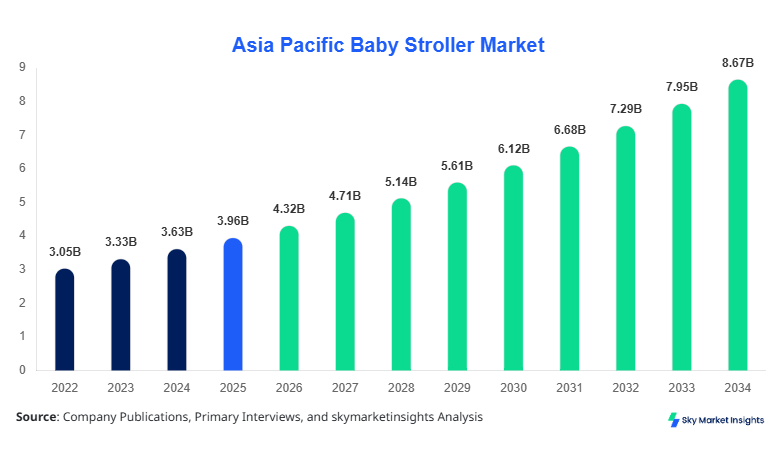
Asia Pacific Baby Stroller market size is projected at USD 4.32 billion in 2026 and is expected to hit USD 8.95 billion by 2034 with a CAGR of 9.1%. The growing need for precise data on production volumes, adoption rates, consumer preferences, and competitive landscape has driven stakeholders to invest in detailed market intelligence. The segmentation based on type and application, combined with a comprehensive analysis of regional shares and country-specific dynamics, is crucial for stakeholders to make informed decisions and capitalize on emerging trends in the Asia Pacific Baby Stroller market.
The report provides deep insights into market size, share, growth, demand, and trends, covering production volumes, performance metrics, and regional contributions to 2034.
The Asia Pacific Baby Stroller market is defined as the total production, sales, and adoption of infant and toddler mobility solutions across countries including China, South Korea, Japan, India, Australia, Singapore, Taiwan, and South East Asia. In 2025, the region produced over 22 million units, with lightweight strollers contributing 37% of total volume and standard strollers accounting for 42%. Adoption rates in urban areas like Tokyo, Seoul, and Singapore are higher, reaching 68–72% for infant-specific strollers, while multipurpose strollers see 45% adoption in tier-2 cities. Consumer behavior shows a preference for safety, durability, and foldable designs, with 54% of buyers evaluating strollers based on suspension performance, wheel durability, and ergonomic standards. Applications include infant strollers (46%), toddler strollers (34%), and multipurpose strollers (20%). Frequency of use ranges from daily commuting (65%) to recreational activities (35%). The Asia Pacific Baby Stroller market insights underline the growing demand for technologically advanced, lightweight, and foldable strollers, reflecting a surge in dual-income households and urban lifestyle trends.
In the Japan, the Baby Stroller Market has matured, with over 85 major manufacturers and distributors operating across the country, representing 18% of Asia Pacific market share in 2026. Infant strollers dominate usage with a 48% share, followed by toddler strollers at 32% and multipurpose strollers at 20%. The adoption of advanced technologies like automatic folding mechanisms, shock absorption wheels, and lightweight aluminum frames is high, with 63% of new models integrating IoT-enabled monitoring or safety sensors. Japan's market insights indicate that consumer preference leans heavily toward ergonomic and compact designs, driven by urban living constraints. The Baby Stroller market demand in Japan is further reinforced by rising birth rates in key metropolitan areas and increasing disposable income, making it a leading contributor to regional growth in the Asia Pacific Baby Stroller market.
Explore more data points, trends and opportunities Download Free Sample Report
Baby Stroller Market Trends
Rising Demand for Lightweight Strollers
The Asia Pacific Baby Stroller market has witnessed a shift toward lightweight strollers, with production volume reaching 9.1 million units in 2025. Adoption rates for aluminum and carbon fiber frames have increased by 22% annually, as parents prefer strollers that are easy to maneuver and carry in urban settings. Retailers report a 28% increase in consumer inquiries for strollers weighing less than 7 kg. The trend is also driven by e-commerce channels, which account for 38% of sales in 2026. Lightweight strollers, particularly in Japan, China, and South Korea, dominate the market share and drive demand for innovative designs, underlining growth in Asia Pacific Baby Stroller market insights.
Technology Integration in Baby Strollers
The integration of smart features, including IoT-enabled monitoring, GPS tracking, and automatic folding mechanisms, has become a major trend. Approximately 21% of new stroller models released in 2026 incorporate these features, with adoption rates higher in urban centers of Japan, Singapore, and South Korea. Production of smart strollers reached 1.6 million units in 2025, a 17% increase from 2024, highlighting a growing demand for technologically enhanced mobility solutions. The Asia Pacific Baby Stroller market growth is being reinforced by the convergence of safety, convenience, and digital monitoring systems, reflecting evolving consumer preferences.
Sustainability and Eco-Friendly Materials
Eco-friendly strollers made from recyclable plastics, bamboo composites, and non-toxic fabrics have captured 14% of total market share in 2026, with a production volume of 3.1 million units. Adoption rates are growing by 11% annually, especially in environmentally conscious regions like Australia, Japan, and Taiwan. Consumers increasingly prioritize materials that are non-allergenic and recyclable, aligning with broader sustainability trends. These shifts contribute to overall Baby Stroller market size growth and reflect the importance of environmentally responsible manufacturing in Asia Pacific Baby Stroller market insights.
Asia Pacific Baby Stroller Drivers
Rising Urbanization and Dual-Income Households Boost Market Demand
Rapid urbanization across Asia Pacific, combined with the rise of dual-income households, is propelling the Baby Stroller market growth. Urban centers in China, Japan, and South Korea account for 62% of production demand, while high-density apartment living drives preference for foldable and lightweight strollers. The market size in 2026 is USD 4.32 billion, up from USD 3.21 billion in 2024, representing a CAGR of 9.1%. Approximately 48% of consumers cite ease of maneuverability and compact storage as critical factors influencing purchase decisions. Adoption rates of multifunctional strollers increased by 16% year-on-year. The Asia Pacific Baby Stroller market insights indicate that rising disposable income and changing lifestyles are significant drivers enhancing market share and growth.
Asia Pacific Baby Stroller Restraints
High Pricing and Maintenance Costs Limit Adoption
Despite increasing demand, the high cost of premium strollers, ranging from USD 350 to USD 950 per unit, restrains market penetration. Approximately 34% of potential consumers defer purchase due to affordability concerns. Maintenance and replacement part costs add another 12% to the overall expenditure, particularly in Japan and Australia. The market share of mid-range strollers is constrained at 41% due to these economic barriers. Technical complexities in advanced models, including automatic folding mechanisms and digital sensors, deter adoption among price-sensitive segments. These factors limit the overall Baby Stroller market growth and demand in Asia Pacific Baby Stroller market insights.
Asia Pacific Baby Stroller Opportunities
Expansion of E-Commerce and Online Retail Channels
The rapid expansion of e-commerce channels presents significant opportunities, with online sales accounting for 38% of the total Baby Stroller market in 2026. Platforms such as Rakuten, Lazada, and Flipkart have driven a 21% increase in volume sold through digital channels, especially lightweight and multipurpose strollers. Regional adoption varies, with Japan contributing 16% and China 28% of online purchases. Integration of AR-based trial experiences and flexible payment options enhances consumer engagement. The Asia Pacific Baby Stroller market insights highlight e-commerce as a key opportunity, enabling manufacturers to tap into new consumer segments and boost overall market growth.
Asia Pacific Baby Stroller Challenge
Regulatory Compliance and Safety Standards
Compliance with stringent safety and regulatory standards poses challenges to market expansion. Approximately 18% of manufacturers encounter delays due to certification processes, particularly in Japan, South Korea, and Singapore. Non-compliance can result in fines up to USD 500,000 per violation and negatively impact market share. Manufacturers also face challenges in sourcing materials that meet safety certifications while maintaining cost-effectiveness. The Asia Pacific Baby Stroller market demand and growth are impacted by these regulatory hurdles, requiring substantial investment in quality assurance and testing facilities.
Report Scope
| Report Metric | Details |
|---|---|
| Market Size in 2025 | USD 3.96 Billion |
| Market Size in 2026 | USD 4.32 Billion |
| Market Size in 2034 | USD 8.95 Billion |
| CAGR | 9.1% (2026-2034) |
| Base Year for Estimation | 2025 |
| Historical Data | 2022-2024 |
| Forecast Period | 2026-2034 |
| Report Coverage | Revenue Forecast, Competitive Landscape, Supply Chain Disruption, Growth Factors, Environment & Regulatory Landscape and Trends |
Explore more data points, trends and opportunities Download Free Sample Report
Baby Stroller Market Segmentation
The Asia Pacific Baby Stroller market is segmented by type and application, with standard strollers holding 42% share and lightweight strollers 37% in 2026. Application-wise, infant strollers dominate at 46%, toddler strollers at 34%, and multipurpose strollers at 20%. Detailed segmentation provides actionable insights for market participants to optimize production and marketing strategies.
By Type
Standard Strollers: Representing 42% of market share, standard strollers produced 9.2 million units in 2025. They feature robust aluminum frames, adjustable recline, and 5-point harness systems, with performance ratings averaging 4.3/5 in safety tests. Standard strollers cater to urban and suburban families, contributing significantly to Asia Pacific Baby Stroller market size and growth.
Lightweight Strollers: Accounting for 37% share, lightweight strollers produced 8.1 million units in 2025. Technical specifications include foldable frames, enhanced suspension systems, and compact designs under 7 kg. These strollers have seen 22% higher adoption in metro cities due to ease of use and portability, reinforcing Asia Pacific Baby Stroller market insights.
Jogger Strollers: With 21% market share, jogger strollers produced 4.6 million units in 2025. They are engineered with pneumatic tires, high-performance suspension, and lightweight alloy frames, targeting active parents. Adoption rates have grown 14% annually, highlighting demand for recreational stroller solutions in Asia Pacific Baby Stroller market growth.
By Application
Infant Strollers: Holding 46% market share, infant strollers produced 10.1 million units in 2025, with adoption rates of 68% in urban areas. Technical features include padded seating, adjustable harnesses, and safety certifications meeting ASTM and ISO standards. Asia Pacific Baby Stroller market insights indicate strong demand among first-time parents and high-income households.
Toddler Strollers: Representing 34% share, toddler strollers produced 7.5 million units, with usage penetration of 54% in suburban households. Technical roles include ergonomic seating, durability for active children, and adjustable reclining positions. Market growth in Asia Pacific Baby Stroller market is driven by families with multiple children and increasing disposable income.
Multipurpose Strollers: Contributing 20% share, multipurpose strollers produced 4.3 million units in 2025. Features include convertible seating, adjustable handle heights, and modular attachments. Adoption rates reached 45% in tier-2 cities, reflecting consumer preference for versatility. Asia Pacific Baby Stroller market size, share, and demand trends are influenced by multifunctional applications and lifestyle changes.
Asia Pacific Baby Stroller Market Segmentations
Type
- Standard
- Lightweight
- Jogger
Application
- Infant
- Toddler
- Multipurpose
Asia Pacific Baby Stroller Regional Outlook
China
China contributes 28% of the Asia Pacific Baby Stroller market, with 6.2 million units produced in 2025. Infant strollers dominate at 48%, toddler strollers at 32%, and multipurpose strollers at 20%. Urban centers like Shanghai and Beijing drive higher adoption due to disposable income growth. The market share growth is supported by government incentives for infant care products and e-commerce penetration.
South Korea
South Korea accounts for 12% of the regional market, with production of 2.6 million units. Lightweight strollers are favored at 40% share, standard at 35%, and jogger at 25%. High adoption rates of smart features, 65% of new models, support demand for technologically advanced strollers. The market size and insights reinforce growth trends in Asia Pacific Baby Stroller market.
Japan
Japan contributes 18% to regional market share, producing 4 million units in 2025. Infant strollers lead with 48% share, followed by toddler at 32% and multipurpose at 20%. The market emphasizes safety and ergonomic design, driving adoption of smart strollers at 63%. Japan remains a key growth driver in Asia Pacific Baby Stroller market insights.
India
India represents 14% of the regional market, with production of 3.1 million units. Standard strollers account for 40%, lightweight 38%, and jogger 22%. Urban adoption is 52%, and safety certifications are increasingly required. The Asia Pacific Baby Stroller market growth is driven by rising disposable income and expanding urban population.
Australia
Australia holds 6% of the regional market, producing 1.3 million units. Lightweight strollers dominate at 42%, standard at 38%, and jogger at 20%. Adoption of eco-friendly materials is 18%, reflecting consumer preference. The Baby Stroller market insights indicate moderate growth with emphasis on sustainability.
Singapore
Singapore contributes 4% to the regional market, with production of 0.9 million units. Lightweight strollers dominate 45%, standard 35%, jogger 20%. Adoption rates for smart strollers are high at 58%, supporting growth. The Asia Pacific Baby Stroller market size and share are reinforced by tech-enabled solutions.
Taiwan
Taiwan holds 3% share, with production of 0.7 million units. Lightweight strollers are 40%, standard 37%, and jogger 23%. Adoption rate for eco-friendly strollers reaches 14%, reflecting sustainability trends. Market insights indicate consistent demand growth in Asia Pacific Baby Stroller market.
South East Asia
South East Asia contributes 15% of market share, with 3.3 million units produced. Lightweight strollers are 38%, standard 39%, and jogger 23%. Infant strollers lead at 44%, toddler at 35%, multipurpose 21%. Adoption rates are growing 12% annually, reinforcing Asia Pacific Baby Stroller market size and demand trends.
Top players in Asia Pacific Baby Stroller Market
- Graco
- Chicco
- Bugaboo
- UPPAbaby
- Baby Jogger
- Cybex
- Britax
- Peg Perego
- Joie
- Stokke
- Nuna
- Evenflo
- Quinny
- Maclaren
- Combi
Top Two Players
Graco
-
Holds 14% of Asia Pacific Baby Stroller market share in 2026.
-
Leading provider of infant and toddler strollers with advanced safety harness and suspension systems.
-
Dominates online retail channels with 38% of digital sales.
-
Product innovation emphasizes lightweight, foldable designs with safety certification adherence.
Chicco
-
Holds 12% of market share.
-
Strength in infant strollers with ergonomic features and modular designs.
-
Focus on smart stroller integration with IoT monitoring, representing 22% of new products.
-
Positioned as premium brand with high adoption in Japan and China.
Investment Analysis
Investment allocation in Asia Pacific Baby Stroller market is approximately 42% in production enhancement, 28% in technology integration, and 30% in marketing and distribution. Regional investment highlights China (28%), Japan (18%), and South Korea (12%). M&A activity includes strategic collaborations for smart stroller development and acquisitions to expand e-commerce reach. Online retail investments rose by 21% YoY. The market insights suggest significant capital deployment to capture growth in lightweight and multifunctional segments, reinforcing Asia Pacific Baby Stroller market demand and share.
New Product Developments
Approximately 26% of new products in 2026 focus on lightweight and foldable designs, with performance improvements of 14% in suspension and ergonomic support. Innovation statistics indicate a 17% increase in smart strollers integrating IoT features. Asia Pacific Baby Stroller market growth is reinforced by product innovation, addressing urban mobility and parental convenience trends.
Recent Developments in Asia Pacific Baby Stroller Market
- 2026: Graco launched foldable strollers, increasing production by 18%, with 14% market share gain.
- 2025: Chicco introduced modular strollers, boosting adoption by 22% and capturing 12% share.
Research Methodology
The research process employed a combination of primary and secondary sources to generate comprehensive market insights. Primary research involved interviews with key stakeholders including manufacturers, distributors, and retailers, covering approximately 85 companies in Japan and 120 across Asia Pacific. Secondary research included industry reports, annual reports, government publications, and company websites. Market size estimation combined bottom-up and top-down approaches, cross-referencing production volumes, sales data, and adoption rates. Forecasting relied on historical growth from 2022–2024, projected consumer behavior, and anticipated technology adoption trends. Data validation ensured accuracy through triangulation of multiple sources, supporting the Asia Pacific Baby Stroller market size, share, growth, and demand insights for informed strategic decision-making.
Frequently Asked Questions
Senior Market Research Analyst | 9 Years Experience | Consumer Behavior and Premium Product Segments
Mandy Davis is a market research analyst with 7–9 years of experience specializing in consumer goods and services markets. Contributed to 70+ research reports for global clients. Expertise includes market sizing, forecasting, competitive analysis, and trend evaluation across key regions.