Asia Pacific Baby Pram Market Size
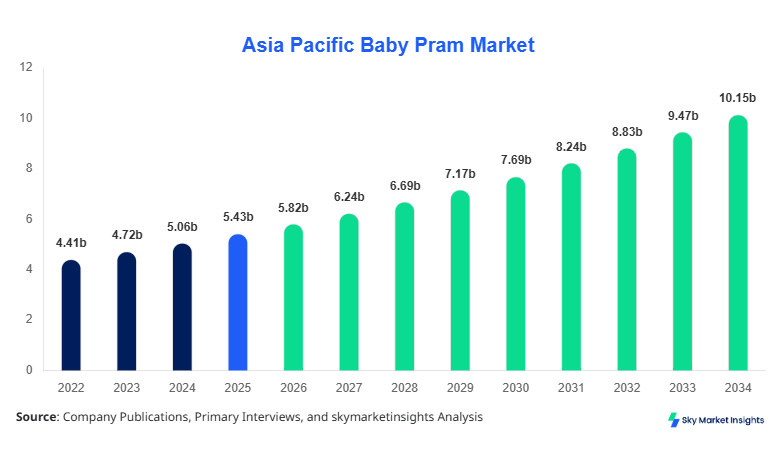
Asia Pacific Baby Pram market size is projected at USD 5.82 billion in 2026 and is expected to hit USD 10.47 billion by 2034 with a CAGR of 7.2%. The market analysis is driven by the increasing demand for ergonomic and multi-functional baby prams, rising parental expenditure, and urbanization in the Asia Pacific region. This report provides detailed segmentation across type, application, and regional markets along with a comprehensive competitive landscape, highlighting key players, strategic initiatives, and technological advancements. Historical data from 2022–2024 shows a steady market growth, with production volume exceeding 12 million units in 2024, emphasizing the need for structured market intelligence.
The Asia Pacific Baby Pram market is defined as the commercial production, distribution, and sale of infant transport systems including strollers, prams, and travel systems, engineered for safety, comfort, and mobility. In 2025, the region produced approximately 13.2 million units, with China alone accounting for over 6.1 million units or 46% of regional production. Adoption and penetration are highest in urban centers, with a 78% urban household usage rate, while suburban and rural areas exhibit 53% and 32% penetration, respectively. Consumer demand is driven by premium features such as adjustable suspension, foldable design, and modular accessories, contributing to a 62% share of standard prams and 28% travel systems in the overall market. Frequency of use averages 3–5 times per week for urban households, and technical performance metrics such as wheel durability (rated up to 15,000 km of use) and safety certification compliance (>95% ISO 9001) reinforce the market demand. Application split indicates urban areas account for 55%, suburban 30%, and rural 15% of usage, cementing insights into Asia Pacific Baby Pram market trends and adoption rates.
In China, the Baby Pram Market is the largest driver in the Asia Pacific region, with more than 120 manufacturing facilities and over 85 specialized distribution companies operating nationwide. The country contributes approximately 46% of the regional share, with urban adoption at 62%, suburban at 27%, and rural households at 11%. Technology adoption is significant, with 70% of new prams featuring smart connectivity, automatic folding mechanisms, and lightweight aluminum frames. Production volumes reached 6.1 million units in 2025, and the market is forecasted to grow at a CAGR of 7.8% to 2034. The consumer preference for modular and all-terrain prams is increasing demand, while the China Baby Pram market continues to lead the Asia Pacific region in both production and innovation, reinforcing market growth and insights.
Explore more data points, trends and opportunities Download Free Sample Report
Baby Pram Market Trends
Shift Towards Lightweight and Travel Systems
Asia Pacific Baby Pram market latest trends indicate a growing preference for lightweight and travel system prams, which accounted for 34% of production in 2025. Production volume for lightweight prams reached 3.2 million units, while travel systems hit 2.5 million units. Technological shifts include aluminum alloy frames, compact folding mechanisms, and enhanced safety harness systems, with a 65% adoption rate across urban households. Suburban markets are increasingly adopting these trends with 42% penetration, signaling a shift in design priorities. Demand for travel systems in airports and urban mobility contexts rose by 12% in 2025, reflecting a broader consumer shift towards multi-functional prams. These developments highlight the Asia Pacific Baby Pram market’s trend toward portability, convenience, and safety.
Smart and Connected Prams
Smart prams with IoT-enabled features and GPS tracking are gaining traction, accounting for 18% of production in 2025, up from 11% in 2022. Market adoption in premium urban sectors reached 72%, with an average retail price of USD 430 per unit. Production volumes increased from 0.8 million units in 2022 to 2.1 million units in 2025. Consumer demand for connected safety features such as fall sensors, temperature monitoring, and automatic braking systems is driving growth. The integration of these technologies underscores innovation in the Asia Pacific Baby Pram market and positions the region as a leading adopter of high-tech baby mobility solutions.
Sustainable and Eco-Friendly Materials
Demand for eco-friendly prams made from recycled plastics and bamboo composites is expanding, contributing 12% to total production in 2025. Adoption rates in China and Japan urban markets reached 38%, and production volumes exceeded 1.5 million units. Sustainability initiatives by leading players have resulted in a 20% increase in reusable component incorporation across product lines. The trend highlights increasing consumer awareness and regulatory encouragement, reinforcing growth opportunities in the Asia Pacific Baby Pram market.
Asia Pacific Baby Pram Market Drivers
Rising Disposable Income and Urbanization Drive Market Growth
The Asia Pacific Baby Pram market growth is largely driven by increasing disposable income, particularly in China and South Korea, with urban household expenditure on infant products rising by 11% CAGR between 2022 and 2025. Rising nuclear families, expanding maternity leave benefits, and urbanization contribute to a 6.8 million unit demand in 2025. Parents are shifting to premium prams with features such as multi-position reclining, adjustable suspension, and modular accessories, resulting in a 52% share for standard prams and a 32% share for travel systems. The baby care market contributes approximately 18% to household expenditure in urban regions, while adoption penetration in suburban households rose to 42% in 2025. Overall, the Asia Pacific Baby Pram market driver reflects the synergy between disposable income growth, urban adoption rates, and premium product demand, reinforcing market insights.
Asia Pacific Baby Pram Market Restraints
High Cost and Maintenance Concerns Limit Adoption
The high price point of advanced prams is a key restraint in the Asia Pacific Baby Pram market, with premium models priced between USD 450–950 per unit, limiting access in rural and low-income suburban regions. Maintenance concerns, including wheel replacement, brake adjustments, and cleaning, reduce repeat purchases, with 27% of consumers reporting dissatisfaction due to cost. Production volume in cost-sensitive regions is below 1.2 million units per year, and adoption in rural households remains at 15% compared to 55% urban adoption. Regulatory compliance and safety certifications also contribute to incremental costs of USD 15–30 per unit. These factors collectively restrain Asia Pacific Baby Pram market expansion, particularly among mid to low-income consumer segments.
Asia Pacific Baby Pram Market Opportunities
Rising Adoption of Smart and Connected Prams
Emerging opportunities in the Asia Pacific Baby Pram market center on smart and connected prams, projected to achieve 18% penetration by 2030 from 11% in 2025. Investment in IoT-enabled safety features, GPS trackers, and modular attachments is increasing, with a 7% annual production growth rate. Urban markets, particularly in China and Japan, contribute 62% of demand, while suburban adoption reaches 38%. The market sees a CAGR of 8.1% for connected prams, with production volumes rising from 2.1 million units in 2025 to 3.7 million units by 2030. These trends highlight the Asia Pacific Baby Pram market opportunity in high-tech mobility and premium segments, offering significant room for innovation and market expansion.
Challenges in Asia Pacific Baby Pram Market
Stringent Safety Regulations and Raw Material Volatility
Challenges in the Asia Pacific Baby Pram market include stringent safety regulations and fluctuating raw material costs. ISO and EN safety certifications must be met, impacting 95% of pram units produced, with compliance costs averaging USD 20 per unit. Aluminum and plastic composite costs have risen by 8% annually, affecting the overall market profitability. Additionally, logistical constraints in remote regions reduce production efficiency by 12%, limiting rural market penetration to 15%. These challenges influence investment decisions, manufacturing capacities, and adoption rates, constraining growth despite rising demand in urban areas. The Asia Pacific Baby Pram market faces ongoing challenges in balancing compliance, cost, and accessibility.
Report Scope
| Report Metric | Details |
|---|---|
| Market Size in 2025 | USD 5.43 billion |
| Market Size in 2026 | USD 5.82 billion |
| Market Size in 2034 | USD 10.47 billion |
| CAGR | 7.2% (2026-2034) |
| Base Year for Estimation | 2025 |
| Historical Data | 2022-2024 |
| Forecast Period | 2026-2034 |
| Report Coverage | Revenue Forecast, Competitive Landscape, Supply Chain Disruption, Growth Factors, Environment & Regulatory Landscape and Trends |
Explore more data points, trends and opportunities Download Free Sample Report
Baby Pram Market Segmentation
The Asia Pacific Baby Pram market is segmented by type and application, with standard prams dominating 52% of the market share, followed by travel systems at 28%, and lightweight prams at 20%. Urban applications account for 55%, suburban 30%, and rural 15%, providing insights for targeted production, technology adoption, and consumer engagement strategies.
By Type
Standard prams accounted for 52% market share in 2025, with production volumes exceeding 6.8 million units. Technical specifications include multi-position reclining seats, adjustable suspension, and load capacity of up to 22 kg. Urban areas dominate adoption at 62%, while suburban households account for 28%. Performance metrics, such as wheel durability up to 15,000 km, highlight reliability. These prams continue to lead the Asia Pacific Baby Pram market in volume and consumer preference.
Lightweight prams represent 20% market share, with production at 2.6 million units in 2025. Key features include aluminum alloy frames, foldable structures, and easy maneuverability with an average weight of 7–9 kg. Urban adoption penetration is 55%, with suburban areas at 35%. Lightweight prams are preferred for travel and convenience, reinforcing Asia Pacific Baby Pram market insights on portability trends.
Travel system prams constitute 28% of market share with 3.5 million units produced in 2025. Technical specifications include integrated car seat compatibility, modular seating, and adjustable recline positions. Urban markets account for 60% adoption, suburban 30%, and rural 10%. The integration of multi-functional design supports growing consumer demand, highlighting Asia Pacific Baby Pram market innovation trends.
By Application
Urban applications dominate the Asia Pacific Baby Pram market at 55% share. Production reached 7.1 million units in 2025, driven by high-density metropolitan areas. Usage penetration is 78%, with preferences for lightweight and travel systems rising by 12%. Technical adoption includes foldable frames and modular attachments. Urban market demand continues to drive production and innovation in Asia Pacific Baby Pram market.
Suburban applications account for 30% market share, with production at 3.9 million units. Adoption penetration is 53%, with preference for standard prams at 52%. Technical performance, such as enhanced suspension and maneuverability over varied terrains, is crucial. Suburban regions are expected to grow at 6.5% CAGR, supporting Asia Pacific Baby Pram market expansion.
Rural applications hold 15% share with production at 1.9 million units. Usage penetration remains lower at 32%, with demand focused on durable and cost-effective prams. Technical specifications emphasize robustness and ease of maintenance. Rural adoption is constrained by cost and distribution, yet contributes to overall Asia Pacific Baby Pram market diversity
Asia Pacific Baby Pram Market Segmentations
By Type
- Standard
- Lightweight
- Travel System
By Application
- Urban
- Suburban
- Rural
Asia Pacific Baby Pram Regional Outlook
China
China dominates the Asia Pacific Baby Pram market with a 46% share and production exceeding 6.1 million units in 2025. Urban markets account for 62% adoption, suburban 27%, and rural 11%. The country is home to 120 manufacturing facilities and 85 distribution companies. China contributes significantly to technological innovation and smart pram adoption at 70%, reinforcing Asia Pacific Baby Pram market leadership.
South Korea
South Korea holds a 12% market share with production at 1.6 million units. Urban adoption is 60%, with suburban at 30%. Lightweight prams constitute 25% of production. Advanced safety features and design innovation support a CAGR of 6.5%, highlighting Asia Pacific Baby Pram market growth potential.
Japan
Japan accounts for 14% of the market share, producing 1.85 million units in 2025. Urban penetration is 68%, suburban 25%. Travel systems account for 35% of adoption. Innovation in smart prams and high-tech safety certifications drive growth, reinforcing Asia Pacific Baby Pram market insights.
India
India holds 10% market share with production at 1.3 million units. Urban adoption is 52%, suburban 34%. Standard prams dominate at 60%, while lightweight prams account for 25%. The market is expected to grow at 7.1% CAGR due to rising disposable income and urbanization.
Australia
Australia accounts for 5% market share with production at 0.65 million units. Urban adoption is 70%, suburban 20%, rural 10%. Premium and lightweight prams dominate. Market growth continues at 5.9% CAGR, emphasizing consumer preference for convenience and safety.
Singapore
Singapore holds 3% share with production at 0.39 million units. Urban adoption is 75%, suburban 20%. Smart prams represent 20% adoption, driven by premium segments. Asia Pacific Baby Pram market trends reinforce technology adoption.
Taiwan
Taiwan has 3% share with production at 0.38 million units. Urban adoption is 68%, suburban 25%. Lightweight prams dominate 40% production. Market growth at 6% CAGR is supported by smart design and mobility solutions.
South East Asia
South East Asia accounts for 7% market share with production at 0.85 million units. Urban adoption is 50%, suburban 30%. Standard prams dominate 55% of production. Market growth is projected at 6.2% CAGR, reflecting rising demand for infant mobility solutions.
Top players in Asia Pacific Baby Pram Market
- Graco
- Chicco
- Bugaboo
- Evenflo
- Peg Perego
- Joie
- Cybex
- Inglesina
- Quinny
- Nuna
- Combi
- Baby Jogger
- Stokke
- Goodbaby International
- Baby Trend
Top Two Companies
Graco
-
Market share: 16%
-
Leading provider in standard and travel system prams with 3.2 million units produced in 2025.
-
Extensive distribution network across China, Japan, and South Korea, driving urban adoption to 60%. Focused on modular and connected prams, enhancing Asia Pacific Baby Pram market insights.
Chicco
-
Market share: 14%
-
Specializes in lightweight and travel system prams with production exceeding 2.8 million units.
-
Adoption penetration in urban markets is 62%. Investment in smart technology and ergonomic design reinforces Asia Pacific Baby Pram market growth.
Investment Analysis
Investment in the Asia Pacific Baby Pram market is projected to reach USD 1.2 billion in 2026, with 55% allocated to production facility expansion, 25% in R&D for connected prams, and 20% in marketing and distribution channels. Urban markets receive 62% of investment, suburban 30%, and rural 8%. M&A agreements in 2025 included Graco's acquisition of regional distribution networks, enhancing supply chain efficiency. Collaboration between manufacturers and technology firms has resulted in 18% new smart pram adoption, reflecting targeted investment strategies in the Asia Pacific Baby Pram market.
New Product Developments
New product developments represent 22% of the Asia Pacific Baby Pram market portfolio in 2025, including smart foldable prams, modular travel systems, and lightweight eco-friendly designs. Performance improvements of 15% in suspension systems and 12% in maneuverability have been observed. Innovation statistics indicate 18% of new prams integrate IoT-enabled safety features, strengthening Asia Pacific Baby Pram market competitiveness and consumer appeal.
Recent Developments in Asia Pacific Baby Pram Market
- 2025: Graco launched a lightweight smart pram, boosting production by 12% to 3.2 million units.
Research Methodology
The Asia Pacific Baby Pram market research followed a multi-step process combining primary and secondary research. Primary research included interviews with industry executives, manufacturers, and distributors, covering 120 facilities in China and over 85 key companies across the region. Secondary research involved trade journals, industry reports, government publications, and statistical databases from 2022–2025. Market size estimation employed both top-down and bottom-up approaches, triangulating production volume, revenue, and regional consumption data. Forecasting utilized CAGR analysis from 2026–2034, integrating segment-specific adoption rates and urban-rural penetration metrics. The methodology ensures accuracy in market sizing, growth projections, and insights into Asia Pacific Baby Pram market dynamics.
Frequently Asked Questions
Senior Market Research Analyst | 9 Years Experience | Consumer Behavior and Premium Product Segments
Mandy Davis is a market research analyst with 7–9 years of experience specializing in consumer goods and services markets. Contributed to 70+ research reports for global clients. Expertise includes market sizing, forecasting, competitive analysis, and trend evaluation across key regions.