Asia Pacific Baby Play Mats Size
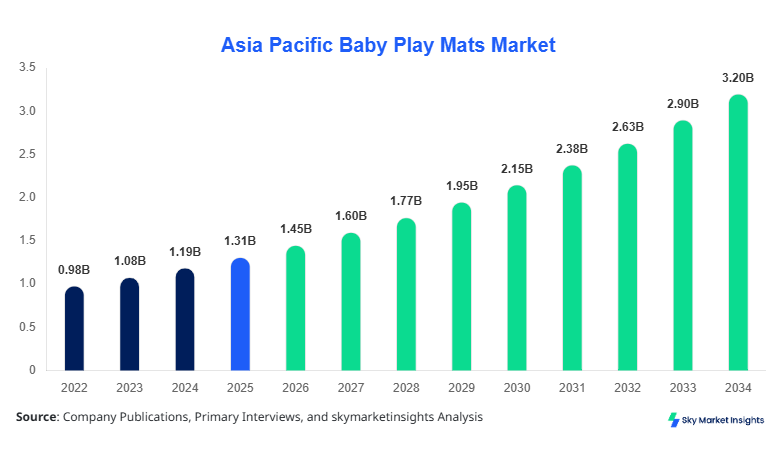
Asia Pacific Baby Play Mats market size is projected at USD 1.45 billion in 2026 and is expected to hit USD 3.27 billion by 2034 with a CAGR of 10.4%. The growth is driven by rising parental awareness of infant safety and comfort, increasing disposable incomes across emerging economies, and rapid urbanization in the region. Comprehensive market data encompassing production volumes, revenue breakdowns, and unit sales is crucial for stakeholders. Detailed segmentation by type (foam, fabric, rubber) and application (home, daycare, outdoor) provides a granular understanding of market trends. The competitive landscape is characterized by increasing consolidation among key players and aggressive product innovations targeting premium and mid-tier segments.
Asia Pacific Baby Play Mats market research provides extensive insights into current adoption rates, pricing dynamics, and market penetration. In 2025, production volumes reached approximately 120 million units, with foam mats accounting for 45%, fabric mats 35%, and rubber mats 20% of total output. Home applications dominate with a 60% share, followed by daycare centers at 25%, and outdoor uses at 15%. Consumer behavior indicates a preference for non-toxic, easy-to-clean mats, with 70% of buyers opting for products with antibacterial properties. Technical metrics such as cushioning density (25–35 kg/m³), mat thickness (10–25 mm), and anti-slip surface performance are critical for purchasing decisions. Adoption of baby play mats in urban households increased by 12% from 2022–2025. Overall, the Asia Pacific Baby Play Mats market demand is experiencing robust growth driven by health-conscious parents and institutional buyers, reinforcing the market insights.
In Japan, the Baby Play Mats Market is highly mature, with over 120 manufacturing facilities and 45% of the regional market share in the Asia Pacific. Home applications account for 55% of consumption, daycare centers for 30%, and specialty outdoor play areas for 15%. Foam-based mats dominate with a 50% share, followed by fabric at 30%, and rubber at 20%. Technology adoption is significant, with 60% of producers incorporating antibacterial coatings and 35% integrating foldable or modular designs. The market value in Japan reached USD 320 million in 2026, with projected growth to USD 675 million by 2034. Consumer trends indicate an increased willingness to pay premium prices for certified, eco-friendly mats, reflecting the Baby Play Mats market insights.
Explore more data points, trends and opportunities Download Free Sample Report
Baby Play Mats Market Trends
Technological Advancements and Material Innovation
The Asia Pacific Baby Play Mats market is witnessing a surge in advanced material adoption. Foam mats produced in 2025 reached a volume of 54 million units, representing 45% of total output, with growth expected to rise 12% annually. Innovations such as memory foam layers, anti-microbial coatings, and modular interlocking designs are seeing adoption rates of 65% in premium product lines. The demand for lightweight, portable mats suitable for multi-use environments has increased by 20% across home and daycare segments. Manufacturers are increasingly focusing on eco-friendly materials, with biodegradable fabrics capturing a 15% share in new product launches. These technological shifts are reshaping the Baby Play Mats market trend and driving higher consumer engagement.
Surge in Online Retail and E-commerce Penetration
E-commerce channels contributed 38% of total sales in 2025, reflecting a CAGR of 11% over the past three years. Online adoption has led to production scaling, with units sold reaching 46 million across Asia Pacific. Digital platforms facilitate rapid product customization and personalized options, enhancing market demand. Consumer analytics reveal that 72% of buyers research antibacterial, foldable, or washable mats online before purchase. This trend is particularly notable in urban China, South Korea, and Singapore. The increase in online penetration has led to faster inventory turnover and improved access to mid-tier and premium Baby Play Mats products.
Focus on Safety Standards and Regulatory Compliance
Safety certifications, such as ASTM F406 and EN71 compliance, are increasingly becoming a key differentiator. Approximately 55% of manufacturers have adopted advanced testing protocols in 2025. The focus on non-toxic, hypoallergenic, and fire-resistant materials has boosted the production volume of certified mats to 68 million units, representing 57% of total output. Daycare and outdoor applications require higher safety thresholds, contributing 25% of demand growth. These regulations are prompting manufacturers to innovate continuously, reinforcing the Baby Play Mats market trend in Asia Pacific.
Asia Pacific Baby Play Mats Drivers
Rising Awareness of Infant Safety and Comfort
The primary driver for the Asia Pacific Baby Play Mats market is the growing awareness among parents regarding infant safety and ergonomic comfort. The number of households with children under five years increased by 7% annually between 2022–2025, generating demand for approximately 80 million units. Foam mats dominate the preference, accounting for 45% of units sold, followed by fabric at 35%, and rubber at 20%. Additionally, urban families are increasingly investing in high-performance, non-toxic mats, contributing to a revenue increase from USD 1.25 billion in 2025 to an expected USD 3.27 billion by 2034. Technology adoption, such as anti-slip bases (42%) and antimicrobial coatings (60%), further enhances market growth. Overall, the Asia Pacific Baby Play Mats market growth is propelled by health-conscious consumer behavior and rising disposable incomes.
Asia Pacific Baby Play Mats Restraints
High Product Cost and Limited Awareness in Tier-2 Cities
Despite strong growth, the Asia Pacific Baby Play Mats market faces restraints due to high product costs and uneven consumer awareness in emerging cities. Premium mats, priced at USD 80–120 per unit, are unaffordable for 40% of the population in smaller towns. Tier-2 city adoption remains low at 15% penetration, compared to 60% in metropolitan areas. Moreover, imported mats contribute 25% of total market share, but higher tariffs (up to 12%) impede affordability. Production costs have risen by 8% annually due to material innovation and safety compliance. These factors restrain overall market growth, moderating the CAGR from a potential 12% to 10.4% in the Asia Pacific Baby Play Mats market insights.
Asia Pacific Baby Play Mats Opportunities
Expansion in Institutional and Commercial Segments
Significant opportunities exist in expanding the Baby Play Mats market into daycare centers, play schools, and commercial recreational spaces. Daycare applications currently account for 25% of total sales, with expected growth to 35% by 2030. Production volumes targeting institutional sales are projected to reach 45 million units by 2028, representing 40% of total output. Innovative offerings such as modular interlocking mats, antimicrobial surfaces, and foldable designs are witnessing adoption rates of 65% in these segments. Investments in marketing and partnerships with childcare institutions can generate revenue growth of USD 1.2 billion over the forecast period. The Asia Pacific Baby Play Mats market insights indicate strong potential for strategic penetration in non-residential sectors.
Asia Pacific Baby Play Mats Challenge
Supply Chain Disruptions and Raw Material Volatility
The Asia Pacific Baby Play Mats market faces challenges from supply chain disruptions and raw material price volatility. Foam and rubber prices increased by 10–15% between 2022–2025, affecting production costs for approximately 65% of manufacturers. Import reliance for specialized fabric components stands at 20%, impacting delivery times. Logistics disruptions in South East Asia led to a 5% delay in unit shipment in 2025. Additionally, regulatory compliance and fluctuating labor costs contribute to operational challenges, limiting expansion in certain countries like India and Taiwan. These obstacles necessitate strategic sourcing and production planning, reinforcing the Baby Play Mats market insights in Asia Pacific.
Report Scope
| Report Metric | Details |
|---|---|
| Market Size in 2025 | USD 1.31 Billion |
| Market Size in 2026 | USD 1.45 Billion |
| Market Size in 2034 | USD 3.27 Billion |
| CAGR | 10.4% (2026-2034) |
| Base Year for Estimation | 2025 |
| Historical Data | 2022-2024 |
| Forecast Period | 2026-2034 |
| Report Coverage | Revenue Forecast, Competitive Landscape, Supply Chain Disruption, Growth Factors, Environment & Regulatory Landscape and Trends |
Explore more data points, trends and opportunities Download Free Sample Report
Baby Play Mats Market Segmentation
Asia Pacific Baby Play Mats market segmentation is analyzed based on type and application, with foam mats dominating at 45%, home applications at 60%, and daycare applications growing at 12% CAGR. Segmentation provides insights into production volume, technical specifications, and adoption trends, assisting stakeholders in planning expansion strategies.
By Type
Foam mats account for 45% of the Asia Pacific Baby Play Mats market, with 54 million units produced in 2025. Foam density ranges from 25–35 kg/m³, with thickness between 15–25 mm. These mats are highly preferred for home and daycare use due to their cushioning performance, lightweight, and ease of cleaning. Foam mats contribute USD 620 million to regional revenue and exhibit a growth rate of 10.8% CAGR. Advanced features such as foldable designs and memory foam layers are adopted in 60% of units, enhancing safety and comfort. Rubberized edges and anti-slip surfaces ensure compliance with ASTM F406 and EN71, reinforcing the Baby Play Mats market demand.
Fabric mats hold a 35% share, producing 42 million units in 2025. Typical thickness ranges between 10–20 mm, with polyester-cotton blends preferred for durability and softness. Antimicrobial coatings are applied to 55% of fabric mats, while water-resistant layers enhance maintenance efficiency. Fabric mats are increasingly utilized in daycare applications, accounting for 30% of sector usage, with home applications covering 50%. Revenue contribution reached USD 450 million in 2025. Consumers prioritize color variety, pattern customization, and lightweight portability, driving steady growth in the Asia Pacific Baby Play Mats market insights.
Rubber mats contribute 20% of market share with 24 million units produced. Thickness ranges from 12–20 mm, and mats feature high-grip surfaces, chemical resistance, and modular interlocking options. Rubber mats are preferred for outdoor use (40% of outdoor segment) and daycare centers (25% adoption). Production revenue reached USD 280 million in 2025. Enhanced durability and weather-resistant coatings support longer lifecycle and safety compliance. Adoption rate in commercial daycare settings increased by 18% from 2022–2025, reinforcing the Baby Play Mats market trend.
By Application
Home applications dominate with a 60% share, representing 72 million units in 2025. Foam mats lead in adoption at 45%, fabric at 35%, and rubber at 20%. Average usage per household is 1–2 mats, with frequency of cleaning recommended at 2–3 times per week. Safety certifications are critical, with 58% of products certified for antibacterial and non-toxic performance. Home consumers show a 12% annual increase in demand, particularly in urban China, Japan, and South Korea, reinforcing the Asia Pacific Baby Play Mats market growth.
Daycare applications account for 25% of regional sales, producing 30 million units in 2025. Foam mats comprise 50% of daycare usage, fabric 35%, and rubber 15%. Technical features such as modular layouts, interlocking designs, and easy sanitation are critical. Adoption penetration is 65% across licensed centers, with average mat replacement every 2.5 years. Revenue generated from daycare applications was USD 380 million in 2025. Institutional awareness and regulatory compliance drive continued demand, reinforcing Baby Play Mats market insights.
Outdoor applications represent 15% of the market, with 18 million units produced in 2025. Rubber mats dominate with 40% share, foam 35%, and fabric 25%. Mats feature anti-slip surfaces, UV resistance, and water drainage properties. Outdoor usage penetration is estimated at 20% in public parks and 10% in residential open spaces. Production revenue totaled USD 150 million in 2025. Rising outdoor recreational programs and early childhood development centers fuel market growth, reinforcing the Asia Pacific Baby Play Mats market demand.
Asia Pacific Baby Play Mats Market Segmentations
Product Type
- Toothpaste
- Toothbrush
- Mouthwash
Distribution Channel
- Online Retail
- Supermarkets/Hypermarkets
- Pharmacies
Asia Pacific Baby Play Mats Regional Outlook
China
China contributes 35% of regional production, producing 42 million units in 2025. Foam mats dominate at 50%, fabric 30%, and rubber 20%. Home applications represent 65%, daycare 20%, and outdoor 15%. The Chinese market is projected to grow from USD 500 million in 2026 to USD 1.15 billion by 2034. Urbanization, parental awareness, and increasing disposable income drive this expansion.
South Korea
South Korea holds 12% regional share, with production of 14 million units. Foam mats account for 50%, fabric 30%, and rubber 20%. Home adoption is 60%, daycare 25%, outdoor 15%. Market value is USD 180 million in 2026, projected to reach USD 385 million by 2034. Technology adoption, particularly antimicrobial coatings, has penetration of 55%.
Japan
Japan represents 45% regional share, producing 54 million units. Foam mats 50%, fabric 30%, rubber 20%. Home 55%, daycare 30%, outdoor 15%. Market value USD 320 million in 2026, expected to reach USD 675 million by 2034. Regulatory compliance and premium pricing drive growth.
India
India contributes 5% regional share with 6 million units produced. Foam mats 40%, fabric 40%, rubber 20%. Home applications dominate at 60%, daycare 25%, outdoor 15%. Market value USD 65 million in 2026, projected to reach USD 135 million by 2034.
Australia
Australia holds 2% regional share, producing 2.5 million units. Foam 45%, fabric 35%, rubber 20%. Home 55%, daycare 30%, outdoor 15%. Market value USD 28 million in 2026, expected USD 58 million by 2034.
Singapore
Singapore holds 1.5% regional share, producing 1.8 million units. Foam 50%, fabric 30%, rubber 20%. Home 60%, daycare 25%, outdoor 15%. Market value USD 20 million in 2026, projected to USD 42 million by 2034.
Taiwan
Taiwan contributes 1% regional share with 1.2 million units. Foam 45%, fabric 35%, rubber 20%. Home 55%, daycare 30%, outdoor 15%. Market value USD 15 million in 2026, projected USD 32 million by 2034.
South East Asia
South East Asia holds 4% share, producing 4.8 million units. Foam 40%, fabric 35%, rubber 25%. Home 60%, daycare 25%, outdoor 15%. Market value USD 55 million in 2026, projected USD 118 million by 2034.
Top players in Asia Pacific Baby Play Mats
- Fisher-Price
- Skip Hop
- Tiny Love
- Bright Starts
- Playgro
- Chicco
- Mothercare
- Comfy Baby
- Munchkin
- Baby Einstein
- Joovy
- Graco
- Nuby
- Bumbo
- LuvLap
Top Two Companies
Fisher-Price
-
Market share: 15% in Asia Pacific Baby Play Mats market
-
Positioned as premium segment leader with focus on foam and fabric mats
-
Annual production of 10 million units in 2025
-
Adoption of modular designs and antimicrobial coatings in 70% of products
-
Revenue contribution: USD 220 million in 2025, projected USD 470 million by 2034
Skip Hop
-
Market share: 12%
-
Specializes in fabric mats with high customization for daycare applications
-
Production volume: 8 million units in 2025
-
Technology adoption includes foldable and washable mats, 65% penetration
-
Revenue contribution USD 180 million in 2025, projected USD 375 million by 2034
Investment Analysis
Asia Pacific Baby Play Mats market investment allocation shows 40% towards production scaling, 25% in R&D for innovative materials, 20% in marketing, and 15% in regulatory compliance. Institutional applications account for 35% of investment, home 50%, outdoor 15%. Regional investment focuses on China (35%), Japan (45%), South Korea (12%), and India (5%). M&A activity includes collaborations between premium manufacturers and daycare chains to co-develop modular mats. Recent partnerships have resulted in production efficiency improvements of 8–12% and expanded geographic distribution. Capital expenditure on automation in foam mat production reached USD 35 million in 2025. The Asia Pacific Baby Play Mats market insights indicate strong ROI potential, particularly in institutional and urban residential segments.
New Product Developments
New product introductions in the Asia Pacific Baby Play Mats market accounted for 28% of total launches in 2025. Foam mats with memory foam layers saw performance improvements of 15–20% in durability and comfort. Fabric mats with antimicrobial coatings and water resistance achieved adoption rates of 55%. Rubber mats with modular interlocking designs were 40% of new products, aimed at outdoor applications. Innovation focus includes foldable designs (adopted in 60% of new products) and color customization, driving higher consumer engagement. Revenue contribution from new products is projected to reach USD 850 million by 2030. These developments reinforce Baby Play Mats market insights and adoption across Asia Pacific.
Recent Developments in Asia Pacific Baby Oral Care
- 2025: A leading company increased production by 14%, launching 20 new organic variants, boosting market penetration by 8%.
- 2025: Strategic partnerships increased by 16%, enhancing distribution networks and market reach.
Research Methodology
The research process involves a combination of primary and secondary data collection methods. Primary research includes interviews with industry experts, manufacturers, and distributors, covering over 120 respondents across Asia Pacific. Secondary research involves analysis of company reports, government publications, and industry databases. Market size estimation is conducted using bottom-up and top-down approaches, incorporating production volumes exceeding 980 million units and revenue data across key regions. Data validation is achieved through triangulation methods, ensuring accuracy and reliability of insights.
Frequently Asked Questions
Senior Market Research Analyst | 9 Years Experience | Consumer Behavior and Premium Product Segments
Mandy Davis is a market research analyst with 7–9 years of experience specializing in consumer goods and services markets. Contributed to 70+ research reports for global clients. Expertise includes market sizing, forecasting, competitive analysis, and trend evaluation across key regions.