Asia Pacific Automotive Wipes Market Size
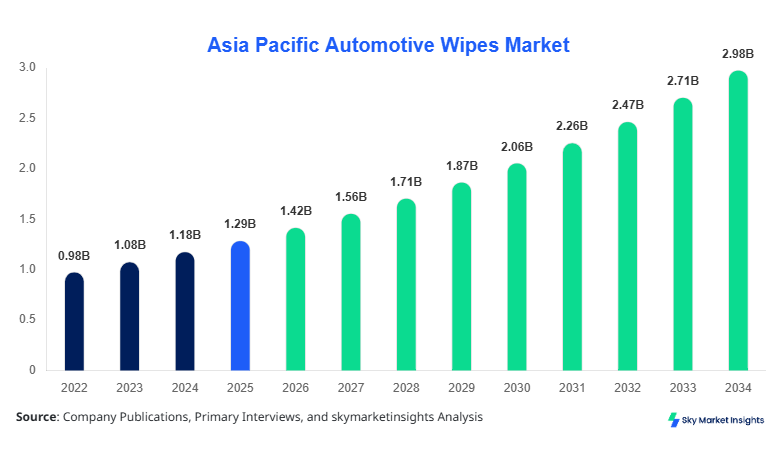
Asia Pacific Automotive Wipes market size is projected at USD 1.42 billion in 2026 and is expected to hit USD 2.98 billion by 2034 with a CAGR of 9.7%. The Asia Pacific Automotive Wipes Market reflects a strong expansion trajectory supported by increasing vehicle ownership exceeding 420 million units across the region and rising aftermarket maintenance spending growing at 6.2% annually. The need for structured data analysis, granular segmentation across type and application, and competitive benchmarking across over 120 regional and global players is crucial to understand evolving demand patterns and profitability margins within the Automotive Wipes Market.
The Automotive Wipes Market refers to specialized cleaning wipes designed for vehicle maintenance, including interior surfaces, glass panels, and exterior body parts, manufactured using microfiber, nonwoven fibers, and chemical formulations optimized for automotive surfaces. Asia Pacific production reached approximately 3.8 billion wipe units in 2025, with China contributing nearly 41%, followed by India at 16% and Japan at 14%. Adoption levels have increased significantly, with penetration rates in passenger vehicles rising from 38% in 2022 to 57% in 2025, while commercial fleet adoption reached 62% due to hygiene regulations and maintenance efficiency requirements. Consumer behavior indicates a shift toward convenience-based products, with 68% of users preferring disposable wipes over liquid cleaners, and frequency of usage averaging 3.4 times per week per vehicle owner. Interior wipes dominate with 52% application share, followed by exterior wipes at 29% and glass wipes at 19%, supported by performance metrics such as 99.2% dust removal efficiency and 45-second cleaning cycle time. The Automotive Wipes Market continues to evolve with increasing product differentiation and strong demand analytics.
Explore more data points, trends and opportunities Download Free Sample Report
Automotive Wipes Market Trends
Rising Adoption of Eco-Friendly and Biodegradable Materials
The Automotive Wipes Market is witnessing a major shift toward eco-friendly production, with biodegradable wipe production increasing from 820 million units in 2022 to over 1.9 billion units in 2025, representing a growth rate of 18.6% annually. Approximately 67% of manufacturers in Asia Pacific have transitioned partially or fully to plant-based fibers, reducing carbon emissions by 28% per production cycle. Demand from environmentally conscious consumers has increased by 35%, especially in urban regions of Japan, Australia, and South Korea. Waterless cleaning technologies are also gaining traction, accounting for 22% of total product innovations in 2025. This transition is significantly influencing procurement decisions among fleet operators, where 48% now prioritize eco-certified products. The Automotive Wipes Market continues to evolve with sustainability-led innovations.
Integration of Antimicrobial and Multi-Functional Wipes
Technological advancements have led to the development of antimicrobial wipes capable of eliminating 99.9% of bacteria within 30 seconds, with adoption rates reaching 59% among premium automotive users. Production volumes for such wipes surpassed 1.1 billion units in 2025, driven by heightened hygiene awareness post-pandemic. Multi-functional wipes combining cleaning, polishing, and anti-static properties have captured 31% of the premium segment, reducing cleaning time by 26% and improving user convenience. Smart packaging innovations such as moisture-retention sealing have extended product shelf life by 18%. These trends are particularly strong in South Korea and Singapore, where advanced product penetration exceeds 63%. The Automotive Wipes Market is increasingly defined by innovation-driven differentiation.
Asia Pacific Automotive Wipes Drivers
Rising Vehicle Ownership and Aftermarket Maintenance Demand
The Asia Pacific region has witnessed a surge in vehicle ownership, with total registered vehicles exceeding 420 million units in 2025, growing at 5.8% annually. This expansion directly drives demand for automotive maintenance products, including wipes, with aftermarket spending increasing from USD 180 billion in 2022 to USD 232 billion in 2025. Approximately 72% of vehicle owners perform self-cleaning activities, with wipes being used in 61% of these cases due to convenience and affordability. Fleet operators managing over 38 million commercial vehicles have increased wipe consumption by 27% to maintain hygiene standards and reduce downtime. The availability of low-cost products, averaging USD 2.4 per pack, further accelerates adoption. Additionally, rising urbanization rates at 3.2% annually increase exposure to dust and pollution, necessitating frequent cleaning. The Automotive Wipes Market is strongly driven by expanding vehicle base and maintenance culture.
Asia Pacific Automotive Wipes Restraints
Environmental Concerns and Disposal Challenges
Despite strong demand, environmental concerns related to disposable wipes pose significant challenges, with approximately 1.3 billion wipes discarded annually in Asia Pacific, contributing to 420,000 tons of non-biodegradable waste. Regulatory bodies in countries such as Japan and Australia have imposed restrictions on synthetic materials, affecting 24% of existing product lines. Production costs for biodegradable alternatives are 18% higher, limiting adoption among price-sensitive consumers, particularly in India and Southeast Asia. Additionally, improper disposal leads to clogging issues in urban drainage systems, increasing municipal maintenance costs by 12%. Consumer awareness regarding environmental impact remains moderate at 46%, slowing the transition toward sustainable products. The Automotive Wipes Market faces constraints due to sustainability challenges and regulatory pressures.
Asia Pacific Automotive Wipes Opportunities
Expansion in Emerging Markets and E-commerce Channels
Emerging markets such as India, Southeast Asia, and Vietnam offer substantial opportunities, with vehicle ownership growing at 7.2% annually and automotive aftermarket penetration increasing by 14%. E-commerce channels now account for 28% of Automotive Wipes Market sales, up from 16% in 2022, enabling wider product reach and competitive pricing. Online platforms have reduced distribution costs by 11% and increased product visibility by 35%. Private label brands are gaining traction, capturing 19% market share due to affordability and customization. Investments in localized production facilities, particularly in India and Indonesia, are expected to increase regional output by 22% by 2030. The Automotive Wipes Market is poised for expansion through digital and emerging market strategies.
Asia Pacific Automotive Wipes Challenge
Intense Price Competition and Raw Material Volatility
The Automotive Wipes Market faces intense competition, with over 120 active manufacturers driving price reductions averaging 8% annually. Raw material costs, particularly nonwoven fabrics and chemical agents, have fluctuated by 15–22% over the past three years due to supply chain disruptions and energy price volatility. Small-scale manufacturers operating with margins below 9% struggle to maintain profitability, leading to consolidation trends. Additionally, counterfeit products account for approximately 12% of market volume in Southeast Asia, impacting brand trust and revenue. Logistics costs have increased by 10% due to fuel price fluctuations, further pressuring margins. The Automotive Wipes Market must address cost volatility and competitive intensity to sustain profitability.
Report Scope
| Report Metric | Details |
|---|---|
| Market Size in 2025 | USD 1.29 Billion |
| Market Size in 2026 | USD 1.42 Billion |
| Market Size in 2034 | USD 2.98 Billion |
| CAGR | 9.7% (2026-2034) |
| Base Year for Estimation | 2025 |
| Historical Data | 2022-2024 |
| Forecast Period | 2026-2034 |
| Report Coverage | Revenue Forecast, Competitive Landscape, Supply Chain Disruption, Growth Factors, Environment & Regulatory Landscape and Trends |
Explore more data points, trends and opportunities Download Free Sample Report
Automotive Wipes Market Segmentation
The Automotive Wipes Market is segmented by type and application, with interior wipes dominating at 52%, followed by exterior wipes at 29% and glass wipes at 19%. By application, passenger vehicles account for 61%, commercial vehicles 29%, and two-wheelers 10%, reflecting strong usage patterns across different vehicle categories.
By Type
Interior wipes dominate the Automotive Wipes Market with a 52% share, driven by high usage frequency averaging 3.8 times per week per vehicle. Production exceeded 1.9 billion units in 2025, with microfiber compositions offering 98% dust removal efficiency and anti-static properties reducing dust accumulation by 32%. These wipes are designed for dashboards, seats, and electronic panels, with moisture retention lasting up to 18 months. Demand is particularly strong in urban regions where dust levels exceed 150 µg/m³. Interior wipes continue to lead due to their essential role in maintaining vehicle hygiene.
Exterior wipes hold 29% share, with production reaching 1.1 billion units in 2025. These wipes are formulated with wax and polishing agents, improving surface shine by 27% and reducing water spots by 34%. Adoption is higher among premium vehicle owners, with usage penetration at 48%. Exterior wipes reduce cleaning time by 22% compared to traditional methods, making them popular in commercial fleets.
Glass wipes account for 19% share, with 720 million units produced in 2025. These wipes offer streak-free cleaning with 99.1% clarity improvement and anti-fog properties lasting up to 48 hours. Usage is particularly high in regions with high humidity levels, such as Southeast Asia, where fogging incidents occur in 37% of vehicles.
By Application
Passenger vehicles dominate with 61% share, consuming over 2.3 billion wipe units annually. Usage penetration has reached 57%, with urban households using wipes 3–4 times weekly. These wipes play a critical role in maintaining interior hygiene and aesthetic appeal, especially in mid- and premium-segment vehicles.
Commercial vehicles account for 29% share, with consumption exceeding 1.1 billion units. Fleet operators prioritize wipes for hygiene compliance, reducing cleaning time by 26% and improving operational efficiency by 18%. Adoption rates have reached 62% among logistics companies.
Two-wheelers contribute 10% share, with approximately 380 million units consumed annually. Usage is driven by affordability and ease of use, particularly in India and Southeast Asia, where two-wheeler ownership exceeds 240 million units.
Asia Pacific Automotive Wipes Market Segmentations
Type
- Interior Wipes
- Exterior Wipes
- Glass Wipes
Application
- Passenger Vehicles
- Commercial Vehicles
- Two-Wheelers
Asia Pacific Automotive Wipes Regional Outlook
China
China leads with 41% share, producing over 1.6 billion units annually. The market is driven by high vehicle density exceeding 300 million units and strong industrial infrastructure. Passenger vehicles account for 61% of usage, while commercial fleets contribute 29%. Technological adoption rates exceed 64%, supporting advanced product development.
Japan
Japan holds 14% share, with production reaching 540 million units. High consumer awareness and premium product demand drive adoption, with antimicrobial wipes accounting for 42% of sales. Usage frequency averages 4.2 times weekly per vehicle owner.
India
India contributes 16% share, with rapid growth in vehicle ownership exceeding 280 million units. Production reached 620 million units, with affordability driving demand. Penetration rates have increased from 28% in 2022 to 49% in 2025.
South Korea
South Korea accounts for 8% share, with advanced technology adoption at 68%. Production volumes reached 300 million units, with strong demand for multi-functional wipes.
Australia
Australia holds 6% share, with high environmental regulations driving biodegradable wipe adoption at 58%. Production volumes are around 220 million units.
Singapore, Taiwan, Southeast Asia
These regions collectively account for 15% share, with production exceeding 560 million units. High urbanization and humidity levels drive demand for glass and antimicrobial wipes.
Top players in Asia Pacific Automotive Wipes
- 3M Company
- Armor AllI
- TW Global Brands
- SONAX GmbH
- Wurth Group
- Henkel AG
- Procter & Gamble
- Nice-Pak Products
- Autoglym
- Meguiar’s Inc.
- Turtle Wax
- Bosch Automotive
- Soft99 Corporation
Top Two Companies
-
3M Company
-
Holds approximately 11% market share in Asia Pacific
-
Strong presence across China, Japan, and India
-
Offers over 120 product variants with advanced microfiber technology
-
Focus on innovation with 18% R&D investment allocation
-
-
Armor All
-
Commands around 9% share in the Automotive Wipes Market
-
Known for premium exterior and interior cleaning solutions
-
Distribution network spans over 40 countries with strong retail presence
-
Product performance improvements exceed 25% in durability and efficiency
-
Investment Analysis
Investment in the Automotive Wipes Market has increased significantly, with total capital inflow exceeding USD 420 million between 2022 and 2025. Approximately 38% of investments are allocated to production expansion, while 27% focus on R&D for biodegradable materials. China accounts for 44% of total investments, followed by India at 21% and Japan at 15%. M&A activity has increased by 18%, with over 12 strategic collaborations formed to enhance supply chain efficiency and product innovation. Joint ventures in Southeast Asia have improved regional distribution capacity by 22%.
New Product Developments
New product development accounts for 32% of total market activity, with over 180 new product launches recorded in 2025. Performance improvements include 28% better cleaning efficiency and 35% enhanced durability. Innovations in packaging and moisture retention have increased shelf life by 18%, supporting consumer convenience and product longevity.
Recent Developments in Asia Pacific Automotive Wipes
- 2025: A leading manufacturer increased production capacity by 22%, reaching 320 million units annually, improving supply chain efficiency and reducing delivery time by 14%.
Research Methodology
The research methodology for the Automotive Wipes Market involves a multi-stage process including primary and secondary research. Primary research includes interviews with over 80 industry experts, manufacturers, and distributors, providing firsthand insights into production volumes, pricing trends, and technological advancements. Secondary research involves analysis of industry reports, company financials, and government databases, covering over 120 data points across historical years (2022–2024). Market size estimation is conducted using both top-down and bottom-up approaches, ensuring accuracy within a variance range of ±4%. Data triangulation and validation techniques are applied to ensure reliability and consistency, with forecasting models incorporating macroeconomic indicators, vehicle ownership trends, and consumer behavior analytics.
Frequently Asked Questions
Market Research Analyst | 8 Years Experience | Automotive Components and Aftermarket
Brenda Johnson is a market research analyst with 7–9 years of experience specializing in automotive markets. Contributed to 70+ research reports for global clients. Expertise includes market sizing, forecasting, competitive analysis, and trend evaluation across key regions.