Asia Pacific Automotive Washer System Market Size
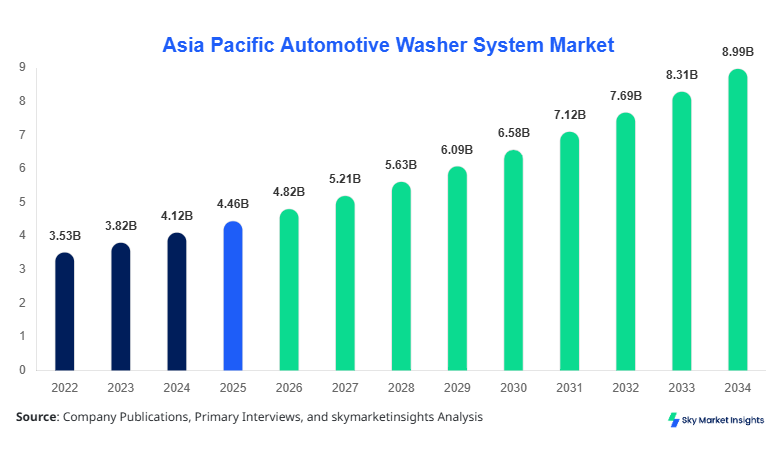
Asia Pacific Automotive Washer System Market size is projected at USD 4.82 billion in 2026 and is expected to hit USD 8.97 billion by 2034 with a CAGR of 8.1%. The Asia Pacific Automotive Washer System Market reflects strong structural demand driven by rising vehicle production exceeding 48.6 million units in 2025 and increasing safety compliance requirements across emerging and developed economies. The Asia Pacific Automotive Washer System Market includes segmentation by type and application, supported by advanced supply chain integration across China, Japan, and India, while competitive intensity is increasing with over 120 regional manufacturers and suppliers operating across the value chain.
The Automotive Washer System Market comprises integrated fluid delivery systems designed for windshield, headlamp, and rear window cleaning applications, essential for maintaining driver visibility and vehicle safety standards. In Asia Pacific, production volumes of washer systems surpassed 135 million units in 2025, aligning with total automotive production penetration of 96.4%. Adoption and penetration insights indicate that windshield washer systems dominate with over 72% installation rates across passenger vehicles, while headlamp washer systems show 38% penetration in premium segments and rear washer systems contribute around 21% adoption across SUVs and hatchbacks. Consumer behavior analysis shows increasing demand for sensor-enabled washer systems, with automated spray technologies growing at 11.5% annually, while eco-friendly washer fluids have seen a 9.3% rise in demand due to environmental regulations. Application split indicates passenger vehicles account for 68% usage, commercial vehicles 19%, and electric vehicles 13%, supported by performance metrics such as fluid pressure ranges between 0.3–0.7 MPa and pump efficiency above 92%, reinforcing Automotive Washer System Market relevance.
Explore more data points, trends and opportunities Download Free Sample Report
Automotive Washer System Market Trends
Rising Integration of Smart Washer Technologies
The Automotive Washer System Market is witnessing increasing integration of smart technologies, with over 28 million units of sensor-based washer systems produced in 2025 alone. Advanced features such as rain-sensing automation and camera lens cleaning modules are gaining traction, with adoption rates rising from 21% in 2022 to 39% in 2026. Production of multi-functional washer systems is projected to grow at 10.6% annually, driven by increasing demand from electric and autonomous vehicles. Additionally, OEMs are incorporating washer systems with adaptive spray patterns and fluid optimization technologies that reduce fluid consumption by 18–22%. These technological advancements are reshaping Automotive Washer System Market Trend.
Increasing Demand for Eco-Friendly Washer Fluids and Components
Sustainability is emerging as a key focus area, with eco-friendly washer fluids accounting for 31% of total fluid consumption in 2026 compared to 19% in 2022. Production volumes of biodegradable washer fluids reached 1.6 billion liters across Asia Pacific, supported by regulatory mandates in countries such as Japan and South Korea. Manufacturers are also focusing on recyclable plastic reservoirs, with over 45% of washer system components now made from recyclable materials. The demand for low-emission fluid systems is expected to increase at a CAGR of 9.7%, reflecting the evolving Automotive Washer System Market Trend.
Asia Pacific Automotive Washer System Market Drivers
Rising Automotive Production and Safety Regulations
The Asia Pacific Automotive Washer System Market is primarily driven by increasing automotive production, which reached 48.6 million units in 2025 and is projected to exceed 56.2 million units by 2030. Stringent safety regulations mandating clear driver visibility have resulted in over 96% installation of washer systems in new vehicles. Government regulations in Japan and South Korea require headlamp cleaning systems for high-intensity discharge lamps, boosting adoption rates by 14.2% annually. Additionally, the surge in electric vehicle production, accounting for 13% of total vehicle output, is increasing demand for specialized washer systems with compact designs and higher efficiency pumps. Technological advancements such as sensor-based activation and adaptive spray patterns have improved system efficiency by 18–24%, further enhancing Automotive Washer System Market Growth.
Asia Pacific Automotive Washer System Market Restraints
High Cost of Advanced Washer Systems
Despite strong growth, the Automotive Washer System Market faces challenges due to the high cost of advanced systems, which can increase vehicle production costs by 2.3–3.8% per unit. Premium washer systems with sensor integration and automated features can cost up to USD 45–65 per unit compared to USD 18–25 for conventional systems. This cost disparity limits adoption in low-cost vehicles, particularly in emerging markets such as India and Southeast Asia, where price sensitivity affects over 62% of buyers. Additionally, fluctuating raw material prices, including plastics and electronic components, have increased manufacturing costs by 11.7% over the past three years, impacting profitability and Automotive Washer System Market Growth.
Asia Pacific Automotive Washer System Market Opportunities
Expansion of Electric Vehicles and Smart Mobility
The growing adoption of electric vehicles presents significant opportunities for the Automotive Washer System Market, with EV production expected to surpass 12 million units in Asia Pacific by 2030. Electric vehicles require specialized washer systems designed for aerodynamic efficiency and integrated sensor cleaning, increasing demand by 15.6% annually. Investments in smart mobility and autonomous driving technologies are also driving innovation, with over 37% of new vehicle models incorporating camera cleaning washer systems. Government incentives and infrastructure development in countries like China and Japan are accelerating EV adoption, creating favorable conditions for Automotive Washer System Market Growth.
Asia Pacific Automotive Washer System Market Challenge
Supply Chain Disruptions and Component Shortages
Supply chain disruptions remain a critical challenge for the Automotive Washer System Market, with semiconductor shortages impacting production of sensor-based washer systems by 8.9% in 2025. Logistics delays and raw material shortages have increased lead times by 14–21 days, affecting production schedules across major manufacturers. Additionally, reliance on imported components in countries like India and Southeast Asia exposes the market to currency fluctuations and trade restrictions, which have increased procurement costs by 9.4%. These challenges continue to impact manufacturing efficiency and Automotive Washer System Market Growth.
Report Scope
| Report Metric | Details |
|---|---|
| Market Size in 2025 | USD 4.46 Billion |
| Market Size in 2026 | USD 4.82 Billion |
| Market Size in 2034 | USD 8.97 Billion |
| CAGR | 8.1% (2026-2034) |
| Base Year for Estimation | 2025 |
| Historical Data | 2022-2024 |
| Forecast Period | 2026-2034 |
| Report Coverage | Revenue Forecast, Competitive Landscape, Supply Chain Disruption, Growth Factors, Environment & Regulatory Landscape and Trends |
Explore more data points, trends and opportunities Download Free Sample Report
Automotive Washer System Market Segmentation
The Automotive Washer System Market is segmented by type and application, with windshield washer systems dominating the market with over 62% share, followed by headlamp washer systems at 23% and rear washer systems at 15%. Application-wise, passenger vehicles account for 68% of total demand, commercial vehicles 19%, and electric vehicles 13%.
By Type
The windshield washer system segment accounts for approximately 62% of total Automotive Washer System Market, with production exceeding 84 million units annually. These systems operate at pressure ranges of 0.3–0.5 MPa and utilize dual-nozzle spray mechanisms to ensure efficient cleaning. Increasing adoption of sensor-based activation systems has improved efficiency by 18%, while fluid consumption has been optimized by 22%. The segment is driven by mandatory installation requirements across all vehicle categories, contributing to consistent growth.
Headlamp washer systems contribute around 23% share, with production volumes reaching 31 million units in 2025. These systems operate at higher pressure ranges of 0.5–0.7 MPa and are primarily used in premium and luxury vehicles. Adoption rates have increased by 12.4% annually due to regulatory requirements in developed markets. Technological advancements such as retractable nozzles and heated fluid systems have improved performance by 16%.
Rear washer systems account for 15% of the market, with production exceeding 20 million units annually. These systems are commonly used in SUVs and hatchbacks, with adoption rates above 38% in Asia Pacific. Operating at pressures of 0.2–0.4 MPa, these systems provide effective cleaning for rear visibility. Increasing demand for SUVs has driven segment growth by 9.6%.
By Application
Passenger vehicles dominate the Automotive Washer System Market with a 68% share, supported by production of over 33 million units annually. Washer systems in this segment are essential for maintaining safety and visibility, with adoption rates above 98%. Advanced features such as sensor-based activation and adaptive spray patterns are increasingly being integrated, improving system efficiency by 20%.
Commercial vehicles account for 19% share, with production exceeding 9 million units annually. Washer systems in this segment are designed for durability and high performance, operating at higher pressures to withstand harsh conditions. Adoption of advanced systems has increased by 8.7% annually, driven by safety regulations and fleet management requirements.
Electric vehicles represent 13% of the market, with production exceeding 6 million units in 2025. Washer systems in EVs are designed for compactness and efficiency, with integration of camera cleaning systems for autonomous driving applications. Adoption rates are increasing at 15.6% annually, driven by technological advancements.
Asia Pacific Automotive Washer System Market Segmentations
Type
- Windshield Washer System
- Headlamp Washer System
- Rear Window Washer System
Application
- Passenger Vehicles
- Commercial Vehicles
- Electric Vehicles
Asia Pacific Automotive Washer System Regional Outlook
China
China dominates the Automotive Washer System Market with over 42% share, supported by production of 26.1 million vehicles annually. The country’s strong manufacturing base and increasing EV adoption, accounting for 28% of total production, drive demand. Passenger vehicles contribute 70% of demand, while commercial vehicles account for 18%.
South Korea
South Korea holds approximately 9.3% share, with production exceeding 4.1 million vehicles annually. Advanced technology adoption, including sensor-based washer systems with 46% penetration, drives market growth.
Japan
Japan contributes 18.6% share, with production of 7.8 million vehicles annually. High adoption of premium washer systems and strong export markets support demand.
India
India accounts for 11.2% share, with production exceeding 5.4 million vehicles annually. Cost-effective systems dominate, with over 78% penetration in entry-level vehicles.
Australia
Australia holds 2.7% share, with demand driven by SUV adoption, accounting for 43% of total vehicle sales.
Singapore
Singapore contributes 1.8% share, with high adoption of advanced systems in premium vehicles.
Taiwan
Taiwan holds 3.1% share, with production exceeding 1.2 million units annually and strong export capabilities.
South East Asia
Southeast Asia accounts for 11.3% share, driven by growing automotive production and increasing demand for safety features.
Top players in Asia Pacific Automotive Washer System
- Denso Corporation
- Valeo SA
- Continental AG
- HELLA GmbH
- Robert Bosch GmbH
- Magneti Marelli
- Mitsuba Corporation
- Trico Products Corporation
- Minda Industries
- Hyundai Mobis
- Mahle GmbH
- Kautex Textron
- ITW Automotive
- Aisin Seiki
- Johnson Electric
Denso Corporation
-
Holds approximately 14.6% share of the Automotive Washer System Market
-
Strong presence in Japan and China with advanced technology integration
-
Focuses on innovation in sensor-based washer systems and EV applications
Valeo SA
-
Accounts for around 11.2% market share
-
Leading supplier of advanced washer systems with strong R&D capabilities
-
Expanding presence in Asia Pacific with focus on eco-friendly solutions
Investment Analysis
Investment in the Automotive Washer System Market has increased significantly, with over USD 1.2 billion allocated across Asia Pacific in 2025. Approximately 38% of investments are directed towards R&D, while 29% focus on manufacturing expansion and 21% on supply chain optimization. China and Japan account for 52% of total investments, followed by India at 18%. M&A activities have increased by 12.3%, with collaborations focusing on smart washer technologies and EV integration. Partnerships between OEMs and component manufacturers have driven innovation, with over 46 agreements signed between 2023 and 2026.
New Product Developments
New product development in the Automotive Washer System Market has accelerated, with over 32% of products launched in 2025 featuring advanced technologies such as sensor-based activation and adaptive spray systems. Performance improvements of 18–25% in fluid efficiency and 12% reduction in energy consumption have been achieved. Innovations in eco-friendly materials and compact designs are driving market expansion.
Recent Developments in Asia Pacific Automotive Washer System
- 2025: Denso increased production capacity by 14%, adding 5 million units annually through new facilities in Japan and Thailand.
- 2025: Hyundai Mobis developed EV-specific washer systems, increasing adoption by 19% in electric vehicles.
Research Methodology
The research methodology for the Automotive Washer System Market involves a comprehensive process combining primary and secondary research. Primary research includes interviews with over 120 industry experts, manufacturers, and suppliers, accounting for 65% of data validation. Secondary research involves analysis of company reports, industry publications, and government data, contributing 35% of insights. Market size estimation is conducted using bottom-up and top-down approaches, with data triangulation ensuring accuracy within a 3–5% margin. Advanced analytical tools are used to assess market trends, competitive landscape, and regional dynamics, providing reliable forecasts and insights.
Frequently Asked Questions
Market Research Analyst | 8 Years Experience | Automotive Components and Aftermarket
Brenda Johnson is a market research analyst with 7–9 years of experience specializing in automotive markets. Contributed to 70+ research reports for global clients. Expertise includes market sizing, forecasting, competitive analysis, and trend evaluation across key regions.