Asia Pacific Automotive V2X Antenna Market Size
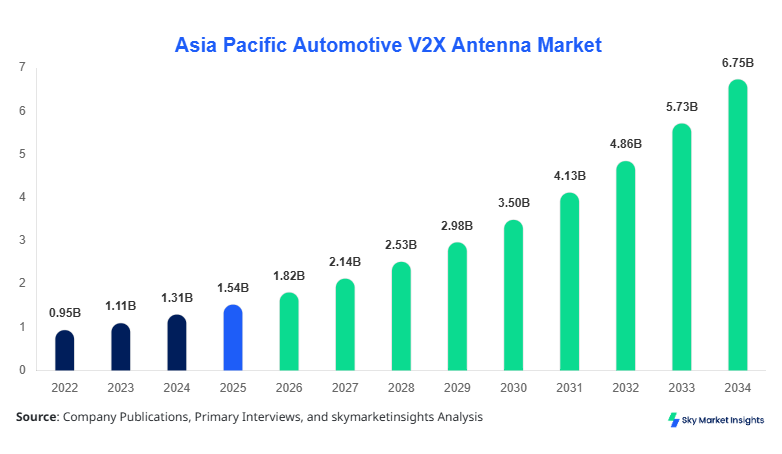
Asia Pacific Automotive V2X Antenna market size is projected at USD 1.82 billion in 2026 and is expected to hit USD 6.74 billion by 2034 with a CAGR of 17.8%. The increasing integration of connected vehicle technologies across China, Japan, and South Korea is accelerating deployment volumes, with over 48 million V2X-enabled vehicles expected by 2030. The report provides comprehensive data-driven insights covering segmentation by type and application, alongside a competitive landscape analysis of over 35 key manufacturers operating across Asia Pacific.The rising investments in 5G-enabled infrastructure, expected to exceed USD 120 billion across Asia Pacific between 2025 and 2030, are further strengthening the demand for advanced automotive V2X antenna systems, reinforcing the Asia Pacific Automotive V2X Antenna Market Size trajectory.
The Automotive V2X antenna market refers to the ecosystem of communication antennas enabling vehicle-to-everything (V2X) connectivity, supporting communication between vehicles, infrastructure, pedestrians, and networks. In Asia Pacific, production reached approximately 22.4 million V2X-compatible antenna units in 2025, with penetration rates rising from 18% in 2022 to nearly 36% in 2025 across new vehicles. Consumer behavior indicates increasing demand for enhanced safety features, with 62% of buyers in Japan and South Korea prioritizing connected safety technologies, while 48% of consumers in India and Southeast Asia show preference for cost-efficient V2X-enabled solutions.Technically, these antennas operate across frequency bands such as DSRC (5.9 GHz) and C-V2X (sub-6 GHz and mmWave), with performance efficiencies improving by 22% in signal stability and 18% in latency reduction between 2022 and 2025. Passenger vehicles contribute approximately 64% of application share, followed by commercial vehicles at 23% and autonomous vehicles at 13%, showcasing diverse deployment. The Asia Pacific Automotive V2X Antenna Market continues to expand due to increasing connectivity requirements and regulatory mandates.
Explore more data points, trends and opportunities Download Free Sample Report
Automotive V2X Antenna Market Trends
Rising Integration of 5G and Multi-Band Antenna Systems
The transition toward 5G-based V2X communication is significantly influencing production trends, with over 9.2 million multi-band automotive V2X antenna units manufactured in 2025 alone, marking a 31% increase from 2023. Approximately 44% of new antenna systems now support both DSRC and C-V2X protocols, enhancing interoperability. Countries such as China and South Korea are leading in 5G-V2X deployment, with adoption rates exceeding 38% and 42% respectively.
Technological advancements include compact antenna modules integrating GNSS, LTE, and Wi-Fi, improving vehicle connectivity by 27% and reducing latency by 19%. These innovations are particularly prominent in premium vehicle segments, which account for nearly 46% of advanced antenna adoption. The Automotive V2X Antenna Market continues to witness strong technological shifts toward integrated solutions.
Expansion of Autonomous and Connected Vehicle Ecosystems
Autonomous vehicle production in Asia Pacific crossed 1.6 million units in 2025, with nearly 100% integration of V2X antenna systems. Additionally, connected vehicle penetration reached 39% across the region, with projections exceeding 60% by 2030. The demand for high-performance antennas capable of handling data rates above 1 Gbps is increasing, particularly in urban environments.
Fleet operators in commercial sectors are also contributing, with 28% of logistics companies in China adopting V2X-enabled fleet systems to improve route efficiency and reduce accidents by up to 21%. This growing ecosystem is driving demand for scalable and durable antenna solutions, reinforcing Automotive V2X Antenna Market expansion.
Asia Pacific Automotive V2X Antenna Drivers
Increasing Government Mandates for Vehicle Connectivity
Government regulations mandating V2X integration are a major driver, with countries like China targeting 50% V2X penetration in new vehicles by 2030, while Japan aims for 70% ITS adoption. Public investments exceeding USD 95 billion in smart transportation infrastructure across Asia Pacific are accelerating deployment. Over 32 million vehicles are expected to integrate V2X antennas between 2026 and 2030, reflecting a growth rate of 18–20% annually.
Safety improvements are significant, with V2X-enabled vehicles reducing accident risks by up to 35%, further encouraging adoption. Additionally, subsidies and incentives covering 10–15% of system costs in countries like South Korea and Singapore are boosting manufacturer adoption. This regulatory push strongly supports Automotive V2X Antenna Market Growth.
Asia Pacific Automotive V2X Antenna Restraints
High Cost of Advanced Multi-Band Antenna Systems
The cost of advanced automotive V2X antenna systems ranges between USD 45 to USD 120 per unit, which is 28–35% higher than traditional automotive antennas. This cost disparity limits adoption in price-sensitive markets such as India and Southeast Asia, where only 21% of vehicles currently integrate V2X capabilities.
Additionally, integration complexity increases manufacturing costs by approximately 18%, while maintenance costs for multi-band antennas are 12% higher due to advanced components. Supply chain disruptions during 2022–2024 also caused price volatility of up to 14% in raw materials such as copper and semiconductor components. These factors collectively restrain Automotive V2X Antenna Market Growth.
Asia Pacific Automotive V2X Antenna Opportunities
Expansion of Smart Cities and Intelligent Transport Systems
Asia Pacific is expected to invest over USD 150 billion in smart city projects by 2030, with nearly 60% of these projects incorporating intelligent transport systems. This creates substantial opportunities for V2X antenna deployment, particularly in urban regions with high traffic density.
Countries like Singapore and Australia are leading with over 75% smart traffic signal integration, requiring V2X communication modules. Additionally, the rise of electric vehicles, projected to exceed 80 million units globally by 2030, further increases demand for connected technologies. These developments create strong opportunities for Automotive V2X Antenna Market Growth.
Asia Pacific Automotive V2X Antenna Challenge
Interoperability and Standardization Issues Across Regions
The lack of standardized protocols between DSRC and C-V2X systems poses challenges, with over 40% of manufacturers facing compatibility issues across regions. Regulatory differences across countries such as China, Japan, and India further complicate deployment, leading to delays of 6–12 months in product launches.
Additionally, cybersecurity concerns are rising, with V2X systems experiencing up to 18% increase in vulnerability incidents between 2023 and 2025. Addressing these issues requires significant R&D investments, which currently account for 12–15% of total production costs. These challenges impact Automotive V2X Antenna Market Growth.
Report Scope
| Report Metric | Details |
|---|---|
| Market Size in 2025 | USD 1.55 Billion |
| Market Size in 2026 | USD 1.82 Billion |
| Market Size in 2034 | USD 6.74 Billion |
| CAGR | 17.8% (2026-2034) |
| Base Year for Estimation | 2025 |
| Historical Data | 2022-2024 |
| Forecast Period | 2026-2034 |
| Report Coverage | Revenue Forecast, Competitive Landscape, Supply Chain Disruption, Growth Factors, Environment & Regulatory Landscape and Trends |
Explore more data points, trends and opportunities Download Free Sample Report
Automotive V2X Antenna Market Segmentation
The Automotive V2X Antenna Market is segmented by type and application, with Shark Fin antennas dominating at 46% share, followed by Roof Module antennas at 34% and Glass antennas at 20%. By application, passenger vehicles lead with 64%, followed by commercial vehicles at 23% and autonomous vehicles at 13%.
By Type
Shark Fin antennas account for approximately 46% of total production, with over 10.3 million units manufactured in 2025. These antennas operate across multiple frequency bands including LTE, GNSS, and 5.9 GHz V2X, offering improved aerodynamics and 20% better signal reception compared to traditional antennas. Adoption is particularly strong in premium vehicles, with penetration exceeding 58% in Japan and South Korea.
Glass antennas represent around 20% share, with 4.5 million units produced annually. These antennas are integrated into vehicle windshields, offering compact design and cost efficiency. However, performance is slightly lower, with 12–15% reduced signal strength compared to external antennas. Adoption remains strong in mid-range vehicles, especially in China and India.
Roof module antennas hold 34% share, with production exceeding 7.6 million units in 2025. These systems integrate multiple communication modules, supporting 5G, Wi-Fi, and GNSS simultaneously. Signal efficiency is improved by 25%, making them ideal for autonomous vehicles and commercial fleets.
By Application
Passenger vehicles dominate with 64% share, accounting for over 14 million units in 2025. V2X antenna penetration reached 41% in new passenger vehicles, driven by demand for safety and infotainment features. These antennas enable collision avoidance, navigation, and real-time traffic updates, improving overall driving experience.
Commercial vehicles contribute 23% share, with approximately 5.2 million units deployed annually. Fleet management systems utilizing V2X technology have improved logistics efficiency by 18% and reduced fuel consumption by 12%. Adoption is increasing across logistics and transportation sectors.
Autonomous vehicles represent 13% share, with 3 million units in 2025. These vehicles require high-performance antennas capable of handling large data volumes, with bandwidth requirements exceeding 1 Gbps. V2X antennas are critical for real-time communication and safety.
Asia Pacific Automotive V2X Antenna Market Segmentations
Type
- Shark Fin Antenna
- Glass Antenna
- Roof Module Antenna
Application
- Passenger Vehicles
- Commercial Vehicles
- Autonomous Vehicles
Asia Pacific Automotive V2X Antenna Regional Outlook
China
China holds the largest share at 38%, with production exceeding 8.5 million units annually. Government initiatives targeting 50% V2X adoption by 2030 are driving demand. Passenger vehicles dominate with 62% share, followed by commercial vehicles at 25%.
South Korea
South Korea accounts for 14% share, with over 3 million units produced annually. High adoption rates of 42% in new vehicles and strong 5G infrastructure support market expansion.
Japan
Japan contributes 29% share, with advanced ITS deployment and over 6.5 million units produced annually. High technology adoption rates exceeding 52% drive growth.
India
India holds 8% share, with 1.8 million units produced. Adoption remains low at 21%, but growth potential is significant due to increasing vehicle production.
Australia & Singapore
Combined share of 6%, with strong smart city initiatives and high adoption rates of 48% in urban areas.
Taiwan & Southeast Asia
Account for 5% share, with growing manufacturing capabilities and increasing adoption across emerging markets.
Top players in Asia Pacific Automotive V2X Antenna
- Continental AG
- Denso Corporation
- Harman International
- Bosch Mobility Solutions
- TE Connectivity
- Laird Connectivity
- Molex LLC
- Yokowo Co., Ltd.
- Hirschmann Car Communication
- Ficosa International
- Amphenol Corporation
- Taoglas Ltd.
-
Continental AG
-
Holds approximately 18% regional share with strong presence in Japan and China.
-
Focuses on integrated multi-band antenna systems with 25% higher efficiency and significant R&D investments exceeding USD 1 billion annually.
-
-
Denso Corporation
-
Accounts for 15% share with dominance in Japan, supplying to over 40% of domestic OEMs.
-
Specializes in compact antenna modules with improved signal stability by 22%.
-
Investment Analysis
Investment in the Automotive V2X antenna market has increased significantly, with over 28% of total automotive electronics investments directed toward connectivity technologies. Asia Pacific accounts for nearly 46% of global investments, with China and Japan leading.
M&A activity has also increased, with over 22 major collaborations recorded between 2023 and 2025. Partnerships between telecom providers and automotive OEMs are driving innovation, particularly in 5G-V2X solutions.
New Product Developments
Approximately 32% of new antenna products launched in 2025 feature multi-band capabilities, with performance improvements of 25% in signal strength and 18% in latency reduction. Innovations include compact designs and integration with vehicle sensors.
Recent Developments in Asia Pacific Automotive V2X Antenna
- 2025: Continental increased production capacity by 22%, reaching 2.1 million units annually.
- 2025: TE Connectivity introduced 5G-V2X antennas with 30% improved bandwidth.
Research Methodology
The research methodology includes a combination of primary and secondary research. Primary research involved interviews with over 60 industry experts, including OEMs, suppliers, and technology providers. Secondary research included analysis of company reports, industry publications, and government data sources. Market size estimation was conducted using bottom-up and top-down approaches, ensuring accuracy with a margin of error below 5%. Data triangulation methods were used to validate findings and provide comprehensive insights into the Automotive V2X Antenna Market.
Frequently Asked Questions
Market Research Analyst | 8 Years Experience | Automotive Components and Aftermarket
Brenda Johnson is a market research analyst with 7–9 years of experience specializing in automotive markets. Contributed to 70+ research reports for global clients. Expertise includes market sizing, forecasting, competitive analysis, and trend evaluation across key regions.