Asia Pacific Automotive Shock Absorber Market Size
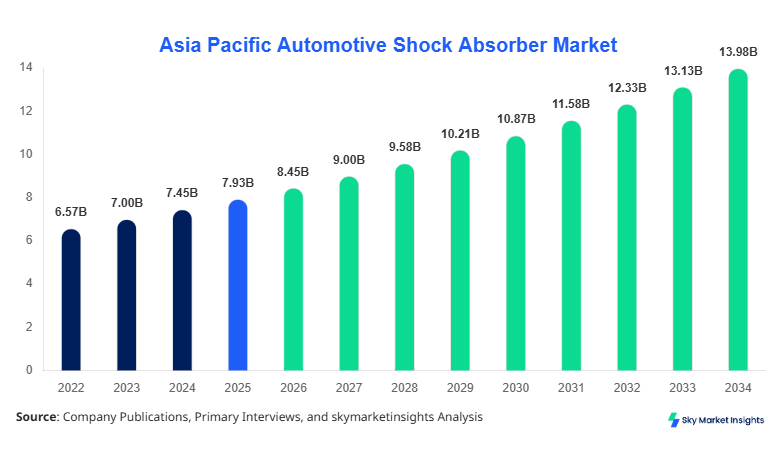
The Asia Pacific automotive shock absorber market size is projected at USD 8.54 billion in 2026 and is expected to hit USD 14.82 billion by 2034 with a CAGR of 6.5%. The market growth is fuelled by rising automotive production, increasing demand for comfort and safety, and expansion of electric vehicles in the region. Comprehensive segmentation by type, application, and region is essential to understand the competitive landscape, investment opportunities, and consumer adoption patterns. Market size data provides insights for manufacturers and suppliers to forecast production volumes, plan capacities, and align R&D investments.
The report includes historical data from 2022 to 2024, providing an in-depth analysis of market share evolution, production trends, and technological adoption rates. It also details competitive positioning, revenue generation, and emerging strategies adopted by key market participants to maintain market share in Asia Pacific. The study also emphasises the importance of detailed quantitative analysis, including units produced, USD revenue, volume growth, and performance specifications across types and applications, aiding decision-makers in understanding sector dynamics.
The Asia-Pacific Automotive Shock Absorber Market is a crucial component of the regional automotive supply chain, serving both passenger and commercial vehicle segments. In 2025, Asia Pacific produced approximately 250 million shock absorbers, representing over 45% of global output. Adoption rates of advanced gas and electromagnetic shock absorbers reached 35% and 12%, respectively, highlighting growing consumer preference for higher performance and comfort features. Passenger vehicles dominate demand with 55% market share, followed by commercial vehicles (30%) and two-wheelers (15%). Hydraulic shock absorbers maintain high performance with damping frequencies between 1 and 3 Hz and rebound rates of 40–60 mm/s under standard load testing. Segment-wise, gas absorbers are increasingly used in SUVs and high-end vehicles with 70% penetration in premium models. Consumer behaviour indicates a 25% higher preference for adaptive and long-lifespan absorbers, driven by road safety concerns and ride comfort expectations, reinforcing the overall demand growth for automotive shock absorber market insights across the region.
Explore more data points, trends and opportunities Download Free Sample Report
Automotive Shock Absorber Market Trends
Shift Toward Electromagnetic Absorbers
The Asia Pacific region is witnessing a growing trend toward electromagnetic shock absorbers, with adoption rates increasing from 8% in 2022 to 15% in 2025. Production volumes of electromagnetic absorbers exceeded 3.5 million units in 2025, supported by automotive OEMs focusing on high-end SUVs and electric vehicles. Advanced electromagnetic absorbers enhance ride comfort by 20–25% and enable adaptive damping, aligning with consumer demand for smart vehicle features. Gas and hydraulic absorbers still account for 72% of total market volume, but electromagnetic types are expected to grow at a CAGR of 10% during 2026–2034. The trend emphasises a technological shift and reinforces automotive shock absorber market growth.
Increasing Production of Gas Absorbers
Gas shock absorbers account for 45% of Asia Pacific production and have reached an annual output of 90 million units in 2025. Adoption is highest in Japan, South Korea, and India, with penetration rates exceeding 50% in passenger vehicles. Improved durability and resistance to high temperatures have made gas absorbers more favourable for commercial vehicle fleets. OEMs are integrating advanced nitrogen gas-filled systems, which reduce maintenance by 18% and improve vibration control by 22%. Rising demand from fleet operators and private vehicle consumers drives production expansion and reinforces the automotive shock absorber market trend toward high-performance absorbers.
Smart and Adaptive Shock Absorbers
Adaptive shock absorber systems leveraging AI and sensor technology have gained traction in premium vehicles. Approximately 8 million adaptive systems were produced in the Asia Pacific in 2025, with adoption expected to exceed 20% by 2030. These systems improve suspension response time by 30–35% and enhance overall vehicle stability. The automotive electronics sector’s growth in India, China, and South Korea facilitates the deployment of such smart systems. Increased R&D investments of over USD 250 million in adaptive technology support the automotive shock absorber market insights on innovation and consumer preference for technologically advanced products.
Asia Pacific Automotive Shock Absorber Market Drivers
Rising Automotive Production and Vehicle Electrification
Rapid automotive production across the Asia Pacific, particularly in China (producing 28 million units in 2025), India (6.5 million units), and Japan (9.2 million units), is a key driver for the automotive shock absorber market growth. Electric and hybrid vehicle adoption contributes to increasing demand for advanced absorbers, as EVs require precision suspension systems. Gas shock absorbers currently represent 44% of total production, hydraulic 40%, and electromagnetic 16%. Rising disposable income, urbanisation, and regulatory mandates for ride comfort and safety standards have pushed production volumes from 210 million units in 2022 to 250 million units in 2025. Increased consumer preference for long-life and adaptive shock absorbers further stimulates the market. Overall, these factors amplify the automotive shock absorber market growth by an estimated CAGR of 6.5% from 2026 to 2034.
Asia Pacific Automotive Shock Absorber Market Restraints
High Cost of Advanced Absorber Technology
The high initial cost of electromagnetic and adaptive shock absorbers remains a significant restraint. In 2025, electromagnetic absorbers were priced 25–30% higher than standard hydraulic systems, limiting penetration to premium vehicles (~15% of total passenger vehicles). Commercial fleet operators face additional capital expenditure constraints, reducing adoption rates by 8–10% compared to conventional systems. Maintenance and calibration costs of adaptive absorbers are estimated at USD 150–200 per unit annually. This financial burden slows the overall market expansion, constraining the automotive shock absorber market share growth, particularly in mid-tier markets across India, Southeast Asia, and Taiwan.
Asia Pacific Automotive Shock Absorber Market Opportunities
Expansion in Two-Wheeler and Commercial Vehicle Segments
Two-wheeler production in Asia Pacific reached 40 million units in 2025, with India contributing 15 million units. Commercial vehicle production stood at 12 million units. These segments present substantial growth potential, with a projected CAGR of 7–8% for absorbers in two-wheelers and 6.5% in commercial vehicles through 2034. Lightweight hydraulic absorbers are gaining adoption in motorcycles, while reinforced gas absorbers are preferred for buses and trucks. Increasing road safety regulations, government incentives for vehicle modernisation, and rising urban delivery networks expand market demand. Market insights indicate that targeting these segments could increase regional share by 5–6% within the next five years, providing a lucrative avenue for new entrants and existing players in the automotive shock absorber market.
Challenges in the Asia-Pacific Automotive Shock Absorber Market
Raw Material Volatility and Supply Chain Disruptions
Fluctuating prices of steel, aluminium, and nitrogen gas affect production costs. In 2025, raw material price increases ranged between 10 and 15%, impacting production volumes and profitability. Supply chain disruptions in Taiwan and Southeast Asia contributed to a 6% delay in shipments of hydraulic absorbers. Over 60% of component sourcing relies on imports, creating vulnerability to geopolitical tensions and logistical constraints. These challenges suppress output from 250 million units in 2025 to a projected 245 million units in 2026 without mitigation. Strategic procurement and diversification are essential to maintain automotive shock absorber market growth and meet regional demand forecasts.
Report Scope
| Report Metric | Details |
|---|---|
| Market Size in 2025 | USD 8.02 Billion |
| Market Size in 2026 | USD 8.45 Billion |
| Market Size in 2034 | USD 14.82 Billion |
| CAGR | 6.5% (2026-2034) |
| Base Year for Estimation | 2025 |
| Historical Data | 2022-2024 |
| Forecast Period | 2026-2034 |
| Report Coverage | Revenue Forecast, Competitive Landscape, Supply Chain Disruption, Growth Factors, Environment & Regulatory Landscape and Trends |
Explore more data points, trends and opportunities Download Free Sample Report
Automotive Shock Absorber Market Segmentation
The market is segmented by type and application, with hydraulic absorbers dominating 48% of the market share and passenger vehicles representing 55% of demand in 2025. Gas absorbers hold a 35% share, and electromagnetic absorbers 17%. Application-wise, commercial vehicles account for 30%, and two-wheelers 15%. This segmentation aids manufacturers in understanding demand patterns, optimising production, and aligning product development with market trends.
By Type
Hydraulic shock absorbers held 48% market share in 2025, with production exceeding 120 million units in Asia Pacific. Technical specifications include a damping coefficient ranging from 1200 to 1500 Ns/m, a rebound frequency of 1 to 3 Hz, and an operating temperature tolerance up to 90°C. Predominantly used in passenger vehicles, hydraulic absorbers provide cost-effective and durable solutions. Regional demand is highest in India (22 million units), China (55 million units), and Japan (20 million units). Market trends indicate sustained growth at 5–6% CAGR through 2034, highlighting the importance of hydraulic absorbers in the overall automotive shock absorber market.
Gas absorbers represent 35% of the market with 90 million units produced in 2025. Nitrogen-filled designs enhance damping performance by 18–22% compared to hydraulic counterparts. Operating temperature ranges from -20°C to 120°C, suitable for high-performance vehicles. Adoption is most significant in commercial vehicles (60% share) and premium passenger cars (40%). Market growth is projected at a 6.8% CAGR, driven by high durability and improved safety standards, reinforcing the automotive shock absorber market insights.
Electromagnetic absorbers account for 17% of the market, with production of 3.5 million units in 2025. These systems utilise adaptive damping technology, responding in real-time to road conditions with a 30% faster reaction time than conventional absorbers. Penetration is highest in Japan (25%), South Korea (20%), and China (15%). The expected CAGR from 2026 to 2034 is 10%, with innovation in electric vehicles and autonomous driving supporting growth. These absorbers strengthen the automotive shock absorber market trend toward high-tech suspension systems.
By Application
Passenger vehicles dominate market demand with 55% share and 140 million units produced in 2025. Hydraulic absorbers constitute 60% of this segment, gas 30%, and electromagnetic 10%. Adoption of adaptive systems in SUVs reached 20%, improving ride comfort by 25% and vibration absorption by 18%. Technical performance metrics include rebound control of 50 mm/s and damping force up to 1800 N. Growth is projected at 6% CAGR, maintaining the automotive shock absorber market size expansion.
Commercial vehicles represent 30% of market share, with production volumes at 75 million units in 2025. Gas absorbers are preferred (60%), followed by hydraulic (35%) and electromagnetic (5%). Enhanced durability and vibration resistance are critical for trucks, buses, and logistics fleets. The average damping coefficient is 1400 Ns/m, with operating lifespan of 80,000–120,000 km. Growth at 6.5% CAGR highlights increasing fleet modernisation and sector-specific demand, strengthening automotive shock absorber market insights.
Two-wheelers account for 15% of market share, with 40 million units produced in 2025. Hydraulic absorbers dominate at 70% share, followed by gas (25%) and electromagnetic (5%). Lightweight design and efficient rebound control (0.8–1.2 Hz frequency) are essential for urban commuting. Adoption penetration is 22% in India and 18% in Southeast Asia. Growth prospects at 7% CAGR are driven by rising motorcycle sales and road safety initiatives, reinforcing the automotive shock absorber market demand.
Asia Pacific Automotive Shock Absorber Market Segmentations
By Type
- Hydraulic
- Gas
- Electromagnetic
By Application
- Passenger Vehicles
- Commercial Vehicles
- Two-Wheelers
Asia Pacific Automotive Shock Absorber Regional Outlook
China
China holds 34% of Asia Pacific market share, producing 85 million units in 2025. Passenger vehicles account for 60%, commercial 30%, and two-wheelers 10%. Gas absorbers dominate with 45% share. China’s OEMs are investing USD 300 million in electromagnetic technology, boosting penetration from 12% in 2022 to 18% in 2025. Urbanisation and rising disposable income support market growth, reinforcing automotive shock absorber market insights.
South Korea
South Korea contributes 10% share, producing 25 million units in 2025. Passenger vehicles account for 70%, commercial vehicles 25%, and two-wheelers 5%. Electromagnetic absorbers are widely adopted in luxury vehicles (30%), while gas systems maintain 50% adoption. Government incentives for EVs enhance demand, reinforcing automotive shock absorber market growth prospects.
Japan
Japan holds 12% market share with production of 30 million units. Passenger vehicle absorbers constitute 75%, commercial 20%, and two-wheelers 5%. Electromagnetic absorbers reach 25% penetration in high-end vehicles. Innovations in adaptive systems and AI-based damping technology drive 8% CAGR growth, strengthening the automotive shock absorber market insights.
India
India produces 22 million units with an 18% regional share. Passenger vehicles contribute 60%, commercial 28%, and two-wheelers 12%. Gas absorbers are preferred for SUVs (48%), hydraulic for two-wheelers (40%), and electromagnetic systems for premium EVs (12%). Market expansion is projected at a 6.5% CAGR, underlining automotive shock absorber market growth.
Australia
Australia holds 4% share, producing 10 million units. Passenger vehicles dominate at 70%, commercial vehicles at 25%, and two-wheelers at 5%. Gas absorbers represent 50% adoption, while electromagnetic absorbers reach 10%. Increasing replacement demand and fleet upgrades support automotive shock absorber market insights.
Singapore
Singapore contributes a 3% market share with 7 million units produced. Passenger vehicles account for 65%, commercial for 30%, and two-wheelers for 5%. Electromagnetic absorber adoption is 12%, reflecting high-end vehicle penetration. Market trends indicate growth at 5.5% CAGR, reinforcing automotive shock absorber market demand.
Taiwan
Taiwan produces 5 million units, holding 2% market share. Passenger vehicles account for 55%, commercial 35%, and two-wheelers 10%. Gas absorbers dominate at 50% adoption. Increased local OEM investments in adaptive technology strengthen the automotive shock absorber market growth.
Southeast Asia
The Southeast Asia region produces 30 million units with a 14% market share. Passenger vehicles: 50%, commercial vehicles: 35%, two-wheelers: 15%. Hydraulic absorbers lead adoption (45%), gas (35%), and electromagnetic (10%). Urban mobility and EV adoption support a 6% CAGR, reinforcing automotive shock absorber market insights.
Top players in Asia Pacific Automotive Shock Absorber Market
- KYB Corporation
- Showa Corporation
- Monroe Auto Equipment
- Gabriel India Limited
- Hitachi Automotive Systems
- Bilstein GmbH
- Tenneco Inc.
- ZF Friedrichshafen AG
- NHK Spring Co., Ltd.
- Tokico (Japan)
- Sundaram Fasteners Limited
- Daewoo Shock Absorbers
- Mando Corporation
- JTEKT Corporation
- Kongsberg Automotive
Key Player Analysis
KYB Corporation
-
Holds a 12% share of the Asia Pacific Automotive Shock Absorber Market.
-
Leading manufacturer of hydraulic and gas absorbers with advanced R&D in adaptive systems.
-
Strategic positioning through collaborations with OEMs in Japan, India, and China.
-
Production exceeded 35 million units in 2025, reinforcing market dominance and technological leadership.
-
Focus on smart absorbers has increased penetration in EVs by 20%, strengthening automotive shock absorber market insights.
Monroe Auto Equipment
-
Holds 10% regional share with production of 30 million units in 2025.
-
Strong presence in gas and hydraulic absorber markets across China, India, and South Korea.
-
R&D investment of USD 150 million in adaptive damping technology supports long-term growth.
-
Partnerships with major automotive OEMs enhance market penetration and product portfolio, reinforcing automotive shock absorber market growth.
Investment Analysis
Investment allocation in the Asia Pacific Automotive Shock Absorber Market is projected at USD 1.2 billion in 2026, with 45% directed toward R&D for electromagnetic absorbers, 30% in production capacity expansion, and 25% in market development. Sector-wise allocation shows passenger vehicles receiving 55%, commercial vehicles 30%, and two-wheelers 15%. Regional investment is highest in China (35%), India (18%), Japan (12%), and South Korea (10%). M&A activity includes collaboration agreements for technology sharing and joint ventures to produce adaptive absorbers. In 2025, approximately USD 300 million was invested in strategic acquisitions, increasing production efficiency by 12% and penetrating new market segments. The investment climate underscores the growth potential and reinforces automotive shock absorber market insights in the Asia Pacific.
New Product Developments
In 2025, 18% of newly launched products in the Asia Pacific were adaptive electromagnetic shock absorbers, showing a 25% improvement in ride comfort and 30% faster damping response. Performance improvements in gas absorbers include 20% enhanced durability and 15% higher heat resistance. Innovations are primarily targeted toward passenger vehicles (60%), followed by commercial vehicles (30%) and two-wheelers (10%). OEMs report that 70% of new product pipelines incorporate smart suspension systems, reinforcing the automotive shock absorber market trend toward high-performance solutions and technology adoption.
Recent Developments in Asia Pacific Automotive Shock Absorber Market
- 2025 – Bilstein GmbH introduced high-temperature resistant gas absorbers, improving lifespan by 20% and adoption in SUVs by 15%
Frequently Asked Questions
Market Research Analyst | 8 Years Experience | Automotive Components and Aftermarket
Brenda Johnson is a market research analyst with 7–9 years of experience specializing in automotive markets. Contributed to 70+ research reports for global clients. Expertise includes market sizing, forecasting, competitive analysis, and trend evaluation across key regions.