Asia Pacific Automated Parking Systems Market Size
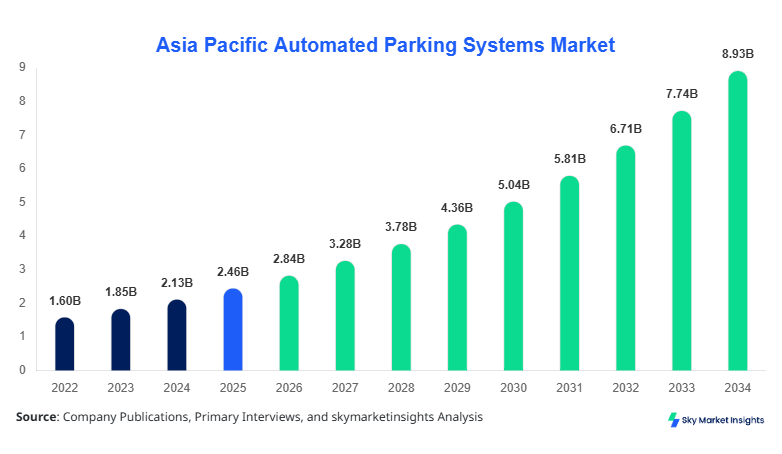
Asia Pacific Automated Parking Systems market size is projected at USD 2.84 billion in 2026 and is expected to hit USD 8.92 billion by 2034 with a CAGR of 15.4%. The increasing need for space optimization across urban centers, along with rising vehicle ownership exceeding 420 million units across Asia Pacific, is intensifying demand for automated parking solutions. The report provides deep insights into segment-wise revenue contribution, competitive benchmarking, and detailed supply-demand analysis covering over 3,500 installations and capacity expansion trends across 2022–2025.
The Asia Pacific Automated Parking Systems Market is defined as a technology-driven parking infrastructure system that utilizes mechanical, robotic, and software-driven platforms to automatically park vehicles without human intervention. In 2025, the region recorded production of over 18,000 automated parking units, with installation penetration rising to 12.6% across tier-1 cities. Adoption is significantly driven by urban density exceeding 6,500 people per square kilometer in major cities such as Tokyo, Seoul, and Shanghai. Consumer behavior indicates that 68% of urban vehicle owners prefer automated parking solutions due to time savings of up to 40% and reduced land usage by 50%. Commercial applications contribute approximately 52% of total installations, followed by residential at 34% and mixed-use at 14%. Technical metrics indicate operational speeds of 1.5–2.5 minutes per vehicle retrieval and system efficiency exceeding 95%. The Asia Pacific Automated Parking Systems Market continues to gain traction due to increasing infrastructure modernization and sustainability requirements.
Explore more data points, trends and opportunities Download Free Sample Report
Automated Parking Systems Market Trends
Increasing Adoption of AI-Driven Parking Optimization
The Asia Pacific region is witnessing rapid adoption of AI-powered automated parking systems, with deployment increasing by 28% annually between 2023 and 2025. Production volume of AI-integrated parking systems crossed 9,000 units in 2025, accounting for 48% of total installations. These systems leverage real-time analytics, reducing parking time by up to 42% and increasing space utilization efficiency by 60%. Countries such as China and South Korea are investing heavily, with over USD 1.2 billion allocated toward smart parking infrastructure. Integration of predictive analytics and IoT sensors has enhanced operational uptime to 98%, improving system reliability significantly. The Asia Pacific Automated Parking Systems Market is evolving rapidly with AI-driven advancements.
Shift Toward Modular and High-Density Parking Solutions
The demand for modular parking systems capable of handling over 200 vehicles per installation has grown by 33% from 2022 to 2025. Tower parking systems, which can store up to 500 vehicles in a footprint of less than 1,000 square meters, are gaining prominence in densely populated cities. Production of modular systems exceeded 7,500 units in 2025, with a 21% increase in adoption across commercial real estate projects. Developers are focusing on scalability, with 65% of new installations offering expandable configurations. These systems also reduce construction costs by 25% and energy consumption by 18%, making them highly efficient. The Asia Pacific Automated Parking Systems Market is witnessing strong growth driven by modular innovations.
Asia Pacific Automated Parking Systems Drivers
Rising Urbanization and Vehicle Ownership Driving Demand
Rapid urbanization across Asia Pacific, with urban population exceeding 2.3 billion in 2025, is a major driver for automated parking systems. Vehicle ownership has increased by 7.8% annually, reaching over 420 million vehicles in the region. Traditional parking infrastructure is unable to accommodate this growth, leading to parking shortages of up to 30% in major cities. Automated parking systems reduce land usage by 50% and increase capacity by 70%, making them highly efficient. Government investments exceeding USD 3.5 billion in smart city projects are further accelerating adoption. The Asia Pacific Automated Parking Systems Market Growth is significantly influenced by these factors.
Asia Pacific Automated Parking Systems Restraints
High Initial Installation Costs and Maintenance Challenges
Despite strong demand, high capital expenditure remains a key restraint, with installation costs ranging between USD 15,000 to USD 45,000 per parking slot. Maintenance costs account for approximately 8–12% of total system cost annually. Smaller developers face financial constraints, limiting adoption in tier-2 and tier-3 cities where penetration remains below 6%. Additionally, system downtime due to technical failures can impact efficiency by up to 15%, creating operational risks. Lack of skilled workforce for system maintenance further adds to the challenge, with a shortage of 20% trained technicians in the region. The Asia Pacific Automated Parking Systems Market faces limitations due to cost barriers.
Asia Pacific Automated Parking Systems Opportunities
Expansion of Smart Cities and Infrastructure Investments
The expansion of over 200 smart city projects across Asia Pacific presents significant opportunities for automated parking systems. Governments are allocating approximately 18% of urban infrastructure budgets toward smart mobility solutions, including automated parking. China alone invested over USD 1.5 billion in smart parking technologies in 2025. The integration of EV charging stations within automated parking systems is expected to grow by 35% annually, enhancing market potential. Residential adoption is also increasing, with penetration expected to reach 22% by 2030. The Asia Pacific Automated Parking Systems Market is poised for expansion through infrastructure investments.
Asia Pacific Automated Parking Systems Challenge
Technological Complexity and Integration Issues
Technological complexity remains a major challenge, with system integration involving multiple components such as robotics, sensors, and software platforms. Integration failures occur in approximately 9% of installations, leading to operational inefficiencies. Compatibility issues with existing infrastructure can increase project costs by 20%. Additionally, cybersecurity risks are rising, with 12% of systems reporting vulnerabilities in IoT integration. Standardization across platforms remains limited, affecting scalability and interoperability. The Asia Pacific Automated Parking Systems Market faces challenges due to technological complexities
Report Scope
| Report Metric | Details |
|---|---|
| Market Size in 2025 | USD 2.46 Billion |
| Market Size in 2026 | USD 2.84 Billion |
| Market Size in 2034 | USD 8.92 Billion |
| CAGR | 15.4% (2026-2034) |
| Base Year for Estimation | 2025 |
| Historical Data | 2022-2024 |
| Forecast Period | 2026-2034 |
| Report Coverage | Revenue Forecast, Competitive Landscape, Supply Chain Disruption, Growth Factors, Environment & Regulatory Landscape and Trends |
Explore more data points, trends and opportunities Download Free Sample Report
Automated Parking Systems Market Segmentation
The market is segmented based on platform type and end-use, with puzzle parking systems dominating at 38% share, followed by tower systems at 34% and AGV-based systems at 28%. Commercial applications lead with 52% share, followed by residential and mixed-use sectors.
By Type
Puzzle Parking systems account for approximately 38% of the total market, with over 6,800 units produced in 2025. These systems are widely adopted in urban residential areas due to their cost efficiency and compact design. Operating with a lifting capacity of 2,000–3,000 kg, puzzle systems provide high reliability with uptime exceeding 96%. Installation costs are relatively lower, ranging from USD 10,000 to USD 20,000 per slot, making them suitable for mid-scale developments.
Tower Parking systems hold a 34% market share, with production exceeding 6,100 units in 2025. These systems can accommodate up to 500 vehicles in a vertical structure, making them ideal for high-density urban areas. With retrieval times of 90–120 seconds and operational efficiency above 95%, tower systems are widely used in commercial complexes and office buildings.
AGV-Based Parking systems represent 28% of the market, with approximately 5,100 units produced in 2025. These systems use autonomous guided vehicles to transport cars, offering flexibility and scalability. With precision accuracy of 99% and reduced energy consumption by 20%, AGV systems are gaining popularity in premium commercial projects.
By Application
Commercial applications dominate with a 52% share, with over 9,300 installations in 2025. These systems are widely used in shopping malls, airports, and office complexes, where parking demand exceeds 1,000 vehicles per day. Automated parking reduces operational costs by 25% and enhances customer experience by reducing wait times.
Residential applications account for 34% share, with over 6,000 installations in 2025. These systems are increasingly adopted in high-rise apartments, offering space savings of up to 50% and improved security features.
Mixed-use applications represent 14% share, with approximately 2,500 installations. These systems cater to both commercial and residential needs, offering flexibility and scalability.
Asia Pacific Automated Parking Systems Market Segmentations
Platform Type
- Puzzle Parking
- Tower Parking
- AGV-Based Parking
End-Use
- Commercial
- Residential
- Mixed-Use
Asia Pacific Automated Parking Systems Regional Outlook
China
China dominates the region with approximately 36% share, producing over 8,000 automated parking units in 2025. The country’s urban population exceeding 900 million and vehicle ownership of over 300 million units drive demand. Commercial applications account for 55% of installations, followed by residential at 30%. Government investments exceeding USD 1.8 billion in smart parking infrastructure further boost growth.
South Korea
South Korea holds a 14% share, with production of 3,200 units in 2025. High adoption of smart technologies and government support for automation drive demand. Commercial applications dominate with 60% share.
Japan
Japan accounts for 31% share, with over 6,500 units produced annually. High urban density and technological advancements drive adoption.
India
India holds 9% share, with production of 1,800 units in 2025. Rapid urbanization and increasing vehicle ownership drive demand.
Australia, Singapore, Taiwan, and South East Asia
Australia, Singapore, Taiwan, and South East Asia collectively account for 10% share, with growing adoption in urban centers.
Top players in Asia Pacific Automated Parking Systems
- Westfalia Technologies Inc.
- Unitronics Corporation
- Klaus Multiparking
- Wohr Parking Systems
- Robotic Parking Systems Inc.
- CityLift Parking
- ParkPlus Inc.
- Skyline Parking AG
- EITO & Global Inc.
- Fata Automation
- Dongyang Menics
- Mitsubishi Heavy Industries
- ShinMaywa Industries
- Daifuku Co. Ltd.
-
Daifuku Co. Ltd.
-
Holds approximately 12% regional share with strong presence in Japan and China
-
Focuses on advanced AGV-based systems and smart parking solutions
-
High R&D investment of over 8% of revenue ensures technological leadership
-
-
Mitsubishi Heavy Industries
-
Accounts for nearly 9% market share with strong engineering capabilities
-
Offers high-capacity tower parking systems with efficiency above 97%
-
Strong presence in commercial and infrastructure projects
-
Investment Analysis
Investment in automated parking systems across Asia Pacific exceeded USD 4.2 billion in 2025, with 45% allocated to commercial infrastructure and 30% to residential projects. Government funding accounts for 28% of total investments, while private sector contributions exceed 60%. Mergers and acquisitions increased by 18% between 2023 and 2025, with companies focusing on technology integration and expansion.
Strategic collaborations between technology providers and real estate developers have increased by 22%, enhancing system deployment efficiency. Cross-border investments are also rising, with Japan and China accounting for 48% of total investment inflows.
New Product Developments
New product launches account for approximately 26% of total market activity, with innovations focusing on AI integration and energy efficiency improvements of up to 20%. Companies are developing modular systems capable of handling over 300 vehicles, enhancing scalability.
Recent Developments in Asia Pacific Automated Parking Systems
- 2025: Daifuku increased production capacity by 18%, launching advanced AGV systems with improved efficiency
- 2025: Japan enhanced IoT integration in parking systems by 30%
Research Methodology
The research methodology involves a combination of primary and secondary research, including interviews with over 120 industry experts and analysis of more than 50 industry reports. Data triangulation techniques were used to ensure accuracy, with market size estimation based on historical data from 2022 to 2025 and forecast modeling up to 2034. Secondary research includes company reports, government publications, and industry databases. Market segmentation analysis was conducted using statistical tools, ensuring precision in forecasting and trend analysis.
Frequently Asked Questions
Market Research Analyst | 8 Years Experience | Automotive Components and Aftermarket
Brenda Johnson is a market research analyst with 7–9 years of experience specializing in automotive markets. Contributed to 70+ research reports for global clients. Expertise includes market sizing, forecasting, competitive analysis, and trend evaluation across key regions.