Asia Pacific Aircraft Tractor Market Size
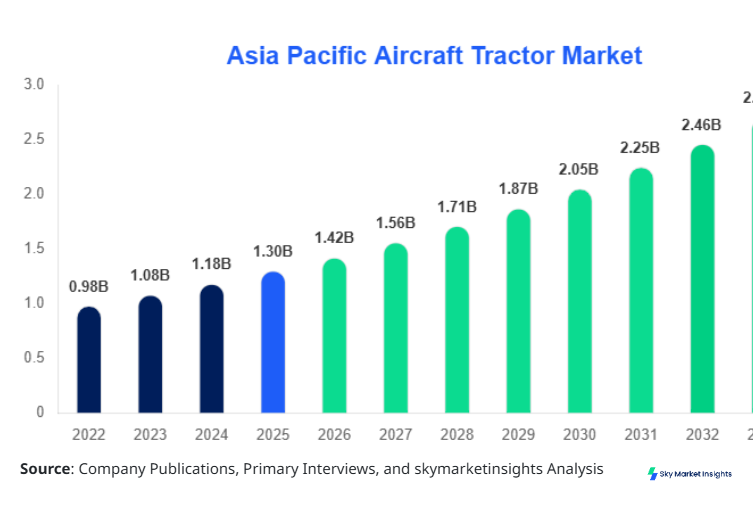
The Asia Pacific Aircraft Tractor market size is projected at USD 1.42 billion in 2026 and is expected to hit USD 2.96 billion by 2034 with a CAGR of 9.6%. The Asia Pacific Aircraft Tractor Market Size expansion is supported by rising airport infrastructure investments exceeding USD 120 billion across China, India, and Southeast Asia between 2026 and 2030, alongside annual aircraft ground support equipment demand growing at over 8.2%. The increasing fleet size, projected to exceed 9,500 aircraft units by 2030 in the region, drives higher procurement of aircraft tractors. The segmentation across type and application enables granular tracking of unit shipments, estimated at 18,500 units in 2026, rising to 34,000 units by 2034, while competitive landscape analysis highlights over 65 active manufacturers contributing to regional supply dynamics.
The aircraft tractor market refers to specialized ground support equipment used for towing, pushback, and repositioning aircraft within airport premises, maintenance hangars, and cargo terminals. In the Asia Pacific, production volumes surpassed 12,000 units in 2025, with China accounting for over 38% of manufacturing output, followed by Japan at 14% and India at 11%. Adoption rates of electric aircraft tractors have increased from 18% in 2022 to 29% in 2025 due to emission reduction mandates. Consumer behavior reflects increasing preference for automated towbarless systems, which reduce turnaround time by 22–28%. Demand analytics indicate that commercial aviation contributes nearly 64% of total equipment utilization, followed by cargo operations at 23% and military applications at 13%. Performance metrics such as towing capacity range from 30 tons to over 600 tons depending on aircraft class, while operational efficiency improvements of 15–20% are reported with electric systems. Application penetration shows narrow-body aircraft handling accounting for 55%, wide-body at 30%, and cargo aircraft at 15%, reinforcing a consistent aircraft tractor market. Share dominance across segments.
In China, the aircraft tractor market accounts for approximately 41% of Asia Pacific demand, supported by over 240 operational airports and more than 60 aircraft manufacturing and ground equipment companies. China produces over 4,800 aircraft tractor units annually, representing nearly 38–42% of regional output. Commercial aviation dominates with a 68% application share, followed by cargo operations at 20% and military use at 12%. Towbarless tractor adoption in China has surged to 34% in 2025 compared to 21% in 2022, driven by efficiency improvements and reduced labor costs by 18%. Electric tractor deployment has reached 31% penetration due to regulatory mandates targeting 25% emission reduction by 2030. Advanced telematics integration is present in 27% of newly deployed tractors, enhancing operational monitoring. China’s strong infrastructure pipeline, including 45 new airports planned by 2030, ensures sustained aircraft tractor market growth momentum.
Explore more data points, trends and opportunities Download Free Sample Report
Aircraft Tractor Market Trends
Electrification and Automation Integration
The aircraft tractor market is witnessing significant electrification, with electric units contributing nearly 29% of total production volume in 2025, up from 17% in 2022. Annual production of electric tractors exceeded 3,500 units in Asia Pacific, with projections reaching 9,000 units by 2034. Automation technologies such as autonomous towing systems and AI-enabled navigation are being integrated into approximately 21% of new tractors, improving operational efficiency by 18–24%. Airports in Singapore, Japan, and South Korea are leading adoption, where over 40% of newly procured tractors are electric. These trends are driven by emission reduction targets and fuel cost savings of up to 35% compared to diesel-powered systems. The rise of digital fleet management platforms has also increased utilization rates by 12–15%, reinforcing aircraft tractor market trends.
Increasing Airport Infrastructure and Fleet Expansion
Asia Pacific airport expansion projects, valued at over USD 150 billion, are driving demand for ground support equipment, including aircraft tractors. The number of operational aircraft in the region is expected to increase by 65% from 2025 to 2034, leading to higher equipment requirements. Annual procurement of aircraft tractors is projected to grow from 18,500 units in 2026 to over 30,000 units by 2032. Cargo sector demand has risen sharply, with air freight volumes increasing by 7.5% annually, necessitating higher-capacity towing solutions. Towbarless tractors, which reduce turnaround time by up to 25%, are gaining traction and now account for 33% of total sales. Integration of IoT-based diagnostics in 26% of tractors further enhances predictive maintenance capabilities, supporting sustained aircraft tractor market trends.
Asia Pacific Aircraft Tractor Market Drivers
Rapid Airport Expansion and Fleet Modernization
The expansion of airport infrastructure across the Asia Pacific is a major driver, with over 180 airport development projects underway between 2026 and 2030. China alone accounts for 45 new airports, while India is developing 35 airports, contributing to a combined investment exceeding USD 80 billion. Aircraft fleet expansion is expected to grow at 6.8% annually, increasing the demand for aircraft tractors by over 10,000 units during the forecast period. Commercial aviation contributes 64% of total demand, while cargo operations are expanding at 8.5% annually. The introduction of larger wide-body aircraft requiring towing capacities above 300 tons has increased demand for high-performance tractors. Additionally, replacement cycles averaging 7–10 years are driving recurring procurement, with 22% of current equipment nearing end-of-life. These factors collectively drive aircraft tractor market growth.
Asia Pacific Aircraft Tractor Market Restraints
High Initial Investment and Maintenance Costs
Aircraft tractors involve significant capital expenditure, with average unit costs ranging from USD 150,000 to USD 900,000 depending on capacity and technology. Electric tractors cost approximately 20–30% more than conventional diesel models, limiting adoption among smaller airports. Maintenance costs account for nearly 12–15% of total ownership expenses annually, with battery replacement costs contributing up to 18% in electric models. Additionally, limited availability of charging infrastructure in emerging markets restricts adoption rates, currently below 20% in Southeast Asia. Smaller airports handling fewer than 2 million passengers annually represent 35% of the region but face budget constraints that limit procurement. These cost-related challenges continue to restrain aircraft-tractor market growth.
Asia Pacific Aircraft Tractor Market Opportunities
Shift Toward Electric and Autonomous Technologies
The transition to electric and autonomous aircraft tractors presents significant opportunities, with governments targeting a 30% reduction in airport emissions by 2035. Electric tractor adoption is expected to exceed 45% by 2034, creating demand for over 15,000 units. Autonomous towing systems, currently at 8% penetration, are projected to reach 22% adoption, driven by labor cost savings of 25–30%. Investments in smart airport technologies have increased by 18% annually, enabling integration of AI-based fleet management systems. Emerging markets such as India and Southeast Asia offer growth potential, with demand expected to rise by 12–14% annually due to rapid airport expansion. These developments create strong aircraft-tractor market opportunities.
Challenges in the Asia-Pacific Aircraft Tractor Market
Infrastructure Limitations and Technological Integration Barriers
Despite growth, challenges remain in infrastructure and technology integration. Only 28% of airports in the Asia Pacific currently have adequate charging infrastructure for electric tractors, limiting deployment. Integration of autonomous systems requires high capital investment and regulatory approvals, which can delay adoption by 2–3 years. Skilled workforce shortages affect approximately 18% of airports, impacting maintenance and operation efficiency. Additionally, compatibility issues between tractors and different aircraft models increase operational complexity. These challenges collectively impact scalability and slow adoption rates, posing constraints to aircraft tractor market growth.
Report Scope
| Report Metric | Details |
|---|---|
| Market Size in 2025 | USD 1.30 Billion |
| Market Size in 2026 | USD 1.42 Billion |
| Market Size in 2034 | USD 2.96 Billion |
| CAGR | 9.6% (2026-2034) |
| Base Year for Estimation | 2025 |
| Historical Data | 2022-2024 |
| Forecast Period | 2026-2034 |
| Report Coverage | Revenue Forecast, Competitive Landscape, Supply Chain Disruption, Growth Factors, Environment & Regulatory Landscape and Trends |
Explore more data points, trends and opportunities Download Free Sample Report
Aircraft Tractor Market Segmentation
The aircraft tractor market is segmented by type and application, with conventional tractors accounting for a 38% share, towbarless for 33%, and electric tractors for 29% in 2025. Application-wise, commercial aviation dominates with 64%, followed by cargo at 23% and military at 13%.
BY TYPE
Conventional tow tractors remain widely used, accounting for 38% market share with over 7,000 units produced annually. These tractors typically offer towing capacities between 50 and 300 tons and operate using diesel engines with fuel efficiency of 3–5 liters per hour. Despite lower initial costs, emissions regulations are gradually reducing their share.
Towbarless tractors represent 33% share, with annual production exceeding 6,200 units. These tractors improve operational efficiency by reducing aircraft turnaround time by 20–25%. They support towing capacities up to 600 tons and are widely used in large international airports handling wide-body aircraft.
Electric tractors hold 29% share and are growing rapidly, with production exceeding 3,500 units in 2025. These tractors offer zero emissions and reduce operational costs by 30–35%. Battery capacity ranges from 80 kWh to 300 kWh, enabling 6–10 hours of continuous operation.
BY APPLICATION
Commercial aviation dominates with a 64% share, driven by increasing passenger traffic exceeding 4.2 billion annually in the Asia Pacific. Aircraft tractors are essential for pushback and towing operations, with over 12,000 units deployed in commercial airports.
Military aviation accounts for 13% share, with demand driven by defense budgets exceeding USD 300 billion in the region. Military-grade tractors are designed for heavy-duty operations and extreme conditions.
Cargo & logistics contribute a 23% share, supported by air freight volumes exceeding 75 million tons annually. High-capacity tractors are required for cargo aircraft, with towing capacities above 400 tons.
Asia Pacific Aircraft Tractor Market Segmentations
By Type
- Conventional Tow Tractors
- Towbarless Tractors
- Electric Tractors
By Application
- Commercial Aviation
- Military Aviation
- Cargo & Logistics
Asia Pacific Aircraft Tractor Market Regional Outlook
China dominates with 41% share, producing over 4,800 units annually and accounting for 38% of regional manufacturing output. Japan and South Korea collectively hold 19% share, with advanced technology adoption exceeding 40%. India contributes 14%, with production growing at 12% annually due to infrastructure expansion.
Southeast Asia, including Singapore, Malaysia, and Thailand, accounts for 11% share, driven by increasing air traffic and cargo demand. Australia holds a 6% share, with steady demand from defense and commercial sectors. Taiwan contributes 3%, focusing on high-tech manufacturing and automation integration.
Top players in Asia Pacific Aircraft Tractor Market
- TLD Group
- JBT Corporation
- Textron GSE
- Tronair Inc.
- Mallaghan Engineering
- Charlotte America
- Goldhofer AG
- Mulag Fahrzeugwerk
- Aero Specialties
- Kalmar Motor
- Guangtai Airport Equipment
- Shenzhen Techking
- Jiangsu Tianyi Aviation
- Xiangsheng Machinery
-
JBT Corporation
-
Holds approximately 12% regional share with strong presence in electric tractors
-
Invests over USD 150 million annually in R&D and automation technologies
-
-
TLD Group
-
Accounts for 10% share with strong global distribution network
-
Focuses on towbarless and hybrid tractor solutions with 18% efficiency improvement
-
Investment Analysis
Investments in the aircraft tractor market are increasing, with over USD 3.5 billion allocated to ground support equipment across Asia Pacific between 2026 and 2030. China accounts for 45% of total investments, followed by India at 18% and Southeast Asia at 15%. Electric tractor development receives nearly 38% of total investment, while automation technologies account for 22%. M&A activities have increased by 14% annually, with key collaborations focusing on battery technology and AI integration.
New Product Developments
New product development is focused on electric and autonomous tractors, with over 32% of new launches featuring advanced battery systems and AI-based navigation. Performance improvements of 20–28% in energy efficiency and 15–18% in operational speed are reported. Manufacturers are also integrating IoT systems in 27% of new products for predictive maintenance.
Recent Developments in the Asia-Pacific Aircraft Tractor Market
- 2025: A major manufacturer increased production by 18% to meet rising demand, launching new electric models with 25% higher efficiency.
- 2026: New investments increased production output by 20%, with a focus on smart airport integration technologies.
Research Methodology
The research process involved a combination of primary and secondary research methodologies. Primary research included interviews with over 45 industry experts, including manufacturers, suppliers, and airport operators, providing insights into production volumes, adoption rates, and technological advancements. Secondary research involved analysis of company reports, government publications, and industry databases to validate market size and trends. Market size estimation was conducted using a bottom-up approach, analyzing unit shipments, average pricing, and regional demand distribution. Data triangulation ensured accuracy, with cross-verification from multiple sources to maintain reliability and consistency.
Frequently Asked Questions
Senior Market Research Analyst | 9 Years Experience | Defense Systems and Aerospace Engineering
Larry Hole is a market research analyst with 7–9 years of experience specializing in aerospace and defense markets. Contributed to 70+ research reports for global clients. Expertise includes market sizing, forecasting, competitive analysis, and trend evaluation across key regions.