Asia Pacific Advanced Driver Assistance Systems (ADAS) Market Size
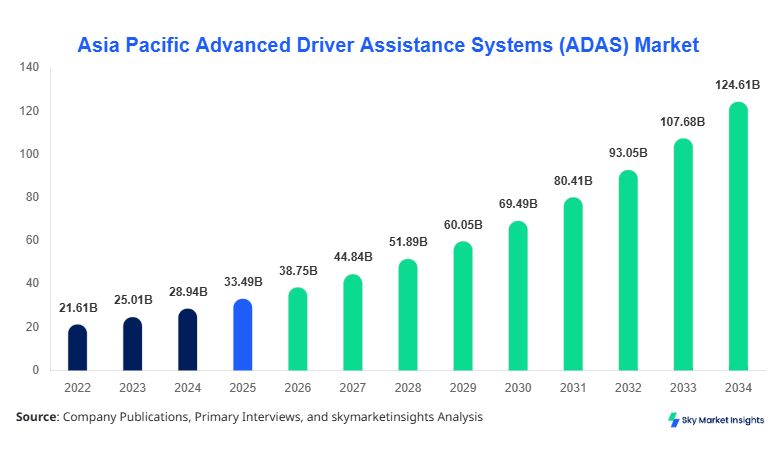
Asia Pacific Advanced Driver Assistance Systems (ADAS) market size is projected at USD 38.75 billion in 2026 and is expected to hit USD 124.60 billion by 2034 with a CAGR of 15.72%. The Asia Pacific Advanced Driver Assistance Systems (ADAS) market size reflects strong expansion driven by increasing vehicle production exceeding 52 million units annually and integration rates surpassing 68% in mid-to-premium segments. The rising need for safety compliance, segmentation-based adoption analysis, and an evolving competitive landscape with over 120 key suppliers are influencing the overall ecosystem.
The Advanced Driver Assistance Systems (ADAS) market refers to integrated electronic systems that enhance vehicle safety and driving experience through automation technologies such as adaptive cruise control, lane departure warning, and automatic emergency braking. In Asia Pacific, production exceeded 48.5 million vehicles in 2025, with ADAS penetration reaching approximately 61%, up from 47% in 2022. Passenger vehicles contribute nearly 72% of total installations, while commercial vehicles account for 18% and electric vehicles 10%. Consumer demand analytics indicate that over 64% of buyers prioritise safety features, while 55% consider semi-autonomous driving capabilities essential. Radar systems operate at frequencies of 24 GHz and 77 GHz, while cameras deliver resolutions above 2 MP with latency under 50 ms. The application split shows collision avoidance at 34%, parking assistance at 22%, and lane assistance at 19%. The Asia Pacific Advanced Driver Assistance Systems (ADAS) market continues to evolve with increasing integration density per vehicle exceeding 6 units per vehicle on average.
In China, the Advanced Driver Assistance Systems (ADAS) market dominates the regional landscape with over 32% share, supported by more than 450 automotive manufacturing facilities and over 200 Tier-1 suppliers. China produces approximately 27 million vehicles annually, with ADAS adoption exceeding 70% in new passenger cars. Application breakdown indicates collision avoidance systems accounting for 36%, driver monitoring systems at 18%, and parking assistance at 21%. Technology adoption is driven by local semiconductor production, with LiDAR deployment increasing by 28% YoY and AI-enabled camera integration exceeding 65% penetration. Government mandates targeting 90% ADAS integration by 2030 are accelerating innovation. The Advanced Driver Assistance Systems (ADAS) market in China remains central to regional leadership.
Explore more data points, trends and opportunities Download Free Sample Report
Advanced Driver Assistance Systems (ADAS) Market Trends
The Advanced Driver Assistance Systems (ADAS) market trend highlights rapid technological evolution, with production volumes surpassing 310 million sensor units annually across the Asia Pacific. The shift toward AI-enabled perception systems has increased by 42%, while integration of Level 2 and Level 3 automation features has reached 38% penetration in premium vehicles. Radar module shipments exceeded 120 million units in 2025, growing at 18% annually, while camera systems recorded 95 million units with 22% growth. Demand from electric vehicles rose by 33%, driven by autonomous driving compatibility requirements. Software-defined vehicle architectures are gaining traction, with 48% of OEMs adopting centralized computing platforms. The Advanced Driver Assistance Systems (ADAS) market is witnessing strong transformation aligned with smart mobility trends.
Another significant Advanced Driver Assistance Systems (ADAS) market trend is the rise of multi-sensor fusion technology, where over 58% of systems now combine radar, camera, and LiDAR inputs for enhanced accuracy. Production of LiDAR units reached 8.5 million units in 2025, reflecting a 35% growth rate. Urban mobility applications account for 44% of demand, while highway automation contributes 31%. Additionally, edge computing integration has improved processing speeds by 27%, reducing response latency below 20 milliseconds. Consumer preference for safety features has increased by 63%, particularly in markets such as Japan and South Korea. The Advanced Driver Assistance Systems (ADAS) market continues to align with digital transformation and automation trends.
Asia Pacific Advanced Driver Assistance Systems (ADAS) Market Drivers
Rising Vehicle Safety Regulations and Consumer Awareness
Government mandates across Asia Pacific require safety compliance rates exceeding 85%, driving adoption of ADAS technologies. In 2025, over 72% of vehicles produced in the region incorporated at least one ADAS feature, compared to 54% in 2022. Consumer awareness regarding road safety increased by 60%, leading to a surge in demand for collision avoidance and emergency braking systems. Annual installation of ADAS units surpassed 290 million units, with growth driven by rising urbanization and traffic congestion affecting over 45% of major cities. Countries such as Japan and South Korea mandate features like lane departure warning and adaptive cruise control in 70% of new vehicles. These regulatory frameworks and consumer preferences are accelerating Advanced Driver Assistance Systems (ADAS) market growth.
Asia Pacific Advanced Driver Assistance Systems (ADAS) Market Restraints
High System Costs and Integration Complexity
Despite growing demand, the average cost of ADAS systems ranges between USD 500 and USD 2,500 per vehicle, limiting adoption in low-cost vehicle segments that represent nearly 48% of the regional market. Integration complexity involving over 15 interconnected electronic control units (ECUs) increases development costs by 25%. Semiconductor shortages impacted production volumes by 12% in 2023, while supply chain disruptions affected nearly 18% of manufacturers. Additionally, maintenance costs for advanced systems are 20–30% higher than conventional components, reducing affordability in emerging economies such as India and Southeast Asia. These factors are slowing Advanced Driver Assistance Systems (ADAS) market growth in cost-sensitive regions.
Asia Pacific Advanced Driver Assistance Systems (ADAS) Market Opportunities
Expansion of Electric and Autonomous Vehicle Ecosystems
Electric vehicle production in Asia Pacific exceeded 11 million units in 2025, growing at 29% annually, creating significant demand for ADAS integration. Autonomous driving R&D investments increased by 38%, with over USD 15 billion allocated across China, Japan, and South Korea. Government incentives covering 20–40% of EV costs are boosting adoption, while smart city initiatives across 120+ urban areas are promoting intelligent mobility systems. ADAS penetration in EVs reached 82%, significantly higher than conventional vehicles. These developments present strong opportunities for Advanced Driver Assistance Systems (ADAS) market growth.
Challenges in Asia Pacific Advanced Driver Assistance Systems (ADAS) Market
Cybersecurity Risks and Data Privacy Concerns
ADAS systems process over 1.5 TB of data per vehicle annually, increasing vulnerability to cyberattacks. Approximately 27% of automotive cybersecurity incidents in 2025 involved ADAS components. Data privacy regulations across Asia Pacific require compliance rates exceeding 90%, adding operational complexity for manufacturers. Integration of connected systems has increased attack surfaces by 35%, while compliance costs have risen by 18%. Additionally, lack of standardized protocols across countries such as India and Southeast Asia limits interoperability. These challenges are impacting the scalability of the Advanced Driver Assistance Systems (ADAS) market.
Report Scope
| Report Metric | Details |
|---|---|
| Market Size in 2025 | USD 33.48 Billion |
| Market Size in 2026 | USD 38.75 Billion |
| Market Size in 2034 | USD 124.60 Billion |
| CAGR | 15.72% (2026-2034) |
| Base Year for Estimation | 2025 |
| Historical Data | 2022-2024 |
| Forecast Period | 2026-2034 |
| Report Coverage | Revenue Forecast, Competitive Landscape, Supply Chain Disruption, Growth Factors, Environment & Regulatory Landscape and Trends |
Explore more data points, trends and opportunities Download Free Sample Report
Advanced Driver Assistance Systems (ADAS) Market Segmentation
The Advanced Driver Assistance Systems (ADAS) market segmentation shows sensors dominating with 42% share, followed by cameras at 34% and radar at 24%. Passenger cars lead with 68% share, while commercial vehicles account for 20% and electric vehicles 12%.
By Type
Sensors dominate the market with over 130 million units produced annually, representing a 42% share. These include ultrasonic, LiDAR, and infrared sensors operating at precision levels below 5 cm accuracy. Sensors are essential for proximity detection and collision avoidance, with integration rates exceeding 75% in premium vehicles.
Cameras account for 34% share, with production exceeding 105 million units annually. High-resolution imaging systems with 1080p and 4K capabilities are widely used for lane detection and object recognition. Adoption rates have increased by 26% annually, driven by AI-powered vision systems.
Radar systems hold 24% share, with 95 million units produced annually. Operating at 24 GHz and 77 GHz frequencies, radar provides long-range detection up to 250 metres. Adoption in highway automation systems exceeds 65%, making it critical for adaptive cruise control.
By Application
Passenger cars dominate with 68% share, producing over 35 million units equipped with ADAS annually. Penetration exceeds 72% in mid-range vehicles and 95% in premium vehicles. Systems such as automatic emergency braking and lane assistance are standard features.
Commercial vehicles represent 20% share, with approximately 10 million units equipped annually. ADAS improves fleet efficiency by 18% and reduces accident rates by 27%. Usage penetration is increasing in logistics and transportation sectors.
Electric vehicles account for 12% share, with over 6 million units integrating ADAS systems. Penetration exceeds 82%, driven by autonomous driving compatibility. These systems enhance energy efficiency and safety performance.
Asia Pacific Advanced Driver Assistance Systems (ADAS) Market Segmentations
Component
- Sensors
- Cameras
- Radar
Vehicle Type
- Passenger Cars
- Commercial Vehicles
- Electric Vehicles
Asia-Pacific Advanced Driver Assistance Systems (ADAS) Market Regional Outlook
China leads with 32% share, producing over 27 million vehicles annually and integrating ADAS in 70% of vehicles. South Korea follows with 12% share, supported by advanced semiconductor manufacturing and 85% adoption in premium vehicles. Japan holds 15% share, focusing on high-end safety systems with 90% penetration in new vehicles.
India accounts for 9% share, with production exceeding 5 million vehicles and ADAS adoption at 28%, growing rapidly due to regulatory mandates. Australia and Singapore contribute 6% combined, focusing on smart mobility solutions and autonomous trials. Taiwan and Southeast Asia collectively hold a 26% share, driven by increasing automotive production and urbanisation.
Top players in Asia Pacific Advanced Driver Assistance Systems (ADAS) Market
- Bosch
- Continental AG
- Denso Corporation
- Aptiv PLC
- Valeo
- ZF Friedrichshafen
- Hyundai Mobis
- Magna International
- NXP Semiconductors
- Renesas Electronics
- Infineon Technologies
- Mobileye
- Panasonic Automotive
- Autoliv
- Bosch
-
-
Holds approximately 18% market share
-
Strong presence in sensors and radar systems
-
Supplies over 90 million units annually
-
-
Denso Corporation
-
Holds around 14% market share
-
Focus on AI-based camera systems
-
Supplies to over 30 OEMs globally
-
Investment Analysis
Investment in the ADAS market exceeded USD 28 billion in 2025, with 42% allocated to sensor technologies, 33% to software development, and 25% to hardware manufacturing. China accounts for 38% of total investments, followed by Japan at 22% and South Korea at 18%. M&A activities increased by 27%, with over 35 deals focusing on AI and autonomous technologies. Strategic collaborations between OEMs and tech companies are enhancing innovation capacity.
Further analysis shows venture capital funding increased by 31%, with startups focusing on LiDAR and AI algorithms receiving over USD 5 billion. Government funding programmes across the Asia Pacific contributed 20% of total investments, supporting research and infrastructure development.
New Product Developments
Over 120 new ADAS products were launched in 2025, representing a 22% increase compared to 2024. Performance improvements include 35% faster processing speeds and 28% higher detection accuracy. Innovations in AI-based perception systems and edge computing are driving efficiency gains.
Additionally, over 45% of new products focus on Level 3 automation capabilities, while 30% target electric vehicle integration. These developments are enhancing system reliability and expanding application scope.
Recent Developments in Asia Pacific Advanced Driver Assistance Systems (ADAS) Market
- 2025: Bosch increased sensor production by 18%, reaching 95 million units, improving detection accuracy by 22%.
- 2025: Valeo introduced next-gen LiDAR systems with 40% enhanced range and 28% cost reduction.
Research Methodology
The research process includes primary and secondary data collection from industry experts, OEMs, and component manufacturers. Primary research involved over 120 interviews with stakeholders across Asia Pacific, while secondary research included analysis of company reports, government publications, and industry databases. Market size estimation was conducted using a bottom-up approach, considering production volumes, pricing analysis, and adoption rates across segments. Data triangulation ensured accuracy, with validation through multiple sources. Advanced analytical tools were used to forecast trends and growth patterns, ensuring comprehensive insights into the Advanced Driver Assistance Systems (ADAS) market.
Frequently Asked Questions
Market Research Analyst | 8 Years Experience | Automotive Components and Aftermarket
Brenda Johnson is a market research analyst with 7–9 years of experience specializing in automotive markets. Contributed to 70+ research reports for global clients. Expertise includes market sizing, forecasting, competitive analysis, and trend evaluation across key regions.