Asia Pacific ADAS And Autonomous Driving Components Market Size
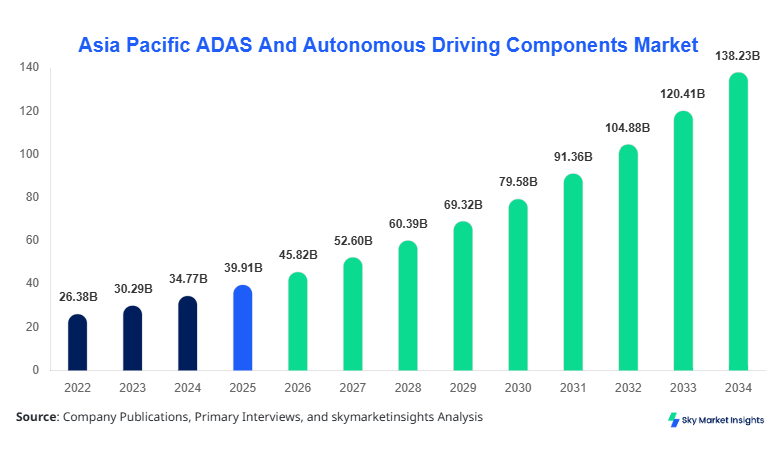
Asia Pacific ADAS And Autonomous Driving Components market size is projected at USD 45.82 billion in 2026 and is expected to hit USD 138.64 billion by 2034 with a CAGR of 14.8%. The market is driven by increasing integration of advanced safety systems across over 32 million vehicles annually, along with rising demand for automation technologies exceeding 65% penetration in premium vehicles. The report provides in-depth segmentation analysis across component types and vehicle categories, supported by competitive benchmarking of over 120 regional and global players.
The Asia Pacific ADAS And Autonomous Driving Components market encompasses technologies such as radar, LiDAR, cameras, control units, and AI-based software that enable semi-autonomous and fully autonomous driving capabilities. Regional production reached approximately 58 million automotive units in 2025, with ADAS penetration exceeding 48% across passenger vehicles and 22% across commercial vehicles. Consumer adoption is strongly influenced by safety awareness, with over 72% of buyers in urban regions preferring vehicles equipped with Level 2 or higher automation features. Demand analytics indicate that collision avoidance systems account for 34% of installations, adaptive cruise control for 26%, and lane-keeping systems for 18%. Technically, radar operates within 24 GHz to 77 GHz frequencies, while LiDAR achieves detection ranges of up to 250 meters with accuracy below 5 cm. Passenger vehicles dominate application usage with 68% share, followed by commercial vehicles at 21% and electric vehicles at 11%, reinforcing the expansion of the ADAS And Autonomous Driving Components market.
In the China, the ADAS And Autonomous Driving Components Market accounts for approximately 42% of the Asia Pacific share, supported by over 200 manufacturing facilities and 350 technology firms specializing in autonomous systems. China produced nearly 30 million vehicles in 2025, of which 55% were equipped with ADAS functionalities. Passenger vehicle applications contribute 70% of demand, while commercial vehicles and EVs contribute 20% and 10%, respectively. Technology adoption rates for Level 2 automation exceed 60%, and Level 3 testing has reached over 500 pilot zones nationwide. Government investments of over USD 12 billion have accelerated AI chip development and sensor integration. The rapid scaling of production and technological adoption reinforces the ADAS And Autonomous Driving Components market.
Explore more data points, trends and opportunities Download Free Sample Report
ADAS And Autonomous Driving Components Market Trends
The increasing adoption of AI-powered perception systems is a key trend shaping the market, with over 18 million units of camera-based systems shipped in 2025 alone. LiDAR adoption has grown by 28% annually, reaching 3.5 million units, driven by cost reductions from USD 800 per unit to below USD 400. Integration of edge computing has enabled processing speeds exceeding 200 TOPS (trillion operations per second), enhancing real-time decision-making capabilities. Additionally, over 65% of new vehicles launched in 2026 feature multi-sensor fusion systems combining radar, LiDAR, and cameras. These advancements are significantly influencing the ADAS And Autonomous Driving Components market.
Another major trend includes the shift toward software-defined vehicles, where over 40% of vehicle functionalities are now controlled via software updates. OTA (over-the-air) update capabilities have penetrated 52% of connected vehicles, enabling continuous improvements in autonomous driving features. Electric vehicle integration has further boosted demand, with EVs accounting for 35% of ADAS installations. Additionally, partnerships between OEMs and tech companies have increased by 22% year-on-year, fostering innovation in autonomous algorithms and data analytics. These evolving trends continue to strengthen the ADAS And Autonomous Driving Components market.
Asia Pacific ADAS And Autonomous Driving Components Drivers
Rising Demand for Vehicle Safety and Automation Technologies
The increasing focus on vehicle safety has driven the adoption of ADAS systems across Asia Pacific, with over 75% of consumers prioritizing safety features in purchasing decisions. Government regulations mandating features such as automatic emergency braking and lane departure warnings have contributed to a 32% increase in installations. Production volumes of ADAS components exceeded 120 million units in 2025, with radar sensors alone accounting for 45 million units. The rising number of road accidents, exceeding 1.3 million annually in the region, has accelerated demand for advanced safety systems. Additionally, integration of AI technologies has improved system efficiency by 25%, enhancing performance reliability. These factors collectively drive the ADAS And Autonomous Driving Components market.
Asia Pacific ADAS And Autonomous Driving Components Restraints
High Cost of Advanced Components and Integration Complexity
Despite rapid growth, the high cost of components such as LiDAR and advanced processors remains a significant restraint, with system costs ranging between USD 1,500 and USD 5,000 per vehicle. Integration complexity has increased development timelines by 18% and raised R&D expenditures by over 22%. Small and mid-sized manufacturers face challenges in adopting advanced technologies due to capital constraints, limiting market penetration to below 35% in lower-end vehicle segments. Additionally, maintenance costs and calibration requirements have increased operational expenses by 15%, impacting overall adoption rates. These constraints hinder the ADAS And Autonomous Driving Components market.
Asia Pacific ADAS And Autonomous Driving Components Opportunities
Expansion of Electric and Connected Vehicle Ecosystems
The rapid growth of electric vehicles presents significant opportunities, with EV production expected to exceed 25 million units by 2030 in Asia Pacific. Integration of ADAS systems in EVs has increased by 38%, driven by the need for intelligent energy management and safety optimization. Investments in smart infrastructure, including over 1,000 smart city projects, have enhanced connectivity and data exchange capabilities. Additionally, advancements in 5G technology, with coverage exceeding 70% in urban areas, enable real-time communication between vehicles and infrastructure. These developments create substantial opportunities for the ADAS And Autonomous Driving Components market.
Asia Pacific ADAS And Autonomous Driving Components Challenge
Regulatory and Standardization Barriers
The lack of uniform regulatory frameworks across Asia Pacific poses challenges, with over 15 different compliance standards affecting product deployment. Testing and validation processes for autonomous systems can take up to 36 months, delaying commercialization. Cybersecurity concerns have increased by 27%, necessitating robust data protection measures. Additionally, limited infrastructure readiness in developing regions restricts adoption to below 20%. These challenges impact scalability and slow down the ADAS And Autonomous Driving Components market.
Report Scope
| Report Metric | Details |
|---|---|
| Market Size in 2025 | USD 39.91 Billion |
| Market Size in 2026 | USD 45.82 Billion |
| Market Size in 2034 | USD 138.64 Billion |
| CAGR | 14.8% (2026-2034) |
| Base Year for Estimation | 2025 |
| Historical Data | 2022-2024 |
| Forecast Period | 2026-2034 |
| Report Coverage | Revenue Forecast, Competitive Landscape, Supply Chain Disruption, Growth Factors, Environment & Regulatory Landscape and Trends |
Explore more data points, trends and opportunities Download Free Sample Report
ADAS And Autonomous Driving Components Market Segmentation
The ADAS And Autonomous Driving Components market is segmented by component type and vehicle type, with sensors dominating at 46% share, followed by processing units at 32% and software at 22%. Passenger vehicles lead with 68% share, highlighting strong consumer demand.
BY TYPE
Sensors dominate the market with a 46% share, driven by high production volumes exceeding 70 million units annually. Radar sensors operate at frequencies between 24 GHz and 77 GHz, while LiDAR systems offer detection ranges up to 250 meters. Camera sensors, accounting for 38% of sensor installations, provide high-resolution imaging for object detection. The increasing integration of multi-sensor systems enhances accuracy by over 30%, supporting the ADAS And Autonomous Driving Components market.
Processing units account for 32% share, with over 25 million units produced annually. These units deliver computational power exceeding 150 TOPS, enabling real-time data processing. Advanced chipsets with AI acceleration capabilities have improved efficiency by 28%, reducing latency below 10 milliseconds. These advancements strengthen the ADAS And Autonomous Driving Components market.
Software components hold 22% share, driven by the growing adoption of AI algorithms and machine learning models. Over 40% of vehicle functionalities are software-driven, with continuous updates improving system performance by 20%. The expansion of cloud-based analytics further enhances data processing capabilities, supporting the ADAS And Autonomous Driving Components market.
BY APPLICATION
Passenger vehicles dominate with 68% share, driven by high adoption rates exceeding 60% for Level 2 automation systems. Production volumes reached 40 million units in 2025, with ADAS features integrated into over 25 million vehicles. These systems enhance safety and driving comfort, reinforcing the ADAS And Autonomous Driving Components market.
Commercial vehicles account for 21% share, with over 12 million units equipped with ADAS systems. Fleet operators are increasingly adopting automation technologies to improve efficiency and reduce accidents by 18%. These trends support the ADAS And Autonomous Driving Components market.
Electric vehicles represent 11% share, with rapid growth driven by sustainability initiatives. EV production exceeded 15 million units, with ADAS integration rates surpassing 55%. These systems optimize energy consumption and enhance driving efficiency, contributing to the ADAS And Autonomous Driving Components market.
Asia Pacific ADAS And Autonomous Driving Components Market Segmentations
Component Type
- Sensors
- Processing Units
- Software
Vehicle Type
- Passenger Vehicles
- Commercial Vehicles
- Electric Vehicles
Asia Pacific ADAS And Autonomous Driving Components Regional Outlook
China
China dominates with 42% share, producing over 30 million vehicles annually and leading in autonomous technology adoption. Government initiatives and investments exceeding USD 12 billion have accelerated innovation.
Japan
Japan holds 18% share, with advanced R&D capabilities and production exceeding 9 million vehicles annually. South Korea contributes 12%, driven by strong semiconductor and automotive industries.
India
India accounts for 10%, with production exceeding 5 million vehicles and growing adoption of ADAS systems. Australia, Singapore, Taiwan, and Southeast Asia collectively contribute 18%, supported by increasing investments and infrastructure development.
Top players in Asia Pacific ADAS And Autonomous Driving Components
- Bosch
- Continental AG
- Denso Corporation
- Aptiv PLC
- NVIDIA Corporation
- Mobileye
- Valeo
- ZF Friedrichshafen AG
- Renesas Electronics
- Harman International
- Magna International
- Texas Instruments
-
Bosch
-
Holds approximately 14% market share with strong presence in sensor technologies
-
Focuses on integrated ADAS solutions with production exceeding 20 million units annually
-
-
Continental AG
-
Accounts for 11% market share with expertise in radar and software solutions
-
Invests heavily in AI-driven systems and autonomous driving platforms
-
Investment Analysis
Investments in the ADAS And Autonomous Driving Components market have increased significantly, with over USD 25 billion allocated in 2025. Approximately 45% of investments are directed toward sensor technologies, while 30% focus on software development and 25% on processing units. Regional investments are concentrated in China (50%), Japan (20%), and South Korea (15%). M&A activities have increased by 18%, with collaborations between OEMs and tech companies driving innovation and market expansion.
New Product Developments
New product development has accelerated, with over 35% of companies launching advanced ADAS solutions in 2025. Performance improvements of up to 28% have been achieved through AI integration and sensor fusion technologies. Innovations in LiDAR and radar systems have reduced costs by 22% while enhancing detection accuracy.
Recent Developments in Asia Pacific ADAS And Autonomous Driving Components
- 2025: Bosch increased sensor production by 20%, reaching 24 million units and expanding market presence significantly.
- 2025: Continental introduced advanced radar systems with 25% higher accuracy and reduced costs.
Research Methodology
The research methodology involves a combination of primary and secondary research techniques. Primary research includes interviews with over 120 industry experts, OEMs, and technology providers, while secondary research involves analysis of company reports, government publications, and industry databases. Market size estimation is conducted using a bottom-up approach, analyzing production volumes, pricing trends, and adoption rates across regions. Data triangulation ensures accuracy, with validation through multiple sources. Advanced analytical tools are used to assess market dynamics, segmentation, and competitive landscape, providing comprehensive insights into the ADAS And Autonomous Driving Components market.
Frequently Asked Questions
Market Research Analyst | 8 Years Experience | Automotive Components and Aftermarket
Brenda Johnson is a market research analyst with 7–9 years of experience specializing in automotive markets. Contributed to 70+ research reports for global clients. Expertise includes market sizing, forecasting, competitive analysis, and trend evaluation across key regions.