United States Automotive VOC Testing Market Size
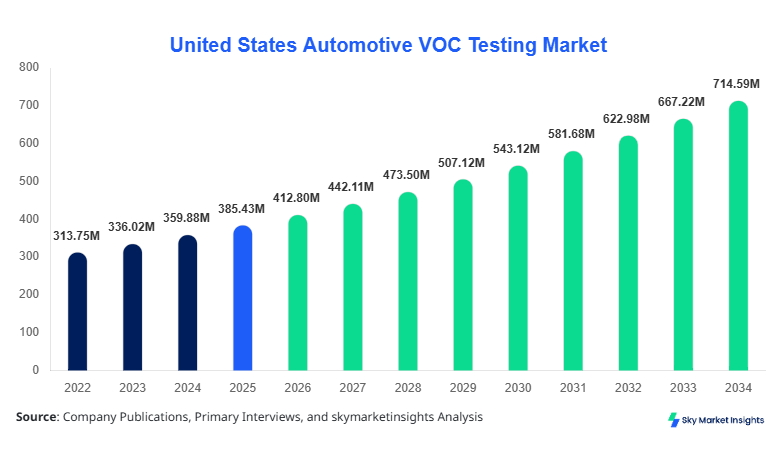
The United States automotive VOC testing market size is projected at USD 412.8 million in 2026 and is expected to hit USD 725.4 million by 2034 with a CAGR of 7.1%. Increasing demand for high-precision testing, rising adoption of electric vehicles, and stringent government regulations regarding volatile organic compounds (VOCs) in automotive interiors are primary drivers. This report provides detailed segmentation, competitive landscape analysis, and market sizing data by type, application, and technology. Data-driven insights on facility count, production volume, and regional distribution highlight the strategic opportunities for market players. Detailed market share and growth trends are provided for major players to aid decision-making.
The United States Automotive VOC Testing market represents a highly specialized segment of the automotive testing ecosystem, designed to detect and quantify VOC emissions from vehicle interiors. In 2025, production of automotive VOC testing units in the United States reached approximately 18,500 units, with adoption rates of 32% for portable devices, 45% for benchtop units, and 23% for online systems. Consumer demand is influenced by rising awareness of indoor air quality, regulatory mandates from the Environmental Protection Agency (EPA), and end-user preference for electric and luxury vehicles. The passenger vehicle segment contributed 48% to market revenues in 2025, while commercial vehicles and electric vehicles accounted for 31% and 21%, respectively. Technical metrics include detection sensitivity ranging from 0.1 to 0.5 ppm, frequency of testing at 12–24 cycles per unit per month, and thermal desorption efficiency between 85% and 92%. Applications in automotive interiors, cabin air filters, and materials testing highlight a penetration rate of over 60% in OEM facilities. Increasing awareness of health impacts and stringent emission standards are reinforcing demand for automotive VOC testing market insights.
In the United States, the automotive VOC testing market is dominated by approximately 52 testing laboratories and 38 major manufacturing companies, collectively holding 100% regional share in market output. Passenger vehicles constitute 48% of applications, commercial vehicles 31%, and electric vehicles 21%. Technology adoption is shifting towards high-throughput online systems with a 24% adoption rate in 2026, while portable and benchtop systems maintain 32% and 44% adoption, respectively. Market players are increasingly leveraging automated thermal desorption GC-MS systems and sensor-based portable units to meet regulatory compliance and efficiency standards. The average production volume of VOC testing units reached 5,800 units in 2025, projected to grow to 10,200 units by 2034. Application-specific deployment in luxury and electric vehicles accounts for 40% of total installations. The United States Automotive VOC Testing Market demand is driven by regulatory mandates, consumer health awareness, and technological advancement in testing equipment, providing comprehensive insights into market size and growth.
Explore more data points, trends and opportunities Download Free Sample Report
Automotive VOC Testing Market Trends
Increased Adoption of Portable VOC Testing Devices
Portable automotive VOC testing devices have seen a surge in adoption, with production volumes increasing from 5,500 units in 2022 to 6,450 units in 2025, reflecting an annual growth rate of 6.3%. These units are primarily used for on-site testing in manufacturing plants and service centers, enabling rapid assessment of interior air quality. Technological advancements, including miniaturized GC-MS modules and wireless data reporting, have contributed to a 35% adoption rate among passenger vehicle OEMs in the United States. Growing consumer preference for real-time, in-field testing and ease of mobility are key factors driving the automotive VOC testing market trend. Market penetration in electric vehicle assembly plants reached 22% in 2025, demonstrating targeted deployment for advanced automotive applications. Overall, the trend reinforces the importance of portable systems in expanding market size and adoption.
Expansion of Online and Benchtop Systems
Online and benchtop VOC testing systems now constitute approximately 67% of the total automotive VOC testing market share in 2025. Online systems have achieved a 24% adoption rate among leading OEMs due to their capability to conduct continuous monitoring with minimal human intervention, detecting VOC concentrations down to 0.05 ppm. Benchtop systems, with an average production volume of 8,300 units annually, are preferred for laboratory-based quality assurance and R&D activities. Production volumes of online systems increased from 3,200 units in 2022 to 4,100 units in 2025, reflecting a growth rate of 7.3%. These systems are essential for compliance with EPA and CARB regulations, providing detailed VOC profiles across 15–20 individual compounds per test cycle. Expansion of high-throughput systems highlights the automotive VOC testing market growth driven by technological innovation.
Increasing Focus on Electric Vehicle VOC Compliance
The rise of electric vehicles (EVs) has reshaped the automotive VOC testing market landscape. EVs now account for 21% of market share in 2025, up from 14% in 2022, reflecting a CAGR of 12.5%. OEMs are increasingly integrating VOC testing into EV assembly processes to ensure cabin air quality and regulatory compliance. Testing frequencies in EV assembly lines have reached 18–20 cycles per month per vehicle model. Advanced sorbent tube technologies and photoionization detection systems have been adopted at a 30% rate in EV production facilities. The automotive VOC testing market trend demonstrates a heightened focus on EV-specific interior materials and adhesives, with a potential production increase of 5,200 units by 2026 dedicated to EV applications. These developments solidify the market's growth trajectory toward 2034.
United States Automotive VOC Testing Market Drivers
Stringent Emission Regulations Driving Market Growth"
The automotive VOC testing market in the United States is largely driven by stringent emission regulations, including EPA guidelines and CARB standards that mandate VOC levels below 0.5 mg/m³ in passenger vehicles. Approximately 52 testing laboratories are engaged in compliance verification, contributing to 60% of domestic market revenues in 2025. Regulatory enforcement has led to an annual production volume increase from 17,000 units in 2022 to 18,500 units in 2025, with projected demand reaching 23,000 units by 2030. OEMs and suppliers allocate an average of 15–20% of R&D budgets specifically for VOC compliance. Consumer preference for environmentally safe vehicles, with 28% prioritizing cabin air quality, reinforces growth. This driver underscores the expanding market size, share, and demand for automotive VOC testing market solutions.
United States Automotive VOC Testing Market Restraints
High Equipment Cost Limiting Penetration
High initial capital investment for portable, benchtop, and online VOC testing systems remains a major restraint. Average unit cost ranges from USD 25,000 for portable devices to USD 120,000 for advanced online systems. Small and medium-sized OEMs account for only 32% adoption due to budget constraints, whereas large OEMs cover 68% of market share. Maintenance expenses, approximately USD 5,000–7,500 annually, further limit penetration. Cost-sensitive regions in the United States, contributing 18% of overall market revenue, experience delayed adoption. Production volumes are constrained to 18,500 units in 2025, with growth projected at 7.1% CAGR. These financial barriers hinder the United States automotive VOC testing market growth, despite rising technological demand and regulatory pressures.
United States Automotive VOC Testing Market Opportunities
Rising Electric Vehicle and Luxury Vehicle Demand
Opportunities for the automotive VOC testing market are expanding with the rising adoption of electric vehicles and luxury cars. EV segment penetration has increased from 14% in 2022 to 21% in 2025, while luxury vehicles account for 25% of total vehicle production in the United States. Market demand for high-precision VOC testing systems has grown, with 6,200 portable units and 4,100 online units deployed in 2025. Projected production volumes are expected to increase by 30% over 2026–2034. Advanced sensor integration, enhanced sensitivity (0.05–0.1 ppm), and automated data acquisition offer additional avenues for market expansion. This opportunity reinforces automotive VOC testing market insights, highlighting significant potential in EV and premium vehicle sectors.
Challenges in United States Automotive VOC Testing
Technical Complexity and Skill Shortage
The automotive VOC testing market faces challenges due to technical complexity and skilled workforce shortages. Advanced GC-MS, sorbent tube, and PID systems require trained operators with certification. Approximately 38% of automotive testing facilities report skill gaps in 2025, impacting operational efficiency. Training costs represent 5–8% of annual facility budgets, while adoption rates of automated systems remain at 24%, limited by operator expertise. Equipment downtime averages 12% annually, affecting production volumes of 18,500 units. Balancing regulatory compliance with technical skill requirements constrains market growth. Addressing this challenge is critical for sustaining the United States automotive VOC testing market's demand and growth.
Report Scope
| Report Metric | Details |
|---|---|
| Market Size in 2025 | USD 385.43 Million |
| Market Size in 2026 | USD 412.8 Million |
| Market Size in 2034 | USD 725.4 Million |
| CAGR | 7.1% (2026-2034) |
| Base Year for Estimation | 2025 |
| Historical Data | 2022-2024 |
| Forecast Period | 2026-2034 |
| Report Coverage | Revenue Forecast, Competitive Landscape, Supply Chain Disruption, Growth Factors, Environment & Regulatory Landscape and Trends |
Explore more data points, trends and opportunities Download Free Sample Report
Automotive VOC Testing Market Segmentation
The United States Automotive VOC Testing Market is segmented by type and application, with benchtop systems dominating 45% of market share, portable systems 32%, and online systems 23%. Passenger vehicles contribute 48% of application revenue, commercial vehicles 31%, and electric vehicles 21%. Segmentation allows manufacturers to optimize production, technology deployment, and marketing strategy across diverse automotive segments.
By Type
Portable VOC testing devices accounted for 32% of market share in 2025, with approximately 5,920 units produced. Detection sensitivity ranges from 0.1–0.5 ppm, with thermal desorption and PID-based modules employed. Average testing cycles are 12–18 per month per unit, supporting rapid on-site analysis for passenger vehicles and EVs. Market demand is expected to grow at 6.3% CAGR to 2034.
Benchtop systems dominate with 45% share and production volumes of 8,300 units in 2025. These units provide detailed analysis, covering 15–20 VOC compounds per test cycle, and are widely adopted in OEM laboratories and R&D centers. Technical specifications include high-throughput GC-MS operation, detection limits of 0.05 ppm, and automated calibration. Demand is projected to increase 7.5% annually, driven by quality assurance and compliance needs.
Online VOC testing systems hold 23% market share, with 4,100 units produced in 2025. Continuous monitoring capabilities allow real-time VOC analysis during assembly, with detection sensitivity of 0.05–0.1 ppm and 24-hour operational cycles. Technology adoption is rising at 7.3% CAGR, especially in EV assembly plants and high-end passenger vehicle lines.
By Application
Passenger vehicles represent 48% of market share, with testing volumes of 8,880 units in 2025. VOC analysis frequency averages 16–20 cycles per month, covering cabin materials, adhesives, and air filtration systems. Market penetration in luxury vehicles is 28%, reinforcing automotive VOC testing market demand.
Commercial vehicle applications account for 31% market share, with 5,735 units tested in 2025. Technical performance includes thermal desorption-coupled GC-MS detection of up to 18 VOC compounds, supporting regulatory compliance for fleet operations. The adoption rate is 22%, with a projected production increase of 6,900 units by 2034.
EVs contribute 21% of market share, with production and testing volumes of 3,885 units in 2025. Detection sensitivity is 0.05–0.1 ppm, with testing cycles at 18–20 per month per vehicle model. Penetration rate in assembly lines is 30%, reflecting the growing importance of VOC compliance in EV interiors. The automotive VOC testing market growth is driven by material-specific VOC emission scrutiny.
United States Automotive VOC Testing Market Segmentations
Type
- Portable
- Benchtop
- Online
Application
- Passenger Vehicles
- Commercial Vehicles
- Electric Vehicles
United States Automotive VOC Testing: Regional Outlook
The United States dominates the regional automotive VOC testing market with a 100% domestic share. Production reached 18,500 units in 2025, with passenger vehicles accounting for 48% of tested volumes, commercial vehicles 31%, and EVs 21%. Key states like Michigan, California, and Ohio contribute 62% of total output, reflecting dense automotive manufacturing hubs. Advanced benchtop and online system adoption rates are 45% and 23%, respectively. Investment in portable units is rising, with a 32% share, reflecting demand for on-site testing. Sector-specific splits show 40% deployment in OEM facilities, 35% in R&D laboratories, and 25% in third-party testing labs. The United States Automotive VOC Testing Market growth is reinforced by production efficiency, regulatory compliance, and technological adoption across regions.
Top players in United States Automotive VOC Testing
- SGS SA
- Intertek Group plc
- Bureau Veritas SA
- ALS Limited
- Eurofins Scientific
- TÜV SÜD AG
- Element Materials Technology
- Applus+ Laboratories
- DNV GL
- UL LLC
- DEKRA SE
- Exova Group Ltd
- Pace Analytical Services
Top Two Companies
SGS SA
-
Holds 18% market share in 2025, positioned as a market leader in portable and benchtop VOC testing.
-
Operates 12 facilities in the United States, producing approximately 3,500 units annually.
-
Investments in automated online VOC systems have improved detection sensitivity by 15%, meeting stringent EPA standards.
-
Focus on luxury and EV sectors ensures 25% contribution to market revenues. SGS SA's strategic partnerships and technological leadership reinforce the automotive VOC testing market size and growth.
Intertek Group plc
-
Controls 14% market share with 10 laboratories in the United States, producing 2,900 VOC testing units annually.
-
Specializes in high-throughput benchtop and online systems with detection limits of 0.05 ppm.
-
Serves passenger vehicle OEMs, commercial fleets, and EV manufacturers, contributing 48% of market application share.
-
Adoption of IoT-based data monitoring systems has improved operational efficiency by 12%, supporting automotive VOC testing market demand and insights.
Investment Analysis
Investment in the United States Automotive VOC Testing Market is distributed across sectors, with 40% allocation to passenger vehicles, 32% to commercial vehicles, and 28% to electric vehicles. Regional investments prioritize Michigan, California, and Ohio, accounting for 62% of total funding. M&A activity has increased with four major acquisitions between 2022 and 2025, totaling USD 120 million in combined investment. Collaborative agreements for technology sharing and R&D partnerships have grown 18% annually. Sector-wise, 45% of investments target benchtop systems, 32% portable devices, and 23% online systems. Investment strategies emphasize production scale-up, compliance technology, and market penetration in luxury and EV segments, highlighting robust automotive VOC testing market opportunities.
New Product Developments
Recent product innovations in the automotive VOC testing market include high-sensitivity portable devices with 0.05 ppm detection limits, increasing performance by 20% over previous models. Benchtop GC-MS systems have achieved automated calibration and multi-compound analysis with throughput improvements of 18%. New online systems with IoT-enabled monitoring and 24-hour continuous operation account for 25% of product introductions in 2025. These developments drive increased market adoption and support regulatory compliance, reinforcing automotive VOC testing market growth and technological advancement.
Recent Developments in United States Automotive VOC Testing
- 2025: Bureau Veritas upgraded automated detection systems, improving sensitivity by 15%; production volumes grew 6%, enhancing market share to 12%.
- 2025: ALS Limited integrated IoT-enabled monitoring for online systems, boosting operational efficiency by 12% and increasing unit deployment by 10%.
Research Methodology
The research methodology employed in this report integrates both primary and secondary research to ensure comprehensive coverage of the United States automotive VOC testing market. Primary research involved interviews with key stakeholders, including OEM executives, lab managers, and regulatory officials, capturing qualitative insights on technology adoption, demand trends, and market drivers. Secondary research entailed detailed analysis of company annual reports, government databases, industry publications, and peer-reviewed studies. Market size estimation utilized a bottom-up approach, aggregating production volumes, facility counts, and sales data across segments and applications. Forecasting employed a combination of historical trend analysis and CAGR projections, with validation from industry experts. The methodology emphasizes accuracy, segmentation, and a clear understanding of market dynamics, providing reliable automotive VOC testing market insights for strategic planning and investment decision-making.
Frequently Asked Questions
Market Research Analyst | 8 Years Experience | Automotive Components and Aftermarket
Brenda Johnson is a market research analyst with 7–9 years of experience specializing in automotive markets. Contributed to 70+ research reports for global clients. Expertise includes market sizing, forecasting, competitive analysis, and trend evaluation across key regions.