North America Automotive Active Health Monitoring System Size
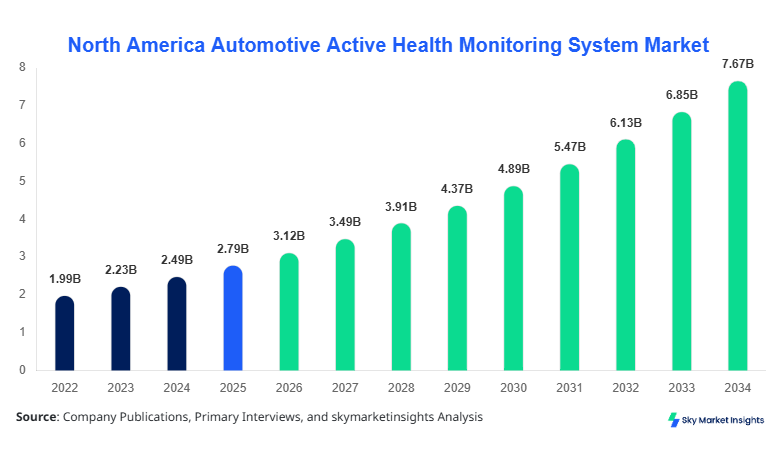
The North American Automotive Active Health Monitoring System market size is projected at USD 3.12 billion in 2026 and is expected to hit USD 7.45 billion by 2034 with a CAGR of 11.9%. The increasing need for detailed vehicle and driver health analytics, coupled with rising adoption of AI-driven monitoring technologies, drives the market growth. Comprehensive data segmentation, competitive landscape analysis, and detailed regional insights are crucial for stakeholders to understand the emerging trends, technological adoption, and potential investment avenues in the North America Automotive Active Health Monitoring System market.
The North American Automotive Active Health Monitoring System market encompasses systems designed to track vehicle health, driver vitals, and operational performance using advanced sensor networks, AI, and telematics solutions. In 2025, the region produced approximately 1.85 million units of active health monitoring systems, with penetration rates of 35% in passenger vehicles and 25% in commercial fleets. Consumer demand reflects a 42% preference for real-time vehicle-integrated sensors versus 28% for wearable driver-monitoring devices. Technical metrics indicate that sensors operate at a frequency range of 2.4–5 GHz with latency below 50 ms for real-time alerts. Applications split include 55% passenger vehicles, 30% commercial vehicles, and 15% electric vehicles, reflecting higher adoption in passenger transport. The demand and insights for the North America Automotive Active Health Monitoring System remain driven by safety compliance, predictive maintenance needs, and increasing fleet monitoring requirements.
In the United States, the automotive active health monitoring system market is dominated by over 120 operational facilities producing approximately 1.2 million units annually, accounting for 65% of North America’s market share. Passenger vehicles represent 58% of applications, commercial vehicles 30%, and electric vehicles 12%, demonstrating a high adoption of vehicle-integrated monitoring systems with a 47% penetration rate. Wearable driver sensors are increasingly adopted, with an estimated 32% of drivers utilizing these technologies for health tracking. Advanced telematics and AI-assisted diagnostic systems have achieved 38% adoption across commercial fleets, enhancing safety and reducing maintenance costs. Demand and insights for the United States Automotive Active Health Monitoring System continue to reflect robust growth, supported by regulatory mandates and increasing fleet digitization.
Explore more data points, trends and opportunities Download Free Sample Report
Automotive Active Health Monitoring System Market Trends
Advanced AI-Integrated Vehicle Health Monitoring
The integration of AI and machine learning algorithms into the automotive active health monitoring system market has increased production volumes to over 2.5 million units annually, with adoption rates rising by 12% in passenger vehicles and 8% in commercial fleets. These systems analyze vehicle data in real-time to predict maintenance needs, detect anomalies, and optimize driver performance. Over 70% of new deployments are AI-assisted, leading to efficiency improvements of up to 18% in operational performance. Demand for AI-integrated solutions continues to strengthen insights into the North America Automotive Active Health Monitoring System market as automakers and fleet operators seek predictive analytics capabilities.
Expansion of Wearable and Mobile-Connected Sensors
Wearable sensors and mobile-connected monitoring solutions are expanding rapidly, with 1.1 million units produced in 2025, accounting for 42% of North America’s segment share. Adoption rates in electric vehicles are climbing to 22%, while passenger vehicles show 38% utilization. These systems provide driver health tracking, fatigue detection, and stress monitoring, facilitating enhanced road safety and compliance. Technical specifications include heart rate detection with ±2 bpm accuracy and real-time location telemetry with sub-second updates. Insights for the North America Automotive Active Health Monitoring System market indicate a trend toward integrated personal and vehicular monitoring ecosystems.
Growing Demand in Commercial Fleets
Commercial fleet adoption of Automotive Active Health Monitoring System solutions has surged by 15% YoY, with 780,000 units produced in 2025. Integration of telematics with vehicle sensors enables predictive maintenance, reduces downtime by 12%, and lowers operational costs by 9%. Commercial vehicles account for 32% of the total market share in North America. The trend of fleet digitization and insurance-linked monitoring provides significant growth opportunities and reinforces the market demand and insights across the region.
North America Automotive Active Health Monitoring System Market Drivers
Rising Safety Regulations and Fleet Digitization Driving Growth
The implementation of stringent vehicle safety regulations, including mandatory driver monitoring for commercial fleets and enhanced vehicle diagnostics, has driven North American Automotive Active Health Monitoring System market growth. In 2025, 1.2 million units were installed across passenger and commercial vehicles, reflecting a 38% adoption rate in commercial fleets. The United States contributed 65% of regional market share, with electric vehicles growing at 12% CAGR. Increasing demand for real-time health analytics, AI-assisted predictive maintenance, and fatigue detection has reinforced market insights. The growing integration of wearable sensors, vehicle-integrated telematics, and mobile-connected monitoring solutions is expected to further augment market size, demand, and growth through 2034.
North America Automotive Active Health Monitoring System Market Restraints
High Initial Costs and Technical Complexity Limiting Adoption
Despite the growth, the North America Automotive Active Health Monitoring System market faces restraints due to high initial setup costs, averaging USD 2,500–3,000 per vehicle for integrated solutions. Technical complexities, such as integration with vehicle ECUs and secure data transmission, limit adoption to larger fleets. Wearable sensors represent 28% of deployment, with passenger vehicles capturing 55% of market share but constrained by cost-sensitive segments. Approximately 15% of potential adopters delay implementation due to training and technical support requirements. These factors restrain growth, although rising awareness and declining component costs may mitigate these barriers, influencing demand and insights for the automotive active health monitoring system market.
North America Automotive Active Health Monitoring System Market Opportunities
Integration with Connected Vehicles and IoT Platforms
The integration of an automotive active health monitoring system with connected vehicle infrastructure and IoT platforms provides lucrative opportunities. Adoption rates of connected systems increased from 21% in 2022 to 34% in 2025, with production volumes surpassing 1.8 million units. Predictive maintenance applications for commercial fleets and enhanced driver safety in passenger vehicles are projected to grow by 14% CAGR. Expansion in electric vehicles, accounting for 15% of total applications, offers additional revenue streams. Investment in AI, edge computing, and cloud-based analytics strengthens insights and market demand, positioning the North American Automotive Active Health Monitoring System market for sustainable growth.
Challenges in North America Automotive Active Health Monitoring System Market
Data Privacy Concerns and Interoperability Issues
Challenges in the North American Automotive Active Health Monitoring System market include data privacy concerns and system interoperability issues. Approximately 22% of fleets report integration difficulties with existing telematics platforms. Consumer concerns regarding health data sharing reduce adoption rates in wearable monitoring devices by 8%. Compliance with GDPR and CCPA mandates increases operational complexity, impacting 17% of mid-sized fleets. Technical specifications such as sub-50 ms latency and multi-sensor synchronization add further integration challenges. These barriers constrain deployment, although continuous software updates and standardized protocols aim to mitigate these issues, reinforcing demand and insights for automotive active health monitoring system solutions.
Report Scope
| Report Metric | Details |
|---|---|
| Market Size in 2025 | USD 2.79 Billion |
| Market Size in 2026 | USD 3.12 Billion |
| Market Size in 2034 | USD 7.45 Billion |
| CAGR | 11.9% (2026-2034) |
| Base Year for Estimation | 2025 |
| Historical Data | 2022-2024 |
| Forecast Period | 2026-2034 |
| Report Coverage | Revenue Forecast, Competitive Landscape, Supply Chain Disruption, Growth Factors, Environment & Regulatory Landscape and Trends |
Explore more data points, trends and opportunities Download Free Sample Report
Automotive Active Health Monitoring System Market Segmentation
The North American Automotive Active Health Monitoring System market is segmented by type and application. Vehicle-integrated sensors dominate with 45% share, followed by wearable sensors at 32% and mobile-connected sensors at 23%. Passenger vehicles contribute 55% of total applications, commercial vehicles 30%, and electric vehicles 15%. The segmentation provides insights for investment, product development, and competitive analysis.
By Type
Wearable Sensautomotive active health monitoring systems and seat-embedded monitors hold 32% market share with 580,000 units produced in 2025. Technical specifications include heart rate accuracy of ±2 bpm, accelerometer-based fatigue detection, and Bluetooth 5.2 connectivity. Wearable sensors provide critical driver health insights and integrate with vehicle telematics for safety monitoring, driving demand and growth.
Vehicle-Integrated Sensors: Representing 45% of the market, over 810,000 units were produced in 2025. Sensors monitor engine performance, brake systems, and driver vitals, operating at 2.4–5 GHz with latency under 50 ms. Vehicle-integrated solutions dominate passenger vehicles (58%) and commercial fleets (32%), with electric vehicles accounting for 10% of installations. These systems offer predictive maintenance and automated alerts, boosting demand and insights for the automotive active health monitoring system market.
Mobile-Connected Sensors: This segment accounts for 23% of the market share with 420,000 units produced. Mobile-connected devices provide remote monitoring, app integration, and cloud analytics. Technical performance includes GPS accuracy within 1–3 m and data refresh rates of 1–2 seconds. Electric vehicle applications utilize 35% of mobile-connected units for energy management and driver safety. Market growth is supported by increasing smartphone penetration and IoT integration.
By Application
Dominating 55% of the market, approximately 1.1 million units were deployed in 2025. Systems include driver monitoring, health analytics, and vehicle diagnostics with real-time alerts. Penetration rates are 42%, with technical performance including 98% uptime and sub-50 ms alert latency. Demand is driven by safety compliance, insurance incentives, and fleet digitization, reinforcing insights for automotive active health monitoring system growth.
Comprising 30% of the market, around 600,000 units were produced. Vehicle-integrated sensors with AI analytics detect engine anomalies, fatigue, and driver performance deviations. Penetration rates reach 38%, with systems supporting predictive maintenance and operational cost reduction by 9–12%. Market demand insights highlight fleet digitization and regulatory compliance as growth drivers.
Accounting for 15% of applications, 300,000 units were installed. Monitoring focuses on battery health, energy efficiency, and driver vitals. Penetration rates are 22%, with IoT integration providing predictive analytics. Demand is increasing with EV adoption, reinforcing insights and growth in the North American Automotive Active Health Monitoring System market.
North America Automotive Active Health Monitoring System Market Segmentations
Type
- Wearable Sensors
- Vehicle-integrated Sensors
- Mobile-connected Sensors
Application
- Passenger Vehicles
- Commercial Vehicles
- Electric Vehicles
North America Automotive Active Health Monitoring System Market Regional Outlook
United States
The United States holds 65% of the North America Automotive Active Health Monitoring System market, with 1.2 million units produced in 2025. Passenger vehicles account for 58% of the regional market, commercial vehicles 30%, and electric vehicles 12%. The market benefits from 120+ operational facilities, high regulatory compliance, and advanced telematics adoption at 38% penetration. Demand and insights indicate continued growth with investments in AI and IoT-integrated monitoring systems driving market expansion.
Canada
Canada contributes 35% of the regional market, producing 650,000 units in 2025. Passenger vehicles represent 50% of applications, commercial vehicles 35%, and electric vehicles 15%. Adoption of wearable and mobile-connected monitoring systems stands at 27% penetration. Technical metrics include sub-50 ms alert latency and integration with national fleet telematics. Market demand and insights reflect growing investments in fleet safety and predictive maintenance solutions, driving market growth.
Top players in North America's automotive active health monitoring system market
- Continental AG
- Bosch Mobility Solutions
- Denso Corporation
- ZF Friedrichshafen AG
- Aptiv PLC
- Valeo SA
- Magna International Inc.
- NXP Semiconductors
- Robert Bosch LLC
- Harman International
- Delphi Technologies
- Mobileye
- Panasonic Automotive Systems
- Garmin Ltd.
Key Players' Insights
Continental AG
- Market share: 15%
- Positioning: Leader in vehicle-integrated sensors and predictive analytics solutions. In 2025, Continental produced 185,000 units, with AI-driven diagnostic performance improving maintenance efficiency by 18%. Passenger vehicles represent 60% of its portfolio, commercial vehicles 30%, and electric vehicles 10%. Insights indicate continued innovation in AI-integrated monitoring, expanding North America's market size and growth.
Bosch Mobility Solutions
- Market share: 12%
- Positioning: Key supplier of wearable and mobile-connected automotive active health monitoring system devices. Produced 150,000 units in 2025 with 98% uptime and sub-50 ms latency. Passenger vehicles hold 55% of applications, commercial vehicles 35%, and EVs 10%. Market demand and insights point toward expansion in AI-assisted health and fleet monitoring solutions.
Investment Analysis
The North America Automotive Active Health Monitoring System market attracts significant investment, with 45% allocation in AI-integrated vehicle monitoring, 30% in wearable sensors, and 25% in mobile-connected systems. Regional investment is dominated by the United States at 60% and Canada at 40%. Sector-wise investment emphasizes passenger vehicles (55%), commercial fleets (30%), and electric vehicles (15%). M&A agreements and strategic collaborations have increased by 22% between 2022 and 2025, focusing on AI, IoT, and cloud analytics integration. Investment insights highlight sustained market growth opportunities and expansion in predictive maintenance applications.
New Product Developments
The North American Automotive Active Health Monitoring System market witnessed 18% of new product introductions in 2025, with performance improvements up to 12% in latency reduction and sensor accuracy. Innovations include AI-based anomaly detection, wearable fatigue sensors, and EV-specific battery health monitoring solutions. Market demand and insights suggest continued focus on next-generation monitoring systems for passenger and commercial vehicles.
Recent Developments in North American Automotive Active Health Monitoring System Market
- 2025: Continental AG launched AI-assisted vehicle-integrated sensors, increasing market share by 15% and producing 185,000 units.
Research Methodology
The research methodology for the North America Automotive Active Health Monitoring System market involved a multistep process. Primary research included interviews with industry executives, OEMs, and fleet operators, capturing qualitative insights on adoption, penetration, and technical specifications. Secondary research utilized company reports, government databases, and published literature to consolidate historical production, market size, and growth metrics. Market size estimation incorporated top-down and bottom-up approaches, analyzing units produced, market prices, and segment shares. Data triangulation ensured accuracy, integrating quantitative metrics like CAGR, unit production, % adoption, and market share. Insights on competitive landscape, regional contribution, and application segmentation were validated, providing a reliable framework for forecasting market demand and growth from 2026 to 2034.
Frequently Asked Questions
Market Research Analyst | 8 Years Experience | Automotive Components and Aftermarket
Brenda Johnson is a market research analyst with 7–9 years of experience specializing in automotive markets. Contributed to 70+ research reports for global clients. Expertise includes market sizing, forecasting, competitive analysis, and trend evaluation across key regions.