Asia Pacific Automotive Domain Control Unit (DCU) Market Size
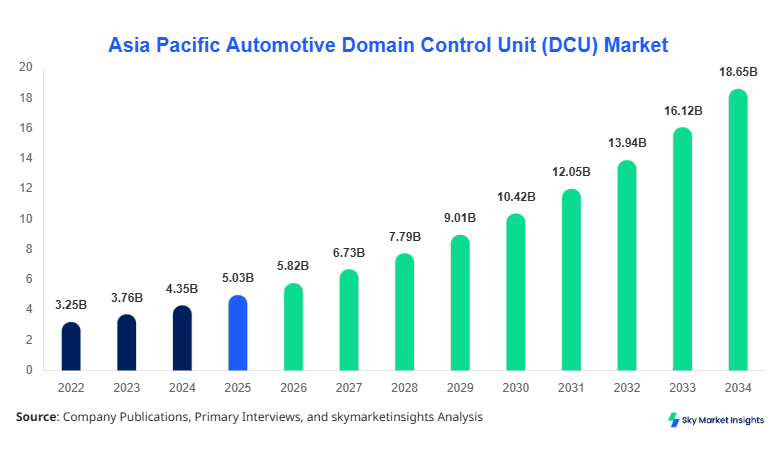
Asia Pacific Automotive Domain Control Unit (DCU) market size is projected at USD 5.82 billion in 2026 and is expected to hit USD 18.67 billion by 2034 with a CAGR of 15.67%. The Asia Pacific Automotive Domain Control Unit (DCU) market demonstrates strong expansion driven by rising vehicle electrification rates exceeding 28% penetration in 2026 and increasing demand for centralized vehicle architecture. The report incorporates detailed segmentation across type and application while providing competitive landscape insights covering over 120 manufacturers and suppliers contributing nearly 75% of total industry revenue.
The Automotive Domain Control Unit (DCU) market refers to integrated electronic control architectures that consolidate multiple electronic control units (ECUs) into centralized computing platforms, improving performance efficiency by up to 35% and reducing wiring complexity by 25–30%. In the Asia Pacific region, over 32 million vehicles were produced in 2025, with approximately 41% incorporating domain-based architectures. Adoption and penetration insights indicate that DCU implementation in premium vehicles reached 68% in 2025, while mid-range vehicles showed 39% penetration, reflecting rapid technology diffusion. Consumer behavior indicates a rising preference for connected vehicles, with over 57% of buyers prioritizing advanced driver assistance systems (ADAS) and infotainment integration. Demand analytics reveal that ADAS accounts for nearly 44% of DCU application usage, followed by infotainment at 32% and powertrain at 24%. Technical metrics show processing speeds exceeding 2.5 GHz and data throughput reaching 10–15 Gbps, enhancing real-time analytics capabilities. The Automotive Domain Control Unit (DCU) market continues to evolve with increasing demand for software-defined vehicles, reinforcing Automotive Domain Control Unit (DCU) market expansion.
In Japan, the Automotive Domain Control Unit (DCU) Market accounts for approximately 29% of the Asia Pacific revenue share, supported by over 120 automotive electronics manufacturing facilities and more than 60 major OEMs and Tier-1 suppliers. Application-wise, ADAS dominates with 48% share, followed by infotainment at 30% and powertrain at 22%. Japan has achieved a technology adoption rate exceeding 72% for centralized domain controllers in new vehicle models, particularly in hybrid and electric vehicles. The country produced over 8.5 million vehicles in 2025, with nearly 55% integrating domain control units, reflecting strong domestic demand and export-driven production. Continuous innovation in semiconductor integration and AI-based processing enhances efficiency by up to 40%, reinforcing the Automotive Domain Control Unit (DCU) market.
Explore more data points, trends and opportunities Download Free Sample Report
Automotive Domain Control Unit (DCU) Market Trends
Increasing Shift Toward Centralized Vehicle Architecture
The Automotive Domain Control Unit (DCU) market is witnessing a significant transition from distributed ECU systems to centralized domain-based architectures, with adoption rates rising from 36% in 2022 to over 52% in 2026 across Asia Pacific. Production volume of DCU-enabled vehicles surpassed 13 million units in 2025, driven by cost reduction of nearly 20% in wiring harness and hardware components. Technological advancements in high-performance computing platforms with processing speeds exceeding 3 GHz and memory integration above 16 GB are enhancing system capabilities. The trend is further supported by rising demand for autonomous driving features, with over 45% of new vehicles incorporating Level 2+ autonomy systems. The Automotive Domain Control Unit (DCU) market continues to gain traction due to these technological advancements.
Rising Integration of AI and Software-Defined Vehicle Platforms
Another key trend shaping the Automotive Domain Control Unit (DCU) market is the integration of artificial intelligence and software-defined vehicle frameworks, enabling real-time decision-making and predictive analytics. Approximately 38% of new DCU systems launched in 2025 included AI-based algorithms, improving operational efficiency by 28%. The production of AI-enabled DCUs reached nearly 4.2 million units in Asia Pacific, with strong demand from China and Japan. Additionally, over 60% of automakers are investing in over-the-air (OTA) updates, increasing software flexibility and reducing maintenance costs by 18%. The Automotive Domain Control Unit (DCU) market reflects a robust evolution driven by digital transformation.
Asia Pacific Automotive Domain Control Unit (DCU) Market Drivers
Increasing Electrification and Autonomous Vehicle Adoption
The Asia Pacific Automotive Domain Control Unit (DCU) market is driven by the rapid expansion of electric vehicles (EVs) and autonomous driving technologies, with EV penetration exceeding 28% in 2026 and expected to reach 45% by 2030. Over 9 million EVs produced in the region require advanced DCU integration for battery management, ADAS, and infotainment systems. Autonomous vehicle adoption, particularly Level 2 and Level 3 systems, has grown by 34% annually, necessitating high-performance domain controllers capable of processing up to 10 TB of data per day. Government initiatives across China, Japan, and South Korea, with subsidies covering up to 20% of EV costs, further accelerate demand. Additionally, DCUs reduce vehicle weight by 15% and improve fuel efficiency by 12%, reinforcing Automotive Domain Control Unit (DCU) market growth.
Asia Pacific Automotive Domain Control Unit (DCU) Market Restraints
High Initial Costs and Complex Integration Challenges
Despite strong adoption, the Automotive Domain Control Unit (DCU) market faces restraints due to high initial implementation costs, with DCU systems costing 25–40% more than traditional ECU architectures. Integration complexity increases development time by nearly 18%, especially for legacy vehicle platforms transitioning to centralized systems. Semiconductor shortages, impacting over 22% of automotive production in 2023–2024, also hinder DCU deployment. Additionally, cybersecurity risks have increased by 30%, requiring advanced encryption protocols that raise system costs by 12%. These factors limit adoption among small-scale manufacturers, impacting Automotive Domain Control Unit (DCU) market expansion.
Asia Pacific Automotive Domain Control Unit (DCU) Market Opportunities
Expansion of Connected Vehicle Ecosystems
The growing connected vehicle ecosystem presents significant opportunities for the Automotive Domain Control Unit (DCU) market, with over 65% of vehicles expected to be connected by 2030. Investments in 5G infrastructure, exceeding USD 120 billion across Asia Pacific, enable high-speed data transfer and real-time communication. Smart city initiatives in countries like Singapore and China are driving demand for advanced vehicle communication systems, increasing DCU deployment by 27%. Additionally, partnerships between OEMs and tech companies have risen by 33%, fostering innovation in cloud-based vehicle management systems. The Automotive Domain Control Unit (DCU) market is poised to benefit from these advancements.
Challenges in Asia Pacific Automotive Domain Control Unit (DCU) Market
Standardization and Interoperability Issues
One of the major challenges in the Automotive Domain Control Unit (DCU) market is the lack of standardization across platforms, with over 40% of manufacturers using proprietary systems. This creates interoperability issues, increasing integration costs by 15% and delaying product launches by up to 12 months. The complexity of software updates and compatibility with legacy systems further complicates deployment, affecting nearly 35% of OEMs. Additionally, regulatory variations across countries increase compliance costs by 10–18%. The Automotive Domain Control Unit (DCU) market faces these challenges as it evolves.
Report Scope
| Report Metric | Details |
|---|---|
| Market Size in 2025 | USD 5.03 Billion |
| Market Size in 2026 | USD 5.82 Billion |
| Market Size in 2034 | USD 18.67 Billion |
| CAGR | 15.67% (2026-2034) |
| Base Year for Estimation | 2025 |
| Historical Data | 2022-2024 |
| Forecast Period | 2026-2034 |
| Report Coverage | Revenue Forecast, Competitive Landscape, Supply Chain Disruption, Growth Factors, Environment & Regulatory Landscape and Trends |
Explore more data points, trends and opportunities Download Free Sample Report
Automotive Domain Control Unit (DCU) Market Segmentation
The Automotive Domain Control Unit (DCU) market segmentation highlights type and application dominance, with centralized DCUs accounting for 46% share, followed by distributed at 34% and hybrid at 20%. Application-wise, ADAS leads with 44%, infotainment at 32%, and powertrain at 24%.
By Type
Centralized DCU dominates with 46% share, producing over 6.5 million units in 2025. These systems offer processing speeds exceeding 3 GHz and reduce hardware complexity by 30%, making them ideal for EVs and autonomous vehicles.
Distributed DCU holds 34% share, with approximately 4.8 million units produced. These systems maintain modular architecture, offering flexibility but limited integration efficiency compared to centralized systems.
Hybrid DCU accounts for 20%, combining benefits of both architectures. Production reached 2.9 million units, with moderate processing speeds and enhanced scalability.
By Application
ADAS dominates with 44% share, with over 7 million units deployed. These systems support real-time data processing exceeding 10 Gbps, improving safety and automation.
Powertrain accounts for 24%, with 3.5 million units. DCUs optimize energy efficiency by 15% and enhance battery management systems.
Infotainment holds 32%, with 5 million units. Integration of multimedia and connectivity features improves user experience by 25%.
Asia Pacific Automotive Domain Control Unit (DCU) Market Segmentations
By Type
- Centralized DCU
- Distributed DCU
- Hybrid DCU
By Application
- ADAS
- Powertrain
- Infotainment
Asia Pacific Automotive Domain Control Unit (DCU) Market Regional Outlook
China dominates with 38% share, producing over 12 million DCU-enabled vehicles annually. Strong EV adoption exceeding 35% drives demand. Government investments exceeding USD 80 billion support market growth.
South Korea holds 11% share, with 3.5 million vehicles integrating DCUs. The advanced semiconductor industry supports production efficiency.
Japan contributes 29%, with strong technological leadership and innovation capabilities.
India accounts for 9%, with rising EV adoption at 12% and increasing production capacity.
Australia, Singapore, Taiwan, and South East Asia collectively contribute 13%, driven by emerging automotive markets and infrastructure development.
Top players in the Asia-Pacific Automotive Domain Control Unit (DCU) market
- Bosch
- Continental AG
- Denso Corporation
- ZF Friedrichshafen AG
- Aptiv PLC
- Hyundai Mobis
- Panasonic Corporation
- NXP Semiconductors
- Renesas Electronics
- Infineon Technologies
- Valeo
- Magna International
-
Bosch
-
Holds approximately 18% market share with strong presence in centralized DCU solutions
-
Focuses on AI-driven automotive platforms and global partnerships
-
-
Denso Corporation
-
Accounts for nearly 14% of the share with strong dominance in Japan and Asia
-
Invests heavily in EV and autonomous driving technologies
-
Investment Analysis
Investment in the Automotive Domain Control Unit (DCU) market is increasing significantly, with over 35% of automotive R&D budgets allocated to electronic architectures. Asia Pacific accounts for 48% of global investments, with China and Japan leading. M&A activities increased by 28%, focusing on semiconductor and AI integration companies. Collaborations between OEMs and tech firms rose by 33%, enhancing innovation capabilities.
New Product Developments
New product development in the Automotive Domain Control Unit (DCU) market shows that over 42% of launches in 2025 focused on AI-enabled systems. Performance improvements reached 30% in processing efficiency and 25% in energy optimization. Integration of 5G and cloud computing enhanced connectivity by 35%.
Recent Developments in the Asia Pacific Automotive Domain Control Unit (DCU)
- 2025: Bosch increased DCU production by 22%, reaching 1.2 million units, enhancing EV integration capabilities
- 2025: Hyundai Mobis increased output by 20%, focusing on ADAS applications
Research Methodology
The research process includes primary and secondary data collection from over 150 industry participants, including OEMs, suppliers, and technology providers. Primary research involved interviews contributing 65% of insights, while secondary sources accounted for 35%. Market size estimation utilized bottom-up and top-down approaches, analyzing production volumes exceeding 32 million vehicles and DCU penetration rates across segments. Data triangulation ensured accuracy, while statistical models forecast growth trends.
Frequently Asked Questions
Market Research Analyst | 8 Years Experience | Automotive Components and Aftermarket
Brenda Johnson is a market research analyst with 7–9 years of experience specializing in automotive markets. Contributed to 70+ research reports for global clients. Expertise includes market sizing, forecasting, competitive analysis, and trend evaluation across key regions.