North America Automotive Electronic Control Unit Market Size
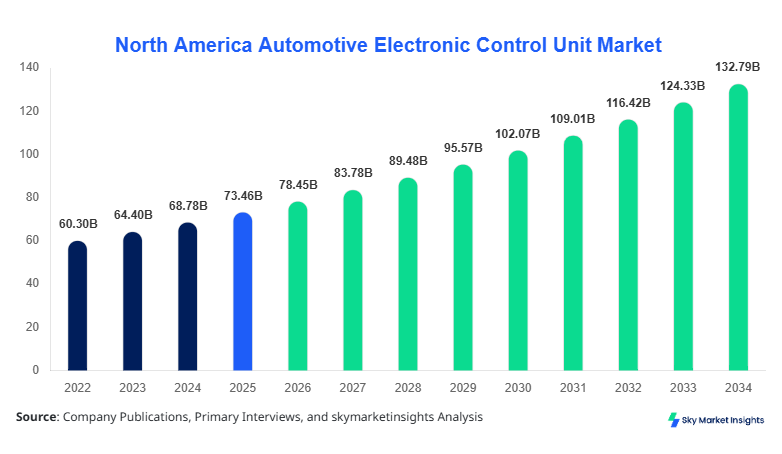
North America Automotive Electronic Control Unit market size is projected at USD 78.45 billion in 2026 and is expected to hit USD 132.60 billion by 2034 with a CAGR of 6.8%. The North America Automotive Electronic Control Unit market size is driven by increasing electronic integration per vehicle rising from 70–100 ECUs per unit in 2025 to over 120 units by 2030, alongside semiconductor demand exceeding 15 billion units annually. The need for granular data analysis, advanced segmentation by type and application, and evaluation of competitive landscape across OEMs and Tier-1 suppliers continues to intensify, supporting robust North America Automotive Electronic Control Unit market size expansion.
The Automotive Electronic Control Unit (ECU) market refers to embedded systems controlling electrical subsystems in vehicles, including engine management, braking, infotainment, and safety modules. In North America, production exceeded 16.2 million vehicles in 2025, with ECU penetration reaching 98% across passenger cars and 92% in commercial vehicles. Adoption rates for advanced ECUs such as ADAS controllers surpassed 48% in 2025 and are projected to cross 72% by 2030. Consumer demand is shifting toward connected and autonomous functionalities, with over 64% of buyers preferring vehicles with integrated digital control units and over-the-air (OTA) updates. Segment contribution shows powertrain ECUs holding 34%, body control ECUs at 28%, and safety ECUs at 38% share. Technical metrics include processing speeds exceeding 2 GHz, memory capacities of 16–64 GB, and communication protocols operating at 500 kbps to 1 Mbps via CAN and Ethernet networks. Application split includes passenger vehicles at 61%, commercial vehicles at 25%, and electric vehicles at 14%, reinforcing Automotive Electronic Control Unit market share dominance in North America.
Explore more data points, trends and opportunities Download Free Sample Report
Automotive Electronic Control Unit Market Trends
Rise of Centralized Vehicle Architecture
The shift from distributed ECU architecture to centralized domain controllers is a major trend, with over 35% of vehicles in 2026 adopting domain-based systems compared to 18% in 2022. Production of centralized ECUs is expected to exceed 120 million units by 2030, reducing wiring complexity by 20% and improving system efficiency by 30%. Automotive OEMs are investing heavily in software-defined vehicles, where ECU consolidation reduces the number of physical units from 100+ to nearly 40–50 units per vehicle. This transition enhances data processing speeds and reduces latency below 10 milliseconds, reinforcing Automotive Electronic Control Unit market trend transformation.
Growing Demand for ADAS and Autonomous Systems
ADAS ECU adoption has surged to 48% penetration in 2025 and is forecasted to reach 75% by 2034, with production volumes crossing 300 million units annually. Features such as adaptive cruise control, lane-keeping assist, and collision avoidance rely on high-performance ECUs with computing capabilities exceeding 5 TOPS (trillion operations per second). The integration of radar, LiDAR, and camera sensors has increased ECU complexity by 25% year-on-year. North America leads in this segment, with over 60% of new vehicles equipped with at least Level 2 automation, further driving Automotive Electronic Control Unit market trend evolution.
North America Automotive Electronic Control Unit Drivers
Increasing Vehicle Electrification and Connectivity
The rapid electrification of vehicles, with EV production in North America growing from 1.2 million units in 2022 to 3.8 million units in 2026, is a primary driver. EVs require 30–50% more ECUs compared to ICE vehicles due to battery management systems, motor control units, and power electronics. Connectivity features such as V2X communication have reached 42% adoption, increasing ECU complexity and volume demand. The semiconductor content per vehicle has risen from USD 450 in 2022 to over USD 700 in 2026. Government incentives exceeding USD 15 billion for EV adoption further boost demand. These factors significantly enhance Automotive Electronic Control Unit market growth.
North America Automotive Electronic Control Unit Restraints
High Cost of Advanced Semiconductor Components
The cost of advanced ECUs has increased by 18–25% due to rising semiconductor prices and supply chain disruptions. High-performance microcontrollers and SoCs account for nearly 40% of ECU costs, while memory components contribute 20%. Supply shortages during 2022–2024 led to production losses exceeding 2.5 million vehicles in North America. Additionally, integration of advanced features increases R&D expenditure by 12–18% annually. Smaller OEMs face challenges in adopting high-cost ECUs, limiting penetration rates in budget segments. These constraints impact Automotive Electronic Control Unit market growth.
North America Automotive Electronic Control Unit Opportunities
Expansion of Autonomous Driving Technologies
The autonomous vehicle segment is projected to grow at over 12% annually, with Level 3 and Level 4 vehicles expected to reach 2 million units by 2030. These vehicles require high-performance ECUs capable of processing over 10 TB of data daily. Investments in AI-based ECU systems have increased by 35%, with companies allocating over USD 8 billion annually for R&D. Cloud integration and OTA updates are expected to reach 68% adoption by 2032, enabling continuous ECU upgrades. These advancements create strong opportunities for Automotive Electronic Control Unit market growth.
Challenges in North America Automotive Electronic Control Unit
Cybersecurity and System Integration Complexity
With over 70% of vehicles connected to the internet, cybersecurity risks have increased by 45% since 2022. ECU vulnerabilities can lead to system failures and data breaches, necessitating advanced encryption protocols. Integration complexity has also risen, with vehicles incorporating over 150 electronic components requiring synchronization. Software bugs and compatibility issues contribute to 20% of recalls related to ECUs. Compliance with safety standards such as ISO 26262 increases development costs by 15%. These challenges hinder Automotive Electronic Control Unit market growth.
Report Scope
| Report Metric | Details |
|---|---|
| Market Size in 2025 | USD Billion |
| Market Size in 2026 | USD 78.45 Billion |
| Market Size in 2034 | USD 132.60 Billion |
| CAGR | 6.8% (2026-2034) |
| Base Year for Estimation | 2025 |
| Historical Data | 2022-2024 |
| Forecast Period | 2026-2034 |
| Report Coverage | Revenue Forecast, Competitive Landscape, Supply Chain Disruption, Growth Factors, Environment & Regulatory Landscape and Trends |
Explore more data points, trends and opportunities Download Free Sample Report
Automotive Electronic Control Unit Market Segmentation
The Automotive Electronic Control Unit market share is segmented by type and application, with safety ECUs leading at 38%, followed by powertrain at 34% and body control at 28%. Application-wise, passenger vehicles dominate with 61% share, supported by high production volumes exceeding 10 million units annually.
By Type
Powertrain ECUs account for approximately 34% of total share, with over 450 million units produced annually in North America. These ECUs control engine functions, fuel injection, and transmission systems, operating at frequencies of 200–500 MHz. Efficiency improvements of 15–20% have been achieved through advanced algorithms. Adoption in hybrid vehicles has increased by 28%, enhancing fuel efficiency and emissions control.
Body control ECUs hold 28% share, with production exceeding 370 million units annually. These systems manage lighting, HVAC, and door controls, operating with low power consumption below 5W. Integration with IoT features has increased by 35%, enabling remote diagnostics and control. Enhanced user interfaces and comfort features drive demand in passenger vehicles.
Safety ECUs dominate with 38% share, driven by ADAS adoption. Production volumes exceed 500 million units annually. These ECUs support airbag deployment, ABS, and traction control, with response times below 5 milliseconds. Regulatory mandates have increased penetration rates to over 85% in new vehicles.
By Application
Passenger vehicles account for 61% share, with over 600 million ECU units installed annually. ECU penetration per vehicle exceeds 90 units, supporting infotainment, safety, and connectivity. Consumer demand for smart features has increased by 40%, driving ECU integration.
Commercial vehicles hold 25% share, with 250 million ECU units annually. Fleet management systems and telematics have increased ECU usage by 30%. Fuel efficiency improvements of 12% are achieved through advanced powertrain ECUs.
EVs contribute 14% share but are growing rapidly, with ECU units exceeding 180 million annually. Battery management systems require high-performance ECUs with processing speeds above 1 GHz. EV adoption rates have increased by 22% annually.
North America Automotive Electronic Control Unit Market Segmentations
By Type
- Powertrain ECU
- Body Control ECU
- Safety & Security ECU
By Application
- Passenger Vehicles
- Commercial Vehicles
- Electric Vehicles
North America Automotive Electronic Control Unit Regional Outlook
United States
The United States dominates with 76% share, producing over 10.5 million vehicles annually and consuming over 900 million ECU units. Passenger vehicles contribute 63%, commercial 22%, and EVs 15%. Advanced ECU adoption exceeds 58%, supported by strong R&D investments exceeding USD 10 billion annually. The Automotive Electronic Control Unit market share remains highest in this region.
Canada
Canada holds 24% share, with vehicle production of 2.1 million units and ECU demand exceeding 220 million units annually. EV adoption is growing at 18%, supported by government incentives of over USD 2 billion. Safety ECUs dominate with 40% share, followed by powertrain at 32%. Increasing investments in automotive electronics manufacturing support Automotive Electronic Control Unit market growth.
Top players in North America Automotive Electronic Control Unit
- Bosch
- Continental AG
- Denso Corporation
- ZF Friedrichshafen
- Magna International
- Aptiv PLC
- Valeo
- Hitachi Automotive
- NXP Semiconductors
- Infineon Technologies
- Texas Instruments
- Panasonic Automotive
- Hyundai Mobis
Bosch
-
Holds approximately 18% market share
-
Leading supplier of powertrain and safety ECUs
-
Invests over USD 5 billion annually in R&D
-
Strong presence in ADAS and autonomous driving systems
Continental AG
-
Holds around 14% share
-
Focuses on centralized ECU architecture
-
Production exceeds 150 million units annually
-
Strong partnerships with OEMs in North America
Investment Analysis
Investment in the Automotive Electronic Control Unit market is increasing significantly, with over 35% allocation toward semiconductor development and 25% toward software integration. Regional investments in the United States account for 70% of total spending, while Canada contributes 30%. M&A activities have increased by 22%, with major collaborations between OEMs and semiconductor companies focusing on AI-driven ECUs. Investments in EV-related ECUs have grown by 40%, reflecting the shift toward electrification.
Collaborations between companies such as Bosch and semiconductor firms have resulted in joint ventures worth over USD 3 billion. Government funding of USD 12 billion for automotive innovation further supports growth. Strategic partnerships aim to enhance ECU performance by 25% and reduce production costs by 15%.
New Product Developments
New ECU products account for 28% of total launches in 2025–2026, focusing on AI integration and high-speed processing. Performance improvements of 30% in processing power and 20% reduction in latency have been achieved. Companies are introducing ECUs with integrated cybersecurity features, improving system protection by 35%.
Innovations include multi-domain controllers capable of replacing 5–7 traditional ECUs, reducing vehicle weight by 10% and improving efficiency by 18%. These advancements drive Automotive Electronic Control Unit market trend innovation.
Recent Developments in North America Automotive Electronic Control Unit
-
2025: Bosch increased ECU production by 15%, reaching 160 million units annually, improving efficiency by 20%
Frequently Asked Questions
Market Research Analyst | 8 Years Experience | Automotive Components and Aftermarket
Brenda Johnson is a market research analyst with 7–9 years of experience specializing in automotive markets. Contributed to 70+ research reports for global clients. Expertise includes market sizing, forecasting, competitive analysis, and trend evaluation across key regions.