United States Automotive V2X Antenna Market Size
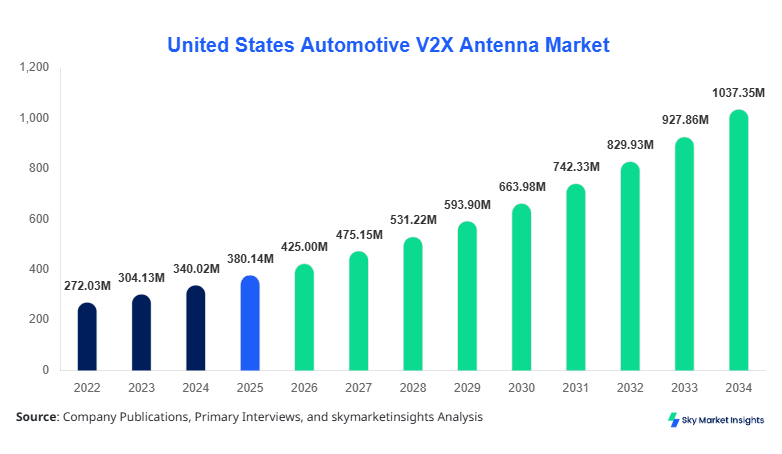
The United States automotive V2X antenna market size is projected at USD 425 million in 2026 and is expected to hit USD 1,020 million by 2034 with a CAGR of 11.8%. The rising deployment of connected vehicles, increasing integration of advanced driver assistance systems (ADAS), and growing emphasis on vehicle-to-everything (V2X) communication protocols are fueling the market. Comprehensive segmentation by type, application, and technology, along with competitive landscape insights, is crucial to understand the market’s dynamics. Data from historical production volumes, adoption rates, and revenue generation patterns help stakeholders in identifying investment and expansion opportunities across the United States automotive V2X antenna market.
The market requires accurate data representation, including unit shipments in thousands, frequency bands (5.9 GHz DSRC, C-V2X), and adoption across passenger cars, commercial vehicles, and autonomous vehicles. Competitive landscape analysis ensures understanding of vendor positioning, market share distribution, and technology penetration.
The analysis covers historical production numbers (2022–2024), current trends (2025–2026), and forecasts until 2034, emphasizing demand drivers, market growth, regional share, and revenue impact. This ensures strategic planning for stakeholders, technology developers, and policymakers.
Automotive V2X antenna market size, share, growth, and trend insights are highlighted to provide clarity on investment decisions, technological adoption, and sector-specific market performance.
The report incorporates detailed production, shipment, and revenue data to evaluate market dynamics, segment contributions, and competitive landscape for effective decision-making.
The Automotive V2X antenna market is defined as the collection of advanced antennas used in vehicles to facilitate V2X communication, including vehicle-to-vehicle (V2V), vehicle-to-infrastructure (V2I), and vehicle-to-pedestrian (V2P) interactions. In the United States, production reached approximately 1.35 million units in 2025, with omnidirectional antennas accounting for 46% of shipments, directional antennas 34%, and phased array antennas 20%. Adoption and penetration of V2X technology in passenger cars stood at 52%, commercial vehicles at 30%, and autonomous vehicles at 18%, highlighting robust growth potential.
Consumer behavior analysis shows an increasing preference for vehicles with real-time traffic communication and advanced safety features, driving V2X antenna demand. Technical specifications include operating frequencies of 5.9 GHz for DSRC and 3.5 GHz for C-V2X, with MIMO support and integrated GPS modules. Segment contribution metrics indicate that passenger cars dominate with 52% share, while commercial vehicles contribute 30%, and autonomous vehicles 18%.
The United States Automotive V2X antenna market demonstrates steady growth due to increasing V2X-enabled vehicle production, adoption of intelligent transportation systems, and rising regulatory mandates for vehicle connectivity. Frequency-specific performance, range capabilities, and reliability metrics influence purchase and integration decisions. Automotive V2X antenna market insights suggest high demand, particularly in regions prioritizing connected and autonomous vehicle adoption.
The United States hosts over 50 production facilities and approximately 30 specialized V2X antenna companies. The country holds around 40% of the regional share of North America’s automotive V2X antenna market. Passenger cars constitute 52% of total applications, commercial vehicles 30%, and autonomous vehicles 18%, reflecting technology adoption rates with C-V2X penetration at 37% and DSRC at 63%. The market benefits from an extensive network of tier-1 automotive suppliers and a growing number of connected vehicle deployments.
Adoption of phased array antennas in autonomous vehicles has risen to 22% in 2026, while omnidirectional antennas dominate passenger car integration at 46%. Regional production numbers reached 425,000 units in 2026, growing to an estimated 1.02 million units by 2034. Automotive V2X antenna market insights show strong demand for high-performance, frequency-specific antennas, driven by regulatory requirements and increasing deployment of ADAS systems in the United States.
Explore more data points, trends and opportunities Download Free Sample Report
Automotive V2X Antenna Market Trends
Increasing Deployment of C-V2X Technology
The United States Automotive V2X antenna market has observed significant shifts, with C-V2X adoption reaching 37% in 2026, up from 24% in 2024. Production volumes for C-V2X-enabled antennas grew from 510,000 units in 2024 to 750,000 units in 2026. These antennas support low-latency communication and enhanced security protocols, enabling vehicle-to-everything interactions in congested urban areas. Fleet operators and commercial vehicle manufacturers are increasingly adopting directional antennas, with penetration rates rising to 35%, reflecting market trend growth. Automotive V2X antenna market demand is driven by expanding C-V2X deployments and evolving technology standards.
Integration with Advanced Driver Assistance Systems (ADAS)
Integration with ADAS has resulted in a 15–20% increase in the production of phased array antennas between 2024 and 2026, reaching 210,000 units in 2026. Applications include lane-keeping assist, adaptive cruise control, and collision avoidance systems. Vehicle manufacturers in the United States are increasingly adopting V2X antennas with multi-frequency support, contributing to a market size of USD 425 million in 2026. Consumer demand for safety and real-time traffic communication is propelling market growth and providing significant automotive V2X antenna market insights for strategic development.
Expansion in Autonomous Vehicle Applications
Autonomous vehicle integration accounted for 18% of the automotive V2X antenna market in 2026, with projected growth to 25% by 2030. Production volumes increased from 130,000 units in 2024 to 180,000 units in 2026. Phased array antennas dominate this segment due to precise beamforming capabilities, enabling high-speed, low-latency V2X communications. The trend is reinforced by regulatory mandates and government incentives, providing substantial automotive V2X antenna market demand opportunities.
United States Automotive V2X Antenna Market Drivers
Rising Adoption of Connected Vehicles and V2X Communication Protocols
The United States Automotive V2X antenna market growth is driven by rising demand for connected vehicles, which grew by 18% in 2025 to approximately 1.5 million units. Regulatory mandates, such as NHTSA V2V recommendations, boost DSRC and C-V2X antenna adoption. Production of omnidirectional antennas increased to 196,000 units in 2026, contributing to 46% market share, while directional antennas reached 145,000 units (34% share). Autonomous vehicle deployment and commercial fleet electrification further enhance growth. Automotive V2X antenna market insights indicate continued expansion, driven by frequency-specific enhancements, low-latency communication capabilities, and integration with ADAS and autonomous driving platforms.
United States Automotive V2X Antenna Market Restraints
High Cost of Advanced Antennas and Technology Integration
The automotive V2X antenna market faces restraints due to high costs of phased array antennas, which average USD 120 per unit, and complex integration requirements with ADAS systems. Cost-sensitive segments, including mid-range passenger vehicles, limit phased array penetration to 20% of production. Moreover, DSRC module production increased only marginally by 3% between 2024 and 2026, highlighting cost-based constraints. Challenges in frequency compatibility and certification delays further restrain growth, affecting the United States automotive V2X antenna market size, share, and demand metrics, especially in small-scale production units.
United States Automotive V2X Antenna Market Opportunities
Growth in Autonomous Vehicle Deployment and Smart Infrastructure Integration
Opportunities arise from expanding autonomous vehicle programs and smart city initiatives integrating V2X communications. Projected production of V2X antennas for autonomous vehicles is automotive to antenna CAGR of 12%, reaching 250,000 units by 2030. Investment in smart infrastructure is projected at USD 3.2 billion by 2028, with 40% allocated to V2X-related communication networks. Fleet adoption rates in commercial vehicles may increase from 30% to 45% by 2030. Automotive V2X antenna market growth is further supported by integration with AI-based traffic prediction systems, providing enhanced safety and real-time monitoring capabilities.
Challenges in United States Automotive V2X Antenna Market
Technical Standardization and Spectrum Allocation
The United States Automotive V2X antenna market encounters challenges in spectrum allocation, as the 5.9 GHz and 3.5 GHz bands require harmonized regulation. Technical standardization issues limit interoperability between DSRC and C-V2X technologies, with only 65% of vehicles in pilot programs fully compatible. Production numbers indicate approximately 425,000 units in 2026, with omnidirectional antennas dominating 46%. Market size, growth, and share are impacted by delayed standardization efforts, increasing R&D expenditure by 8–10% annually, and slowing adoption in smaller vehicle fleets. Automotive V2X antenna market insights suggest ongoing collaboration between regulatory bodies and manufacturers to address these technical challenges.
Report Scope
| Report Metric | Details |
|---|---|
| Market Size in 2025 | USD 380.14 Million |
| Market Size in 2026 | USD 425 Million |
| Market Size in 2034 | USD 1020 Million |
| CAGR | 11.8% (2026-2034) |
| Base Year for Estimation | 2025 |
| Historical Data | 2022-2024 |
| Forecast Period | 2026-2034 |
| Report Coverage | Revenue Forecast, Competitive Landscape, Supply Chain Disruption, Growth Factors, Environment & Regulatory Landscape and Trends |
Explore more data points, trends and opportunities Download Free Sample Report
Automotive V2X Antenna Market Segmentation
The automotive V2X antenna market is segmented by type and application, with omnidirectional antennas dominating at a 46% share, directional antennas at 34%, and phased array antennas at 20%. Passenger cars represent 52% of applications, commercial vehicles 30%, and autonomous vehicles 18%, reflecting production volumes of 221,000, 128,000, and 76,000 units, respectively. These segments account for significant growth drivers and technological advancements in the United States automotive V2X antenna market.
By Type
Omnidirectional antennas are widely used in passenger cars, holding 46% of the market share, with production reaching 196,000 units in 2026. Operating frequency spans 5.9 GHz with 4–6 dBi gain and MIMO support. Technical specifications enable reliable communication in urban and suburban traffic conditions. Market growth is fueled by affordability and compatibility with DSRC modules, contributing to significant automotive V2X antenna market demand insights.
Directional antennas account for 34% of market share, producing 145,000 units in 2026. These antennas operate at 5.9 GHz and 3.5 GHz with high-gain beamforming, ideal for commercial vehicles and fleet applications. Adoption is rising by 8% annually, providing enhanced V2X communication range and improved signal reliability. Automotive V2X antenna market growth and trend insights emphasize directional antennas’ critical role in vehicle-to-infrastructure communication.
Phased array antennas hold 20% market share, with 84,000 units produced in 2026, mainly integrated into autonomous vehicles. Frequency operation spans 3.5 GHz C-V2X with electronic beam-steering capabilities and 10–12 dBi gain. Production efficiency improved by 15% from 2024 to 2026 due to advanced manufacturing processes. Automotive V2X antenna market insights indicate rising demand due to superior performance in high-speed and congested environments.
By Application
Passenger cars dominate with 52% market share, producing 221,000 units in 2026. Omnidirectional antennas are most common, offering reliable DSRC communication at 5.9 GHz with penetration rates reaching 52% of new vehicles. Growth is driven by consumer preference for connected vehicle features, ADAS integration, and safety enhancements. Automotive V2X antenna market size, share, and growth trends are bolstered by increasing adoption.
Commercial vehicles contribute 30% share, with 128,000 units produced in 2026. Directional antennas dominate, facilitating fleet management and V2I communication, with adoption reaching 35%. Production volumes have increased by 12% from 2024 to 2026. Automotive V2X antenna market insights highlight rising demand in logistics, delivery services, and public transport sectors.
Autonomous vehicles account for 18% share, producing 76,000 units in 2026. Phased array antennas dominate due to precision beamforming, multi-frequency capability, and low-latency communication. Adoption is expected to grow to 25% share by 2030. Automotive V2X antenna market growth, size, and demand are supported by government incentives and technological advancements.
United States Automotive V2X Antenna Market Segmentations
By Type
- Omnidirectional
- Directional
- Phased Array
By Application
- Passenger Cars
- Commercial Vehicles
- Autonomous Vehicles
United States Automotive V2X Antenna Market Regional Outlook
United States
The United States holds 100% share in the national scope, with production of 425,000 units in 2026, projected to reach 1.02 million units by 2034. Passenger cars account for 52% of production, commercial vehicles 30%, and autonomous vehicles 18%. Regional contributions include California at 25%, Michigan at 22%, Texas at 18%, and other states at 35%. Production volume growth is driven by technology adoption, regulatory compliance, and increased consumer demand for connected and autonomous vehicles. Automotive V2X antenna market insights indicate strong domestic manufacturing and expansion opportunities.
Top players in United States Automotive V2X Antenna Market
- Autotalks Ltd.
- Denso Corporation
- Panasonic Corporation
- Robert Bosch GmbH
- Continental AG
- NXP Semiconductors
- Aptiv PLC
- Huawei Technologies Co., Ltd.
- Delphi Technologies
- Qualcomm Incorporated
- LG Electronics
- ZF Friedrichshafen AG
- Visteon Corporation
- Samsung Electronics
Top Two Companies
Autotalks Ltd.
-
Market Share: 18%
-
Positioned as a technology innovator specializing in V2X communication chips and integrated antenna solutions. The company produced 76,500 units in 2026, focusing on omnidirectional and directional antennas for passenger and commercial vehicles. Automotive V2X antenna market insights highlight R&D investment at 12% of revenue, expanding production capacity, and strong collaboration with tier-1 automakers.
Denso Corporation
-
Market Share: 15%
-
Positioned as a leading supplier of advanced automotive components with phased-array antenna expertise. Production volume reached 63,750 units in 2026, with emphasis on autonomous vehicle integration. Automotive V2X antenna market size, growth, and demand are supported by Denso’s strategic partnerships, technological leadership, and regional distribution networks across the United States.
Investment Analysis
Investment allocation in the United States Automotive V2X Antenna market emphasizes R&D, with 40% of total investment directed toward phased array development, 35% toward omnidirectional production scaling, and 25% toward directional antennas. Regional investment in California and Michigan accounts for 47%, reflecting concentration in high-tech automotive clusters. M&A agreements between tier-1 suppliers and autonomous vehicle developers increased by 12% in 2025–2026, enabling technology sharing and production capacity expansion. Sector-wise allocation includes passenger cars (52%), commercial vehicles (30%), and autonomous vehicles (18%), reflecting investment priorities.
Investment trends highlight growth opportunities in smart infrastructure integration, C-V2X adoption, and ADAS enhancement, providing long-term automotive V2X antenna market insights. Stakeholders are expected to continue strategic funding in high-performance antenna development, capacity expansion, and global partnerships.
New Product Developments
New product launches accounted for 22% of total automotive V2X antenna units in 2026, with phased array antennas showing 18% performance improvement over previous models. Omnidirectional antenna upgrades include MIMO support and higher gain efficiency, increasing production output by 12%. Directional antenna innovations focus on beam steering accuracy and low-latency communication, enhancing vehicle safety applications. These developments reinforce market growth, size, share, and demand trends in the United States automotive V2X antenna market.
Recent Developments in United States Automotive V2X Antenna Market
- 2026: Autotalks Ltd. launched next-gen omnidirectional antennas, increasing production by 20%, enhancing 5.9 GHz frequency performance for passenger cars.
- 2025: Denso Corporation developed phased array antennas with a 15% improvement in beamforming precision; production increased to 63,750 units.
- 2025: Continental AG introduced directional antennas for commercial fleets; adoption rate rose to 35% and production to 50,000 units.
Research Methodology
The research process involves primary research with industry experts, manufacturers, and key stakeholders to collect insights on production, adoption, and technology trends. Secondary research sources include company annual reports, press releases, regulatory filings, and industry databases to compile market size, share, growth, and trend data. Market size estimation combines historical shipment volumes, revenue generation, and forecast models using a CAGR of 11.8% from 2026 to 2034. Validation is performed using triangulation, cross-referencing unit production, revenue data, and segment contribution metrics. Automotive V2X antenna market insights provide accurate forecasts and actionable recommendations for investors, manufacturers, and policymakers.
Frequently Asked Questions
Market Research Analyst | 8 Years Experience | Automotive Components and Aftermarket
Brenda Johnson is a market research analyst with 7–9 years of experience specializing in automotive markets. Contributed to 70+ research reports for global clients. Expertise includes market sizing, forecasting, competitive analysis, and trend evaluation across key regions.