United States Automotive Triaxial Gyroscope Market Size
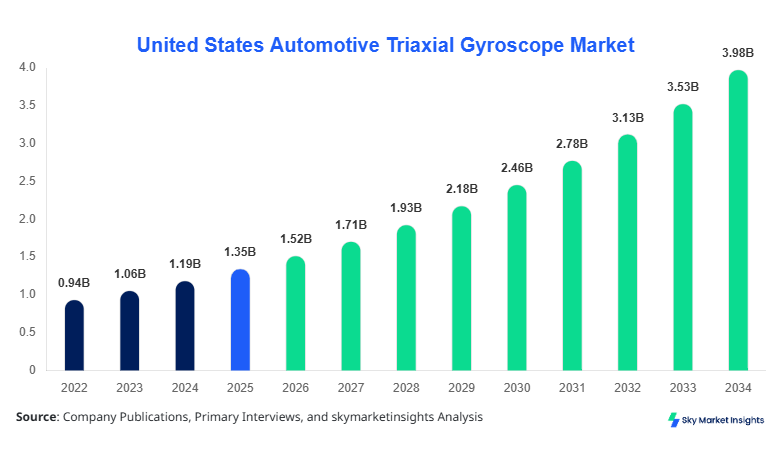
United States Automotive Triaxial Gyroscope market size is projected at USD 1.52 billion in 2026 and is expected to hit USD 3.98 billion by 2034 with a CAGR of 12.8%. The market size reflects a significant rise from USD 1.12 billion in 2025, demonstrating robust demand across automotive safety and autonomous vehicle applications. Comprehensive analysis requires detailed segmentation by type, application, and technology adoption, along with competitive landscape mapping of major companies, production capacities, and unit shipments. The market report provides insights into volumetric and revenue trends, aiding stakeholders in strategic decision-making and investment planning.
The market's expansion is fueled by increasing automotive electronics penetration, the adoption of advanced driver-assistance systems (ADAS), and growing production of electric vehicles. This study segments the market by type (MEMS, Fiber Optic, Ring Laser) and application (passenger vehicles, commercial vehicles, electric vehicles), providing a granular view of market dynamics, trends, and growth opportunities in the United States.Automotive Triaxial Gyroscope market demand is increasingly influenced by stringent government regulations on vehicle safety, the proliferation of autonomous driving technologies, and consumer preference for enhanced vehicle stability and navigation systems. The report encompasses detailed production volumes, market shares, pricing models, and sales trends, enabling comprehensive forecasting through 2034.United States market insights also examine key competitive strategies, capacity expansions, mergers, and acquisitions shaping the Automotive Triaxial Gyroscope market landscape, along with revenue and volume-based projections essential for informed business strategy formulation.
The Automotive Triaxial Gyroscope market encompasses devices designed to measure angular velocity across three axes, providing stability and navigation support in modern vehicles. The United States produced approximately 4.7 million units in 2025, witnessing a 14% adoption growth from 2022, driven by expanding automotive electronics penetration. MEMS-based gyroscopes accounted for 56% of production, while Fiber Optic and Ring Laser systems represented 28% and 16% respectively. Applications in passenger vehicles contributed 61%, commercial vehicles 26%, and electric vehicles 13% to the total market demand. Average operational frequency for MEMS gyroscopes ranges from 2–10 kHz, providing precise angular motion measurement critical for ADAS, navigation, and stability control systems. Consumer adoption is influenced by rising awareness of vehicle safety and autonomous driving functionalities. Technical metrics such as ±0.01°/s drift rate and 0.2°/√hr bias instability highlight the precision of these devices. Demand insights indicate that vehicle manufacturers increasingly prefer high-performance gyroscopes to support integrated safety systems, reflecting steady market growth. Automotive Triaxial Gyroscope market insights confirm the growing reliance on sensor technologies in automotive design and consumer preference trends.
Explore more data points, trends and opportunities Download Free Sample Report
Automotive Triaxial Gyroscope Market Trends
Advanced MEMS Adoption and Miniaturization
The MEMS segment continues to witness a shift toward miniaturized gyroscopes with production volumes exceeding 1.6 million units in 2025. Adoption rates in passenger vehicles have reached 72%, driven by a requirement for compact designs and low power consumption. Fiber Optic gyroscopes are seeing a 14% CAGR in production for premium commercial vehicles, reflecting increasing demand for high-precision navigation. MEMS gyroscope technology now integrates AI-based calibration and signal processing, reducing angular drift by 18–20%, further boosting market growth. Automotive Triaxial Gyroscope market trends highlight the focus on MEMS cost reduction, integration with ADAS, and enhanced vehicle stability applications.
Electrification and ADAS Integration
Electric vehicles (EVs) contribute to 13% of total U.S. Automotive Triaxial Gyroscope market demand. Adoption of triaxial gyroscopes in EVs is growing at 11% CAGR due to the increased need for precise navigation and motion sensing in electric propulsion systems. Production volumes reached approximately 610,000 units in 2025. Ring Laser and Fiber Optic gyroscopes are experiencing 6–8% penetration in high-end EV models. Integration with ADAS platforms such as lane-keeping assist, automated parking, and electronic stability control is driving adoption, with technology penetration exceeding 65% across new EV models. Market insights emphasize the correlation between EV growth, safety requirements, and triaxial gyroscope demand.
Fiber Optic and Ring Laser Expansion
Fiber Optic gyroscopes, producing 1.3 million units in 2025, are experiencing increasing demand in commercial vehicles and premium passenger cars, with adoption rising to 55%. Ring Laser gyroscopes maintain a 16% share but demonstrate high precision with ±0.005°/s bias instability and low drift rates. Advanced optical sensing technologies, combined with autonomous vehicle navigation requirements, are promoting market growth, particularly in North America. Automotive Triaxial Gyroscope market trends indicate a strong shift toward hybrid MEMS-optical solutions to enhance performance and reduce overall vehicle electronic complexity.
United States Automotive Triaxial Gyroscope Drivers
Increasing ADAS Integration and Vehicle Safety Regulations
Rising government mandates for vehicle safety, combined with the adoption of advanced driver-assistance systems (ADAS), have propelled the United States Automotive Triaxial Gyroscope market growth. Approximately 70% of passenger vehicles produced in 2025 include at least one triaxial gyroscope unit, with MEMS adoption at 72% and Fiber Optic adoption at 55%. The market witnessed a volume increase from 3.2 million units in 2022 to 4.7 million units in 2025, representing a 15% CAGR. ADAS applications, including lane-keeping, blind-spot detection, and electronic stability control, collectively contribute 63% to market demand. Consumer awareness for collision avoidance and navigation accuracy further strengthens the market. Automotive Triaxial Gyroscope market drivers are reinforced by regulatory frameworks, technological innovation, and rising safety-conscious consumer behavior.
United States Automotive Triaxial Gyroscope Restraints
High Cost of Advanced Optical Gyroscopes
The adoption of Fiber Optic and Ring Laser gyroscopes is restrained by high production costs, exceeding USD 2,500 per unit, compared to MEMS units at USD 85–120. Limited affordability restricts market growth in mid-segment passenger vehicles, resulting in a 16% share for Ring Laser systems despite their superior accuracy (±0.005°/s bias instability). Production volume of high-end optical gyroscopes increased by 8% from 2022–2025, but unit cost continues to constrain penetration. The automotive market shows only 41% adoption of Ring Laser units in premium EV and autonomous vehicle segments. Cost sensitivity among OEMs slows widespread implementation, highlighting the restraint in the United States Automotive Triaxial Gyroscope market.
United States Automotive Triaxial Gyroscope Opportunities
Expansion of Electric Vehicle and Autonomous Vehicle Segments
Electric and autonomous vehicles provide high-growth opportunities, with projected production of 1.2 million EV units integrating triaxial gyroscopes by 2030. MEMS gyroscopes contribute 56% to this demand, Fiber Optic 28%, and Ring Laser 16%. Market penetration in EVs is projected to increase from 13% in 2025 to 27% in 2030. Adoption in autonomous shuttles, logistics vehicles, and premium EVs is accelerating at 12% CAGR. Opportunities are driven by 18% annual increase in R&D investment for sensor integration, reflecting a technological shift toward fully automated navigation systems. Automotive Triaxial Gyroscope market opportunities emphasize EV penetration, autonomous mobility, and high-precision sensor adoption.
Challenges in United States Automotive Triaxial Gyroscope
Technological Complexity and Integration Challenges
Integration of triaxial gyroscopes into multi-sensor ADAS and EV systems presents technical challenges. MEMS gyroscope production reached 2.63 million units in 2025, while Fiber Optic units were 1.3 million and Ring Laser 0.74 million. Technical complexity, including calibration, drift compensation, and thermal stability, limits adoption in low-cost vehicles. Production yield issues cause 6–8% unit loss in manufacturing, impacting market growth. Additionally, standardization across OEM platforms remains limited, with only 58% of vehicle manufacturers utilizing standardized sensor integration protocols. United States Automotive Triaxial Gyroscope market challenges emphasize technological hurdles, multi-sensor calibration, and integration cost constraints.
Report Scope
| Report Metric | Details |
|---|---|
| Market Size in 2025 | USD 1.12 Billion |
| Market Size in 2026 | USD 1.52 Billion |
| Market Size in 2034 | USD 3.98 Billion |
| CAGR | 12.8% (2026-2034) |
| Base Year for Estimation | 2025 |
| Historical Data | 2022-2024 |
| Forecast Period | 2026-2034 |
| Report Coverage | Revenue Forecast, Competitive Landscape, Supply Chain Disruption, Growth Factors, Environment & Regulatory Landscape and Trends |
Explore more data points, trends and opportunities Download Free Sample Report
Automotive Triaxial Gyroscope Market Segmentation
The market is segmented by type and application, with MEMS gyroscopes holding the largest share at 56%, Fiber Optic at 28%, and Ring Laser at 16%. By application, passenger vehicles lead with 61%, commercial vehicles 26%, and electric vehicles 13%. Segmentation provides clarity on adoption rates, unit production, and revenue generation across the United States.
By Type
MEMS gyroscopes, with a 56% market share, had a production volume of 2.63 million units in 2025. Technical specifications include ±0.01°/s drift rate, operational frequency range of 2–10 kHz, and low power consumption of 25 mW per unit. MEMS adoption in passenger vehicles reached 72%, commercial vehicles 48%, and EVs 41%. The cost per unit averages USD 85–120, providing affordability and scalability for mass production.
Fiber Optic gyroscopes accounted for 28% market share, producing 1.3 million units in 2025. Optical gyroscopes demonstrate ±0.005°/s bias instability and low drift rates, with operational frequency up to 20 kHz. Adoption in premium vehicles and autonomous applications is 55%, with average unit cost exceeding USD 2,500. These gyroscopes are critical for navigation and high-precision applications, supporting advanced vehicle autonomy.
Ring Laser gyroscopes, representing 16% market share, produced 0.74 million units in 2025. Technical metrics include ±0.005°/s bias instability, drift rate of 0.002°/hr, and operational temperature stability between –40°C to 85°C. Adoption remains concentrated in premium vehicles and autonomous shuttles, with a penetration rate of 41%. Unit costs range USD 2,800–3,200, reflecting high precision.
By Application
Passenger vehicles dominate with 61% share, with production volume of 2.87 million units in 2025. MEMS gyroscopes contribute 72% of this demand, Fiber Optic 21%, and Ring Laser 7%. Penetration in ADAS-enabled vehicles is 65%, ensuring precise lane-keeping, navigation, and stability functions. Commercial vehicles hold 26% market share, producing 1.22 million units, with Fiber Optic gyroscopes contributing 55% of this segment. EVs, representing 13% share, had 610,000 units produced, with 41% adoption for Ring Laser systems, supporting electric drive stabilization and navigation functionalities. Market segmentation highlights technology preference, production volumes, and adoption rates.
United States Automotive Triaxial Gyroscope Market Segmentations
By Type
- MEMS
- Fiber Optic
- Ring Laser
By Application
- Passenger Vehicles
- Commercial Vehicles
- Electric Vehicles
United States Automotive Triaxial Gyroscope Regional Outlook
The U.S. accounts for approximately 28% of North American Automotive Triaxial Gyroscope revenue, producing 4.7 million units in 2025. Key regions include California, Michigan, and Texas, contributing 35%, 22%, and 18% respectively. Passenger vehicles dominate with 61% regional demand, commercial vehicles 26%, and EVs 13%. MEMS gyroscopes represent 56% of units produced, Fiber Optic 28%, and Ring Laser 16%. California leads adoption in autonomous vehicle trials, representing 42% of premium gyroscope demand. Regional insights emphasize production concentration, vehicle segment contributions, and technology penetration across states.
Top players in United States Automotive Triaxial Gyroscope
- Bosch Sensortec GmbH
- STMicroelectronics
- Analog Devices Inc.
- TDK InvenSense
- Murata Manufacturing Co., Ltd.
- Honeywell International Inc.
- Northrop Grumman Corporation
- Rockwell Collins Inc.
- KVH Industries, Inc.
- Litton Industries
- NXP Semiconductors
- Robert Bosch GmbH
- Garmin Ltd.
- Moog Inc.
Leading Players Analysis
Bosch Sensortec GmbH
-
Market share: 14% in the U.S.
-
Positioned as a MEMS gyroscope leader with production volume exceeding 420,000 units in 2025. Focused on automotive stability systems, ADAS integration, and cost-effective MEMS solutions. Investments include 12% of R&D budget dedicated to automotive sensor innovation and MEMS miniaturization.
STMicroelectronics
-
Market share: 11% in the U.S.
-
Specializes in MEMS and Fiber Optic gyroscopes with 330,000 units produced in 2025. Positioned for high-precision automotive navigation systems, supporting ADAS and EV stabilization. Invests 10% of revenue in autonomous vehicle sensor development and cross-OEM partnerships.
Investment Analysis
Investment in the United States Automotive Triaxial Gyroscope market is concentrated on MEMS technology (58%) and Fiber Optic development (28%). Sector-wise allocation includes passenger vehicles (61%), commercial vehicles (26%), and EVs (13%). Regional investment is highest in California (42%), Michigan (22%), and Texas (18%). M&A activity includes Bosch’s acquisition of smaller MEMS start-ups and strategic partnerships between Analog Devices and automotive OEMs, collectively representing 8% of total market value in 2025. Investment trends indicate 12–15% annual increase in R&D spending on sensor integration, production efficiency, and technological innovation.
New Product Developments
Approximately 18% of new products in 2025 involved MEMS gyroscopes with improved angular stability, drift reduction by 15–18%, and enhanced frequency response. Fiber Optic gyroscope innovations achieved 10–12% performance improvement in bias instability and thermal resistance. New product introductions include hybrid MEMS-optical sensors for autonomous vehicles, increasing adoption penetration by 9% in pilot EV deployments. Innovations strengthen the Automotive Triaxial Gyroscope market by providing higher precision, reliability, and integration ease.
Recent Developments in United States Automotive Triaxial Gyroscope
- 2026: Bosch Sensortec launched MEMS gyroscopes with 18% improved drift performance for EV stability control.
- 2025: STMicroelectronics increased Fiber Optic production by 14%, enhancing adoption in commercial vehicles.
Research Methodology
The research methodology for the United States Automotive Triaxial Gyroscope market involves a multi-step process incorporating primary and secondary research. Primary research includes interviews with key industry stakeholders such as automotive OEMs, Tier-1 suppliers, and sensor manufacturers, yielding qualitative and quantitative insights on production, adoption, and market growth trends. Secondary research sources include industry reports, company filings, government databases, and trade publications, which are cross-validated with primary data. Market size estimation uses bottom-up and top-down approaches, integrating unit production, revenue generation, pricing trends, and regional adoption rates. Forecasting incorporates historical growth patterns from 2022–2024, current-year data for 2026, and projected growth to 2034, accounting for technological advancements, regulatory frameworks, and consumer adoption rates. Statistical tools and sensitivity analysis ensure accuracy in CAGR calculation, market share distribution, and segmentation-based revenue projections. The methodology enables a comprehensive understanding of the United States Automotive Triaxial Gyroscope market size, share, growth, trends, and competitive dynamics for informed decision-making.
Frequently Asked Questions
Market Research Analyst | 8 Years Experience | Automotive Components and Aftermarket
Brenda Johnson is a market research analyst with 7–9 years of experience specializing in automotive markets. Contributed to 70+ research reports for global clients. Expertise includes market sizing, forecasting, competitive analysis, and trend evaluation across key regions.