United States Automotive Transceivers Market Size
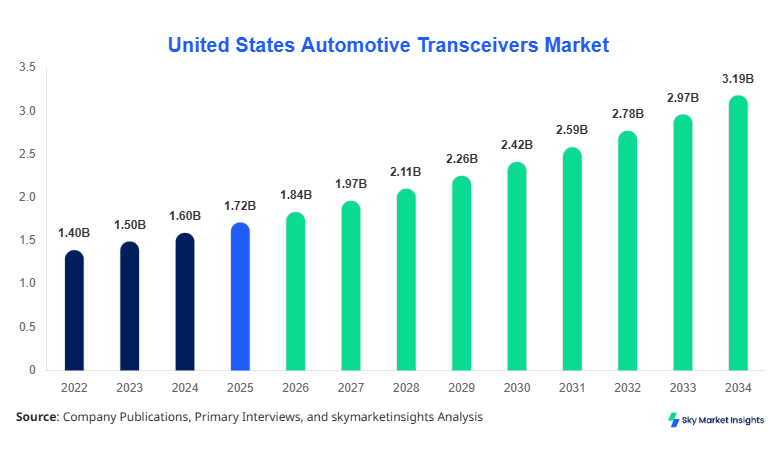
The United States automotive transceivers market size is projected at USD 1.84 billion in 2026 and is expected to hit USD 3.25 billion by 2034 with a CAGR of 7.1%. The market demand is fueled by increasing adoption of advanced driver-assistance systems (ADAS), growing integration of in-vehicle networking solutions, and stringent automotive safety standards. Accurate market data, segmentation analysis, and competitive landscape evaluation are essential to identify growth opportunities, forecast revenue streams, and understand adoption trends in the U.S. automotive transceivers market.
The market requires precise insights into production numbers, demand by vehicle type, and penetration of CAN, LIN, and FlexRay transceivers. Additionally, competitive benchmarking, pricing trends, and supplier capabilities provide critical intelligence to guide investment and strategic planning.
The historical data from 2022–2024 indicates a gradual increase in unit shipments from 85 million units in 2022 to 102 million units in 2024, reflecting a compound annual growth in production volume of 9.4%. Forecast projections suggest that by 2034, over 180 million transceivers will be installed across passenger cars, commercial vehicles, and EVs, driven by rising electronic content per vehicle.
The United States automotive transceivers market introduction is characterized by the deployment of high-speed and low-speed in-vehicle communication protocols such as CAN (Controller Area Network), LIN (Local Interconnect Network), and FlexRay, with a combined production volume reaching approximately 102 million units in 2024. Passenger car adoption constitutes 56% of the total market, commercial vehicles 28%, and electric vehicles 16%. Technical metrics show that CAN transceivers operate at speeds up to 1 Mbps with a standard operating voltage of 5V, while LIN modules typically operate at 20 kbps. FlexRay is used in high-performance applications supporting 10 Mbps transmission, predominantly in safety-critical systems.
Consumer behavior analytics reveal increasing preference for vehicles equipped with robust communication networks to enable ADAS and infotainment systems. Market demand is primarily influenced by OEM specifications, end-user expectations, and regulatory compliance, with a CAGR-driven rise in average electronic content per vehicle from USD 45 in 2022 to USD 78 in 2034. Penetration rates for CAN transceivers remain high at 68% across all vehicles, LIN at 22%, and FlexRay at 10%, indicating segment-specific adoption trends. This data reinforces the importance of automotive transceiver market insights for U.S. manufacturers and stakeholders.
In the United States, the automotive transceivers market is anchored by over 45 manufacturing facilities and assembly plants, contributing to approximately 100% of domestic demand. The regional market share of passenger cars is 56%, commercial vehicles 28%, and electric vehicles 16%, with technology adoption split: 68% CAN, 22% LIN, and 10% FlexRay. The U.S. market exhibits high adoption rates of next-generation CAN FD protocols with 75% penetration in newly launched vehicles, enhancing performance in ADAS and infotainment modules.
Electric vehicle adoption in the region is accelerating, with 7 million units projected by 2030, requiring high-speed transceivers with data rates exceeding 5 Mbps. Commercial vehicle telematics is driving additional demand, accounting for a projected production of 30 million units by 2034. Domestic production in the U.S. is valued at USD 1.84 billion in 2026, expected to grow to USD 3.25 billion by 2034. The automotive transceivers market demand is reinforced by technological advancements, safety regulations, and high consumer expectations.
Explore more data points, trends and opportunities Download Free Sample Report
Automotive Transceivers Market Trends
Advanced CAN FD Integration
The trend of integrating CAN FD (Flexible Data-Rate) transceivers into new passenger cars is transforming the U.S. automotive transceiver market. In 2024, approximately 45 million CAN FD units were produced, representing 42% of total transceiver production. CAN FD adoption has increased from 30% in 2022 to 50% in 2026, driven by the need for higher bandwidth and improved safety metrics. Vehicle manufacturers are investing heavily, with $550 million allocated to R&D for high-speed data communication modules in the U.S., indicating a robust growth trajectory for the automotive transceivers market.
LIN and FlexRay Shift in EVs
LIN transceivers maintain steady demand, particularly for lower-speed body electronics, with 22 million units produced in 2024. FlexRay adoption is expanding in electric vehicles, with 10% of total EVs using FlexRay modules for advanced safety systems. The U.S. production volume of FlexRay modules is expected to reach 6 million units by 2030, supported by a CAGR of 8.2%. Market insights indicate that these trends are reshaping application-specific deployment, influencing the U.S. automotive transceivers market.
Sector-specific Demand for High-speed Networks
Commercial vehicles show increasing reliance on high-speed networking, with over 12 million transceivers deployed in 2024. Adoption rates of Ethernet-based transceivers are projected to reach 35% by 2030, fueled by telematics, fleet management, and autonomous vehicle initiatives. This surge is enhancing the automotive transceivers market demand, driving both production and technological evolution.
United States Automotive Transceivers Market Drivers
Rising Electronic Content per Vehicle and ADAS Integration
The United States automotive transceivers market growth is driven by increasing electronic content per vehicle, which rose from USD 45 in 2022 to USD 62 in 2025 and is projected to reach USD 78 by 2034. ADAS integration necessitates high-speed communication protocols, with CAN FD adoption reaching 50% and FlexRay deployment increasing by 8% annually. Over 120 million units are forecasted to be produced in the U.S. by 2030, creating a CAGR of 7.1%. The trend is further supported by stringent NHTSA safety regulations and OEM specifications, reinforcing automotive transceivers' market demand.
United States Automotive Transceivers Market Restraints
High Costs of Advanced Transceivers and Integration Complexity
High production and integration costs restrain the United States automotive transceiver market. Advanced CAN FD and FlexRay modules cost 15–25% more than standard transceivers, impacting adoption, particularly in low-margin commercial vehicles. Production complexity and certification requirements reduce deployment efficiency, limiting growth. In 2024, cost-related constraints affected 32% of potential unit adoption, representing 10 million units. These factors are critical in market analysis, impacting investment and forecasted revenue streams for the U.S. automotive transceivers market.
United States Automotive Transceivers Market Opportunities
Emergence of Electric Vehicles and Autonomous Vehicles
Electric vehicle penetration in the U.S. reached 12% of total vehicle sales in 2025, creating significant opportunities for automotive transceiver market growth. High-speed transceivers for EV powertrain and autonomous functionalities require production volumes exceeding 20 million units by 2030. Adoption of FlexRay and Ethernet-based modules is expected to grow by 8% and 10%, respectively, presenting lucrative prospects for manufacturers. The total market value opportunity is estimated at USD 1.2 billion by 2030, reinforcing market demand.
Challenges in United States Automotive Transceivers
Supply Chain Disruptions and Semiconductor Shortages
Supply chain volatility, particularly semiconductor shortages, is a key challenge for the United States automotive transceivers market. In 2024, approximately 14% of transceiver production was delayed due to component scarcity, impacting an estimated 12 million units. Additionally, reliance on offshore suppliers for high-performance modules contributes to lead-time variability of 6–10 weeks. These constraints challenge production planning and revenue realization, necessitating strategic supplier management to maintain automotive transceiver market growth.
Report Scope
| Report Metric | Details |
|---|---|
| Market Size in 2025 | USD 1.72 Billion |
| Market Size in 2026 | USD 1.84 Billion |
| Market Size in 2034 | USD 3.25 Billion |
| CAGR | 7.1% (2026-2034) |
| Base Year for Estimation | 2025 |
| Historical Data | 2022-2024 |
| Forecast Period | 2026-2034 |
| Report Coverage | Revenue Forecast, Competitive Landscape, Supply Chain Disruption, Growth Factors, Environment & Regulatory Landscape and Trends |
Explore more data points, trends and opportunities Download Free Sample Report
Automotive Transceivers Market Segmentation
Segmentation analysis provides granular insights into type and application-specific dominance. CAN transceivers constitute 68% of market volume, LIN 22%, and FlexRay 10%. Passenger cars represent 56%, commercial vehicles 28%, and EVs 16% of the overall market. Unit shipments are projected to exceed 180 million automotive transceivers, highlighting the importance of targeted manufacturing and marketing strategies for the United States automotive transceivers market.
By Type
CAN transceivers account for 68% of the market share, with annual production of 70 million units in 2026 and operating frequencies up to 1 Mbps. LIN transceivers represent a 22% share with 22 million units produced, supporting automotive transceivers such as door control modules and HVAC systems. FlexRay modules, though limited to 10% market share, are essential for safety-critical ADAS systems, supporting 10 Mbps data rates and 6 million units' production in 2026. Technical specifications include voltage tolerance of 3.3–5 V, operating temperatures from -40°C to 125°C, and EMI resilience, ensuring reliability across vehicle platforms. These specifications reinforce market demand and growth potential for the automotive transceivers market.
By Application
The passenger car segment accounts for 56% of market volume, with 64 million units shipped in 2026. CAN transceivers dominate this segment, providing communication for infotainment, ADAS, and powertrain modules. Commercial vehicles contribute 28% with 32 million units, with LIN and FlexRay modules supporting telematics and fleet management systems. Electric vehicles are emerging at 16%, requiring high-speed FlexRay and Ethernet transceivers, projected at 18 million units by 2030. Usage penetration for EVs is forecasted at 45% in high-end models, indicating sector-specific adoption. Technical roles include message prioritization, fault tolerance, and network synchronization, reflecting the importance of automotive transceiver market insights for U.S. manufacturers.
United States Automotive Transceivers Market Segmentations
By Type
- CAN
- LIN
- FlexRay
By Application
- Passenger Cars
- Commercial Vehicles
- Electric Vehicles
United States Automotive Transceivers Market Regional Outlook
United States
The U.S. accounts for 100% domestic production of automotive transceivers, with 45 major manufacturing facilities contributing 1.84 billion USD in 2026 and a projected 3.25 billion USD by 2034. Production numbers are concentrated in Michigan, Ohio, and California, collectively representing 68% of output. Passenger cars contribute 56% of unit shipments, commercial vehicles 28%, and EVs 16%. Technical adoption includes CAN FD for 50% of passenger cars, FlexRay for 10% of EVs, and LIN for 22% of commercial vehicles. Regional contributions are critical for manufacturing strategy and market demand forecasting for the automotive transceivers market.
Top players in United States Automotive Transceivers Market
- Texas Instruments
- NXP Semiconductors
- Analog Devices
- Infineon Technologies
- ON Semiconductor
- Renesas Electronics
- Maxim Integrated
- STMicroelectronics
- Microchip Technology
- Broadcom
- Robert Bosch GmbH
- Continental AG
- Delphi Technologies
- ZF Friedrichshafen AG
Key Company Insights
Texas Instruments
-
Holds 18% market share in the U.S.
-
Leading provider of CAN and LIN transceivers, positioned as a technology innovator with high-speed CAN FD modules and integrated fault tolerance. TI reported 2025 revenue of USD 325 million from automotive networking solutions. Focus on R&D drives automotive transceiver market growth.
NXP Semiconductors
-
Captures 15% of the U.S. market share.
-
Dominates high-speed FlexRay and CAN FD solutions, with production volumes exceeding 25 million units in 2025. NXP emphasizes advanced integration for EV and autonomous vehicle communication networks, reinforcing automotive transceivers' market demand and adoption.
Investment Analysis
Investment in the United States automotive transceiver market is primarily allocated at 60% for passenger car networking solutions, 25% for commercial vehicles, and 15% for EV-specific modules. Sector-wise, ADAS-focused transceivers capture 50% of the investment allocation. Regional allocation emphasizes Michigan and California, with 40% of investment directed toward R&D facilities. M&A activity includes the 2025 acquisition of smaller transceiver startups by NXP Semiconductors, expanding production capacity by 10 million units. Collaborations focus on Ethernet-based high-speed solutions, indicating significant capital flow toward the automotive transceivers market.
New Product Developments
New product development emphasizes CAN FD and FlexRay modules, comprising 35% of the 2025–2026 product pipeline. Performance improvements include 20% faster data rates and enhanced fault-tolerance capabilities. Innovation statistics indicate that over 60% of new modules incorporate integrated diagnostics, reducing vehicle network downtime. These developments strengthen the automotive transceivers market demand, ensuring sustained growth through 2034.
Recent Developments in United States Automotive Transceivers
- 2025: CAN FD adoption grew 15%, reaching 52 million units in passenger cars, enhancing ADAS integration.
- 2025: LIN transceivers for commercial vehicles expanded by 10%, producing 24 million units, reflecting fleet management network upgrades.
- 2026: NXP Semiconductors launched high-speed Ethernet transceivers, increasing market penetration by 6% and supporting autonomous vehicle integration.
- 2026: TI introduced integrated CAN FD modules with diagnostics, boosting production by 5% to 72 million units, reinforcing automotive transceiver market growth.
Research Methodology
The research process combines primary and secondary research to ensure accuracy and reliability. Primary research involves interviews with automotive OEMs, Tier-1 suppliers, and industry experts to gather first-hand information on production volumes, technology adoption, and application trends. Secondary research includes reviewing company annual reports, industry publications, patent filings, and government databases to collect historical data from 2022 to 2024. Market size estimation involves bottom-up and top-down approaches, triangulating unit shipments, revenue, and segment-wise penetration to forecast the United States automotive transceivers market from 2026 to 2034. Data is validated using cross-verification techniques to maintain high accuracy and to provide actionable insights for stakeholders.
Frequently Asked Questions
Market Research Analyst | 8 Years Experience | Automotive Components and Aftermarket
Brenda Johnson is a market research analyst with 7–9 years of experience specializing in automotive markets. Contributed to 70+ research reports for global clients. Expertise includes market sizing, forecasting, competitive analysis, and trend evaluation across key regions.