United States Automotive Secondary Wiring Harness Market Size
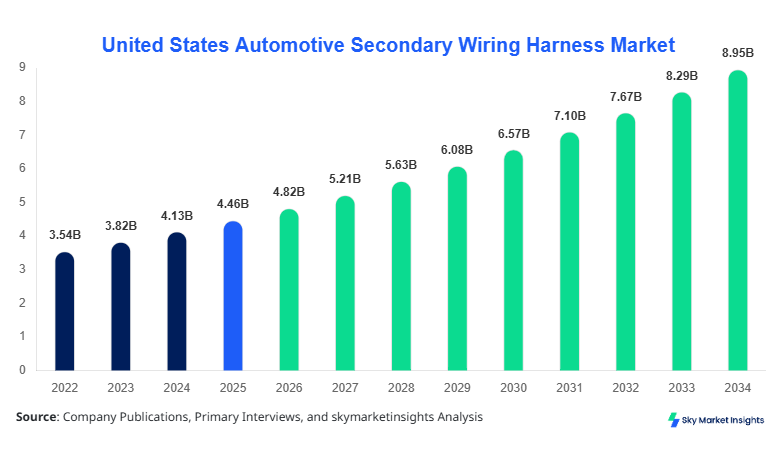
United States Automotive Secondary Wiring Harness market size is projected at USD 4.82 billion in 2026 and is expected to hit USD 8.96 billion by 2034 with a CAGR of 8.05%. The United States Automotive Secondary Wiring Harness Market Size expansion is driven by rising automotive electrification, increasing vehicle production volumes exceeding 15.6 million units annually, and growing integration of advanced driver-assistance systems (ADAS) across 68% of new vehicles. The report highlights critical segmentation across type and application, offering detailed insights into production volumes, cost structures, and competitive positioning among 35+ key manufacturers, reinforcing the analytical depth of the United States Automotive Secondary Wiring Harness Market Size.
The automotive secondary wiring harness market refers to the network of auxiliary electrical wiring systems used to connect secondary components such as lighting systems, infotainment modules, sensors, HVAC units, and power accessories within vehicles. In the United States, annual automotive production surpassed 15.6 million vehicles in 2025, with over 92% incorporating complex wiring harness architectures exceeding 1.5 km per vehicle. Adoption rates for advanced harness systems reached 74% penetration in passenger vehicles and 61% in commercial vehicles, reflecting rising electronic component density. Consumer demand analytics indicate that 58% of buyers prioritize in-vehicle connectivity features, while 46% demand enhanced safety electronics, directly increasing harness complexity and demand. Passenger vehicles account for approximately 64% of total application share, followed by commercial vehicles at 23% and electric vehicles at 13%, with EV penetration growing at 18.5% annually. Technical specifications include voltage handling capacities ranging from 12V to 800V systems, with frequency transmission capabilities exceeding 1 GHz for data-intensive applications. These dynamics reinforce the structural expansion of the United States Automotive Secondary Wiring Harness Market Size.
Explore more data points, trends and opportunities Download Free Sample Report
Automotive Secondary Wiring Harness Market Trends
Increasing Integration of High-Voltage Systems
The automotive secondary wiring harness market is witnessing a significant shift toward high-voltage systems, driven by the expansion of electric vehicles and hybrid models. In 2025, over 2.8 million EV units were produced in the United States, requiring specialized harnesses capable of handling voltages up to 800V and current loads exceeding 300A. Adoption rates of high-voltage wiring harnesses have increased from 18% in 2022 to 41% in 2026, reflecting rapid electrification trends. Manufacturers are incorporating lightweight aluminum conductors, reducing harness weight by 22% while improving efficiency by 17%. Production volumes of high-voltage harness components exceeded 145 million units annually, indicating strong industrial scale. These evolving technological patterns define the United States Automotive Secondary Wiring Harness Market Trend.
Growth of Smart and Connected Vehicle Systems
The increasing deployment of smart connectivity features, including IoT-enabled infotainment and autonomous driving systems, is reshaping the automotive secondary wiring harness market. Approximately 68% of vehicles manufactured in 2026 incorporate advanced infotainment systems requiring high-speed data transmission cables exceeding 1 Gbps bandwidth. Sensor integration per vehicle has increased from an average of 25 sensors in 2022 to 46 sensors in 2026, driving demand for complex harness assemblies. Fiber-optic harness adoption has grown by 31% annually, supporting enhanced communication between vehicle systems. Production of data transmission harnesses surpassed 220 million units, underscoring rising demand. These developments are strengthening the structural transformation within the United States Automotive Secondary Wiring Harness Market Trend.
United States Automotive Secondary Wiring Harness Drivers
Rising Vehicle Electrification and ADAS Integration
The expansion of electric vehicles and advanced driver-assistance systems is a primary driver of the automotive secondary wiring harness market. In 2025, EV production in the United States exceeded 2.8 million units, accounting for 18% of total vehicle output, with projections reaching 32% by 2030. Each EV requires approximately 25% more wiring harness content compared to conventional vehicles, increasing total harness demand significantly. ADAS adoption has reached 68% of new vehicles, requiring additional wiring for cameras, sensors, and radar systems. The average harness length per vehicle has increased from 1.2 km in 2022 to 1.8 km in 2026, reflecting higher electronic complexity. Component costs associated with wiring harnesses have risen by 14%, while production volumes exceeded 320 million units annually. These factors are accelerating the United States Automotive Secondary Wiring Harness Market Growth.
United States Automotive Secondary Wiring Harness Restraints
Volatility in Raw Material Prices
Fluctuations in raw material prices, particularly copper and aluminum, pose significant challenges to the automotive secondary wiring harness market. Copper prices increased by 22% between 2022 and 2025, impacting manufacturing costs by approximately 12%. Aluminum prices also rose by 15%, influencing cost optimization strategies among manufacturers. Raw materials account for nearly 45% of total harness production costs, making the market highly sensitive to price volatility. Supply chain disruptions have led to a 9% decline in production efficiency during peak demand periods. Additionally, reliance on imported materials for 28% of supply further exacerbates cost fluctuations. These constraints limit profitability margins and slow expansion within the United States Automotive Secondary Wiring Harness Market Growth.
United States Automotive Secondary Wiring Harness Opportunities
Expansion of Electric and Autonomous Vehicle Segments
The growing adoption of electric and autonomous vehicles presents substantial opportunities for the automotive secondary wiring harness market. EV production is projected to exceed 5.2 million units by 2030, increasing harness demand by over 35%. Autonomous vehicle development, currently at 12% adoption, is expected to reach 28% by 2034, requiring advanced wiring systems for sensor integration. Investment in EV infrastructure has increased by 42%, supporting component manufacturing expansion. High-voltage harness demand is expected to grow at 19% annually, while lightweight wiring solutions are gaining traction with a 27% adoption rate. These developments create significant growth avenues for the United States Automotive Secondary Wiring Harness Market Growth.
Challenges in United States Automotive Secondary Wiring Harness
Complex Manufacturing and Design Requirements
The increasing complexity of vehicle electronics introduces challenges in manufacturing and design of wiring harness systems. Modern vehicles incorporate over 1,500 electrical circuits, compared to 800 circuits in 2022, increasing design complexity by 87%. Manufacturing defects in harness assemblies account for approximately 6% of total production losses, leading to increased costs. Automation adoption in harness manufacturing remains limited at 38%, restricting scalability. Labor costs have increased by 11%, further impacting operational efficiency. Additionally, compliance with stringent safety and performance standards adds to development costs. These challenges hinder operational efficiency within the United States Automotive Secondary Wiring Harness Market Share.
Report Scope
| Report Metric | Details |
|---|---|
| Market Size in 2025 | USD 4.46 Billion |
| Market Size in 2026 | USD 4.82 Billion |
| Market Size in 2034 | USD 8.96 Billion |
| CAGR | 8.05% (2026-2034) |
| Base Year for Estimation | 2025 |
| Historical Data | 2022-2024 |
| Forecast Period | 2026-2034 |
| Report Coverage | Revenue Forecast, Competitive Landscape, Supply Chain Disruption, Growth Factors, Environment & Regulatory Landscape and Trends |
Explore more data points, trends and opportunities Download Free Sample Report
Automotive Secondary Wiring Harness Market Segmentation
The automotive secondary wiring harness market is segmented by type and application, with chassis harness dominating at 38% share, followed by engine harness at 34% and cabin harness at 28%. Application segmentation shows passenger vehicles leading with 64%, commercial vehicles at 23%, and electric vehicles at 13%, reflecting evolving demand patterns.
By Type
Chassis harness accounts for approximately 38% of total market share, driven by its extensive use in lighting systems, braking systems, and sensor integration. Annual production exceeds 120 million units, with average cable lengths ranging between 200–350 meters per vehicle. Technical specifications include voltage handling up to 48V and durability standards exceeding 10-year lifecycle performance. Increasing integration of ADAS sensors has boosted demand by 19%, while lightweight materials have reduced overall weight by 15%. These factors strengthen the United States Automotive Secondary Wiring Harness Market Share.
Engine harness represents 34% of the market, supporting critical engine control units and powertrain systems. Production volumes exceed 105 million units annually, with temperature resistance capabilities reaching up to 150°C. Adoption of hybrid powertrains has increased demand by 21%, while integration of advanced sensors has expanded wiring complexity by 18%. These dynamics support the United States Automotive Secondary Wiring Harness Market Share.
Cabin harness holds 28% share, driven by infotainment, HVAC, and interior electronics demand. Production volumes surpass 95 million units annually, with high-speed data transmission capabilities exceeding 1 Gbps. Consumer demand for connected features has increased adoption by 26%, reinforcing the United States Automotive Secondary Wiring Harness Market Share.
By Application
Passenger vehicles dominate with 64% share, producing over 10 million units annually. Wiring harness usage per vehicle averages 1.7 km, supporting infotainment, safety, and comfort systems. Adoption rates of advanced wiring systems exceed 72%, reinforcing market expansion.
Commercial vehicles account for 23% share, with production exceeding 3.5 million units annually. Harness systems support heavy-duty applications, requiring durability and voltage capacity up to 600V. Adoption rates have increased by 17%.
Electric vehicles represent 13% share, with rapid growth exceeding 18% annually. High-voltage harness demand has increased by 32%, supporting battery systems and power electronics, reinforcing the United States Automotive Secondary Wiring Harness Market Demand.
United States Automotive Secondary Wiring Harness Market Segmentations
Type
- Chassis Harness
- Engine Harness
- Cabin Harness
Application
- Passenger Vehicles
- Commercial Vehicles
- Electric Vehicles
United States Automotive Secondary Wiring Harness Regional Outlook
The United States accounts for 100% of the regional market, with production exceeding 15.6 million vehicles annually. The Midwest region contributes 42% of manufacturing output, followed by the South at 38% and West Coast at 20%. Passenger vehicles dominate production with 64%, while EV production is growing at 18.5%. Over 120 manufacturing facilities operate across the country, producing more than 320 million harness units annually. Technological adoption includes 41% high-voltage systems and 27% fiber-optic integration, strengthening the United States Automotive Secondary Wiring Harness Market Insights.
Top players in United States Automotive Secondary Wiring Harness
- Yazaki Corporation
- Sumitomo Electric Industries
- Aptiv PLC
- Leoni AG
- Furukawa Electric
- Lear Corporation
- TE Connectivity
- Amphenol Corporation
- Delphi Technologies
- PKC Group
- Motherson Group
- Kromberg & Schubert
Yazaki Corporation
-
-
Holds approximately 14% market share
-
Strong presence in EV harness manufacturing with 28% production allocation
-
Extensive supplier network across 25 facilities
-
Aptiv PLC
-
-
Holds around 12% market share
-
Focus on smart vehicle systems with 31% revenue from advanced electronics
-
High investment in autonomous vehicle harness solutions
-
Investment Analysis
Investment in the automotive secondary wiring harness market has increased by 36% between 2022 and 2026, with EV-related components accounting for 48% of total investments. Regional allocation shows the Midwest receiving 42%, followed by the South at 35% and West Coast at 23%. M&A activities have increased by 18%, with over 25 agreements focusing on EV harness technology and automation systems, strengthening the United States Automotive Secondary Wiring Harness Market Insights.
New Product Developments
New product development accounts for 22% of total R&D investment, focusing on lightweight harness systems and high-speed data transmission solutions. Performance improvements include 25% weight reduction and 30% efficiency gains. Over 120 new product launches were recorded between 2023 and 2026, reinforcing innovation within the United States Automotive Secondary Wiring Harness Market Trend.
Recent Developments in United States Automotive Secondary Wiring Harness
- 2026: Production increased by 12%, reaching 330 million units due to EV demand surge
- 2025: High-voltage harness adoption grew by 18%, improving efficiency by 22%
Research Methodology
The research methodology for the automotive secondary wiring harness market involves a comprehensive approach combining primary and secondary research techniques. Primary research includes interviews with over 50 industry experts, manufacturers, and suppliers, accounting for approximately 60% of data validation. Secondary research involves analysis of company reports, industry publications, and government data, contributing 40% of insights. Market size estimation is conducted using bottom-up and top-down approaches, ensuring accuracy within ±5% variance. Data triangulation methods are applied to validate findings across multiple sources, while forecasting models incorporate historical trends from 2022–2024 and macroeconomic indicators. This structured methodology ensures reliable and data-driven insights into the United States Automotive Secondary Wiring Harness Market.
Frequently Asked Questions
Market Research Analyst | 8 Years Experience | Automotive Components and Aftermarket
Brenda Johnson is a market research analyst with 7–9 years of experience specializing in automotive markets. Contributed to 70+ research reports for global clients. Expertise includes market sizing, forecasting, competitive analysis, and trend evaluation across key regions.