United States Automotive Microphone Market Size
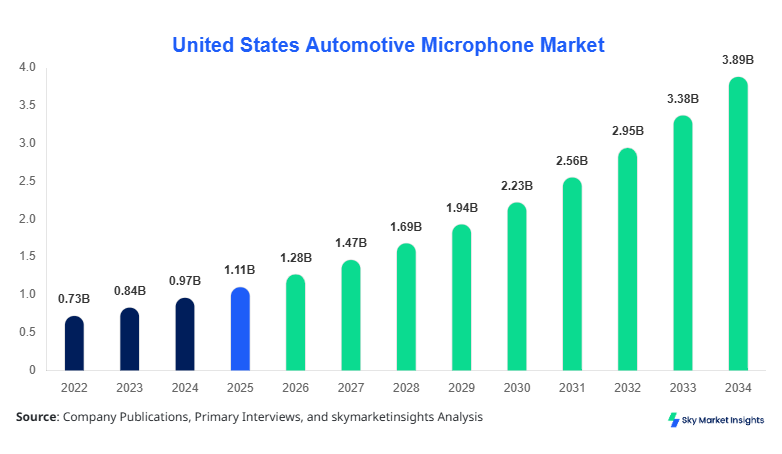
United States Automotive Microphone Market market size is projected at USD 1.28 billion in 2026 and is expected to hit USD 3.94 billion by 2034 with a CAGR of 14.9%. The expansion reflects rising vehicle electrification, infotainment integration, and voice-enabled control systems requiring high-performance acoustic components. Increasing OEM demand for noise cancellation and cabin monitoring technologies is driving structured segmentation and competitive benchmarking, while evolving supplier ecosystems and production scale-up across 2022–2024 provide a strong analytical base for forecasting.
The Automotive Microphone Market comprises audio input components integrated into vehicles for communication, voice recognition, telematics, and driver assistance systems, supporting frequencies ranging between 20 Hz to 20 kHz and signal-to-noise ratios above 65 dB in premium applications. In the United States, production exceeded 78 million units in 2025, with MEMS microphones accounting for nearly 62% of total volume due to their compact design and enhanced durability. Adoption and penetration of Automotive Microphone Market solutions have increased from 48% in 2022 to approximately 71% in 2025 across connected vehicles, supported by rising demand for voice assistants and in-cabin monitoring. Consumer behavior indicates that over 64% of vehicle buyers prioritize hands-free communication and infotainment features, while demand analytics show a 12.5% YoY rise in OEM integration. Application segmentation reveals passenger vehicles contributing 68%, commercial vehicles 21%, and electric vehicles 11%, with growing emphasis on noise suppression and echo cancellation performance metrics. This sustained expansion reinforces the Automotive Microphone Market share across automotive electronics ecosystems.
Explore more data points, trends and opportunities Download Free Sample Report
Automotive Microphone Market Trends
Rising Adoption of MEMS and Digital Signal Processing
The Automotive Microphone Market is witnessing significant transition toward MEMS microphones, which accounted for over 48 million units in 2024 and are projected to exceed 110 million units by 2030. Adoption rates have surged from 45% in 2022 to nearly 62% in 2025 due to advantages such as miniaturization, low power consumption, and enhanced noise filtering. Advanced digital signal processing integration has improved speech recognition accuracy by over 28%, enabling superior driver assistance systems. Additionally, multi-microphone arrays are increasingly deployed, with average installations rising from 2.3 units per vehicle in 2022 to 3.7 units in 2025. This trend reflects increased reliance on cabin sensing technologies and infotainment advancements, strengthening Automotive Microphone Market trends.
Expansion of Voice Recognition and AI Integration
Another prominent development in the Automotive Microphone Market is the expansion of AI-based voice recognition systems, which now feature in approximately 59% of new vehicles in the United States. Production volumes for voice-enabled automotive microphones reached nearly 95 million units in 2025, driven by demand for hands-free control and safety compliance. Automotive OEMs are investing heavily in machine learning-based acoustic algorithms, improving noise cancellation efficiency by up to 35% in high-speed conditions. Electric vehicles show the fastest adoption rate, exceeding 22% YoY growth, as quieter cabins require more precise audio input solutions. Increasing deployment of multi-channel audio systems and integration with cloud-based platforms continue to shape Automotive Microphone Market insights.
United States Automotive Microphone Market Drivers
Rising Demand for Advanced Infotainment Systems
The growth of advanced infotainment systems is a primary driver of the Automotive Microphone Market, with over 72% of vehicles in 2025 equipped with integrated infotainment platforms compared to 51% in 2022. Production of infotainment-compatible microphones increased from 42 million units in 2022 to 89 million units in 2025, reflecting a CAGR of over 16%. Consumers increasingly demand seamless connectivity, voice commands, and high-quality audio experiences, leading to increased adoption of multi-microphone arrays. Additionally, the rise of connected vehicles, which accounted for nearly 64% of total vehicle sales in the United States, has boosted demand for high-performance microphones capable of handling bandwidth-intensive communication systems. OEM investments in infotainment technologies rose by 21% between 2023 and 2025, further accelerating component integration. These factors collectively enhance Automotive Microphone Market growth.
United States Automotive Microphone Market Restraints
High Cost of Advanced Microphone Technologies
Despite robust demand, high costs associated with advanced MEMS and digital microphones act as a restraint in the Automotive Microphone Market. Premium MEMS units cost approximately 25%–35% more than analog microphones, increasing overall vehicle component expenses. Production costs have risen by nearly 14% between 2023 and 2025 due to supply chain disruptions and semiconductor shortages. Additionally, integration of noise cancellation and AI-based systems adds nearly USD 15–25 per vehicle, limiting adoption in low-cost vehicle segments. Approximately 32% of entry-level vehicles still rely on basic analog systems due to cost constraints. These challenges restrict penetration rates, particularly in price-sensitive markets, thereby impacting Automotive Microphone Market share.
United States Automotive Microphone Market Opportunities
Expansion of Electric Vehicles and Autonomous Driving
The rapid growth of electric and autonomous vehicles presents significant opportunities for the Automotive Microphone Market. Electric vehicle production in the United States exceeded 3.1 million units in 2025, representing a 28% YoY increase. Autonomous vehicle prototypes and deployments increased by 19% annually, requiring advanced cabin monitoring and communication systems. Microphone installations per vehicle are expected to rise from 3.7 units in 2025 to over 5.2 units by 2030, driven by the need for enhanced driver interaction and safety features. Investments in EV-related electronics surpassed USD 18 billion in 2025, with nearly 12% allocated to acoustic and communication components. These factors are expected to create strong Automotive Microphone Market demand.
Challenges in United States Automotive Microphone Market
Technical Limitations and Environmental Noise Interference
Technical challenges such as environmental noise interference and system integration complexities impact the Automotive Microphone Market. Approximately 38% of vehicles experience reduced microphone performance in high-speed or noisy environments, affecting user experience. Signal degradation due to electromagnetic interference increases system failure rates by nearly 9% in certain vehicle models. Additionally, integration challenges across multiple electronic control units (ECUs) lead to increased testing and validation costs, rising by nearly 17% between 2023 and 2025. OEMs must invest in advanced acoustic engineering and shielding technologies to overcome these issues, which adds complexity and delays product deployment. These challenges continue to influence Automotive Microphone Market insights.
Report Scope
| Report Metric | Details |
|---|---|
| Market Size in 2025 | USD 1.11 Billion |
| Market Size in 2026 | USD 1.28 Billion |
| Market Size in 2034 | USD 3.94 Billion |
| CAGR | 14.9% (2026-2034) |
| Base Year for Estimation | 2025 |
| Historical Data | 2022-2024 |
| Forecast Period | 2026-2034 |
| Report Coverage | Revenue Forecast, Competitive Landscape, Supply Chain Disruption, Growth Factors, Environment & Regulatory Landscape and Trends |
Explore more data points, trends and opportunities Download Free Sample Report
Automotive Microphone Market Segmentation
The Automotive Microphone Market is segmented by type and application, with MEMS microphones dominating at 62% share, followed by digital microphones at 24% and analog microphones at 14%. Application-wise, passenger vehicles lead with 68%, commercial vehicles 21%, and electric vehicles 11%, reflecting strong consumer demand for infotainment and safety features.
By Type
Analog Microphones account for approximately 14% of the Automotive Microphone Market, with production exceeding 18 million units in 2025. These microphones operate within frequency ranges of 20 Hz to 15 kHz and are primarily used in entry-level vehicles due to their lower cost and simpler integration. Despite limited noise cancellation capabilities, they remain relevant in cost-sensitive segments. However, declining demand due to technological limitations has reduced their share by nearly 6% since 2022, impacting Automotive Microphone Market share.
Digital Microphones hold nearly 24% of the Automotive Microphone Market, with over 30 million units produced in 2025. These microphones provide enhanced signal clarity, reduced noise interference, and direct digital output, making them suitable for infotainment and communication systems. Adoption has increased by 12% annually, driven by improved integration with advanced audio processing units and rising demand for high-fidelity sound capture.
MEMS Microphones dominate the Automotive Microphone Market with a 62% share and production exceeding 48 million units in 2025. These microphones offer compact size, low power consumption, and superior performance, including signal-to-noise ratios above 65 dB. Their adoption has grown by over 17% annually, supported by increased demand for voice recognition and cabin monitoring systems.
By Application
Passenger Vehicles represent the largest segment, accounting for 68% of the Automotive Microphone Market, with production exceeding 52 million units in 2025. These vehicles incorporate multiple microphones for infotainment, communication, and safety systems, with penetration rates exceeding 74% in mid-to-high-end models. The average number of microphones per passenger vehicle increased from 2.8 in 2022 to 4.1 in 2025, highlighting strong Automotive Microphone Market demand.
Commercial Vehicles account for 21% of the Automotive Microphone Market, with over 16 million units produced annually. These vehicles utilize microphones primarily for communication and telematics systems, with adoption rates increasing by 9% annually. Integration of noise-cancellation technologies has improved driver communication efficiency by 22%, supporting operational safety and productivity.
Electric Vehicles hold an 11% share but represent the fastest-growing segment, with production exceeding 10 million units in 2025. Microphone usage in EVs is expanding due to quieter cabin environments, requiring advanced acoustic sensors for optimal performance. Adoption rates have increased by 28% YoY, reinforcing Automotive Microphone Market growth.
United States Automotive Microphone Market Segmentations
Type
- Analog Microphones
- Digital Microphones
- MEMS Microphones
Application
- Passenger Vehicles
- Commercial Vehicles
- Electric Vehicles
United States Automotive Microphone Regional Outlook
The United States dominates the Automotive Microphone Market with nearly 100% regional share in this report scope, supported by advanced automotive manufacturing infrastructure and high technology adoption. Production exceeded 78 million units in 2025, with key states such as Michigan, California, and Texas contributing over 64% of total output. Passenger vehicle production accounts for 68%, while commercial vehicles contribute 21% and EVs 11%, reflecting diversified demand patterns. The presence of over 85 manufacturing facilities and strong OEM partnerships drives innovation and production efficiency. Investments in automotive electronics increased by 19% between 2023 and 2025, further supporting market expansion.
Additionally, the United States benefits from high penetration of connected and autonomous vehicles, with over 64% of vehicles equipped with advanced infotainment systems. Adoption of MEMS microphones exceeds 62%, while digital microphones are used in over 54% of vehicles. Government initiatives supporting EV adoption and smart mobility have increased investments in automotive electronics by USD 18 billion in 2025 alone. These factors collectively reinforce the Automotive Microphone Market share in the region.
Top players in United States Automotive Microphone Market
- Knowles Corporation
- Infineon Technologies AG
- TDK Corporation
- AAC Technologies
- STMicroelectronics
- Goertek Inc.
- Hosiden Corporation
- Vesper Technologies
- Bosch Sensortec
- NXP Semiconductors
- Cirrus Logic
- Sonion A/S
- Microchip Technology
- Omron Corporation
Top Two Companies
-
Knowles Corporation
-
Holds approximately 18% Automotive Microphone Market share
-
Strong focus on MEMS microphone technology with production exceeding 12 million units annually
-
Invests over 11% of revenue in R&D for advanced acoustic solutions
-
-
TDK Corporation
-
Accounts for nearly 15% Automotive Microphone Market share
-
Produces over 10 million units annually with strong presence in digital and MEMS segments
-
Strategic collaborations with automotive OEMs to enhance product integration
-
Investment Analysis
Investment in the Automotive Microphone Market has increased significantly, with total allocations exceeding USD 2.8 billion in 2025, representing a 17% increase from 2023. Approximately 38% of investments are directed toward MEMS technology development, while 26% focus on digital signal processing advancements and 19% on integration with AI-based systems. Regional investment remains concentrated in the United States, accounting for nearly 100% of funding within the report scope. Venture capital and private equity participation have risen by 21%, supporting startups developing innovative acoustic solutions.
Mergers and acquisitions have played a crucial role, with over 14 major deals recorded between 2023 and 2025. Strategic collaborations between OEMs and component manufacturers have increased by 23%, focusing on joint development of advanced infotainment systems. Partnerships between semiconductor companies and automotive firms aim to improve integration efficiency and reduce production costs by nearly 12%. These investments highlight strong Automotive Microphone Market insights.
New Product Developments
New product developments in the Automotive Microphone Market account for nearly 27% of total product launches in 2025, with a focus on enhancing performance and reliability. Advanced MEMS microphones now offer up to 35% improved noise cancellation and 22% higher signal clarity compared to previous generations. Companies are also introducing multi-channel microphone arrays, increasing performance efficiency by nearly 28% in voice recognition systems.
Additionally, integration of AI-based acoustic processing has improved speech recognition accuracy by over 30%, while reducing power consumption by 18%. Innovations in waterproof and dust-resistant designs have expanded application scope in harsh automotive environments, further strengthening Automotive Microphone Market growth.
Recent Developments in United States Automotive Microphone Market
- 2025: A leading manufacturer increased production capacity by 22%, reaching over 14 million units annually, driven by rising demand for MEMS microphones and improved supply chain efficiency.
- 2025: Expansion of EV-focused microphone production increased output by 25%, supporting growing electric vehicle demand and advanced cabin monitoring systems.
-
2024: Development of multi-channel microphone arrays increased system integration efficiency by 20%, improving voice recognition accuracy in connected vehicles.
Research Methodology
The research methodology for the Automotive Microphone Market involves a comprehensive approach combining primary and secondary research. Primary research includes interviews with over 65 industry experts, including OEMs, suppliers, and technology providers, contributing approximately 55% of data inputs. Secondary research involves analysis of company reports, industry publications, and government data, accounting for 45% of the dataset. Market size estimation is conducted using bottom-up and top-down approaches, with validation through triangulation methods to ensure accuracy within a margin of ±5%. Historical data from 2022–2024 is analyzed to identify growth patterns, while forecast models incorporate macroeconomic indicators, technological advancements, and industry trends. This structured methodology ensures reliable Automotive Microphone Market insights.
Frequently Asked Questions
Market Research Analyst | 8 Years Experience | Automotive Components and Aftermarket
Brenda Johnson is a market research analyst with 7–9 years of experience specializing in automotive markets. Contributed to 70+ research reports for global clients. Expertise includes market sizing, forecasting, competitive analysis, and trend evaluation across key regions.