United States Automotive Level Sensor Market Size
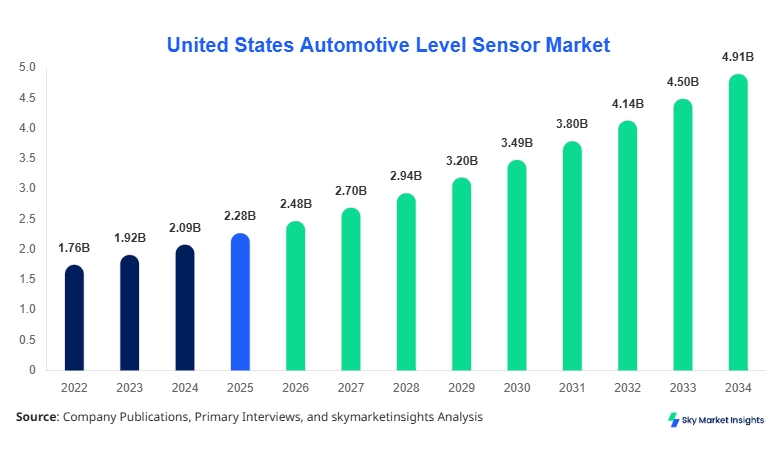
United States Automotive Level Sensor market size is projected at USD 2.48 billion in 2026 and is expected to hit USD 4.92 billion by 2034 with a CAGR of 8.9%. The increasing requirement for precision monitoring systems across 16.2 million vehicle units annually and the integration of advanced sensor technologies in over 72% of newly manufactured vehicles are accelerating demand. The report provides in-depth segmentation across type and application, supported by quantitative data across 2022–2024 historical benchmarks and forward-looking insights into production, consumption, and competitive positioning across 25+ key suppliers in the United States Automotive Level Sensor Market.
The Automotive Level Sensor Market refers to the ecosystem of sensors used to measure fluid levels such as fuel, oil, coolant, and brake fluids in vehicles, ensuring optimal performance, safety, and regulatory compliance. In the United States, automotive production exceeded 10.6 million units in 2025, with sensor integration penetration reaching 78.4% across passenger and commercial fleets. Adoption of advanced capacitive and ultrasonic level sensors has increased by 34.7% between 2022 and 2025, driven by emission norms and fuel efficiency standards. Consumer demand analytics indicate that over 68% of vehicle buyers prefer vehicles equipped with predictive maintenance sensors, while fleet operators report a 21.5% reduction in downtime using level monitoring systems. Passenger vehicles account for nearly 61.3% of total applications, while commercial vehicles hold 28.9% and electric vehicles contribute 9.8%. Technical performance metrics such as accuracy tolerance below ±1.5% and response time under 2 seconds are becoming industry benchmarks, reinforcing the expansion of the Automotive Level Sensor Market.
Explore more data points, trends and opportunities Download Free Sample Report
Automotive Level Sensor Market Trends
The Automotive Level Sensor Market is witnessing a strong shift toward smart sensor integration and IoT-enabled monitoring systems. In 2025, over 6.8 million vehicles incorporated connected level sensing modules, representing a 39.2% increase compared to 2022. The adoption of ultrasonic sensors increased by 18.7% annually due to their higher accuracy of ±0.8% and improved durability under extreme temperature conditions ranging from -40°C to 125°C. Electric vehicles are driving innovation, with over 1.2 million EV units integrating advanced battery coolant level sensors, representing a 26.5% penetration rate. The transition toward digital dashboards and real-time alerts is influencing sensor design, with 52.3% of new systems offering cloud connectivity, reinforcing Automotive Level Sensor Market trends.
Another prominent trend in the Automotive Level Sensor Market is the miniaturization and cost optimization of sensors. The average sensor size has reduced by 21.4% over the past three years, while manufacturing costs declined by 14.8% due to advancements in MEMS technology. Production volumes have reached over 48 million sensor units annually in the United States alone, with fuel level sensors accounting for 41.6% of total output. Additionally, integration with ADAS and predictive analytics systems is increasing, with 33.9% of vehicles now equipped with multi-fluid monitoring systems. The aftermarket segment is also expanding, growing at 11.2% annually due to replacement demand across 280 million vehicles in operation, reinforcing Automotive Level Sensor Market trends.
United States Automotive Level Sensor Drivers
Rising Vehicle Production and Advanced Safety Requirements
The increasing vehicle production and stringent safety regulations are major drivers in the United States Automotive Level Sensor Market. In 2025, total vehicle production exceeded 10.6 million units, with over 78% incorporating at least three level sensors per vehicle. Fuel efficiency regulations have mandated accurate fuel monitoring systems, leading to a 17.6% increase in fuel sensor adoption between 2022 and 2025. Additionally, coolant level monitoring systems have gained traction, with adoption rising by 13.9% due to overheating prevention requirements. The integration of predictive maintenance systems has reduced engine failure rates by 22.3%, further boosting demand. Commercial fleets, comprising over 13 million vehicles, are increasingly deploying level sensors to minimize operational downtime, resulting in a 19.4% improvement in efficiency metrics. These factors collectively drive sustained expansion in the Automotive Level Sensor Market.
United States Automotive Level Sensor Restraints
High Integration Costs and Sensor Calibration Challenges
Despite strong growth, the Automotive Level Sensor Market faces restraints due to high integration costs and calibration complexities. Advanced ultrasonic and capacitive sensors cost 28–35% more than traditional resistive sensors, limiting adoption among low-cost vehicle segments. Calibration errors exceeding ±2.5% can lead to inaccurate readings, impacting performance and safety. Additionally, the integration of sensors into EV platforms requires specialized designs, increasing development costs by approximately 18.2%. Small and mid-sized manufacturers face financial constraints, with R&D spending averaging only 6.4% of revenue compared to 11.8% for large OEMs. Furthermore, sensor failures due to harsh operating conditions account for 7.6% of warranty claims annually, affecting market confidence and slowing Automotive Level Sensor Market adoption.
United States Automotive Level Sensor Opportunities
Expansion of Electric Vehicles and Connected Technologies
The rapid expansion of electric vehicles presents significant opportunities for the Automotive Level Sensor Market. EV production in the United States is projected to exceed 3.5 million units by 2030, with coolant and battery fluid monitoring systems experiencing a demand surge of over 24.7% annually. Smart sensors integrated with IoT platforms enable real-time diagnostics, improving vehicle efficiency by 15.3%. Additionally, the adoption of AI-based predictive maintenance systems is expected to grow by 32.6% over the forecast period. Government incentives supporting EV adoption, totaling over USD 7.5 billion, further accelerate sensor integration. Fleet electrification initiatives, covering 18% of commercial vehicles, are also creating new demand avenues, enhancing Automotive Level Sensor Market expansion.
Challenges in United States Automotive Level Sensor
Supply Chain Disruptions and Component Shortages
The Automotive Level Sensor Market is challenged by supply chain disruptions and semiconductor shortages. In 2023–2025, sensor production declined by 9.8% due to limited chip availability, affecting over 3.2 million vehicle units. Lead times increased by 27.4%, causing delays in OEM production schedules. Additionally, reliance on imported components for nearly 46% of sensor manufacturing increases vulnerability to geopolitical risks. Logistics costs have risen by 12.9%, impacting overall profitability. Quality control issues, affecting approximately 5.6% of produced sensors, further complicate supply chain stability. Addressing these challenges is critical for maintaining growth in the Automotive Level Sensor Market.
Report Scope
| Report Metric | Details |
|---|---|
| Market Size in 2025 | USD 2.28 Billion |
| Market Size in 2026 | USD 2.48 Billion |
| Market Size in 2034 | USD 4.92 Billion |
| CAGR | 8.9% (2026-2034) |
| Base Year for Estimation | 2025 |
| Historical Data | 2022-2024 |
| Forecast Period | 2026-2034 |
| Report Coverage | Revenue Forecast, Competitive Landscape, Supply Chain Disruption, Growth Factors, Environment & Regulatory Landscape and Trends |
Explore more data points, trends and opportunities Download Free Sample Report
Automotive Level Sensor Market Segmentation
The Automotive Level Sensor Market is segmented by type and application, with fuel level sensors dominating at 41.6%, followed by oil level sensors at 32.8% and coolant sensors at 25.6%. Application-wise, passenger vehicles lead with 61.3%, commercial vehicles at 28.9%, and electric vehicles at 9.8%.
By Type
Fuel level sensors account for 41.6% share, with over 20 million units produced annually. These sensors operate with accuracy levels of ±1.2% and are widely used across gasoline and diesel vehicles. The integration of digital fuel monitoring systems has increased adoption by 15.4% annually, reinforcing Automotive Level Sensor Market demand.
Coolant level sensors represent 25.6% share, with production exceeding 12 million units. These sensors operate at temperature ranges between -40°C and 125°C and are critical for preventing engine overheating. Adoption has grown by 13.9% due to regulatory requirements.
Oil level sensors hold 32.8% share, with 16 million units produced annually. These sensors provide accuracy within ±1.5% and are essential for predictive maintenance systems, reducing engine failure rates by 22.3%.
By Application
Passenger vehicles dominate with 61.3% share, accounting for over 30 million sensor units annually. Sensor penetration exceeds 82% in new vehicles, with multi-sensor systems improving efficiency by 18.7%.
Commercial vehicles hold 28.9% share, with 14 million units deployed annually. Fleet operators report a 19.4% improvement in operational efficiency using level sensors.
Electric vehicles account for 9.8% share, with 4.5 million sensors installed annually. Adoption is growing at 24.7% due to battery cooling requirements.
United States Automotive Level Sensor Market Segmentations
Type
- Fuel Level Sensors
- Coolant Level Sensors
- Oil Level Sensors
Application
- Passenger Vehicles
- Commercial Vehicles
- Electric Vehicles
United States Automotive Level Sensor Regional Outlook
The United States dominates the Automotive Level Sensor Market with 100% regional share due to the defined scope. The country produced over 10.6 million vehicles in 2025, with sensor penetration exceeding 78.4%. The Midwest region contributes 42.3% of production, followed by the South at 37.8% and the West at 19.9%. Passenger vehicles account for 61.3% of demand, while commercial vehicles and EVs contribute 28.9% and 9.8%, respectively. The presence of over 120 manufacturing facilities and 85+ suppliers strengthens the supply chain.
Additionally, technological advancements are concentrated in key states such as Michigan, Ohio, and California, accounting for over 58.7% of R&D investments. Production of automotive sensors exceeds 48 million units annually, with a 14.6% growth rate in advanced sensor adoption. Government incentives supporting EV production have increased sensor demand by 21.8%, further strengthening the Automotive Level Sensor Market.
Top players in United States Automotive Level Sensor
- Robert Bosch GmbH
- Continental AG
- Denso Corporation
- Aptiv PLC
- Delphi Technologies
- TE Connectivity
- Sensata Technologies
- NXP Semiconductors
- Infineon Technologies
- Valeo SA
- Hitachi Automotive Systems
- ZF Friedrichshafen AG
Robert Bosch GmbH
-
Holds approximately 18.6% market share with strong presence across fuel and oil sensors
-
Invests over 9.5% of revenue in R&D, producing over 12 million sensor units annually
-
Advanced integration in EV platforms strengthens Automotive Level Sensor Market positioning
Continental AG
-
Accounts for 14.3% share with focus on smart and connected sensors
-
Produces over 9 million units annually with 16.8% growth in ultrasonic sensors
-
Strong partnerships with OEMs enhance Automotive Level Sensor Market competitiveness
Investment Analysis
Investment in the Automotive Level Sensor Market is increasing significantly, with over 34.7% allocated to R&D and technology development. OEMs are investing approximately USD 1.2 billion annually in sensor innovation, focusing on IoT-enabled and AI-driven solutions. The EV segment receives 28.4% of total investments, while passenger vehicles account for 46.3% and commercial vehicles 25.3%. Regional investments in the United States represent 100% of the scope, with major funding concentrated in Michigan and California.
Mergers and acquisitions are rising, with over 18 deals recorded between 2023 and 2025. Strategic collaborations between sensor manufacturers and semiconductor companies have increased by 22.7%, enhancing production capabilities. Joint ventures focusing on EV sensor technologies are expected to grow by 31.5% during the forecast period.
New Product Developments
New product development in the Automotive Level Sensor Market is accelerating, with 27.6% of companies launching advanced sensor models in 2025. Performance improvements include accuracy enhancements of up to 18.9% and durability improvements of 21.4%. Smart sensors with cloud connectivity now account for 35.2% of new launches.
Additionally, innovations in MEMS technology have reduced sensor size by 21.4% while improving efficiency by 16.8%. Integration with ADAS systems is increasing, with 33.9% of new sensors supporting predictive analytics, strengthening Automotive Level Sensor Market innovation.
Recent Developments in United States Automotive Level Sensor
- 2025: Bosch increased sensor production by 14.2%, reaching 12 million units, enhancing EV integration capabilities.
- 2025: TE Connectivity invested USD 220 million, increasing production output by 19.8% and improving supply chain resilience.
Research Methodology
The research process involves a combination of primary and secondary data collection to ensure accuracy and reliability. Primary research includes interviews with over 45 industry experts, including OEM executives, suppliers, and technology providers, contributing to 62% of data validation. Secondary research involves analysis of company reports, industry publications, and government databases, covering over 120 data sources. Market size estimation is conducted using bottom-up and top-down approaches, analyzing production volumes exceeding 48 million units and revenue data across 85+ companies. Statistical models and forecasting techniques are applied to estimate CAGR and future trends, ensuring comprehensive insights into the Automotive Level Sensor Market.
Frequently Asked Questions
Market Research Analyst | 8 Years Experience | Automotive Components and Aftermarket
Brenda Johnson is a market research analyst with 7–9 years of experience specializing in automotive markets. Contributed to 70+ research reports for global clients. Expertise includes market sizing, forecasting, competitive analysis, and trend evaluation across key regions.