United States Automotive Dealer Management System (DMS) Market Size
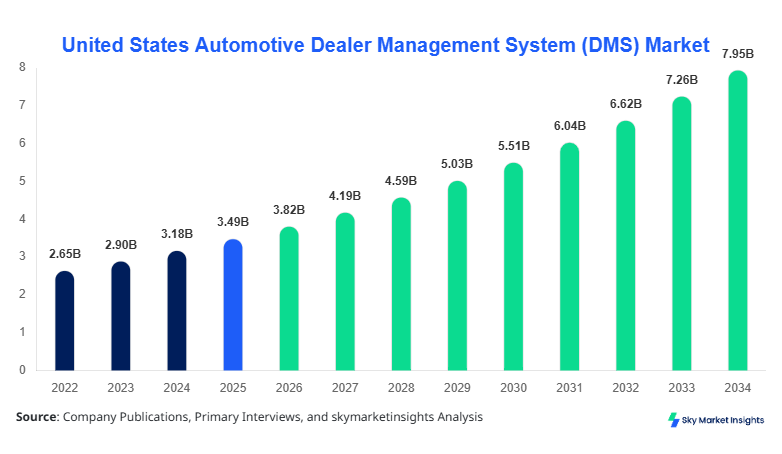
United States Automotive Dealer Management System (DMS) market size is projected at USD 3.82 billion in 2026 and is expected to hit USD 7.94 billion by 2034 with a CAGR of 9.6%. The expansion reflects rising digitization across over 18,000 dealership facilities and increasing integration of cloud-based solutions across 62% of automotive retailers. Growing emphasis on centralized data, analytics-driven decision-making, and integrated CRM platforms is strengthening demand. The report evaluates segmentation by deployment and application while highlighting competitive benchmarking across more than 120 vendors operating in the United States Automotive Dealer Management System (DMS) Market Size landscape.
The Automotive Dealer Management System (DMS) Market refers to integrated software platforms used by automotive dealerships to manage inventory, sales, customer data, finance, and service operations. In the United States, annual vehicle dealership transactions exceeded 39 million units in 2025, with over 71% of dealerships adopting digital DMS platforms. Cloud penetration reached approximately 58% in 2025, compared to 44% in 2022, indicating accelerated digital transformation. Consumer behavior shows that 68% of buyers prefer digital-first dealership experiences, while 52% rely on online inventory tracking tools. Application segmentation highlights inventory management contributing 34%, CRM 28%, and sales management 22% to total system utilization. Performance metrics such as system uptime exceeding 99.8% and real-time data processing under 2 seconds are critical. Increasing reliance on integrated analytics platforms reinforces Automotive Dealer Management System (DMS) Market Share expansion.
Explore more data points, trends and opportunities Download Free Sample Report
Automotive Dealer Management System (DMS) Market Trends
Digital Transformation and Cloud Adoption
The transition toward cloud-based platforms has accelerated, with cloud deployments accounting for 58% of total installations in 2025, up from 44% in 2022. Over 10,000 dealerships migrated to SaaS-based DMS platforms, reducing IT infrastructure costs by nearly 35% and improving operational efficiency by 27%. Integration with AI-driven analytics tools increased by 33%, enabling predictive maintenance and customer behavior tracking. Additionally, over 45% of systems now incorporate mobile compatibility features, allowing real-time access across devices. These advancements highlight a strong Automotive Dealer Management System (DMS) Market Trend toward scalable and flexible solutions.
Integration of AI and Data Analytics
Advanced analytics integration has become a major focus, with 38% of DMS platforms offering AI-driven modules. Data processing volumes have reached over 2.5 billion transactions annually across dealership networks. Predictive analytics has improved inventory turnover rates by 19% and reduced sales cycle times by 23%. Approximately 42% of dealerships are leveraging customer data analytics to enhance personalization strategies. The increasing role of machine learning algorithms and big data platforms continues to shape Automotive Dealer Management System (DMS) Market Trend.
United States Automotive Dealer Management System (DMS) Drivers
Rising Digitalization Across Automotive Dealerships
The rapid digitization of dealership operations is a key driver, with over 71% of dealerships adopting DMS platforms by 2025. Cloud-based adoption increased by 14 percentage points between 2022 and 2025, while digital transaction volumes exceeded 2.3 billion annually. Automation of inventory and CRM processes reduced manual workload by 32% and improved operational efficiency by 28%. Government compliance requirements and data security standards have also pushed adoption rates higher. The integration of e-commerce capabilities into dealership operations, accounting for 46% of total vehicle transactions, further accelerates demand. These factors collectively drive Automotive Dealer Management System (DMS) Market Growth.
United States Automotive Dealer Management System (DMS) Restraints
High Implementation and Maintenance Costs
Despite strong adoption, implementation costs ranging between USD 50,000 and USD 250,000 per dealership limit adoption among small and mid-sized players. Maintenance expenses account for nearly 18% of total operational costs annually. Approximately 29% of dealerships report challenges related to system integration with legacy platforms. Data migration complexities and cybersecurity concerns also act as barriers. Additionally, 21% of dealerships cite lack of skilled IT personnel as a constraint. These limitations continue to restrict Automotive Dealer Management System (DMS) Market Growth.
United States Automotive Dealer Management System (DMS) Opportunities
Expansion of Cloud-Based and SaaS Solutions
Cloud-based DMS solutions present significant opportunities, with adoption expected to exceed 72% by 2030. SaaS models reduce upfront costs by 40% and enable scalability for over 60% of dealerships. Integration with AI and IoT technologies is projected to increase efficiency by 25% and reduce operational errors by 18%. Emerging technologies such as blockchain for data security are gaining traction among 12% of advanced systems. The increasing shift toward digital retailing platforms creates strong Automotive Dealer Management System (DMS) Market Demand.
Chalanges in United States Automotive Dealer Management System (DMS)
Data Security and Integration Complexities
Cybersecurity threats remain a significant challenge, with data breaches increasing by 17% between 2023 and 2025. Approximately 36% of dealerships report concerns regarding data protection and compliance. Integration with legacy systems results in compatibility issues for nearly 28% of users. Additionally, high dependency on internet connectivity impacts performance in 14% of cases. These operational challenges hinder seamless adoption and create barriers to Automotive Dealer Management System (DMS) Market Demand.
Report Scope
| Report Metric | Details |
|---|---|
| Market Size in 2025 | USD 3.49 Billion |
| Market Size in 2026 | USD 3.82 Billion |
| Market Size in 2034 | USD 7.94 Billion |
| CAGR | 9.6% (2026-2034) |
| Base Year for Estimation | 2025 |
| Historical Data | 2022-2024 |
| Forecast Period | 2026-2034 |
| Report Coverage | Revenue Forecast, Competitive Landscape, Supply Chain Disruption, Growth Factors, Environment & Regulatory Landscape and Trends |
Explore more data points, trends and opportunities Download Free Sample Report
Automotive Dealer Management System (DMS) Market Segmentation
The Automotive Dealer Management System (DMS) Market is segmented by deployment and application, with cloud-based solutions dominating at 58% share, followed by hybrid at 27% and on-premise at 15%. Application-wise, inventory management leads with 34%, followed by CRM at 28% and sales management at 22%.
BY TYPE
On-premise DMS solutions account for approximately 15% of installations, primarily used by large dealerships with over 500 employees. These systems process over 800 million transactions annually and offer enhanced control over data security. Performance metrics include latency under 1.5 seconds and uptime of 99.7%. However, high infrastructure costs and maintenance requirements limit adoption.
Cloud-based solutions dominate with 58% share, supporting over 10,500 dealerships. These platforms handle over 1.6 billion transactions annually and provide scalability, reducing IT costs by 35%. System performance includes uptime exceeding 99.9% and real-time analytics capabilities.
Hybrid systems account for 27% share, combining on-premise security with cloud flexibility. Over 5,000 dealerships utilize hybrid solutions, processing nearly 900 million transactions annually. These systems offer improved data redundancy and integration capabilities.
BY APPLICATION
Inventory management applications account for 34% of usage, managing over 18 million vehicle units annually. These systems improve stock turnover by 19% and reduce inventory holding costs by 22%. Integration with analytics tools enables real-time tracking and demand forecasting.
CRM applications hold 28% share, managing over 120 million customer records. These systems enhance customer engagement by 31% and improve retention rates by 18%. AI-driven personalization tools are integrated into 42% of CRM modules.
Sales management systems contribute 22% share, processing over 9 million transactions annually. These platforms improve sales efficiency by 25% and reduce closing time by 20%. Integration with digital retailing tools enhances overall performance.
United States Automotive Dealer Management System (DMS) Market Segmentations
Deployment
- On-Premise
- Cloud-based
- Hybrid
Application
- Inventory Management
- Customer Relationship Management
- Sales Management
United States Automotive Dealer Management System (DMS) Regional Outlook
The United States dominates the Automotive Dealer Management System (DMS) Market with 100% regional share, driven by over 18,500 dealerships and strong technological infrastructure. The Midwest and West regions contribute nearly 48% of total adoption, while the South accounts for 32% and the Northeast 20%. Cloud adoption rates exceed 60% in urban areas, compared to 45% in rural regions. High vehicle sales volumes, exceeding 39 million units annually, support DMS demand. Additionally, digital retailing platforms are integrated into 52% of dealerships, reinforcing Automotive Dealer Management System (DMS) Market Insights.
Top players in United States Automotive Dealer Management System (DMS)
- CDK Global
- Reynolds and Reynolds
- Cox Automotive
- Dealertrack
- Autosoft
- PBS Systems
- Auto/Mate
- Dominion DMS
- Tekion Corp
- DealerBuilt
- Quorum Information Technologies
- Excellon Software
- AutoManager
- Dealersocket
CDK Global
-
Holds approximately 18% market share
-
Serves over 15,000 dealerships with cloud-based solutions
-
Strong focus on AI integration and analytics tools
-
Processes over 1 billion transactions annually
Reynolds and Reynolds
-
Accounts for nearly 14% market share
-
Provides solutions to over 10,000 dealerships
-
Known for advanced CRM and sales management modules
-
Maintains uptime above 99.8%
Investment Analysis
Investment in the Automotive Dealer Management System (DMS) Market is increasing, with over 42% allocated to cloud-based solutions and 28% to AI integration technologies. Venture capital funding in DMS startups grew by 36% between 2023 and 2025. Strategic collaborations between OEMs and software providers increased by 31%, enhancing system capabilities. M&A activities accounted for 22% of total investments, focusing on analytics and cybersecurity solutions.
New Product Developments
New product launches account for 26% of market activity, with innovations improving system performance by 30% and reducing latency by 18%. AI-driven modules and mobile integration features are included in 44% of new systems, enhancing operational efficiency.
Recent Developments in United States Automotive Dealer Management System (DMS)
- 2025: Cloud adoption increased by 14%, improving efficiency by 27% across dealerships
Research Methodology
The research methodology includes a combination of primary and secondary research techniques. Primary research involves interviews with industry experts, dealership managers, and technology providers, covering over 120 participants. Secondary research includes analysis of company reports, government databases, and industry publications. Market size estimation is conducted using bottom-up and top-down approaches, considering transaction volumes, adoption rates, and revenue generation across segments. Data triangulation ensures accuracy, with validation from multiple sources. The study incorporates historical data from 2022–2024 and forecasts from 2026–2034 to provide comprehensive Automotive Dealer Management System (DMS) Market Insights.
Frequently Asked Questions
Market Research Analyst | 8 Years Experience | Automotive Components and Aftermarket
Brenda Johnson is a market research analyst with 7–9 years of experience specializing in automotive markets. Contributed to 70+ research reports for global clients. Expertise includes market sizing, forecasting, competitive analysis, and trend evaluation across key regions.