Japan Automated Truck Loading System Market Size
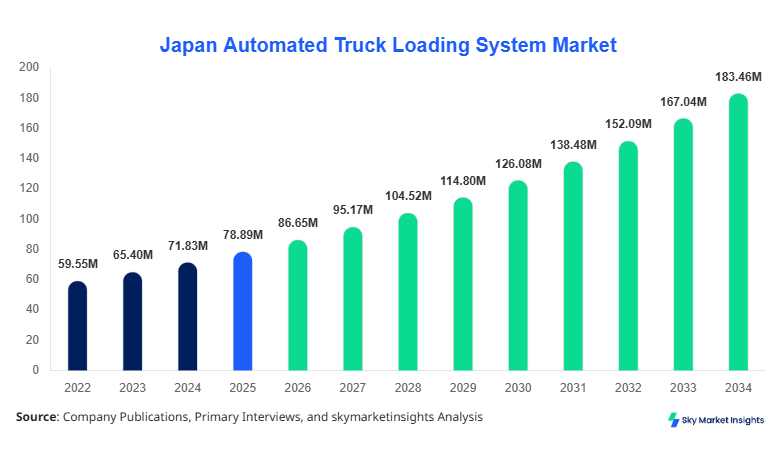
Japan Automated Truck Loading System Market size is projected at USD 86.65 million in 2026 and is expected to hit USD 184.31 million by 2034 with a CAGR of 9.83%. The 2025 base-year valuation was USD 78.87 million. The report evaluates 8 system categories, 5 truck classes, loading-dock configurations, automation levels, components, end-user demand, and the competitive landscape.
Key Takeaways
- Japan accounts for 100% of the analyzed national market; Kanto is estimated to dominate domestic deployments, while Kyushu is expected to record the fastest regional expansion through 2034.
- Chain conveyor systems lead with USD 24.85 million and a 28.68% share in 2026; AGV-based systems post the fastest 10.10% CAGR.
- Standard trailer trucks dominate with USD 31.10 million and a 35.93% share in 2026; containerized trucks expand fastest at 10.25%.
- Chain conveyor systems reach USD 53.55 million by 2034, while standard trailer truck applications reach USD 65.50 million.
- The total opportunity rises by USD 97.66 million between 2026 and 2034, equivalent to approximately 112.71% cumulative expansion.
The automated truck loading system market comprises conveyors, autonomous lift trucks, AGVs, robotic arms, control software, sensors, and integration services that transfer pallets or loose goods between warehouses and trailers with limited manual intervention. Japan produced approximately 8.99 million motor vehicles in 2023, including more than 1 million commercial vehicles and buses, while operating 435,299 industrial robots; annual robot installations reached 46,106 units. In 2026, chain conveyors contribute 28.68% of system revenue, slat conveyors 18.11%, and roller tracks 14.78%. Standard trailers account for 35.93% of truck-type revenue and refrigerated trucks contribute 31.55%.
Explore more data points, trends and opportunities Download Free Sample Report
Japan Automated Truck Loading System Market Trends
AI-Guided Mobile Equipment Is Extending Automation into the Trailer
Japan's installed industrial-robot population increased 5% to 435,299 units, although annual installations declined 9% to 46,106 units in 2023. This large automation base is accelerating the transition from fixed conveyors toward 3D-LiDAR, machine vision, deep learning, digital twins, and marker-free navigation. Autonomous lift trucks can now detect trailer position, locate pallets, and generate approach routes without floor-mounted guides.
Sector demand is shifting from repetitive automotive flows to mixed-load FMCG, beverage, e-commerce, and healthcare operations. Japan produced 8.99 million vehicles in 2023, up 14.8%, while automotive shipments reached JPY 71.6 trillion and represented 19.2% of manufacturing shipments. Automated loading increasingly connects warehouse management systems, fleet controllers, dock sensors, and robotic palletizers to achieve 24-hour operation, reduce loading errors, and support high-mix distribution.
Japan Automated Truck Loading System Market Drivers
Labor Regulation and Logistics Capacity Constraints Accelerate Deployment
Japan's logistics "2024 problem" intensified after overtime limits for truck drivers took effect, increasing pressure to reduce waiting, loading, and unloading time. With the industrial-robot fleet already exceeding 435,000 units and logistics operations commonly requiring 2–3 manual workers per dock, automated systems can consolidate repetitive pallet handling into continuously monitored workflows. A typical 24-hour distribution center operating across 2 or 3 shifts gains additional value from automated trailer positioning, synchronized dock scheduling, and reductions in idle-time percentages.
Japan Automated Truck Loading System Market Restraints
High Retrofit Costs and Trailer Variability Restrict Standardization
Brownfield facilities may contain 4 dock designs, several trailer heights, uneven floors, and pallet-position deviations measured in millimeters. Systems incorporating 3D-LiDAR, cameras, safety PLCs, conveyors, and WMS interfaces require installation, testing, and recurring maintenance. Even a 1–2% alignment error can interrupt loading, while integration across 5 truck categories and 8 system technologies increases engineering complexity. Smaller operators with fewer than 10 docks often face longer payback periods than high-throughput facilities running 2 or 3 shifts.
Japan Automated Truck Loading System Market Opportunities
Cold Chain, E-commerce, and Brownfield Automation Create Expansion Potential
Temperature-controlled logistics offers substantial potential because automated loading reduces door-open time, product exposure, and manual handling. Refrigerated trucks already represent more than 31% of measured truck-type revenue. Modular AGVs, autonomous forklifts, and telescopic conveyors can address facilities handling 50–1,000 cases per hour without complete dock reconstruction. Cloud analytics, predictive maintenance, and fleet orchestration can also convert one-time hardware projects into 5–10-year software and service relationships.
Challenges in Japan Automated Truck Loading System Market
Mixed Loads, Safety Validation, and System Interoperability Remain Critical
Mixed-SKU pallets, deformable packaging, and load shifts of only a few millimeters can cause unstable placement or pallet collapse. Systems must coordinate at least 3 operating domains—warehouse, dock, and vehicle—while maintaining personnel detection and emergency-stop coverage. Robotic unloading platforms can process more than 1,000 cases per hour and reach approximately 52 feet into a trailer, but reliable performance depends on packaging recognition, network availability, sensor calibration, and exception-management procedures.
Report Scope
| Report Metric | Details |
|---|---|
| Market Size in 2025 | USD 78.89 Million |
| Market Size in 2026 | USD 86.65 Million |
| Market Size in 2034 | USD 184.31 Million |
| CAGR | 9.83% (2026-2034) |
| Base Year for Estimation | 2025 |
| Historical Data | 2022-2024 |
| Forecast Period | 2026-2034 |
| Report Coverage | Revenue Forecast, Competitive Landscape, Supply Chain Disruption, Growth Factors, Environment & Regulatory Landscape and Trends |
Explore more data points, trends and opportunities Download Free Sample Report
Japan Automated Truck Loading System Market Segmentation
The market is segmented by system type, truck type, loading-dock design, industry, automation level, and component. Chain conveyors command 28.68% of 2026 system revenue, while standard trailers represent 35.93% of truck-type revenue.
By System Type
Chain conveyor systems are the largest category, increasing from USD 22.58 million in 2025 to USD 24.85 million in 2026 and USD 53.55 million in 2034 at a 10.07% CAGR. Slat, roller, belt, and skate conveyors collectively generate USD 46.04 million in 2026.
AGV-based systems are the fastest-growing category at 10.10%, advancing from USD 6.14 million in 2026 to USD 13.27 million in 2034. Robotic-arm systems reach USD 12.11 million at a 9.85% CAGR, while other systems attain USD 8.12 million at 9.56%.
By Truck Type
Standard trailer trucks lead, rising from USD 28.33 million in 2025 to USD 31.10 million in 2026 and USD 65.50 million by 2034 at a 9.76% CAGR. Refrigerated trucks follow with USD 27.31 million in 2026 and USD 56.44 million in 2034.
Containerized trucks expand fastest at 10.25%, increasing from USD 13.19 million in 2026 to USD 28.78 million in 2034. Special-purpose trucks grow at 10.08%, while flatbeds advance at 9.57% to USD 20.96 million.
By Loading Dock Design
Flush docks constitute the principal deployment environment because they support standardized conveyor alignment and high-volume pallet transfer. The quantified market totals USD 86.65 million in 2026 and USD 184.31 million in 2034, creating a USD 97.66 million expansion pool across 4 dock formats.
Enclosed docks are expected to record the fastest adoption because they improve safety, weather protection, and cold-chain control. Open and sawtooth docks remain important for constrained sites, although no separate CAGR or monetary split was supplied for these 4 categories.
By Industry
Automotive is the leading application, supported by Japan's 8.99 million-vehicle production base and JPY 71.6 trillion in automotive shipments. FMCG, retail, food, and beverage operations also require high-frequency pallet handling across 2–3 daily shifts.
E-commerce and logistics are expected to expand fastest as operators automate mixed-SKU movement and 24-hour fulfillment. Pharmaceuticals, chemicals, postal services, and other industries form additional demand across 8 specified vertical groups; standalone monetary values and CAGRs were not provided.
By Automation Level
Semi-automated systems currently represent the broader installed category because they can combine powered conveyors with manual trailer positioning. The overall opportunity increases 112.71% from USD 86.65 million in 2026 to USD 184.31 million in 2034.
Fully automated systems are expected to advance faster as 3D-LiDAR, AI vision, and autonomous forklifts mature. The segment reduces dependence on 2–3 dock workers per shift, although separate revenue and CAGR figures for the 2 automation levels were not supplied.
By Component
Hardware is the principal component, incorporating conveyors, robots, sensors, controls, and safety equipment. Equipment demand is supported by 46,106 annual industrial-robot installations and an operational stock exceeding 435,000 units.
Software is expected to grow faster as fleet control, WMS integration, analytics, and digital twins become standard. Services span 3 major activities—installation, maintenance, and integration—but independent component values and CAGRs were not supplied.
Japan Automated Truck Loading System Market Segmentations
By System Type
- Chain Conveyor System
- Slat Conveyor System
- Roller Track System
- Belt Conveyor System
- Skate Conveyor System
- Automated Guided Vehicles (AGVs) Based System
- Robotic Arm-Based System
- Others (e.g., telescopic belt loaders, modular lift systems)
By Truck Type
- Standard Trailer Trucks
- Refrigerated/Cold Chain Trucks
- Containerized Trucks
- Flatbed Trucks
- Special Purpose Trucks
By Loading Dock Design
- Flush Docks
- Enclosed Docks
- Open Docks
- Sawtooth Docks
By Industry
- Automotive
- FMCG and Retail
- E-commerce and Logistics
- Pharmaceuticals and Healthcare
- Food and Beverage
- Chemicals
- Postal and Courier
- Others (Textile, Electronics, Aerospace, etc.)
By Automation Level
- Semi-Automated Systems
- Fully Automated Systems
By Component
- Hardware
- Software
- Services (Installation, Maintenance, Integration)
Japan Automated Truck Loading System Market Country Outlook
Kanto Japan Automated Truck Loading System Market
Kanto is estimated to account for approximately 38% of national deployments, supported by Tokyo–Yokohama consumption, Chiba logistics assets, and Saitama fulfillment centers. The regional mix is weighted toward e-commerce, FMCG, postal, and containerized freight; Japan contributes 100% of the national USD 86.65 million total.
Chubu Japan Automated Truck Loading System Market
Chubu is estimated at 29%, reflecting Aichi's automotive and industrial concentration. Japan's 8.99 million-vehicle production ecosystem supports conveyor-intensive flows, while chain conveyors represent 28.68% and standard trailers 35.93% of the corresponding national segment totals.
Kansai Japan Automated Truck Loading System Market
Kansai is estimated to hold 21%, led by Osaka, Hyogo, and Kyoto distribution corridors. Food, beverage, pharmaceuticals, chemicals, and retail form the principal sector split; refrigerated-truck applications contribute 31.55% of national truck-type revenue.
Kyushu and Other Regions Japan Automated Truck Loading System Market
Kyushu and other regions collectively represent an estimated 12% and are positioned for faster expansion through new semiconductor, automotive, and regional fulfillment investments. AGV-based systems carry the fastest system CAGR of 10.10%, while containerized-truck applications grow at 10.25%.
Top players in Japan Automated Truck Loading System Market
- Toyota Industries Corporation
- Daifuku Co., Ltd.
- IHI Logistics & Machinery Corporation
- Murata Machinery, Ltd.
- Mitsubishi Logisnext Co., Ltd.
- Mujin, Inc.
- Okura Yusoki Co., Ltd.
- Seibu Electric & Machinery Co., Ltd.
- Kawasaki Heavy Industries, Ltd.
- FANUC Corporation
- Yaskawa Electric Corporation
- Omron Corporation
- Dematic
- Swisslog
- BEUMER Group
Top Two Companies
-
Toyota Industries Corporation — estimated 18% share: Toyota Industries occupies a leading position through its lift-truck installed base, autonomous material-handling portfolio, and direct access to Japanese manufacturing and distribution customers. Its autonomous truck-loading forklift combines 3D-LiDAR, image recognition, deep learning, pallet detection, and guideless routing. Commercial work with Kao and Coca-Cola Bottlers Japan demonstrates deployment across high-mix consumer products and beverage logistics. The company's position is reinforced by integration capabilities spanning vehicles, warehouse equipment, telematics, and maintenance. Its estimated 18% competitive share reflects strength in mobile automation rather than fixed conveyor equipment alone.
-
Daifuku Co., Ltd. — estimated 14% share: Daifuku is positioned strongly in integrated material handling, combining AGVs, conveyors, sortation, warehouse controls, and lifecycle services. The company has sold more than 20,000 AGVs since entering the category in 1961, providing a substantial installed-base advantage. Its Japanese manufacturing expansion includes a facility completed in July 2025 for assembling AGVs serving manufacturing and distribution industries. Daifuku's estimated 14% competitive share is supported by large-system engineering, domestic service coverage, and integration across automotive, retail, airport, and logistics environments.
Recent Developments in Japan Automated Truck Loading System Market
- 2025: Kao disclosed fully automated product receipt, storage, and truck loading at its Toyohashi Plant, implemented with Toyota Industries after initial operation in July 2024.
- 2025: Daifuku completed Building M for AGV assembly, expanding production capability for manufacturing and distribution automation.
Research Methodology
The assessment uses 2025 as the base year, 2026 as the current year, historical review for 2022–2024, and forecasts through 2034. Supplied system-type and truck-type tables form the primary quantitative source. Shares were calculated as segment revenue divided by the respective 2026 total; regional and company shares are analytical estimates. Validation incorporated production, robotics, logistics-regulation, corporate-release, and technology-deployment evidence, with values standardized to USD millions and growth expressed as CAGR.
Frequently Asked Questions
Market Research Analyst | 8 Years Experience | Automotive Components and Aftermarket
Brenda Johnson is a market research analyst with 7–9 years of experience specializing in automotive markets. Contributed to 70+ research reports for global clients. Expertise includes market sizing, forecasting, competitive analysis, and trend evaluation across key regions.