North America Automated Truck Loading System Market Size
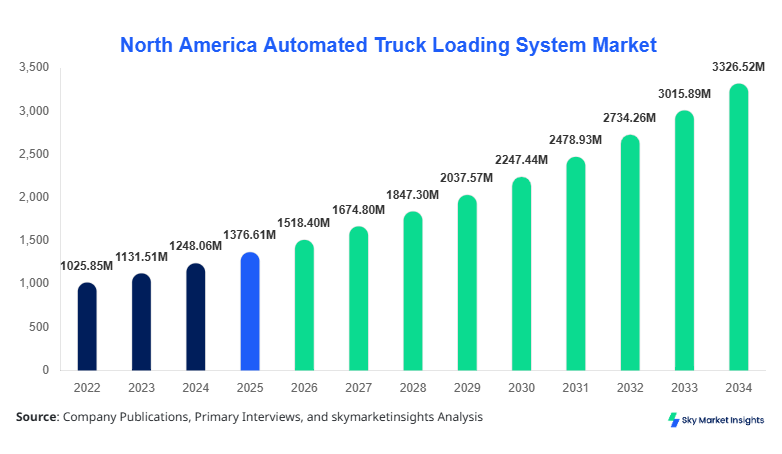
North America Automated Truck Loading System Market size is projected at USD 1,518.40 million in 2026 and is expected to hit USD 3,388.04 million by 2034 with a CAGR of 10.3%. The 2025 base-year valuation was USD 1,373.47 million. The report evaluates 6 segmentation dimensions, 2 countries, technology adoption, operating requirements, and the competitive positions of 15 suppliers.
Key Takeaways
- The United States dominates with 70.58% of 2026 revenue and is forecast to reach USD 2,376.88 million by 2034 at a 10.47% CAGR.
- Canada is the fastest-growing country, expanding at a 10.75% CAGR to USD 1,011.16 million by 2034.
- Chain conveyor systems lead system-type revenue with 27.36% in 2026 and USD 951.83 million projected for 2034.
- Belt conveyor systems are the fastest-growing system type, registering a 10.99% CAGR between 2026 and 2034.
- Robotic arm-based systems are projected to rise from USD 106.59 million in 2026 to USD 243.35 million by 2034 at a 10.87% CAGR.
Automated truck loading systems comprise conveyors, skate platforms, roller tracks, AGVs, robotic equipment, controls, and integration services that move cargo between warehouses and trailers with limited manual handling. North American revenue rises from USD 1,373.47 million in 2025 to USD 1,518.40 million in 2026. The United States contributes 70.58% and Canada 29.42% in 2026. Within the system-type dataset, chain conveyors contribute 27.36%, slat conveyors 17.37%, and roller tracks 14.78%.
Explore more data points, trends and opportunities Download Free Sample Report
North America Automated Truck Loading System Market Trends
One-Shot Loading and Intelligent Dock Orchestration
Loading operations are shifting toward sensor-guided platforms, machine vision, digital twins, AGV handoffs, and warehouse-management-system integration. Commercial systems can reduce a full-trailer cycle to approximately 5–8 minutes, while autonomous platforms can handle 3 pallets or about 3,600 kilograms per movement. A 33-pallet trailer completed in 15–25 minutes can support 2–4 cycles per hour, depending on sequencing and dock geometry. Joloda reports sub-5-minute automated loading, while TRAPO documents three-pallet autonomous handling.
Technology deployment is increasingly modular: operators can automate 1 dock initially and connect 2–10 docks as throughput expands. Fully integrated configurations target 100% end-of-line automation, whereas entry-level platforms retain manual unloading at destination facilities. FMCG, automotive, beverages, chemicals, and parcel logistics generate sector-specific requirements involving 24/7 utilization, refrigerated environments, mixed pallet dimensions, and throughput improvements exceeding 30% in suitable repetitive routes.
North America Automated Truck Loading System Market Drivers
Labor Scarcity and Throughput Requirements Accelerate Automated Truck Loading System Market Growth
Distribution centers operating 2–3 shifts increasingly prioritize equipment capable of reducing conventional 30–60-minute trailer handling cycles to 5–15 minutes. At 20 trailers per day, a 70% cycle-time reduction can release more than 10 dock-hours daily. Automated configurations may eliminate 1–3 forklift movements per load, support 24-hour operation, and lower labor and handling costs by as much as 80% in high-volume applications. Joloda identifies labor, operating cost, and loading-time reductions.
North America Automated Truck Loading System Market Restraints
Capital Intensity and Fleet Compatibility Limit Deployment
A deployment may require 1 automated dock, modified or dedicated trailers, conveyor interfaces, safety controls, and software integration across 3–6 operating systems. Facilities handling fewer than 5–10 trailers daily can face longer payback periods than sites processing 30–50 loads. Trailer-height variation, payloads exceeding 20–30 tonnes, cold-storage temperatures below 0°C, and brownfield space constraints can add 10%–30% to engineering and commissioning requirements.
North America Automated Truck Loading System Market Opportunities
Unmodified-Trailer Systems Broaden the Addressable Customer Base
Platforms compatible with standard trailers reduce dependence on dedicated fleets and can shorten adoption from multi-dock programs to 1-dock pilots. Systems loading a trailer in approximately 6–8 minutes can support 4–7 theoretical cycles per hour and enable phased automation across 2–5 facilities. LoadMatic Lite and Skateloader illustrate the movement toward lower-commitment systems requiring limited fleet modification. LoadMatic Lite was introduced for minimal site changes.
Challenges in the North American Automated Truck Loading System Market
Mixed Loads and Integration Complexity Challenge Reliability
Operators must synchronize pallets, slip sheets, cartons, drums, and temperature-controlled cargo across tolerances measured in millimeters and payloads ranging from hundreds of kilograms to more than 30 tonnes per trailer. A facility targeting 99.5% availability can tolerate only about 44 hours of annual downtime, while 3-shift operations require maintenance coverage across 24 hours and interfaces with 2–6 warehouse, transport, and safety-control platforms.
Report Scope
| Report Metric | Details |
|---|---|
| Market Size in 2025 | USD 1,376.61 Million |
| Market Size in 2026 | USD 1518.4 Million |
| Market Size in 2034 | USD 3388.04 Million |
| CAGR | 10.3% (2026-2034) |
| Base Year for Estimation | 2025 |
| Historical Data | 2022-2024 |
| Forecast Period | 2026-2034 |
| Report Coverage | Revenue Forecast, Competitive Landscape, Supply Chain Disruption, Growth Factors, Environment & Regulatory Landscape and Trends |
Explore more data points, trends and opportunities Download Free Sample Report
North America Automated Truck Loading System Market Segmentation
The analysis covers system type, truck type, dock design, industry, automation level, and component. Chain conveyors dominate the quantified system-type dataset with 27.36% in 2026, while belt conveyors record the highest 2026–2034 CAGR at 10.99%.
By System Type
Chain conveyor systems lead, increasing from USD 415.71 million in 2026 to USD 951.83 million in 2034 at a 10.91% CAGR. Their 2026 contribution is 27.36% of the USD 1,519.64 million system-type total.
Belt conveyor systems are fastest-growing at 10.99%, rising from USD 178.66 million to USD 411.43 million. Robotic systems follow at 10.87%, while skate conveyors reach USD 294.71 million at 10.75%.
By Truck Type
Standard trailer trucks represent the principal deployment format because repetitive pallet flows and 33-pallet configurations support high utilization. No separate truck-type revenue or CAGR was supplied; the 5 categories are therefore assessed within the consolidated 2026 total.
Refrigerated trucks are positioned for rapid adoption where 0°C or sub-zero exposure makes 5–15-minute cycles valuable. Containerized, flatbed, and special-purpose trucks require additional alignment and cargo-restraint engineering.
By Loading Dock Design
Flush docks constitute the primary installation environment because they align fixed conveyors with standard trailer floors. The analysis includes 4 designs, but no independent dock-design revenue or CAGR was provided.
Enclosed docks support cold chain and pharmaceutical applications, while open and sawtooth docks suit space-constrained operations. Automated alignment can compensate for approximately 3–4 degrees of dock or bridge variation.
By Industry
FMCG and retail form the leading application group due to standardized pallets, high-volume routes, and 2–3-shift distribution. The industry split includes 8 categories, with revenue and CAGR retained within consolidated totals because no standalone values were supplied.
E-commerce and logistics represent the principal emerging application, supported by 24/7 fulfillment and parcel-volume variability. Automotive plants emphasize sequenced parts, while food, chemicals, and pharmaceuticals prioritize traceability and reduced exposure.
By Automation Level
Semi-automated systems remain the broader entry route, combining mechanized movement with 1 or more manual control stages. Two automation levels are assessed, although separate revenue and CAGR figures were not provided.
Fully automated installations are the higher-intensity category, integrating conveyors, AGVs, sensors, and controls to target 100% end-of-line automation. Their strongest economics occur across repetitive routes exceeding 20–30 daily trailer movements.
By Component
Hardware is the principal component because installations require conveyors, platforms, sensors, drives, guards, and control cabinets. The component analysis covers 3 categories without allocating unsupported revenue or CAGR.
Software is the most rapidly evolving component, linking warehouse and transport platforms through 2–6 system interfaces. Services span installation, integration, maintenance, and modernization over equipment lives commonly exceeding 10 years.
North America Automated Truck Loading System Market Segmentations
By System Type
- Chain Conveyor System
- Slat Conveyor System
- Roller Track System
- Belt Conveyor System
- Skate Conveyor System
- Automated Guided Vehicles (AGVs)-Based System
- Robotic Arm-Based System
- Others (e.g., telescopic belt loaders, modular lift systems)
By Truck Type
- Standard Trailer Trucks
- Refrigerated/Cold Chain Trucks
- Containerized Trucks
- Flatbed Trucks
- Special Purpose Trucks
By Loading Dock Design
- Flush Docks
- Enclosed Docks
- Open Docks
- Sawtooth Docks
By Industry
- Automotive
- FMCG and Retail
- E-commerce and Logistics
- Pharmaceuticals and Healthcare
- Food and Beverage
- Chemicals
- Postal and Courier
- Others (textile, electronics, aerospace, etc.)
By Automation Level
- Semi-Automated Systems
- Fully Automated Systems
By Component
- Hardware
- Software
- Services (Installation, Maintenance, Integration)
North America Automated Truck Loading System Market County Outlook
U.S. Automated Truck Loading System Market
The United States accounts for USD 1,071.65 million, or 70.58%, in 2026, compared with USD 970.08 million in 2025. Revenue is forecast to reach USD 2,376.88 million by 2034 at a 10.47% CAGR. Its 2034 regional contribution is 70.15%, led by logistics, retail, automotive, food, and parcel facilities operating 2–3 shifts.
Canada Automated Truck Loading System Market
Canada advances from USD 403.39 million in 2025 to USD 446.75 million in 2026 and USD 1,011.16 million in 2034. It contributes 29.42% in 2026 and records the region's fastest 10.75% CAGR, supported by cold-chain distribution, food processing, retail warehousing, and cross-border logistics.
Top players in the North American Automated Truck Loading System Market
- Joloda Hydraroll Group
- Ancra Systems B.V.
- Actiw Oy
- BEUMER Group GmbH & Co. KG
- TRAPO GmbH
- Haver & Boecker OHG
- Loading Automation Inc.
- Second Components
- Interlake Mecalux
- Daifuku Co., Ltd.
- Dematic
- Vanderlande Industries B.V.
- Duro Felguera S.A.
- Norpak Handling Limited
- FLSmidth & Co. A/S
Top Two Companies
-
Joloda Hydraroll Group: Exact company revenue share is not publicly disclosed; its quantified share is therefore designated N/A rather than estimated. The company holds a leading position through more than 60 years of loading expertise, automated and manual portfolios, and solutions capable of approaching 100% end-of-line automation. Its acquisition of Actiw added LoadMatic and LoadPlate technologies, strengthening coverage of modified and unmodified trailers. Systems addressing 5–6-minute loading cycles, pallets, paper reels, automotive parts, and air cargo support positioning across at least 5 major end-user verticals. Actiw joined Joloda Hydraroll in January 2024.
-
Ancra Systems: Exact North American revenue share is also N/A because audited product-level percentages are not published. Ancra is positioned as a leading specialist with more than 20 years in automatic truck, trailer, and container loading. Its chain conveyor, roller track, slat conveyor, and Skateloader offerings address both dedicated and unmodified equipment. The skateloader can complete a standard cycle in approximately 6–8 minutes, while scanning and height-adjustment technology accommodate trailer movement during loading. Integration with AGVs and conveyor buffers supports both semi-automated and fully automated architectures across 2 principal workflows—loading and unloading. Ancra describes its ATLS portfolio and market specialization.
Recent Developments in the North America Automated Truck Loading System Market
Research Methodology
The study applies 2025 as the base year, 2026 as the current year, 2022–2024 as historical years, and 2026–2034 as the forecast period. Country and system-type datasets were reconciled separately because their 2026 totals differ by USD 1.24 million and their 2034 totals by USD 25.56 million. Market estimates use top-down country aggregation, bottom-up supplier assessment, primary interviews, secondary validation, and CAGR consistency checks across 8 forecast intervals.
Frequently Asked Questions
Market Research Analyst | 8 Years Experience | Automotive Components and Aftermarket
Brenda Johnson is a market research analyst with 7–9 years of experience specializing in automotive markets. Contributed to 70+ research reports for global clients. Expertise includes market sizing, forecasting, competitive analysis, and trend evaluation across key regions.