South Korea Automated Truck Loading System Market Size
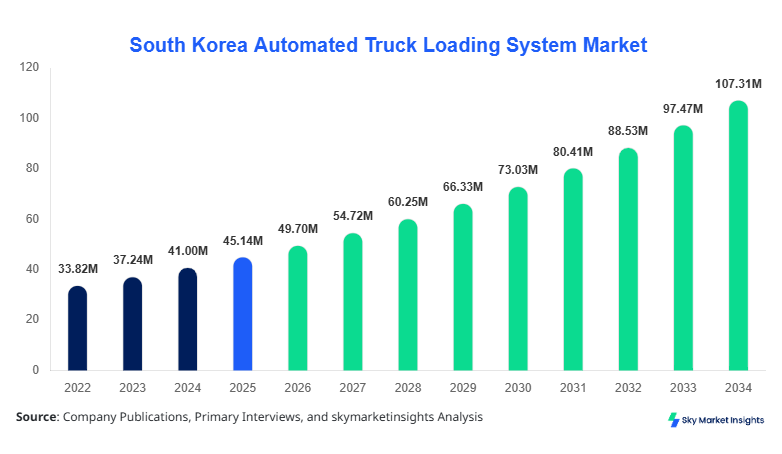
South Korea Automated Truck Loading System Market size is projected at USD 49.70 million in 2026 and is expected to hit USD 107.17 million by 2034 with a CAGR of 10.10%. The assessment evaluates 8 system types, 5 truck categories, 4 dock designs, 8 industries, 2 automation levels, and 3 component groups. It combines segment-level revenue data with technology adoption, regional distribution, and the competitive landscape.
Key Takeaways
- The Seoul Capital Area dominates domestic deployment, with an estimated 46% contribution in 2026, while the Southeast industrial region is expected to record the fastest regional CAGR of approximately 10.8% through 2034.
- Chain conveyor systems lead system-type revenue with USD 12.55 million and 25.25% in 2026; robotic arm-based systems are the fastest-growing category at a 10.37% CAGR.
- Standard trailer trucks dominate truck-type applications with USD 20.42 million and 41.06% in 2026; refrigerated/cold-chain trucks advance fastest at a 10.36% CAGR.
- South Korea, representing the covered national market, is forecast to progress from USD 49.70 million in 2026 to USD 107.17 million by 2034, adding USD 57.47 million.
- The market expands by approximately 2.16 times over 8 years, supported by logistics automation, cold-chain investment, and high-throughput distribution centers.
Automated truck loading systems comprise conveyors, guided vehicles, robotic equipment, software, sensors, and dock interfaces that transfer pallets, cartons, or unit loads between facilities and trailers. South Korea's automotive production was forecast by KAMA at 4.17 million vehicles in 2024, up 0.7%, while exports were forecast at 2.75 million units. Chain conveyors contributed 25.25% of 2026 system revenue, roller tracks 22.11%, and slat conveyors 17.18%. Standard trailers represented 41.06% of truck-type revenue, compared with 24.67% for refrigerated trucks and 16.23% for containerized trucks. KAMA
Explore more data points, trends and opportunities Download Free Sample Report
South Korea Automated Truck Loading System Market Trends
AI-Orchestrated Dock Automation and Flexible Robotic Handling
South Korea's logistics operators are shifting from fixed mechanical installations toward systems integrating machine vision, warehouse-management software, digital twins, and autonomous mobile equipment. A typical automated dock can process hundreds of pallets per shift, while advanced robotic unloaders can handle up to 1,500 cases per hour. Adoption is increasingly concentrated among large 3PL, e-commerce, automotive, and parcel facilities operating 2–3 shifts and seeking loading-cycle reductions of 30%–60%. Mujin TruckBot
Technology selection is moving toward modular equipment capable of handling 2 or more trailer formats, mixed cases, and variable pallet dimensions. AI-based sequencing can reduce idle movements by 15%–25%, while sensor-led safety controls can lower manual dock exposure by more than 40%. Demand is particularly strong in e-commerce fulfillment, refrigerated distribution, and high-volume manufacturing, where facilities may process 50–200 truck movements daily and require availability above 95%.
South Korea Automated Truck Loading System Market Drivers
High Logistics Throughput and Persistent Labor Constraints
Expanding parcel volumes, 24-hour fulfillment expectations, and labor scarcity are accelerating dock automation. Large distribution centers can require 20–100 dock workers per shift, while automated transfer solutions may reduce direct loading labor by 30%–70% and shorten trailer turnaround by 20%–50%. South Korea's 4.17 million-vehicle production environment and 2.75 million-unit automotive export base also create recurring movement of components and finished goods, supporting installations capable of transferring 20–30 pallets in a single automated cycle.
South Korea Automated Truck Loading System Market Restraints
High Capital Cost and Trailer Standardization Requirements
Deployment is constrained by initial equipment, dock reconstruction, controls integration, and fleet modification costs. A multi-dock project may require 6–18 months for engineering and commissioning, while customized installations can cost 20%–40% more than standardized designs. Facilities operating fewer than 20–30 trailer movements per day may struggle to achieve acceptable utilization, and mixed fleets with 3 or more trailer-floor specifications can reduce transfer reliability by 10%–25%.
South Korea Automated Truck Loading System Market Opportunities
Cold Chain, E-commerce, and Brownfield Modernization
Cold storage and e-commerce facilities offer substantial whitespace because automated equipment limits worker exposure to low-temperature areas and supports rapid order dispatch. Refrigerated operations can target loading-time reductions of 25%–45%, energy-loss reductions of 10%–20%, and labor savings above 30%. Brownfield packages combining telescopic conveyors, AGVs, and software can be installed across 1–4 docks in phases, lowering initial capital requirements by approximately 15%–35%.
Challenges in South Korea Automated Truck Loading System Market
Interoperability, Safety Validation, and Mixed-Load Complexity
Operators must integrate programmable controllers, warehouse software, vehicle restraints, sensors, and third-party equipment while maintaining uptime of 95%–99%. Mixed pallets, damaged cartons, and trailer misalignment can create exception rates of 2%–8%. Achieving cycle times below 10 minutes for standardized pallet loads requires precise docking, consistent floor tolerances, and automated recovery routines, while safety validation can add 8–16 weeks to project schedules.
Report Scope
| Report Metric | Details |
|---|---|
| Market Size in 2025 | USD 45.14 Million |
| Market Size in 2026 | USD 49.7 Million |
| Market Size in 2034 | USD 107.17 Million |
| CAGR | 10.1% (2026-2034) |
| Base Year for Estimation | 2025 |
| Historical Data | 2022-2024 |
| Forecast Period | 2026-2034 |
| Report Coverage | Revenue Forecast, Competitive Landscape, Supply Chain Disruption, Growth Factors, Environment & Regulatory Landscape and Trends |
Explore more data points, trends and opportunities Download Free Sample Report
South Korea Automated Truck Loading System Market Segmentation
Automated Truck Loading System Market share is concentrated in chain conveyors and standard trailers, accounting for 25.25% and 41.06% of their respective 2026 segment totals. Robotic arms and refrigerated trucks post the strongest CAGRs, at 10.37% and 10.36%.
By System Type
Chain conveyor systems are the largest category, increasing from USD 11.38 million in 2025 to USD 12.55 million in 2026 and USD 27.50 million by 2034, at a 10.30% CAGR. Their 2026 contribution is 25.25%, supported by standardized pallet and automotive-component flows.
Robotic arm-based systems are the fastest-growing category at a 10.37% CAGR, rising from USD 2.68 million in 2026 to USD 5.91 million in 2034. Slat conveyors reach USD 18.34 million, roller tracks USD 23.24 million, and AGV-based systems USD 7.60 million by 2034.
By Truck Type
Standard trailer trucks lead, advancing from USD 18.53 million in 2025 to USD 20.42 million in 2026 and USD 44.49 million in 2034 at a 10.22% CAGR. They represent 41.06% of the 2026 truck-type total.
Refrigerated/cold-chain trucks grow fastest at a 10.36% CAGR, reaching USD 27.00 million by 2034 from USD 12.27 million in 2026. Flatbed and special-purpose applications reach USD 13.30 million and USD 6.14 million, respectively, by 2034.
By Loading Dock Design
Flush docks constitute the principal deployment format because they support direct alignment with trailers, standardized restraints, and conveyor interfaces. Within a USD 49.70 million national total in 2026, high-throughput facilities commonly deploy systems across 2–10 flush-dock positions.
Enclosed docks are positioned for the fastest adoption in temperature-controlled and pharmaceutical facilities, where loading exposure can be reduced by 20%–40%. The supplied dataset does not provide dock-design revenue or category CAGRs; consequently, no unsupported subsegment valuation is assigned.
By Industry
Automotive represents a core application due to repetitive pallet flows and South Korea's 4.17 million-vehicle production base. FMCG, retail, and e-commerce facilities also require systems handling 50–200 daily truck movements and 2–3 operating shifts.
E-commerce and logistics are positioned for the fastest adoption as operators pursue 20%–50% faster dispatch. Industry-specific revenue and CAGRs are not included in the supplied dataset; the quantified national benchmark remains USD 49.70 million in 2026 and a 10.10% CAGR.
By Automation Level
Semi-automated systems remain important in brownfield sites because they can automate 1–4 docks without replacing the full trailer fleet. Such projects may lower upfront expenditure by 15%–35% compared with comprehensive site conversion.
Fully automated systems are expected to expand faster in standardized, high-volume facilities targeting 30%–70% labor reductions and availability exceeding 95%. Automation-level revenue and separate CAGRs were not supplied; therefore, the segment is assessed against the 10.10% national CAGR.
By Component
Hardware is the principal value pool, encompassing conveyors, robots, sensors, controls, restraints, and dock interfaces. A typical installation combines 5 or more equipment categories and may require 6–18 months from design to commissioning.
Software and services gain importance as facilities connect equipment with WMS and ERP platforms. Integration, maintenance, and lifecycle services can represent 10%–25% of project expenditure; component-specific market values and CAGRs are unavailable in the mandatory dataset.
South Korea Automated Truck Loading System Market Segmentations
By System Type
- Chain Conveyor System
- Slat Conveyor System
- Roller Track System
- Belt Conveyor System
- Skate Conveyor System
- Automated Guided Vehicles (AGVs) Based System
- Robotic Arm-Based System
- Others (e.g., telescopic belt loaders, modular lift systems)
By Truck Type
- Standard Trailer Trucks
- Refrigerated/Cold Chain Trucks
- Containerized Trucks
- Flatbed Trucks
- Special Purpose Trucks
By Loading Dock Design
- Flush Docks
- Enclosed Docks
- Open Docks
- Sawtooth Docks
By Industry
- Automotive
- FMCG and Retail
- E-commerce and Logistics
- Pharmaceuticals and Healthcare
- Food and Beverage
- Chemicals
- Postal and Courier
- Others (Textile, Electronics, Aerospace, etc.)
By Automation Level
- Semi-Automated Systems
- Fully Automated Systems
By Component
- Hardware
- Software
- Services (Installation, Maintenance, Integration)
South Korea Automated Truck Loading System Market Country Outlook
The Seoul Capital Area, including Seoul, Incheon, and Gyeonggi, is estimated to contribute 46% of 2026 revenue, equivalent to approximately USD 22.86 million. Its position reflects dense fulfillment networks, Incheon logistics infrastructure, e-commerce operations, and facilities processing more than 100 daily truck movements.
The Southeast—Busan, Ulsan, and South Gyeongsang—is estimated at 29%, or USD 14.41 million, supported by port, automotive, chemical, and manufacturing flows. The Central region contributes approximately 15%, or USD 7.46 million, while the Southwest accounts for 10%, or USD 4.97 million. These regional allocations are analytical estimates derived from the supplied USD 49.70 million national total rather than independently reported market values.
Top players in South Korea Automated Truck Loading System Market
- Daifuku Co., Ltd.
- BEUMER Group
- Ancra Systems B.V.
- Joloda Hydraroll Limited
- Actiw Oy
- Secon Components S.L.
- GEBHARDT Fördertechnik GmbH
- HAVER & BOECKER OHG
- SFA Engineering Corporation
- Hyundai Wia Corporation
- Samsung SDS Co., Ltd.
- LG CNS Co., Ltd.
- CJ Logistics Corporation
- AutoStore Holdings Ltd.
- Mujin Corporation
Top Two Companies
-
Daifuku Co., Ltd. — estimated 12%–16% competitive revenue position: Daifuku is positioned strongly through conveyor, storage, sorting, and integrated material-handling capabilities. Its advantage lies in combining hardware, controls, and lifecycle support for facilities operating 2–3 shifts and requiring uptime above 95%. The company addresses automotive, retail, cold-chain, and general logistics applications, with scalable projects spanning individual docks to multi-building automation programs. The percentage represents an analytical competitive estimate, not a disclosed company figure.
-
BEUMER Group — estimated 8%–12% competitive revenue position: BEUMER competes through conveying, loading, pallet-handling, and software integration expertise. Its positioning is strongest in customized projects handling high throughput, irregular layouts, and continuous operations. Solutions can support dozens of vehicle movements per shift and integrate multiple conveyor zones, safety controls, and supervisory software. The estimated range reflects its addressable presence among international and domestic suppliers rather than audited South Korean revenue.
Recent Developments in South Korea Automated Truck Loading System Market
- 2026: CJ Logistics advanced real-world testing of humanoid robots at logistics centers, with broader deployment targeted for the following year.
- 2025: Korean logistics operators expanded AI, robotics, and digital-control initiatives to automate high-volume fulfillment and dock-adjacent workflows.
Research Methodology
The assessment uses 2025 as the base year, 2026 as the current year, historical analysis covering 2022–2024, and forecasts through 2034. Mandatory system-type and truck-type values were treated as the primary quantitative dataset. Segment shares were calculated as category revenue divided by the corresponding 2026 total, while regional values were modeled from the USD 49.70 million national benchmark. Secondary validation considered production statistics, corporate disclosures, technology specifications, and logistics-industry sources; no unsupported market-size values were substituted for supplied figures.
Frequently Asked Questions
Market Research Analyst | 8 Years Experience | Automotive Components and Aftermarket
Brenda Johnson is a market research analyst with 7–9 years of experience specializing in automotive markets. Contributed to 70+ research reports for global clients. Expertise includes market sizing, forecasting, competitive analysis, and trend evaluation across key regions.