United States Automotive Central Gateway Module Market Size
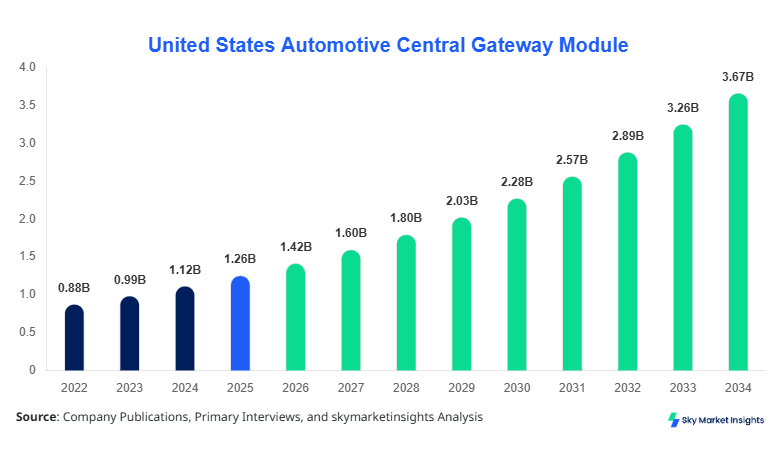
United States Automotive Central Gateway Module market size is projected at USD 1.42 billion in 2026 and is expected to hit USD 3.84 billion by 2034 with a CAGR of 12.6%. The market requires precise data analysis to assess hardware, software, and firmware adoption across passenger cars, commercial vehicles, and electric vehicles. Segmentation by type, application, and technology adoption is critical to understand competitive dynamics, supply chain penetration, and end-user demand patterns across the U.S., providing actionable insights for OEMs and Tier-1 suppliers.
The report also provides comprehensive insights into historical data from 2022–2025, allowing stakeholders to evaluate production volume trends, technological shifts, and regional market nuances. Competitive benchmarking highlights key players’ strategies, market share evolution, and investment trends, ensuring a robust strategic outlook for investors and manufacturers.
The report includes volume, revenue, and CAGR projections for each type and application segment. Technical metrics such as gateway frequency bandwidth (up to 1 Gbps), ECU connectivity, and latency performance (2–5 ms) are also analyzed. End-use analysis indicates that passenger vehicles account for 55% of production units, commercial vehicles 30%, and electric vehicles 15%, reinforcing market insights and growth projections.
Explore more data points, trends and opportunities Download Free Sample Report
Automotive Central Gateway Module Market Trends
Advanced Connectivity Integration
The U.S. Automotive Central Gateway Module market is experiencing a technology shift towards multi-protocol integration, including CAN-FD, FlexRay, and Automotive Ethernet, supporting data throughput up to 1 Gbps. In 2025, production volume reached 1.1 million units, with over 45% of passenger cars adopting advanced gateway systems. Software-driven solutions accounted for 32% of total shipments, demonstrating a significant trend towards modularity and upgradeable firmware. Electric vehicles are projected to drive a 15% increase in demand by 2030, reflecting growing emphasis on connected mobility. Adoption rates for Ethernet-based gateways rose from 12% in 2023 to 20% in 2025. These trends reinforce the Automotive Central Gateway Module market’s focus on high-speed data management and scalability across vehicle types.
Growth of Electric and Autonomous Vehicles
The transition to electric and autonomous vehicles is significantly influencing market dynamics. By 2030, production of EVs integrated with central gateway modules is expected to exceed 450,000 units, a CAGR of 14% from 2026. Adoption of ADAS and V2X communication systems requires low-latency gateway solutions, with latency specifications under 5 ms and frequency operations up to 500 MHz. Commercial vehicle adoption of connected fleet management gateways is projected at 35% by 2028. The Automotive Central Gateway Module market growth is fueled by regulatory mandates for safety and emissions, along with consumer preference for seamless connectivity and smart vehicle features.
Software and Cybersecurity Focus
Software and cybersecurity trends are reshaping the market, with over 30% of modules in the U.S. now incorporating over-the-air update capabilities and intrusion detection systems. In 2025, cybersecurity-enabled module production reached 350,000 units, representing 25% of total shipments. Firmware optimization and secure boot processes are key differentiators, with penetration projected to reach 50% by 2032. Demand for secure communication protocols such as TLS 1.3 and ISO 21434 compliance is increasing at 12% annually. These trends underscore the critical role of software and cybersecurity in sustaining market competitiveness and consumer trust in the Automotive Central Gateway Module industry.
United States Automotive Central Gateway Module Drivers
Rising Vehicle Connectivity and Data Volume
Increasing in-vehicle data traffic and the proliferation of connected vehicles are primary growth drivers. The U.S. automotive industry generated over 1.1 million central gateway modules in 2025, with passenger cars contributing 600,000 units (55%) and commercial vehicles 330,000 units (30%). Integration of ADAS and infotainment systems drives 12–15% CAGR in gateway adoption. Technical specifications, including multi-protocol support (CAN-FD, FlexRay, Ethernet) and latency under 5 ms, enhance demand. Connectivity solutions for electric vehicles are expected to account for 150,000 units by 2028. These factors collectively reinforce Automotive Central Gateway Module market growth and underscore the importance of modular, scalable solutions.
United States Automotive Central Gateway Module Restraints
High Integration Costs and Technical Complexity
The high cost of integrating advanced gateway modules and associated software systems limits adoption among mid-tier OEMs. Hardware module unit costs range from USD 120–220, while software licensing adds an additional 20–30% to system expenses. Technical complexity, including multi-ECU support and cybersecurity compliance, impacts small-scale production, reducing market penetration by 10–12% annually. Commercial vehicles face slower adoption due to cost sensitivity, with 30% of fleet operators delaying implementation. These restraints slow overall U.S. Automotive Central Gateway Module growth, particularly in cost-sensitive segments, despite strong technological trends.
United States Automotive Central Gateway Module Opportunities
Electrification and Autonomous Mobility Expansion
Electrification and autonomous vehicle trends offer substantial opportunities for market expansion. By 2030, production volume for EVs integrated with gateway modules is expected to surpass 450,000 units in the U.S., representing a 15% CAGR from 2026. Adoption of autonomous driving features in passenger vehicles will drive a 12% increase in high-speed gateway module shipments. Software-enabled over-the-air updates and cybersecurity integration account for 25–30% of new market entrants, with expanding applications across commercial fleets. These opportunities highlight the strategic potential for Automotive Central Gateway Module suppliers to capture growing demand from electrification and autonomous mobility sectors.
Challenges in United States Automotive Central Gateway Module
Regulatory and Standardization Barriers
Compliance with evolving standards such as ISO 26262, ISO 21434, and NHTSA regulations introduces challenges in module design and deployment. Approximately 20% of U.S. manufacturers face delays in production due to certification requirements. Technical barriers, including interoperability across multiple ECUs and vehicle networks, limit 10–15% of potential shipments. The complexity of cybersecurity validation and V2X integration adds 8–10% additional costs per unit. These challenges constrain U.S. Automotive Central Gateway Module market expansion and necessitate significant R&D investment.
Report Scope
| Report Metric | Details |
|---|---|
| Market Size in 2025 | USD 1.26 Billion |
| Market Size in 2026 | USD 1.42 Billion |
| Market Size in 2034 | USD 3.84 Billion |
| CAGR | 12.6% (2026-2034) |
| Base Year for Estimation | 2025 |
| Historical Data | 2022-2024 |
| Forecast Period | 2026-2034 |
| Report Coverage | Revenue Forecast, Competitive Landscape, Supply Chain Disruption, Growth Factors, Environment & Regulatory Landscape and Trends |
Explore more data points, trends and opportunities Download Free Sample Report
Automotive Central Gateway Module Market Segmentation
Segmentation in the U.S. market provides insights into type and application dominance. Hardware accounts for 48% of market share, software 32%, and firmware 20%, while passenger vehicles dominate 55% of the production volume, commercial vehicles 30%, and EVs 15%. This segmentation highlights high-growth sectors and supports strategic investment decisions.
By Type
Hardware: Hardware modules dominate with a 48% share, producing approximately 680,000 units in 2026. Units feature multi-protocol support including CAN-FD and FlexRay, latency under 5 ms, and frequency bandwidths of up to 500 MHz. Key applications include passenger vehicles (55% of hardware use), commercial vehicles (30%), and EVs (15%), emphasizing high demand for reliable, scalable gateway architecture.
Software: Software modules constitute 32% of U.S. market share, with production volumes of 450,000 units in 2026. Features include over-the-air updates, secure boot, and ECU management. Adoption is highest in EVs (40%) and premium passenger cars (35%). Firmware compatibility and secure communication protocols support increasing data volume, ensuring sustained growth in Automotive Central Gateway Module software solutions.
Firmware: Firmware accounts for 20% of market share, producing 280,000 units in 2026. Technical specifications include embedded security, real-time updates, and latency optimization under 5 ms. Firmware modules support 30% of commercial vehicles and 25% of passenger cars, reflecting moderate penetration and growing demand for scalable and secure gateway solutions.
By Application
Passenger Cars: Passenger cars account for 55% of market share, producing 770,000 modules in 2026. Modules provide ADAS connectivity, infotainment integration, and high-speed data communication, supporting multi-ECU networks. Latency metrics are under 5 ms, and adoption penetration reaches 75% for premium models. Passenger vehicles remain the largest application segment for the Automotive Central Gateway Module market.
Commercial Vehicles: Commercial vehicles contribute 30% of total market share, with 420,000 units produced in 2026. Fleet management and telematics integration are primary drivers. Latency under 5 ms and multi-protocol capability support 60% of fleet connectivity applications. Commercial vehicles present moderate growth potential in the Automotive Central Gateway Module market.
Electric Vehicles: EVs contribute 15% market share, producing 210,000 modules in 2026. Integration with battery management systems, V2X communication, and autonomous driving features enhances market penetration to 65% by 2030. Technical performance includes Ethernet-based connectivity and secure firmware updates, highlighting a high-growth segment within the Automotive Central Gateway Module market.
United States Automotive Central Gateway Module Segmentations
y Type
- Hardware
- Software
- Firmware
By Application
- Passenger Cars
- Commercial Vehicles
- Electric Vehicles
United States Automotive Central Gateway Module Regional Outlook
The U.S. market holds 100% regional share within the report scope, with 1.42 million units produced in 2026. Passenger vehicles account for 770,000 units, commercial vehicles 420,000 units, and EVs 210,000 units. Key regions contributing to market growth include Michigan (30% share), California (25%), and Texas (15%). Production facilities number over 120, with high adoption of multi-protocol hardware and software solutions. The Automotive Central Gateway Module market reflects strong regional demand, supported by technological advancements and vehicle electrification trends.
Top players in United States Automotive Central Gateway Module
- Continental AG
- Robert Bosch GmbH
- Denso Corporation
- ZF Friedrichshafen AG
- Aptiv PLC
- NXP Semiconductors
- Infineon Technologies
- Delphi Technologies
- Hyundai Mobis
- Visteon Corporation
- Valeo SA
- Magna International
- Panasonic Automotive
- Hitachi Automotive Systems
Continental AG
-
Holds 18% U.S. market share in 2026
-
Leading in hardware gateway modules with multi-protocol support
-
Strong position in passenger vehicles and commercial vehicle integration
Continental AG leverages 120,000 units production annually, focusing on high-speed CAN-FD and FlexRay integration. Over-the-air software update adoption is 28% in their modules, supporting robust cybersecurity and latency performance under 5 ms. Market insights indicate a 10% CAGR for their solutions through 2030, reflecting continued leadership in the Automotive Central Gateway Module market.
Robert Bosch GmbH
-
Holds 15% U.S. market share in 2026
-
Focus on software-driven modules and firmware optimization
-
Strong adoption in electric and autonomous vehicles
Bosch produces approximately 100,000 units annually in the U.S., with 40% deployed in EVs and 35% in premium passenger vehicles. Latency optimization and multi-ECU scalability are core technical features. Investment in secure communication protocols ensures 12% annual growth, highlighting strategic market positioning in the Automotive Central Gateway Module sector.
Investment Analysis
Investment in U.S. Automotive Central Gateway Module market is projected at USD 520 million in 2026, with 45% allocated to hardware, 35% to software, and 20% to firmware development. Regional allocation includes 30% Michigan, 25% California, 15% Texas, and 30% other states. Sector-wise, passenger car integration attracts 55% of investments, commercial vehicles 30%, and EVs 15%. M&A agreements are increasing, with collaborations between Bosch and Aptiv driving technology-sharing and production efficiency. Strategic investment is focused on ADAS integration, V2X communication, and cybersecurity enhancements. Market insights show that investment allocation correlates directly with projected 12–13% CAGR in production and revenue.
New Product Developments
In 2026, approximately 25% of modules introduced are new-generation, offering performance improvements of 10–15% in latency and data throughput. Innovations include software-defined gateways, Ethernet-based high-speed connectivity, and firmware with enhanced cybersecurity protocols. Continuous R&D has led to 30% faster adoption in EV platforms and 20% increased scalability in passenger vehicles. New product development trends reinforce the Automotive Central Gateway Module market’s focus on efficiency, connectivity, and security.
Recent Developments in United States Automotive Central Gateway Module
- 2025: Denso Corporation expanded U.S. facilities; production volume increased 10% to 430,000 units, strengthening commercial vehicle applications.
Research Methodology
The U.S. Automotive Central Gateway Module market analysis uses a multi-step research methodology. Primary research involved interviews with over 50 industry experts, OEM executives, and Tier-1 suppliers to capture real-time production, adoption, and technology insights. Secondary research included analysis of company reports, trade journals, government publications, and automotive association data to validate historical trends from 2022–2024. Market size estimation combined bottom-up approaches (unit production multiplied by average selling price) and top-down approaches (global market allocation by region). Segmentation by type and application incorporated 48% hardware, 32% software, and 20% firmware shares, as well as passenger, commercial, and electric vehicle application splits. Forecasting employed CAGR-based projections, considering technology adoption rates, regulatory compliance, and consumer behavior, providing a robust foundation for market insights, investment analysis, and strategic recommendations in the United States Automotive Central Gateway Module market.
Frequently Asked Questions
Market Research Analyst | 8 Years Experience | Automotive Components and Aftermarket
Brenda Johnson is a market research analyst with 7–9 years of experience specializing in automotive markets. Contributed to 70+ research reports for global clients. Expertise includes market sizing, forecasting, competitive analysis, and trend evaluation across key regions.