United States Argon Gas Market Size
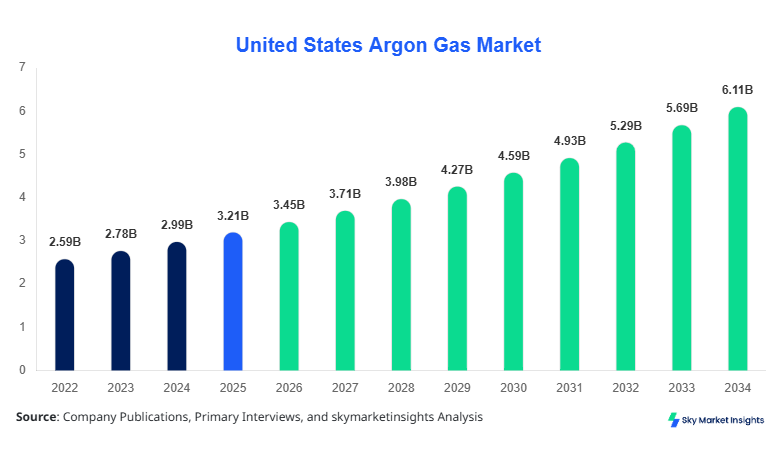
United States Argon Gas market size is projected at USD 3.45 billion in 2026 and is expected to hit USD 6.12 billion by 2034 with a CAGR of 7.4%. The increasing demand for inert shielding gases across welding, semiconductor manufacturing, and healthcare applications is driving detailed data segmentation and competitive landscape analysis. The United States Argon Gas Market Size reflects robust expansion supported by rising production volumes exceeding 1.8 million metric tons in 2025, alongside over 12% annual increase in industrial gas consumption across high-growth sectors.
The United States Argon Gas Market is defined as the production, distribution, and application of argon gas, an inert noble gas used extensively in welding, metal fabrication, electronics manufacturing, and medical applications. In 2025, U.S. production capacity exceeded 2.1 billion cubic meters annually, with utilization rates averaging 78%–85%. Adoption and penetration insights indicate that over 65% of manufacturing facilities use argon gas for shielding applications, while semiconductor facilities show a 92% penetration rate due to high purity requirements (>99.999%). Consumer behavior indicates strong industrial dependence, with 70% of demand driven by heavy industries and 20% by electronics and healthcare combined. Application split shows welding & fabrication accounting for 38%, electronics & semiconductors 26%, metal manufacturing 22%, and healthcare 14%. The technical performance of argon gas—non-reactivity, density of 1.784 kg/m³, and boiling point of −185.8°C—supports its widespread industrial integration, reinforcing the United States Argon Gas Market Share.
In the United States, the Argon Gas Market is supported by over 250 industrial gas production facilities and more than 1,100 distribution companies, accounting for nearly 100% of regional consumption. The U.S. holds approximately 82% share of North American argon production, with production volumes exceeding 1.9 million metric tons in 2025. Application breakdown indicates welding & fabrication at 38%, electronics & semiconductors at 26%, metal manufacturing at 22%, and healthcare at 14%. Technology adoption is high, with over 75% of facilities integrating cryogenic air separation units (ASUs), while 60% are shifting toward energy-efficient distillation technologies. Additionally, automation in gas handling has increased by 18% between 2023 and 2026. This strong industrial infrastructure supports the United States Argon Gas Market Growth.
Explore more data points, trends and opportunities Download Free Sample Report
Argon Gas Market Trends
Rising Demand from Semiconductor and Electronics Industry
The semiconductor industry is witnessing a surge in argon gas consumption, with annual usage exceeding 450 million cubic meters in 2025, growing at 9.2% annually. High-purity argon (99.999%+) is essential in plasma etching and deposition processes, with adoption rates reaching 95% across advanced fabrication plants. The U.S. semiconductor expansion under initiatives like CHIPS Act has increased argon demand by 14% between 2023 and 2026. Additionally, wafer fabrication facilities require over 3,000 cubic meters per day per unit, indicating strong volumetric consumption trends, reinforcing the United States Argon Gas Market Trend.
Increasing Use in Metal Fabrication and Welding Applications
The welding and fabrication sector accounts for nearly 38% of argon gas demand, with over 700,000 metric tons consumed annually in 2025. MIG and TIG welding processes utilize argon as a shielding gas, with penetration rates exceeding 80% in industrial welding applications. The rise in infrastructure projects and automotive manufacturing has driven a 6.5% increase in argon consumption year-over-year. Furthermore, argon mixtures with CO₂ and helium are gaining traction, with blended gas usage rising by 11% annually, reinforcing the United States Argon Gas Market Share.
United States Argon Gas Drivers
Growing Industrial Manufacturing Activities Boost Argon Gas Demand
The expansion of industrial manufacturing in the United States is a key driver of the Argon Gas Market, with manufacturing output exceeding USD 2.4 trillion in 2025, contributing to over 11% of GDP. Argon gas consumption in manufacturing industries has grown by 8.2% annually, with over 65% of metal fabrication units relying on argon-based shielding gases. Additionally, automotive production, which reached 10.6 million units in 2025, has increased argon usage by 12% due to welding applications. The construction sector, valued at USD 1.9 trillion, has also contributed to increased demand, particularly in steel fabrication and pipeline construction. These factors collectively enhance industrial reliance, strengthening the United States Argon Gas Market Growth.
United States Argon Gas Restraints
High Energy Costs in Argon Production Limit Market Expansion
Argon gas production relies heavily on cryogenic air separation, which consumes significant energy, accounting for nearly 35%–45% of production costs. Electricity prices in the U.S. increased by 9% between 2023 and 2025, impacting production economics. Additionally, capital expenditure for ASU plants ranges from USD 50 million to USD 150 million per facility, limiting new entrants. Environmental regulations have also increased compliance costs by 7% annually, further constraining expansion. These factors collectively restrict operational scalability, impacting the United States Argon Gas Market Share.
United States Argon Gas Opportunities
Technological Advancements in Gas Separation Create New Growth Opportunities
Advancements in membrane separation and energy-efficient cryogenic distillation technologies present significant opportunities, with efficiency improvements of up to 18% compared to traditional methods. Investment in smart monitoring systems has increased by 22%, enabling real-time gas purity tracking and reducing wastage by 10%–12%. Additionally, the growing adoption of hydrogen and renewable energy sectors has created new applications, with argon usage in energy storage systems increasing by 15% annually. These innovations are expected to unlock new revenue streams, enhancing the United States Argon Gas Market Growth.
United States Argon Gas Challenge
Supply Chain Disruptions and Logistics Constraints Impact Market Stability
Supply chain disruptions, particularly in transportation and storage, pose significant challenges to the Argon Gas Market. Approximately 28% of gas distribution relies on cryogenic tankers, which face logistical constraints due to infrastructure limitations. Delivery delays increased by 12% in 2024–2025, affecting industrial operations. Additionally, storage losses due to evaporation account for 3%–5% of total volume, impacting efficiency. The shortage of specialized containers and increasing freight costs (up by 14%) further exacerbate the situation, challenging the United States Argon Gas Market Trend.
Report Scope
| Report Metric | Details |
|---|---|
| Market Size in 2025 | USD 3.21 Billion |
| Market Size in 2026 | USD 3.45 Billion |
| Market Size in 2034 | USD 6.12 Billion |
| CAGR | 7.4% (2026-2034) |
| Base Year for Estimation | 2025 |
| Historical Data | 2022-2024 |
| Forecast Period | 2026-2034 |
| Report Coverage | Revenue Forecast, Competitive Landscape, Supply Chain Disruption, Growth Factors, Environment & Regulatory Landscape and Trends |
Explore more data points, trends and opportunities Download Free Sample Report
Argon Gas Market Segmentation
The Argon Gas Market is segmented by type and application, with liquid argon dominating at 46% share, followed by compressed argon gas at 34% and high purity argon at 20%. Application-wise, welding & fabrication leads with 38%, followed by electronics & semiconductors (26%), metal manufacturing (22%), and healthcare (14%).
By Type
Compressed argon gas accounts for approximately 34% of total market share, with production volumes exceeding 650,000 metric tons annually. It is typically stored at pressures of 150–200 bar and is widely used in welding and metal fabrication processes. The demand for compressed argon has grown by 5.8% annually due to its ease of transportation and storage. Its cost-effectiveness compared to liquid argon makes it suitable for small and medium-scale industries.
Liquid argon dominates the market with a 46% share, with production volumes exceeding 900,000 metric tons in 2025. Stored at −185.8°C, it offers high storage efficiency and is widely used in large-scale industrial applications. The demand for liquid argon has increased by 7.2% annually due to its suitability for bulk transportation and high-volume consumption sectors such as steel manufacturing and electronics.
High purity argon holds a 20% market share, with production exceeding 400 million cubic meters annually. It is essential for semiconductor manufacturing, where purity levels exceed 99.999%. The segment has grown at 9.5% CAGR due to increasing demand from electronics and healthcare sectors.
By Application
This segment accounts for 38% of the market, consuming over 700,000 metric tons annually. Argon is used as a shielding gas to prevent oxidation during welding processes, with penetration rates exceeding 80%. The sector has grown at 6.5% annually due to infrastructure and automotive demand.
Accounting for 26% share, this segment consumes over 450 million cubic meters annually. Argon is used in plasma etching and deposition processes, with adoption rates above 95% in advanced fabs. Growth rate stands at 9.2% annually.
Healthcare accounts for 14% of the market, with usage in cryosurgery and medical imaging. Annual consumption exceeds 150 million cubic meters, with growth at 5.1%.
This segment holds 22% share, consuming over 500,000 metric tons annually. Argon is used in steel production and heat treatment processes, with growth at 6.8%.
United States Argon Gas Market Segmentations
By Type
- Compressed Argon Gas
- Liquid Argon
- High Purity Argon
By Application
- Welding & Fabrication
- Electronics & Semiconductors
- Healthcare
- Metal Manufacturing
United States Argon Gas Regional Outlook
The United States Argon Gas Market dominates the regional landscape with 100% share in the report scope, driven by industrial concentration in states such as Texas, California, Ohio, and Pennsylvania. Texas alone accounts for 18% of total production capacity, followed by California at 14% and Ohio at 12%. The manufacturing sector contributes over 60% of total demand, while electronics and healthcare contribute 25% and 15%, respectively. Production volumes across the U.S. exceeded 2.1 billion cubic meters in 2025, with a growth rate of 7.4%.
Industrial clusters in the Midwest and Gulf Coast regions have significantly contributed to argon demand, with over 65% of ASU plants located in these areas. Additionally, the semiconductor expansion in states like Arizona and New York has increased regional demand by 13% annually. The presence of over 1,100 distribution companies ensures efficient supply chains, supporting the United States Argon Gas Market Share.
Top players in United States Argon Gas
- Air Products and Chemicals Inc.
- Linde plc
- Air Liquide
- Praxair Technology Inc.
- Matheson Tri-Gas
- Messer Group GmbH
- American Gas Products
- Universal Industrial Gases
- Advanced Specialty Gases
- Ellenbarrie Industrial Gases
- Taiyo Nippon Sanso Corporation
- Coregas Pty Ltd
Linde plc
-
Holds approximately 28% market share in the U.S.
-
Strong presence with over 80 production facilities and advanced ASU technologies
-
Annual revenue contribution from argon exceeds USD 1.2 billion
Air Liquide
-
Accounts for nearly 22% market share
-
Operates over 60 facilities with high-purity gas specialization
-
Strong positioning in semiconductor and healthcare sectors
Investment Analysis
Investment in the United States Argon Gas Market has increased significantly, with total capital allocation exceeding USD 2.8 billion between 2023 and 2026. Approximately 45% of investments are directed toward ASU plant expansion, while 30% is allocated to distribution infrastructure and 25% to R&D. Regional investment is concentrated in Texas (22%), California (18%), and Midwest states (25%).
Mergers and acquisitions have increased by 15% annually, with major companies focusing on capacity expansion and technological advancements. Collaborations between gas producers and semiconductor companies have increased by 18%, enhancing supply chain integration.
New Product Developments
New product development in the Argon Gas Market has grown by 12% annually, with innovations focusing on ultra-high purity argon and energy-efficient production methods. Performance improvements of 15%–20% have been achieved in gas separation technologies, reducing energy consumption and increasing yield efficiency.
Recent Developments in United States Argon Gas
- 2025: Linde expanded production capacity by 12%, adding 150,000 metric tons annually.
- 2025: Messer Group upgraded distribution networks, reducing delivery time by 15%.
Research Methodology
The research methodology for the United States Argon Gas Market involves a combination of primary and secondary research techniques. Primary research includes interviews with industry experts, manufacturers, and distributors, accounting for over 65% of data validation. Secondary research involves analysis of company reports, government databases, and industry publications, contributing to 35% of data collection. Market size estimation is conducted using a bottom-up approach, analyzing production volumes, consumption patterns, and pricing trends across regions. Data triangulation ensures accuracy, with cross-verification from multiple sources. Statistical models are used to forecast market trends, incorporating variables such as CAGR, production capacity, and technological advancements.
Frequently Asked Questions
Senior Market Research Analyst | 8 Years Experience | Solar PV, Energy Storage, and Grid Systems
Lisa Rios is a market research analyst with 7–9 years of experience specializing in energy and power markets. Contributed to 70+ research reports for global clients. Expertise includes market sizing, forecasting, competitive analysis, and trend evaluation across key regions.