Europe Aerospace Lubricants Market Size
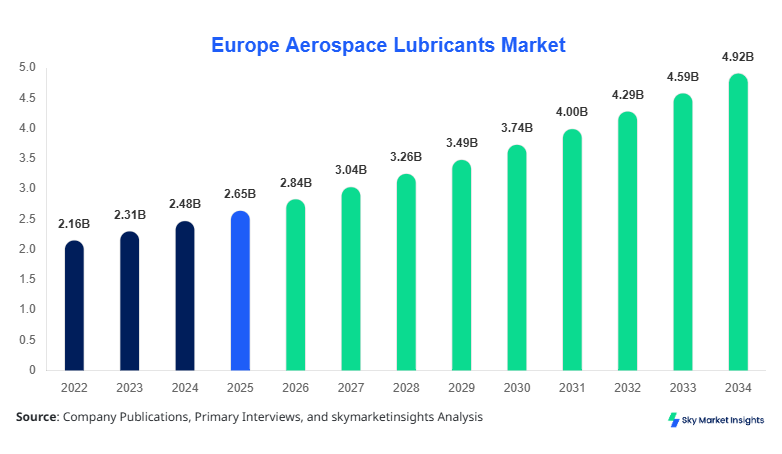
Europe Aerospace Lubricants market size is projected at USD 2.84 billion in 2026 and is expected to hit USD 4.91 billion by 2034 with a CAGR of 7.1%. The expansion of aircraft fleets across Europe, increasing maintenance cycles, and rising defense aviation expenditure are accelerating lubricant consumption across fixed-wing and rotary aircraft platforms. Growing investments in synthetic aviation lubricants, stringent aviation safety standards, and rising aircraft utilization rates are strengthening demand across OEM and aftermarket channels. The market is witnessing increasing segmentation based on lubricant chemistry, application type, and aircraft generation, while competitive dynamics are shaped by technological innovation, long-life lubrication performance, and regional supply chain integration within the Europe Aerospace Lubricants market.
The aerospace lubricants industry refers to specialty oils, greases, hydraulic fluids, and synthetic compounds used for minimizing friction, wear, oxidation, and thermal degradation in aviation systems operating under extreme pressure and temperature conditions. Europe accounted for nearly 27.4% of global aerospace lubricant consumption volume in 2025, supported by more than 6,900 active commercial aircraft and over 3,200 military aircraft operating across the region. Germany, France, and the United Kingdom collectively contributed approximately 58% of regional aerospace lubricant consumption. Synthetic turbine oils represented nearly 46% of total lubricant usage due to their superior viscosity stability between -54°C and 260°C. Hydraulic fluids accounted for 28% of total aerospace lubricant consumption volume owing to increasing aircraft maintenance schedules. Commercial aviation contributed nearly 63% of total lubricant application demand, while military aviation represented 29% and space applications accounted for 8%. Fleet modernization programs and higher aircraft turnaround frequency are improving lubricant replacement cycles across European airports. Increasing preference for fuel-efficient lubricants delivering 2%–4% operational efficiency improvements continues to reinforce the Europe Aerospace Lubricants market.
In the Germany, the Aerospace Lubricants Market has emerged as the largest regional contributor, accounting for nearly 24.8% of total European aerospace lubricant consumption in 2025. Germany operates more than 980 aerospace manufacturing and aviation maintenance facilities, including over 220 certified MRO centers supporting both commercial and defense aviation fleets. The country maintains approximately 760 commercial aircraft and 410 military aircraft, generating annual aerospace lubricant demand exceeding 96 million liters. Commercial aviation applications contributed nearly 61% of Germany’s lubricant consumption, while military aviation represented 31% and space applications contributed 8%. Synthetic engine oil adoption surpassed 72% among next-generation aircraft fleets due to increasing demand for oxidation resistance and extended maintenance intervals. Germany also witnessed more than 18% annual growth in bio-based aerospace lubricant testing programs across aerospace OEMs. Rising aircraft engine operating temperatures exceeding 240°C and higher hydraulic system pressures above 5,000 psi are accelerating demand for high-performance lubricants across the Germany Aerospace Lubricants market.
Explore more data points, trends and opportunities Download Free Sample Report
Aerospace Lubricants Market Trends
Rising Adoption of Synthetic and Bio-Based Aviation Lubricants
European aerospace companies are increasingly transitioning toward synthetic ester-based and bio-derived lubricants to improve thermal stability, corrosion resistance, and environmental compliance. In 2025, synthetic aerospace lubricants accounted for nearly 71% of total lubricant consumption volume across Europe compared with 63% in 2022. Airlines operating narrow-body and long-haul fleets reported nearly 12% lower maintenance-related failures through the use of advanced synthetic turbine oils. More than 140 aerospace lubricant formulations were certified under European aviation environmental standards during 2024–2025. Germany and France collectively represented approximately 48% of synthetic lubricant production output in Europe, producing more than 410 million liters annually. Increasing preference for low-volatility lubricants with viscosity indexes above 140 is improving aircraft fuel system reliability and operational efficiency. The transition toward sustainable aviation technologies continues to influence product development strategies within the Aerospace Lubricants market.
Expansion of Aircraft Maintenance and MRO Infrastructure
The expansion of maintenance, repair, and overhaul infrastructure across Europe is significantly boosting aerospace lubricant consumption. More than 65 new MRO expansion projects were announced across Europe during 2024 and 2025, with investments exceeding USD 3.2 billion. The United Kingdom, Germany, and Spain collectively accounted for over 54% of regional MRO lubricant demand. Aircraft maintenance cycles increased by nearly 14% between 2022 and 2025 due to higher aircraft utilization rates and post-pandemic fleet recovery. Hydraulic fluid replacement demand increased by 11.6% annually, while engine oil consumption rose by 9.8%. Advanced predictive maintenance technologies integrated with lubricant condition monitoring systems improved lubricant lifecycle management efficiency by 17%. Increasing deployment of AI-enabled fluid monitoring sensors and contamination analysis systems is strengthening operational reliability across aviation fleets, reinforcing long-term opportunities in the Aerospace Lubricants market.
Increasing Defense Aviation Expenditure Across Europe
European defense aviation expenditure surpassed USD 118 billion in 2025, resulting in increased procurement of fighter jets, helicopters, and transport aircraft requiring advanced lubrication systems. Military aircraft lubricant consumption rose by approximately 10.4% between 2023 and 2025. NATO modernization initiatives and fleet expansion programs across Germany, Italy, and France accelerated demand for high-temperature synthetic greases and anti-corrosion lubricants. More than 1,200 military aircraft engines underwent overhaul procedures across Europe in 2025, generating strong aftermarket lubricant demand. Defense aircraft increasingly require lubricants capable of operating under temperatures exceeding 300°C and high-speed rotational environments above 15,000 RPM. Rising military aviation activities and aerospace modernization programs continue to strengthen the Aerospace Lubricants market.
Europe Aerospace Lubricants Drivers
Increasing Commercial Aircraft Fleet Expansion Across Europe
The rapid expansion of commercial aircraft fleets across Europe is a major factor driving aerospace lubricant consumption. Europe added more than 540 commercial aircraft between 2022 and 2025, increasing annual flight operations by nearly 16%. Airlines across Germany, France, and the United Kingdom collectively accounted for over 58% of new aircraft deliveries in 2025. Rising passenger traffic, which exceeded 1.3 billion travelers across Europe during 2025, has accelerated aircraft utilization rates and lubricant replacement frequency. Engine oils represented nearly 42% of total lubricant expenditure among commercial airlines due to higher turbine engine operating temperatures and extended flight durations. Aircraft operating cycles exceeding 3,500 flight hours annually require advanced synthetic lubricants capable of maintaining viscosity stability under extreme conditions. Additionally, OEM recommendations for next-generation aircraft engines increasingly favor high-performance lubricants with oxidation resistance above 500 operational hours. Expansion of low-cost carrier fleets and increased cargo aviation activities are supporting long-term demand across the Aerospace Lubricants market.
Europe Aerospace Lubricants Restraints
Stringent Environmental Regulations and High Product Certification Costs
Stringent aviation safety standards and environmental regulations remain major constraints for lubricant manufacturers operating in Europe. Aerospace lubricant formulations must comply with REACH regulations, OEM certifications, and aviation safety approvals, increasing development timelines by 18–24 months. Product certification costs for advanced synthetic aerospace lubricants often exceed USD 4 million per formulation due to extensive laboratory and flight testing requirements. Approximately 37% of smaller lubricant manufacturers face challenges related to regulatory compliance and production scalability. Restrictions on volatile organic compounds and hazardous additives are increasing raw material substitution costs by nearly 11%. Bio-based aerospace lubricants currently account for less than 9% of commercial aviation lubricant usage due to compatibility concerns and high production expenses. Additionally, fluctuations in synthetic base oil prices increased lubricant manufacturing costs by approximately 14% during 2024–2025. Regulatory complexity and high operational expenditure continue to impact profitability across the Aerospace Lubricants market.
Europe Aerospace Lubricants Opportunities
Growth in Sustainable Aviation and Electric Aircraft Technologies
The emergence of sustainable aviation technologies and electric aircraft platforms presents substantial opportunities for aerospace lubricant manufacturers. Europe allocated more than USD 8.7 billion toward sustainable aviation research and low-emission aerospace technologies during 2025. Electric and hybrid-electric aircraft programs across Germany, France, and the United Kingdom increased by nearly 21% annually between 2023 and 2025. Advanced lubrication systems for electric propulsion components, cooling systems, and lightweight gear assemblies are expected to generate new revenue streams. More than 46 aerospace startups across Europe are actively developing electric aircraft prototypes requiring specialty thermal management lubricants. Demand for biodegradable aerospace lubricants is projected to rise significantly as carbon reduction targets intensify across the aviation sector. High-efficiency lubricants capable of reducing energy losses by 3%–5% are attracting strong OEM interest. Expanding investment in green aviation technologies is creating long-term innovation potential across the Aerospace Lubricants market.
Europe Aerospace Lubricants Challenge
Supply Chain Disruptions and Volatility in Raw Material Availability
Supply chain instability and fluctuating raw material availability continue to challenge aerospace lubricant manufacturers across Europe. Synthetic ester base oils, additives, and specialty chemicals experienced price volatility ranging from 12% to 28% during 2024–2025. More than 41% of aerospace lubricant suppliers reported delays exceeding eight weeks for critical raw material procurement. Geopolitical tensions and energy cost fluctuations increased lubricant transportation and refining costs by approximately 15%. Europe imports nearly 34% of specialty aviation lubricant additives from external markets, exposing manufacturers to international trade disruptions. Aerospace OEMs and airlines increasingly demand localized production capabilities and strategic inventory management to reduce operational risks. Furthermore, fluctuating crude oil prices impacted production planning and aftermarket pricing structures across lubricant distribution networks. Addressing supply chain resilience and raw material diversification remains a significant operational challenge across the Aerospace Lubricants market.
Report Scope
| Report Metric | Details |
|---|---|
| Market Size in 2025 | USD 2.65 Billion |
| Market Size in 2026 | USD 2.84 Billion |
| Market Size in 2034 | USD 4.91 Billion |
| CAGR | 7.1% (2026-2034) |
| Base Year for Estimation | 2025 |
| Historical Data | 2022-2024 |
| Forecast Period | 2026-2034 |
| Report Coverage | Revenue Forecast, Competitive Landscape, Supply Chain Disruption, Growth Factors, Environment & Regulatory Landscape and Trends |
Explore more data points, trends and opportunities Download Free Sample Report
Aerospace Lubricants Market Segmentation
The Europe Aerospace Lubricants market is segmented by type and application, with synthetic engine oils dominating nearly 42% of total market revenue in 2025. Commercial aviation remained the largest application segment with approximately 63% share due to high fleet utilization and maintenance requirements. Increasing aircraft deliveries, higher MRO activities, and adoption of advanced synthetic lubricant technologies are influencing segmental performance across Europe.
By Type
Hydraulic fluids accounted for nearly 28% of Europe’s aerospace lubricant consumption volume in 2025 due to rising aircraft hydraulic system complexity and increasing maintenance frequency. More than 4,600 commercial and military aircraft operating across Europe utilize phosphate ester and synthetic hydrocarbon-based hydraulic fluids capable of withstanding pressures above 5,000 psi. Germany and France collectively contributed approximately 44% of hydraulic fluid demand. Aircraft hydraulic systems require high oxidation stability, low compressibility, and fire-resistant properties, particularly in advanced fighter aircraft and wide-body commercial fleets. Annual hydraulic fluid replacement volume exceeded 118 million liters across Europe in 2025. Increased deployment of fly-by-wire systems and advanced landing gear technologies continues to support demand within the Aerospace Lubricants market.
Engine oils represented the largest segment, accounting for approximately 42% of total market revenue in 2025. Commercial aircraft turbine engines operating above 240°C require synthetic ester-based lubricants with exceptional thermal stability and anti-wear performance. Europe consumed more than 176 million liters of aerospace engine oils during 2025, driven primarily by commercial aviation. Synthetic turbine oils with viscosity grades between 3 cSt and 5 cSt dominated the segment due to improved oxidation resistance and reduced deposit formation. Airlines reported nearly 8% reduction in engine maintenance costs through adoption of high-performance lubricants. Rising aircraft utilization rates exceeding 11 flight hours per day among major European airlines continue to accelerate engine oil replacement cycles, reinforcing the Aerospace Lubricants market.
Greases accounted for nearly 18% of total aerospace lubricant demand due to increasing requirements for corrosion protection, vibration resistance, and load-bearing capability in aircraft components. Aerospace greases are extensively used in landing gear assemblies, control systems, bearings, and actuators operating under temperatures ranging from -60°C to 200°C. Europe produced approximately 62 million kilograms of aerospace-grade greases in 2025, with Germany and the United Kingdom accounting for over 51% of production output. Lithium-complex and polyurea-based greases represented the majority of consumption due to superior mechanical stability and water resistance. Military aviation applications accounted for approximately 39% of aerospace grease usage because of extreme operational environments and high-performance requirements across defense aircraft fleets.
By Application
Commercial aviation dominated the Europe Aerospace Lubricants market with approximately 63% revenue share in 2025. More than 6,900 active commercial aircraft generated annual lubricant demand exceeding 290 million liters across Europe. Narrow-body aircraft accounted for nearly 58% of lubricant consumption due to higher flight frequencies and shorter maintenance intervals. Engine oils represented approximately 48% of commercial aviation lubricant expenditure, followed by hydraulic fluids at 31%. Airlines increasingly adopted predictive maintenance systems integrated with lubricant analysis technologies, reducing unplanned maintenance downtime by 13%. High passenger traffic growth and expansion of low-cost airline networks across Europe continue to strengthen lubricant demand across the commercial aviation segment.
Military aviation represented approximately 29% of market revenue due to increasing defense aircraft procurement and modernization programs across NATO countries. Europe operated more than 3,200 military aircraft in 2025, including fighter jets, helicopters, surveillance aircraft, and transport fleets. Military aerospace lubricant consumption exceeded 108 million liters annually, supported by rising defense expenditure and fleet overhaul programs. High-temperature synthetic lubricants with thermal resistance above 300°C are increasingly utilized in combat aircraft engines and hydraulic systems. Germany, France, and Italy collectively contributed nearly 57% of military aviation lubricant demand. Enhanced operational readiness requirements and rising military flight training activities are accelerating lubricant replacement frequency across defense aviation applications within the Aerospace Lubricants market.
Space applications accounted for nearly 8% of Europe’s aerospace lubricant consumption due to increasing satellite launches, spacecraft manufacturing, and reusable launch vehicle development. Space-grade lubricants require ultra-low volatility, radiation resistance, and operational capability under vacuum conditions. Europe conducted more than 32 orbital launches and satellite deployment missions during 2025, generating demand for specialty synthetic lubricants and vacuum-compatible greases. France and Germany together represented approximately 61% of space application lubricant demand due to strong aerospace manufacturing infrastructure. Increasing investments in satellite communication systems, defense space programs, and commercial launch platforms are supporting niche growth opportunities in the Aerospace Lubricants market.
Europe Aerospace Lubricants Market Segmentations
Type
- Hydraulic Fluids
- Engine Oils
- Greases
Application
- Commercial Aviation
- Military Aviation
- Space Applications
Europe Aerospace Lubricants Regional Outlook
United Kingdom
The United Kingdom accounted for approximately 18% of Europe Aerospace Lubricants market revenue in 2025, supported by strong aerospace manufacturing and defense aviation infrastructure. The country operates more than 520 commercial aircraft and over 260 military aircraft, generating annual lubricant demand exceeding 74 million liters. Commercial aviation represented nearly 59% of total lubricant consumption, while military aviation accounted for 33%. The United Kingdom hosts more than 140 aerospace component manufacturing facilities and over 60 certified MRO centers. Synthetic turbine oils dominated the market due to increasing adoption across next-generation aircraft fleets. Rising investment in sustainable aviation fuel infrastructure and low-emission aircraft technologies continues to influence lubricant development strategies across the country.
Germany
Germany remained the largest regional contributor with approximately 24.8% market share in 2025. The country produced more than 410 million liters of aerospace lubricants annually and maintained a strong aerospace engineering ecosystem consisting of over 980 aviation-related facilities. Commercial aviation accounted for 61% of lubricant demand, while defense aviation represented 31%. Germany also led Europe in aerospace R&D investment, allocating nearly USD 5.4 billion toward aviation technologies during 2025. The country witnessed increasing adoption of condition-monitoring lubricant systems integrated with AI-based predictive maintenance platforms. Rising aircraft engine overhaul activity and increasing defense aircraft procurement continue to strengthen lubricant demand across Germany.
France
France accounted for nearly 19% of Europe Aerospace Lubricants market revenue due to its strong aerospace manufacturing base and advanced space program infrastructure. The country operates over 640 commercial aircraft and more than 300 military aircraft, generating annual lubricant demand exceeding 82 million liters. Aerospace manufacturing clusters in Toulouse and Paris significantly contribute to lubricant consumption across OEM and aftermarket channels. France represented approximately 29% of Europe’s space application lubricant demand due to increasing satellite and launch vehicle production activities. Advanced synthetic hydraulic fluids and vacuum-compatible greases witnessed rising adoption across defense and aerospace programs.
Spain
Spain contributed approximately 11% of regional aerospace lubricant demand in 2025, supported by rising tourism-driven commercial aviation growth and increasing airline fleet expansion. The country handled more than 310 million air passengers during 2025, increasing aircraft utilization rates and maintenance frequency. Commercial aviation accounted for nearly 68% of aerospace lubricant consumption in Spain. More than 35 MRO facilities and aircraft maintenance hubs operate across Madrid and Barcelona, supporting rising demand for engine oils and hydraulic fluids. Spain also recorded nearly 14% annual growth in low-cost airline operations, accelerating lubricant replacement cycles across narrow-body aircraft fleets.
Italy
Italy represented approximately 10% of Europe Aerospace Lubricants market revenue in 2025 due to increasing military aviation activities and aerospace manufacturing investments. The country operates more than 290 commercial aircraft and nearly 180 military aircraft. Military aviation contributed approximately 36% of Italy’s aerospace lubricant demand owing to defense modernization programs and helicopter fleet expansion. Italy produced more than 24 million kilograms of aerospace-grade greases annually, primarily for military and industrial aerospace applications. Rising adoption of advanced synthetic lubricants capable of extending maintenance intervals by 20% continues to support market development.
Russia
Russia accounted for approximately 12% of Europe Aerospace Lubricants market demand due to its large defense aviation fleet and domestic aerospace manufacturing capabilities. The country operates more than 700 military aircraft and over 420 commercial aircraft, generating annual lubricant consumption exceeding 95 million liters. Military aviation represented nearly 52% of total aerospace lubricant usage in Russia. Domestic production of synthetic turbine oils and high-temperature greases increased by approximately 16% between 2023 and 2025. Increasing investments in military aircraft modernization and aerospace component manufacturing continue to support lubricant consumption across Russia.
Top players in Europe Aerospace Lubricants
- Royal Dutch Shell plc
- ExxonMobil Corporation
- TotalEnergies SE
- BP plc
- Castrol Limited
- FUCHS SE
- Chevron Corporation
- Eastman Chemical Company
- Nye Lubricants Inc.
- AeroShell
- Lukoil
- Phillips 66 Company
- Klüber Lubrication
- Sinopec Lubricant Company
- Petro-Canada Lubricants
Royal Dutch Shell plc
-
Royal Dutch Shell plc accounted for approximately 16% of the Europe Aerospace Lubricants market revenue in 2025 through its AeroShell product portfolio and strategic airline partnerships.
-
The company operates lubricant manufacturing facilities across Germany, France, and the United Kingdom with annual aerospace lubricant production capacity exceeding 180 million liters.
-
Shell’s synthetic turbine oils are utilized across more than 2,400 aircraft in Europe, particularly among commercial airlines and military fleets.
-
The company invested nearly USD 420 million in advanced aviation lubricant R&D between 2023 and 2025 to improve thermal stability and extend lubricant lifecycle performance.
ExxonMobil Corporation
-
ExxonMobil Corporation held nearly 13% share of the Europe Aerospace Lubricants market in 2025 through its Mobil Jet Oil and synthetic hydraulic fluid product portfolio.
-
The company supplies aerospace lubricants to more than 180 airline operators and defense aviation programs across Europe.
-
ExxonMobil’s aviation lubricant manufacturing output exceeded 145 million liters during 2025, with significant distribution operations in Germany and France.
-
The company reported approximately 9% annual increase in demand for high-performance synthetic turbine oils designed for next-generation fuel-efficient aircraft engines.
Investment Analysis
Investments in Europe Aerospace Lubricants market exceeded USD 6.8 billion between 2023 and 2025, primarily directed toward synthetic lubricant manufacturing expansion, sustainable aviation technologies, and advanced additive chemistry development. Approximately 46% of total investment allocation focused on commercial aviation lubricant production infrastructure, while military aviation represented 32% and space applications accounted for 22%. Germany, France, and the United Kingdom collectively attracted over 61% of regional aerospace lubricant investments. MRO infrastructure modernization projects contributed significantly to aftermarket lubricant demand expansion across Europe.
Strategic collaborations between lubricant manufacturers and aerospace OEMs increased substantially during 2024–2025. More than 38 partnership agreements were signed involving synthetic lubricant testing, sustainable aviation fuel compatibility, and next-generation engine lubrication technologies. Aerospace companies allocated nearly 18% of total aviation maintenance budgets toward predictive lubricant monitoring systems and condition-based maintenance technologies. Mergers and acquisitions within the aerospace specialty chemicals sector also intensified, with transaction values surpassing USD 2.1 billion during 2025. Increasing investor focus on low-emission aviation and advanced thermal management solutions continues to create long-term opportunities across the Aerospace Lubricants market.
New Product Developments
Manufacturers across Europe introduced more than 70 new aerospace lubricant formulations during 2024 and 2025, focusing on high-temperature performance, lower volatility, and extended maintenance intervals. Synthetic turbine oils with oxidation resistance improvements exceeding 22% gained significant adoption among commercial airlines. More than 31% of new aerospace lubricant products launched in 2025 were bio-based or partially biodegradable formulations designed to meet sustainability objectives across the aviation sector.
Advanced aerospace greases capable of operating under temperatures exceeding 320°C and vacuum-compatible space lubricants witnessed increasing commercialization across Europe. Lubricant manufacturers also developed low-friction hydraulic fluids capable of improving fuel efficiency by approximately 2.8%. Integration of nanotechnology-based additives and AI-supported lubricant monitoring systems is accelerating innovation and strengthening product differentiation across the Aerospace Lubricants market.
Recent Developments in Europe Aerospace Lubricants
- In 2025, Shell expanded its aerospace lubricant production facility in Germany by 18%, increasing annual output capacity by nearly 32 million liters to support rising commercial aviation demand across Europe.
- In 2025, ExxonMobil signed strategic supply agreements with multiple European airlines covering more than 1,100 aircraft fleets, increasing regional aerospace lubricant distribution volume by approximately 12%.
- In 2025, BP plc launched bio-based aerospace hydraulic fluids with approximately 19% improved thermal efficiency and enhanced environmental compliance capabilities for commercial and defense aviation applications.
Research Methodology
The Europe Aerospace Lubricants market report was developed using a combination of primary research, secondary research, and quantitative market estimation methodologies. The research process involved extensive analysis of aerospace lubricant manufacturers, OEM supply chains, airline maintenance operations, defense aviation programs, and aerospace regulatory databases across Europe. Primary research included interviews with lubricant manufacturers, airline maintenance executives, aerospace engineers, MRO operators, and aviation technology specialists representing more than 65 organizations across Germany, France, the United Kingdom, Spain, Italy, and Russia.
Secondary research involved the evaluation of aerospace production databases, aviation authority publications, trade journals, defense expenditure records, aircraft fleet statistics, and financial reports from leading lubricant manufacturers. Market size estimation was conducted using bottom-up and top-down analytical frameworks integrating aircraft fleet volumes, lubricant replacement cycles, annual flight hours, production capacities, and regional consumption trends. Data triangulation techniques were utilized to validate market forecasts, segment contributions, investment analysis, and competitive positioning across the Europe Aerospace Lubricants market during the forecast period from 2026 to 2034.
Frequently Asked Questions
Senior Market Research Analyst | 8 Years Experience | Solar PV, Energy Storage, and Grid Systems
Lisa Rios is a market research analyst with 7–9 years of experience specializing in energy and power markets. Contributed to 70+ research reports for global clients. Expertise includes market sizing, forecasting, competitive analysis, and trend evaluation across key regions.