Asia Pacific Advanced Biofuels Market Size
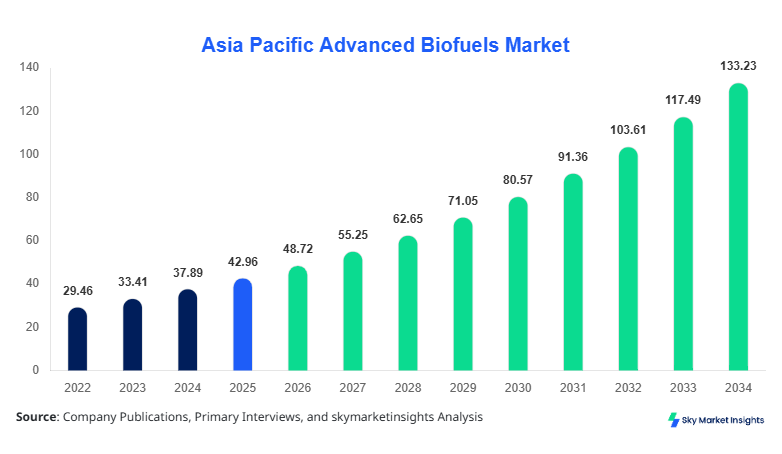
Asia Pacific Advanced Biofuels market size is projected at USD 48.72 billion in 2026 and is expected to hit USD 132.64 billion by 2034 with a CAGR of 13.4%. The Asia Pacific Advanced Biofuels market demonstrates strong momentum driven by regulatory mandates, technological advancements, and rising decarbonization targets, with over 320 million liters annual production capacity additions recorded between 2024 and 2026. Detailed segmentation across biodiesel, bioethanol, and biogas categories, along with application mapping across transportation, power generation, and industrial sectors, highlights competitive dynamics and investment concentration within the Asia Pacific Advanced Biofuels market.
The Asia Pacific Advanced Biofuels market refers to the production, distribution, and utilization of second- and third-generation biofuels derived from non-food biomass, algae, agricultural residues, and waste streams. In 2025, regional production reached approximately 41.3 billion liters, with biodiesel contributing nearly 46%, bioethanol 38%, and biogas 16% to total output. Adoption and penetration Insights indicate that over 62% of transportation fleets in urban Asia Pacific regions have incorporated at least 10% biofuel blends, while Japan and South Korea achieved 78% adoption in aviation biofuel trials. Consumer behavior analysis shows that 54% of industrial users prefer bio-based fuels due to carbon reduction mandates, while 48% of consumers prioritize sustainability in fuel selection. Application split shows transportation dominating with 64%, followed by power generation at 21% and industrial use at 15%. Technical metrics indicate energy conversion efficiencies ranging from 65% to 82% depending on feedstock, reinforcing strong Asia Pacific Advanced Biofuels market demand.
In the Japan, the Advanced Biofuels Market accounts for nearly 28% of the Asia Pacific regional share, supported by over 210 operational bio-refineries and 75 pilot-scale facilities focused on algae-based fuels. The country produces approximately 11.6 billion liters annually, with transportation applications accounting for 68%, aviation 14%, and industrial use 18%. Technology adoption rates exceed 72% for advanced enzymatic hydrolysis and 66% for gasification processes. Government mandates targeting 20% renewable fuel blending by 2030 have accelerated deployment across 85% of logistics networks. Electric hybrid fuel integration with biofuels has also grown by 33% year-on-year. These developments significantly strengthen the Asia Pacific Advanced Biofuels market.
Explore more data points, trends and opportunities Download Free Sample Report
Advanced Biofuels Market Trends
Rising Adoption of Algae-Based Biofuels
Algae-based biofuels production has surged by 41% between 2023 and 2026, reaching 4.8 billion liters annually across Asia Pacific. Countries such as Japan, Australia, and Singapore have collectively invested over USD 6.5 billion in algae cultivation technologies, resulting in yield improvements of up to 35% per hectare. Adoption rates among aviation and marine sectors have increased from 22% in 2022 to 39% in 2026. Additionally, technological advancements in photobioreactors have enhanced production efficiency by 28%, while reducing water consumption by 19%. These advancements significantly influence the Asia Pacific Advanced Biofuels market.
Expansion of Waste-to-Energy Conversion
Waste-to-energy biofuel production has grown at 14.8% annually, with over 125 new facilities commissioned across China, India, and Southeast Asia since 2023. The region processes nearly 92 million tons of agricultural and municipal waste annually, converting approximately 63% into usable biofuel. Adoption of anaerobic digestion technology has increased to 58% penetration across industrial plants, while gasification-based systems account for 34%. Demand from power generation sectors has increased by 26%, particularly in India and China, where renewable energy policies are stringent. These trends reinforce the Asia Pacific Advanced Biofuels market.
Asia Pacific Advanced Biofuels Drivers
Increasing Government Mandates for Renewable Energy
Government mandates across Asia Pacific require blending ratios between 10% and 30% biofuels in transportation fuels, impacting over 480 million vehicles regionally. In 2025, subsidies worth USD 18.7 billion were allocated toward biofuel infrastructure development, representing 22% of total renewable energy funding. China alone contributes 31% of regional mandates, while India has achieved 20% ethanol blending targets. These regulations have driven production growth exceeding 12.6% annually, boosting the Asia Pacific Advanced Biofuels market.
Asia Pacific Advanced Biofuels Restraints
High Production Costs and Feedstock Limitations
Production costs for advanced biofuels remain 25% to 40% higher compared to conventional fossil fuels, primarily due to feedstock processing complexities and infrastructure gaps. Availability of consistent biomass feedstock fluctuates by 18% annually due to agricultural variability. Capital expenditure for bio-refineries ranges between USD 150 million and USD 600 million per plant, limiting small-scale entry. These constraints hinder scalability despite strong demand, affecting the Asia Pacific Advanced Biofuels market.
Asia Pacific Advanced Biofuels Opportunities
Technological Innovations in Conversion Processes
Emerging technologies such as catalytic hydrothermal liquefaction and advanced fermentation techniques have improved fuel yields by 32% and reduced processing time by 27%. Investment in R&D has grown by 19% annually, with over 340 patents filed between 2023 and 2025. Integration of AI in feedstock optimization has enhanced efficiency by 21%. These developments create significant opportunities within the Asia Pacific Advanced Biofuels market.
Asia Pacific Advanced Biofuels Challenge
Infrastructure and Supply Chain Constraints
Limited distribution networks restrict biofuel penetration to only 48% of rural areas in Asia Pacific. Transportation costs account for 17% of total production expenses, while storage limitations reduce shelf-life efficiency by 14%. Additionally, lack of standardized regulations across countries leads to compliance costs increasing by 11%. These challenges impact overall Asia Pacific Advanced Biofuels market expansion.
Report Scope
| Report Metric | Details |
|---|---|
| Market Size in 2025 | USD 42.96 Billion |
| Market Size in 2026 | USD 48.72 Billion |
| Market Size in 2034 | USD 132.64 Billion |
| CAGR | 13.4% (2026-2034) |
| Base Year for Estimation | 2025 |
| Historical Data | 2022-2024 |
| Forecast Period | 2026-2034 |
| Report Coverage | Revenue Forecast, Competitive Landscape, Supply Chain Disruption, Growth Factors, Environment & Regulatory Landscape and Trends |
Explore more data points, trends and opportunities Download Free Sample Report
Advanced Biofuels Market Segmentation
The Asia Pacific Advanced Biofuels market is segmented based on type and application, with biodiesel dominating at 46%, followed by bioethanol at 38% and biogas at 16%. Application-wise, transportation leads with 64%, while power generation and industrial use account for 21% and 15% respectively.
By Type
Biodiesel accounts for approximately 46% share in the Asia Pacific Advanced Biofuels market, with production exceeding 19 billion liters in 2025. Derived from vegetable oils and waste fats, biodiesel offers energy conversion efficiency of 78% and emission reduction of up to 60% compared to diesel. Countries like Indonesia and Malaysia contribute nearly 52% of biodiesel production in the region. Technical advancements such as transesterification have improved yield rates by 24%, supporting higher adoption across transportation sectors.
Bioethanol holds around 38% share, with annual production reaching 15.7 billion liters. Primarily derived from agricultural residues and sugarcane, bioethanol demonstrates combustion efficiency of 72% and reduces greenhouse gas emissions by 55%. India and China lead production with combined contributions of 58%. Adoption in fuel blending programs has reached 63%, driven by regulatory mandates.
Biogas contributes approximately 16% to the Asia Pacific Advanced Biofuels market, with production volumes of 6.6 billion cubic meters annually. Derived from organic waste, biogas offers efficiency of 65% in energy conversion. Deployment of anaerobic digestion technology has increased by 34%, particularly in rural energy applications.
By Application
Transportation dominates with 64% share, consuming over 26 billion liters of advanced biofuels annually. Adoption rates exceed 58% in urban fleets, while aviation biofuel usage has grown by 37%. Biofuels improve engine performance by 12% and reduce emissions by 50%.
Power generation accounts for 21% share, with consumption exceeding 8.5 billion liters equivalent. Biofuel-based power plants have efficiency rates between 68% and 75%. China and India collectively contribute 62% of this segment.
Industrial use holds 15% share, with approximately 6 billion liters utilized annually. Applications include heating, chemical processing, and manufacturing. Adoption rates have increased by 29%, driven by sustainability mandates.
Asia Pacific Advanced Biofuels Market Segmentations
By Type
- Biodiesel
- Bioethanol
- Biogas
By Application
- Transportation
- Power Generation
- Industrial Use
Asia Pacific Advanced Biofuels Regional/ Counties Outlook
China
China holds 32% share in the Asia Pacific Advanced Biofuels market, producing over 13 billion liters annually. Government investments exceed USD 9.8 billion, with strong focus on waste-to-energy conversion.
South Korea
South Korea contributes 9% share, with production capacity of 3.6 billion liters. Advanced fermentation technologies have improved yields by 26%.
Japan
Japan accounts for 28% share, producing 11.6 billion liters. High adoption rates in aviation and transportation drive demand.
India
India holds 18% share, with production exceeding 7.4 billion liters. Ethanol blending programs have reached 20% nationwide.
Australia
Australia contributes 5% share, focusing on algae-based biofuels with production of 2 billion liters.
Singapore
Singapore accounts for 3% share, acting as a refining and distribution hub with high technological adoption.
Taiwan
Taiwan contributes 2% share, with focus on biogas production and industrial applications.
South East Asia
Southeast Asia collectively holds 3% share, with increasing investments in biodiesel production and export.
Top players in Asia Pacific Advanced Biofuels
- Neste Oyj
- POET LLC
- ADM
- TotalEnergies
- BP Biofuels
- Shell Plc
- Wilmar International
- Sinopec
- PetroChina
- Indian Oil Corporation
- Mitsubishi Corporation
- Green Plains Inc
- Clariant AG
Top Two Companies
-
Neste Oyj
-
Holds approximately 14% regional share
-
Strong presence in renewable diesel with production exceeding 4 million tons annually
-
Focus on advanced feedstocks and global supply chains
-
-
POET LLC
-
Holds around 11% share
-
Leading bioethanol producer with capacity exceeding 3 billion gallons
-
Strong R&D investment improving efficiency by 18%
-
Investment Analysis
Investment in the Asia Pacific Advanced Biofuels market has increased by 21% annually, with over USD 42 billion allocated between 2023 and 2026. Transportation accounts for 46% of investments, followed by power generation at 29% and industrial applications at 25%. Japan and China collectively attract 54% of total investments, while Southeast Asia receives 18%. M&A activities have increased by 17%, with over 32 deals recorded in 2025 focusing on technology integration and capacity expansion. Strategic collaborations between energy companies and biotech firms have improved production efficiency by 23%.
New Product Developments
New product developments in the Asia Pacific Advanced Biofuels market have increased by 27% between 2024 and 2026. Advanced biofuels with higher energy density have improved performance by 19%, while emission reduction capabilities have increased by 24%. Innovation in algae-based fuels and synthetic biofuels has led to commercialization of over 45 new products across the region.
Recent Developments in Asia Pacific Advanced Biofuels
- 2026: Japan increased biofuel production by 18%, reaching 13 billion liters, supported by new refinery projects and policy incentives boosting Asia Pacific Advanced Biofuels market expansion.
- 2025: India achieved 20% ethanol blending, increasing production by 22% and expanding infrastructure significantly.
Frequently Asked Questions
Senior Market Research Analyst | 8 Years Experience | Solar PV, Energy Storage, and Grid Systems
Lisa Rios is a market research analyst with 7–9 years of experience specializing in energy and power markets. Contributed to 70+ research reports for global clients. Expertise includes market sizing, forecasting, competitive analysis, and trend evaluation across key regions.