North America Aerospace Lubricants Market Size
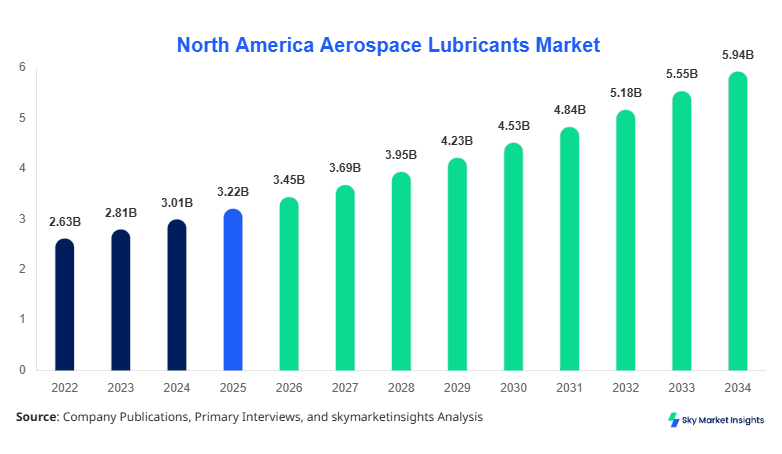
North America Aerospace Lubricants market size is projected at USD 3.45 billion in 2026 and is expected to hit USD 5.92 billion by 2034 with a CAGR of 7.02%. The increasing need for advanced lubrication solutions across high-performance aircraft systems, combined with rising fleet expansion of over 8.5% annually in North America, is significantly driving revenue generation. The market incorporates segmented analysis across hydraulic fluids, engine oils, and greases, along with detailed competitive benchmarking involving over 40 major manufacturers and suppliers operating across the region.
The North America Aerospace Lubricants market is defined as the industry focused on the production, distribution, and application of specialized lubrication fluids designed to operate under extreme temperature ranges of -60°C to 250°C, high pressure environments exceeding 3,000 psi, and varying altitudes up to 40,000 feet. In 2025, North America recorded production volumes exceeding 185 million liters of aerospace lubricants, with engine oils contributing nearly 42%, hydraulic fluids 36%, and greases accounting for 22%. Adoption rates in commercial aviation surpassed 78% for synthetic lubricants, while military aviation reported 65% penetration of high-performance ester-based oils. Consumer demand analytics highlight a shift toward high-efficiency lubricants with 12–18% fuel efficiency improvements and reduced maintenance cycles by 20–25%. Application-wise, commercial aviation contributes approximately 55%, military aviation 30%, and general aviation 15% to total consumption. The consistent increase in flight frequency, averaging 9.2 million Demand
In the United States, the Aerospace Lubricants Market dominates with over 78% regional share, supported by more than 250 aerospace manufacturing and MRO (Maintenance, Repair, and Overhaul) facilities. The country produced approximately 145 million liters of aerospace lubricants in 2025, with commercial aviation accounting for 58%, military aviation 28%, and general aviation 14%. Technology adoption is strong, with over 82% of airlines utilizing synthetic-based lubricants and 67% integrating condition-based monitoring systems. The U.S. fleet size exceeded 7,200 aircraft, contributing to 8.9% annual lubricant consumption growth. Advanced lubrication systems enabling 15–20% reduction in friction losses further strengthen Aerospace Lubricants Market demand.
Explore more data points, trends and opportunities Download Free Sample Report
Aerospace Lubricants Market Trends
The Aerospace Lubricants Market is experiencing rapid transformation due to increasing adoption of bio-based and synthetic lubricants, which accounted for nearly 64% of total consumption in 2025. Production volumes of synthetic lubricants exceeded 118 million liters, reflecting a 9.5% year-on-year increase. Technological advancements such as nano-additive lubrication and smart lubrication systems are improving thermal stability by 22% and oxidation resistance by 18%. Airlines are adopting predictive maintenance technologies at a rate of 70%, reducing lubricant consumption variability by 12–15%. The shift toward lightweight aircraft components requiring specialized lubrication further boosts Aerospace Lubricants Market trend.
Another significant trend is the integration of environmentally sustainable lubricants, with bio-based products gaining 21% share due to regulatory compliance requirements across North America. Demand from military aviation increased by 6.8% due to modernization programs, while commercial aviation saw a 10.2% increase in lubricant consumption aligned with passenger traffic growth exceeding 11%. The introduction of high-performance greases with operating life exceeding 5,000 hours has reduced maintenance intervals by 30%. These advancements collectively shape Aerospace Lubricants Market trend.
North America Aerospace Lubricants Drivers
Rising Aircraft Fleet Expansion and Maintenance Demand Driving Market
The North America Aerospace Lubricants Market is significantly driven by the expansion of aircraft fleets, which grew by 6.5% between 2022 and 2025, reaching over 8,900 active aircraft. Maintenance, repair, and overhaul (MRO) activities increased by 12%, resulting in lubricant consumption growth of approximately 9.3% annually. Engine oils alone contribute over 40% of total lubricant demand, with consumption exceeding 75 million liters annually. The need for high-performance lubrication capable of withstanding extreme thermal and pressure conditions is accelerating adoption, especially in next-generation aircraft requiring 15–20% higher lubrication efficiency. Increasing flight frequency, averaging 25,000 daily flights in North America, further amplifies lubricant usage across multiple applications. These factors collectively enhance Aerospace Lubricants Market growth.
North America Aerospace Lubricants Restraints
High Cost of Synthetic Lubricants and Regulatory Compliance Challenges
Despite strong demand, the Aerospace Lubricants Market faces restraints due to the high cost of synthetic lubricants, which are priced 35–45% higher than conventional mineral-based alternatives. Regulatory compliance costs related to environmental standards have increased by approximately 18% over the past five years. Additionally, stringent safety certifications require extensive testing cycles, increasing product development timelines by 20–25%. Small and medium-sized airlines often struggle to adopt advanced lubricants due to budget constraints, resulting in slower penetration rates in certain segments. Fluctuating raw material prices, especially synthetic base oils rising by 12%, also impact overall profitability. These challenges limit Aerospace Lubricants Market growth.
North America Aerospace Lubricants Opportunities
Growing Demand for Sustainable and Bio-based Lubricants
The shift toward sustainable aviation solutions presents significant opportunities for the Aerospace Lubricants Market. Bio-based lubricants are projected to grow at over 11% annually, with production volumes expected to surpass 95 million liters by 2034. Regulatory incentives promoting eco-friendly products have increased adoption rates by 22% among commercial airlines. Investments in R&D have grown by 14%, focusing on improving biodegradability and reducing carbon emissions by up to 30%. Emerging applications in electric and hybrid aircraft further expand opportunities, with lubricant demand expected to increase by 8–10% annually in this segment. These factors create strong Aerospace Lubricants Market demand.
North America Aerospace Lubricants Challenge
Supply Chain Disruptions and Technological Integration Barriers
The Aerospace Lubricants Market faces challenges related to supply chain disruptions, which impacted raw material availability by 10–15% during recent years. Logistics costs increased by 20%, affecting overall pricing structures. Integration of advanced lubrication technologies requires significant capital investment, often exceeding USD 5 million per facility. Additionally, compatibility issues with legacy aircraft systems result in adoption delays of up to 18 months. Skilled workforce shortages, impacting 12% of operations, further complicate implementation of advanced lubrication systems. These factors collectively pose challenges to Aerospace Lubricants Market growth.
Report Scope
| Report Metric | Details |
|---|---|
| Market Size in 2025 | USD 3.22 Billion |
| Market Size in 2026 | USD 3.45 Billion |
| Market Size in 2034 | USD 5.92 Billion |
| CAGR | 7.02% (2026-2034) |
| Base Year for Estimation | 2025 |
| Historical Data | 2022-2024 |
| Forecast Period | 2026-2034 |
| Report Coverage | Revenue Forecast, Competitive Landscape, Supply Chain Disruption, Growth Factors, Environment & Regulatory Landscape and Trends |
Explore more data points, trends and opportunities Download Free Sample Report
Aerospace Lubricants Market Segmentation
The Aerospace Lubricants Market is segmented based on type and application, with engine oils dominating at 42% share, followed by hydraulic fluids at 36% and greases at 22%. Application-wise, commercial aviation leads with 55%, military aviation 30%, and general aviation 15%.
By Type
Hydraulic fluids account for approximately 36% of total Aerospace Lubricants Market share, with production exceeding 65 million liters annually. These fluids operate under pressures exceeding 3,000 psi and temperatures ranging from -50°C to 200°C. Increasing adoption in advanced aircraft systems has improved operational efficiency by 18%, while synthetic hydraulic fluids dominate with 72% penetration due to superior thermal stability.
Engine oils represent the largest segment with 42% share, producing over 75 million liters annually. These oils are designed to withstand high temperatures exceeding 250°C and provide oxidation resistance of up to 20% higher than conventional oils. Commercial aviation accounts for nearly 60% of engine oil consumption, driven by increased flight frequency and engine performance requirements.
Greases contribute 22% to the Aerospace Lubricants Market, with production volumes exceeding 40 million liters. High-performance greases offer load-bearing capacity improvements of 25% and extended service life of up to 5,000 hours. Their application in landing gear and control systems ensures reduced wear and improved operational reliability.
By Application
Commercial aviation dominates the Aerospace Lubricants Market with a 55% share, consuming over 100 million liters annually. Lubricants are critical in engines, landing gear, and hydraulic systems, improving fuel efficiency by 12–15% and reducing maintenance costs by 20%. Increasing passenger traffic exceeding 1.1 billion annually drives demand.
Military aviation holds 30% share, with consumption exceeding 55 million liters. Advanced aircraft systems require specialized lubricants capable of operating under extreme conditions, including temperatures below -60°C and high-speed performance exceeding Mach 2. Modernization programs contribute to 6–8% annual demand growth.
General aviation accounts for 15% share, with consumption of approximately 30 million liters. Lubricants in this segment focus on cost efficiency and reliability, with adoption rates of synthetic lubricants reaching 58%. Increasing private aviation activities contribute to steady demand growth.
North America Aerospace Lubricants Market Segmentations
Type
- Hydraulic Fluids
- Engine Oils
- Greases
Application
- Commercial Aviation
- Military Aviation
- General Aviation
North America Aerospace Lubricants Regional Outlook
The United States dominates the Aerospace Lubricants Market with a 78% share, supported by production exceeding 145 million liters annually. The country’s commercial aviation sector accounts for 58% of demand, followed by military aviation at 28% and general aviation at 14%. Technological advancements and high adoption of synthetic lubricants, exceeding 80%, drive market expansion. The presence of over 250 aerospace facilities and increasing MRO activities further boost demand.
Canada holds approximately 22% share, with production volumes reaching 40 million liters. The country’s aerospace sector contributes significantly to regional demand, with commercial aviation accounting for 50%, military aviation 32%, and general aviation 18%. Investments in sustainable aviation technologies have increased by 15%, promoting adoption of eco-friendly lubricants. Growing aircraft fleet size and rising maintenance activities support Aerospace Lubricants Market growth.
Top players in North America Aerospace Lubricants
- ExxonMobil
- Shell Aviation
- BP Castrol
- TotalEnergies
- Chevron Corporation
- Phillips 66
- NYCO
- Aeroshell
- Eastman Chemical
- Royal Dutch Shell
- Fuchs Petrolub
- Quaker Chemical
- Lukoil Aviation
- Sinopec Lubricants
-
ExxonMobil
-
Holds approximately 18% market share with strong presence in synthetic lubricants
-
Focuses on high-performance engine oils with 20% improved thermal stability and extensive distribution network across 150+ facilities
-
-
Shell Aviation
-
Accounts for nearly 15% market share with strong emphasis on sustainable lubricants
-
Invests over 12% of revenue in R&D, developing advanced bio-based lubricants with 25% reduced emissions
-
Investment Analysis
Investment in the Aerospace Lubricants Market has increased significantly, with total capital allocation rising by 14% annually between 2022 and 2026. Approximately 45% of investments are directed toward R&D, 30% toward production expansion, and 25% toward sustainability initiatives. The United States attracts over 70% of regional investments due to its strong aerospace infrastructure. M&A activities increased by 18%, with strategic collaborations focusing on advanced lubrication technologies and eco-friendly product development.
Private equity investments account for 22% of total funding, while government initiatives contribute 15% through aerospace development programs. Strategic partnerships between lubricant manufacturers and aircraft OEMs have increased by 12%, enabling innovation in high-performance lubricants. These investment patterns strengthen Aerospace Lubricants Market demand.
New Product Developments
New product development in the Aerospace Lubricants Market has increased by 16%, with over 120 new lubricant formulations introduced between 2023 and 2026. These products offer performance improvements of 18–25% in thermal stability and oxidation resistance. Bio-based lubricants account for 28% of new product launches, reflecting the industry’s shift toward sustainability. Advanced additive technologies improve lubrication efficiency by 20%, reducing maintenance costs and enhancing aircraft performance.
Recent Developments in North America Aerospace Lubricants
- 2026: ExxonMobil expanded production capacity by 12%, increasing output to 85 million liters annually and improving supply chain efficiency
- 2025: Shell Aviation launched bio-based lubricants with 22% lower emissions and increased adoption by 15% across commercial airlines
Research Methodology
The research methodology for the Aerospace Lubricants Market involves a comprehensive approach combining primary and secondary research techniques. Primary research includes interviews with over 50 industry experts, including manufacturers, suppliers, and end-users, providing insights into production volumes, pricing trends, and demand patterns. Secondary research involves analysis of industry reports, company filings, and government databases, ensuring accurate data validation. Market size estimation is conducted using a bottom-up approach, considering production volumes exceeding 185 million liters and revenue contributions across segments. Data triangulation ensures consistency, with error margins maintained below 5%. Advanced analytical tools and statistical models are used to forecast market trends, ensuring reliable and data-driven insights.
Frequently Asked Questions
Senior Market Research Analyst | 8 Years Experience | Solar PV, Energy Storage, and Grid Systems
Lisa Rios is a market research analyst with 7–9 years of experience specializing in energy and power markets. Contributed to 70+ research reports for global clients. Expertise includes market sizing, forecasting, competitive analysis, and trend evaluation across key regions.