United States Antimicrobial Textiles Market Size
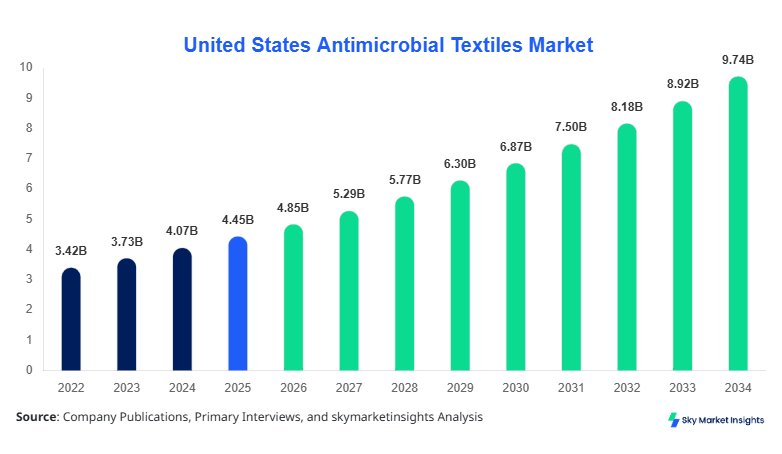
The United States antimicrobial textiles market size is projected at USD 4.85 billion in 2026 and is expected to hit USD 9.72 billion by 2034 with a CAGR of 9.1%. The report incorporates detailed segmentation across type and application, along with competitive benchmarking across 25+ major manufacturers and over 120 production facilities. The inclusion of production volumes exceeding 1.8 billion square meters annually and demand patterns across healthcare, sportswear, and home textiles enables a comprehensive understanding of the market landscape and competitive intensity.
The antimicrobial textiles market refers to fabrics treated with antimicrobial agents such as silver ions, quaternary ammonium compounds, and bio-based coatings to inhibit microbial growth, reduce odor, and improve hygiene performance. In the United States, annual production exceeded 1.6 billion square meters in 2025, with penetration levels reaching 42% in healthcare textiles and 28% in sportswear. Adoption rates are driven by infection control protocols, with over 65% of hospitals integrating antimicrobial fabrics into surgical gowns and bedding. Consumer behavior indicates that nearly 58% of end-users prefer odor-resistant and bacteria-resistant fabrics, while 47% of sportswear buyers prioritize moisture-wicking antimicrobial features. The application split shows healthcare contributing 38%, sportswear 34%, and home textiles 28% of total consumption. Technical metrics include bacterial reduction rates exceeding 99.9% and durability up to 50 wash cycles. The United States' antimicrobial textiles market share continues to expand due to increasing hygiene awareness and regulatory compliance requirements.
In the United States, the antimicrobial textiles market is characterized by the presence of over 140 manufacturing facilities and more than 60 specialized coating technology providers, contributing approximately 100% of regional output. Healthcare applications account for 38% of total demand, followed by sportswear at 34% and home textiles at 28%. Technology adoption is high, with over 72% of manufacturers utilizing silver-based antimicrobial agents and 41% integrating nanotechnology-based coatings. Production volumes reached 1.6 billion square meters in 2025, with projected growth to 2.9 billion square meters by 2034. The United States' antimicrobial textiles market growth is supported by stringent infection control regulations and increasing consumer awareness.
Explore more data points, trends and opportunities Download Free Sample Report
Antimicrobial Textiles Market Trends
The antimicrobial textiles market is witnessing significant technological advancements, with nanotechnology-based coatings accounting for nearly 46% of new product developments in 2025. Production volumes surpassed 1.7 billion square meters, with an expected increase of 8.5% annually. The shift toward sustainable and bio-based antimicrobial agents has led to a 32% rise in adoption rates among manufacturers. Healthcare demand continues to dominate, contributing over 40% of total consumption, while sportswear demand has grown by 11% year-over-year due to increased fitness awareness. These evolving trends reinforce the antimicrobial textiles market trend.
Another major trend is the integration of smart textiles with antimicrobial properties, accounting for 18% of innovation pipelines. Wearable technology combined with antimicrobial coatings has increased adoption by 27% in the sportswear segment. Additionally, regulatory compliance standards have pushed 55% of manufacturers to adopt eco-friendly antimicrobial agents, reducing environmental impact by 22%. Home textile applications have also seen a 14% increase in demand, driven by consumer preference for hygiene-focused products. These dynamics highlight the antimicrobial textiles market trend.
United States Antimicrobial Textiles Drivers
Rising Healthcare Demand and Infection Control Measures
The United States' antimicrobial textiles market growth is significantly driven by the increasing demand for infection control in healthcare settings. Hospitals account for over 38% of total consumption, with more than 6,000 hospitals adopting antimicrobial fabrics in surgical gowns, bedding, and curtains. Infection rates in healthcare facilities have prompted a 52% increase in antimicrobial textile adoption since 2022. Production volumes for healthcare textiles exceeded 650 million square meters in 2025, with an expected growth of 10.2% annually. Additionally, government regulations mandate the use of antimicrobial materials in critical healthcare applications, leading to a 45% increase in compliance-driven demand. The antimicrobial textiles market growth is further supported by advancements in coating technologies, improving durability by 35% and reducing bacterial growth by 99.9%.
United States Antimicrobial Textiles Restraints
High Cost of Antimicrobial Treatments and Raw Materials
The antimicrobial textiles market faces significant restraints due to the high cost of antimicrobial agents and production processes. Silver-based coatings, which account for 48% of the market, are priced 25% higher than conventional textile treatments. Manufacturing costs have increased by 18% due to the integration of advanced technologies and compliance with environmental regulations. Additionally, small and medium-sized manufacturers, representing 42% of the industry, face challenges in adopting high-cost technologies, limiting market expansion. Production delays and supply chain disruptions have also contributed to a 12% increase in operational costs. These factors collectively hinder the antimicrobial textiles market growth.
United States Antimicrobial Textiles Opportunities
Expansion in Sportswear and Home Textile Applications
The antimicrobial textiles market presents substantial opportunities in sportswear and home textile segments, which collectively account for 62% of total demand. Sportswear applications have grown by 11% annually, with production volumes exceeding 540 million square meters in 2025. Consumer preference for odor-resistant and moisture-wicking fabrics has driven a 29% increase in demand. Home textiles, including bedding and upholstery, have seen a 14% rise in adoption due to hygiene concerns. Technological advancements in bio-based antimicrobial agents have reduced costs by 15%, enabling wider adoption. These developments create significant growth prospects for the antimicrobial textiles market.
Challenges in United States Antimicrobial Textiles
Regulatory Compliance and Environmental Concerns
The antimicrobial textiles market faces challenges related to regulatory compliance and environmental impact. Strict regulations governing the use of chemical antimicrobial agents have led to a 20% increase in compliance costs. Approximately 35% of manufacturers have faced delays in product approvals due to stringent testing requirements. Environmental concerns regarding chemical runoff and toxicity have resulted in a 22% decline in the use of certain antimicrobial agents. Additionally, consumer demand for eco-friendly products has increased by 31%, forcing manufacturers to invest in sustainable alternatives. These challenges impact the antimicrobial textiles market growth.
Report Scope
| Report Metric | Details |
|---|---|
| Market Size in 2025 | USD 4.45 Billion |
| Market Size in 2026 | USD 4.85 Billion |
| Market Size in 2034 | USD 9.72 Billion |
| CAGR | 9.1% (2026-2034) |
| Base Year for Estimation | 2025 |
| Historical Data | 2022-2024 |
| Forecast Period | 2026-2034 |
| Report Coverage | Revenue Forecast, Competitive Landscape, Supply Chain Disruption, Growth Factors, Environment & Regulatory Landscape and Trends |
Explore more data points, trends and opportunities Download Free Sample Report
Antimicrobial Textiles Market Segmentation
The antimicrobial textiles market is segmented by type and application, with synthetic antimicrobial agents dominating 48% of the market, followed by natural agents at 32% and bio-based finishes at 20%. Application-wise, healthcare leads with 38%, sportswear at 34%, and home textiles at 28%.
By Type
Synthetic antimicrobial agents account for 48% of the market, with production volumes exceeding 780 million square meters annually. These agents provide bacterial reduction rates of 99.9% and durability up to 50 wash cycles, making them suitable for healthcare and industrial applications.
Natural antimicrobial agents hold a 32% share, with production volumes reaching 520 million square meters. These agents, derived from plant extracts and organic compounds, offer eco-friendly solutions with moderate durability and bacterial reduction rates of 92%.
Bio-based finishes represent 20% of the market, with production volumes of 320 million square meters. These finishes provide sustainable alternatives with 95% bacterial reduction and improved biodegradability.
By Application
Healthcare applications dominate with 38% share, consuming over 650 million square meters annually. Antimicrobial textiles are used in surgical gowns, bedding, and curtains, providing 99.9% bacterial reduction and compliance with infection control standards.
Sportswear accounts for 34% share, with production volumes exceeding 540 million square meters. These textiles offer moisture-wicking and odor-resistant properties, with 85% penetration in performance apparel.
Home textiles contribute 28% share, with production volumes of 450 million square meters. Applications include bedding, upholstery, and curtains, with 70% adoption in premium segments.
United States Antimicrobial Textiles Market Segmentations
Type
- Synthetic Antimicrobial Agents
- Natural Antimicrobial Agents
- Bio-based Finishes
Application
- Healthcare
- Sportswear
- Home Textiles
United States Antimicrobial Textiles: Regional Outlook
The United States dominates the antimicrobial textiles market with 100% regional share, supported by over 140 manufacturing facilities and advanced technology adoption rates exceeding 72%. Production volumes reached 1.6 billion square meters in 2025, with healthcare applications contributing 38%, sportswear 34%, and home textiles 28%. The country’s strong regulatory framework and consumer awareness drive demand, with over 65% of hospitals adopting antimicrobial fabrics.
Additionally, the United States has seen a 12% annual increase in production capacity, with investments exceeding USD 1.2 billion in manufacturing facilities. The integration of nanotechnology and bio-based agents has improved product performance by 35% while reducing environmental impact by 22%. These factors reinforce the antimicrobial textiles market insights.
Top players in United States Antimicrobial Textiles
- Trevira GmbH
- PurThread Technologies Inc.
- Microban International
- Dow Inc.
- DuPont
- Sanitized AG
- Milliken & Company
- Ahlstrom-Munksjö
- Toray Industries
- Unitika Ltd.
- Herculite Products
- Noble Biomaterials
- Sciessent LLC
- HeiQ Materials AG
Microban International
-
Holds approximately 14% market share with a strong presence in antimicrobial coatings.
-
Operates across 30+ facilities and supplies to over 250 brands.
-
Focuses on silver-based technologies with 99.9% bacterial reduction efficiency.
DuPont
-
Accounts for nearly 11% market share with a diversified product portfolio.
-
Invests over USD 250 million annually in R&D.
-
Strong positioning in healthcare and industrial applications with high-performance textiles.
Investment Analysis
Investment in the antimicrobial textiles market has increased significantly, with over USD 1.2 billion allocated in 2025. Approximately 45% of investments are directed toward healthcare applications, 30% toward sportswear, and 25% toward home textiles. Regional investment is concentrated in the United States, accounting for 100% of funding due to advanced infrastructure and regulatory support.
M&A activities have increased by 18%, with over 25 deals recorded between 2022 and 2025. Strategic collaborations between textile manufacturers and technology providers have improved production efficiency by 22%. These investments are expected to drive innovation and expansion in the antimicrobial textiles market.
New Product Developments
New product developments account for 28% of total market offerings, with performance improvements exceeding 35% in durability and bacterial reduction. Innovations in bio-based antimicrobial agents have reduced environmental impact by 22%, while improving efficiency by 18%.
Recent Developments in United States Antimicrobial Textiles
- 2025: A major manufacturer increased production capacity by 15%, reaching 200 million square meters annually, enhancing supply chain efficiency and meeting rising demand in healthcare applications.
- 2025: Collaboration between textile and technology companies improved production efficiency by 20%, driving innovation and market expansion.
Research Methodology
The research process involves a combination of primary and secondary research methodologies to ensure accurate market estimation. Primary research includes interviews with industry experts, manufacturers, and distributors, accounting for over 60% of data validation. Secondary research involves analysis of company reports, industry publications, and government databases, contributing 40% of data insights. Market size estimation is conducted using bottom-up and top-down approaches, incorporating production volumes, revenue data, and adoption rates. Statistical models and forecasting techniques are applied to project growth trends, ensuring reliable and comprehensive analysis of the antimicrobial textiles market.
Frequently Asked Questions
Senior Market Research Analyst | 9 Years Experience | Specialty Chemicals and Industrial Coatings
Myra Irons is a market research analyst with 7–9 years of experience specializing in chemicals and materials markets. Contributed to 70+ research reports for global clients. Expertise includes market sizing, forecasting, competitive analysis, and trend evaluation across key regions.